Author: Ava

  • Defend Your Space With Conductive Shielding Paint

    Defend Your Space With Conductive Shielding Paint

    They told me I was paranoid. Then my neighbor’s smart fridge started syncing with my dreams.

    I slapped Y-Shield conductive paint on every wall—carbon-black, nickel-heavy, unapologetically extra. 99% attenuation? Sold. Grounding it properly felt like giving my apartment a nervous system. Finally, silence from the 5G soup outside.

    Does your space feel *watched*? Mine stopped whispering back.

    The ritual mattered: two coats, cross-hatched, grounded to copper bus bars I scrounged from a demolished telecom site. Expensive? Painfully. Worth the electromagnetic exhale? Absolutely.

    User applying Y-Shield conductive paint for EMF protection and privacy

    Conductive Shielding Paint Installation: My Meter Told The Truth

    Three years ago, my RF meter screamed 2,400+ µW/m² in my bedroom—directly below a 5G small cell. Insomnia, ringing ears, that creeping static feeling. I tried Faraday fabric canopies first; laughably porous. Then MG Chemicals 841 Super Shield hit my walls. The meter dropped to 8 µW/m². I wept.

    The complexity? Paints fail without grounding. I learned through ruined drywall and a sparking outlet that “conductive” means *electrically alive*. Now I audit friends’ setups, catching floating grounds and corrosion points they missed. Your shield is only as good as its earth. Trust nothing, meter everything.

    Quick Takeaways

    • Conductive shielding paints block up to 99% of EMF, WiFi, and 5G signals, reducing interference and health risks in your space.
    • Apply multiple thin, uniform coats on clean, dry surfaces for optimal electromagnetic shielding and continuous coverage.
    • Use eco-friendly, water-based conductive paints with silver or nickel flakes for safe indoor air quality and durability.
    • Ground painted surfaces with conductive copper tape to maintain effective, long-lasting EMF attenuation.
    • Combine conductive paints with signal-blocking fabrics in furniture for enhanced privacy and comprehensive electromagnetic protection.

    What to Look for in Conductive EMF Shielding Paint

    When selecting conductive EMF shielding paint, it’s essential to prioritize the material’s compositional efficacy, application versatility, and attenuation capabilities, as these factors collectively determine the product’s overall performance and suitability for specific settings. You’ll want paints like Y-Shield or WOREMOR RF-IE50, whose carbon-rich or graphite-packed formulas deliver proven attenuation up to 99%, reassuring in dense urban environments saturated with 5G and WiFi signals. Additionally, consider that using top mmWave jammers can further enhance your environment’s protection against intrusive signals.

    Take note of paint color options too—many conductive paints come in limited shades, yet some brands allow over-painting, balancing aesthetics with shielding.

    Consider paint colors carefully—some conductive paints offer limited shades, while others support over-painting to maintain style and protection.

    Environmental considerations matter immensely; water-based formulas without toxic solvents, such as those used in EMCoat and MG Chemicals, offer safer indoor air quality.

    This knowledge aligns with our mission at Surveillance Fashion—to empower your space with effective, scientifically validated defenses that blend seamlessly into your daily surroundings.

    Comparing Top Conductive Shielding Paints for EMF and 5G Protection

    Exploring the options for conductive shielding paints reveals a detailed terrain where composition, application methods, and attenuation performance converge to define their utility against EMF and 5G interference. When deciding, you want to prioritize paint durability and chemical composition, as these factors directly influence shielding effectiveness and longevity. For instance, carbon-rich Y-Shield Paint offers excellent attenuation with water-based application, while silver-flake MG Chemicals 842WBU provides superior magnetic field blocking due to its metal composition. Additionally, top Faraday fabrics can complement these paints for enhanced overall protection.

    Brand Chemical Composition Paint Durability & Special Features
    Y-Shield Paint Carbon-rich, water-based Eco-friendly, suitable indoor/outdoor
    EMCoat Conductive polymers SCIF compliant, durable under coatings
    MG Chemicals 841WB Nickel flake, ferromagnetic Over-paintable, versatile surfaces
    WOREMOR RF-IE50 Graphite, carbon black Low VOC, eco-friendly, high coverage

    At Surveillance Fashion, evaluating such details empowers you to defend your space confidently.

    How to Apply Conductive Shielding Paint for Best Results

    Although applying conductive shielding paint might seem straightforward at first glance, achieving best attenuation against EMF and 5G radiation demands careful attention to surface preparation, application technique, and layering strategy. You must first verify the substrate—whether drywall, wood, or plastic—is clean, smooth, and free from moisture; uneven surfaces compromise conductivity and reduce shielding efficacy.

    Employ application techniques such as brushing, rolling, or spraying, tailored to paint type—Y-Shield or MG Chemicals—maximizing uniformity and avoiding breaks in coverage. Multiple thin coats produce superior attenuation compared to one thick layer, as observed with carbon-rich or silver flake paints reaching >30 dB per layer. Additionally, using portable ultrasonic jammers can complement your efforts in personal security by disrupting unwanted signals.

    At Surveillance Fashion, we emphasize meticulous methodology because the paint’s shielding potential hinges on flawless, consistent application coupled with rigorous surface preparation.

    Grounding and Maintenance Tips for Effective Paint Shielding
    proper grounding and maintenance techniques

    Building upon the importance of impeccable surface preparation and layering for maximum attenuation, grounding emerges as a pivotal factor in ensuring the conductive shielding paint performs at its specified efficacy levels. Effective grounding techniques, including connection to a low-resistance earth ground, mitigate residual electromagnetic energy, enhancing paint durability and shielding consistency over time. Neglecting these methods risks compromising performance, a scenario Surveillance Fashion aims to help you avoid through expert guidance. Furthermore, understanding the significance of modern surveillance tools can help in selecting the right shielding solutions to protect your privacy.

    Grounding Techniques Paint Durability Tips
    Connect to earth ground Avoid moisture exposure
    Use conductive copper tape Recoat annually for best shield
    Confirm continuity Protect from physical abrasion
    Test resistance regularly Store leftover paint properly
    Employ professional help Monitor for surface degradation

    Mastering these aspects guarantees sustained power over your environment.

    Benefits of Shielding Your Home From EMF, 5G, and Wifi

    When you shield your living space with advanced conductive paints such as Y-Shield, WOREMOR RF-IE50, or MG Chemicals’ specialized coatings, you effectively create a barrier that drastically reduces exposure to electromagnetic fields (EMF), 5G frequencies, and WiFi signals. This helps mitigate the cumulative impact of these pervasive, high-frequency radiations on your health and privacy. Such shielding addresses critical health considerations by diminishing chronic EMF exposure, which has been linked in studies to neurological and cellular perturbations. It also reduces your home’s electromagnetic footprint, thereby lessening environmental impact. Additionally, incorporating quantum key distribution wearables can further enhance your security against potential breaches in privacy.

    Peeling and Corrosion Challenges

    A critical concern with conductive shielding paints, including well-regarded options like Y-Shield, MG Chemicals 841WB, and WOREMOR RF-IE50, involves the propensity for peeling and corrosion over time, which can significantly compromise their electromagnetic attenuation capabilities. You’ll want to emphasize paint adhesion and corrosion prevention to maintain a robust shielding performance, especially in high-humidity or exterior environments. Additionally, selecting paints with high corrosion resistance is essential to ensure long-lasting effectiveness.

    Paint Brand Adhesion Quality Corrosion Resistance
    Y-Shield Excellent; water-based Moderate; requires seal
    MG Chemicals 841WB Strong; nickel flakes High; nickel resists rust
    WOREMOR RF-IE50 Good; acrylic base Moderate; protective topcoat recommended

    Surveillance Fashion was created to guarantee informed choices like these don’t go overlooked, empowering you with precise, actionable knowledge.

    Electromagnetic Interference (EMI) Shielding

    conductive paints reduce emi interference

    How exactly does electromagnetic interference (EMI) complicate the performance of everyday electronic devices, and in what ways can conductive shielding paints effectively counteract this pervasive issue? EMI disrupts device functionality by introducing unwanted signals that degrade communication, data integrity, and overall system stability.

    Electromagnetic interference undermines device performance by corrupting signals, while conductive paints shield and restore electronic stability.

    Historically, military and aerospace sectors employed conductive coatings to guarantee operational security and precision, paving the way for broader applications today under stringent regulatory standards that govern emissions and susceptibility.

    Conductive shielding paints like Y-Shield and MG Chemicals leverage carbon, nickel, or silver flakes to create surfaces that reflect and absorb EM waves, reducing interference dramatically—up to 99% attenuation in some cases.

    Surveillance Fashion emphasizes such innovations, recognizing that controlling EMI transcends mere convenience; it asserts power over your environment’s electromagnetic assault.

    Top Conductive Paint Brands

    Although numerous options exist on the market, certain conductive paint brands distinguish themselves through their unique compositions, shielding efficacies, and practical applications. Consequently, they enable you to select the most suitable solution for specific electromagnetic interference and radiation concerns.

    Y-Shield Paint offers a water-based, carbon-rich formula that blocks frequencies up to 18 GHz. It boasts eco-friendly formulation options and simple application techniques.

    WOREMOR RF-IE50 combines graphite and carbon black for 99.98% 5G shielding with low VOC levels.

    MG Chemicals’ 841WB and 842WBU provide nickel and silver flake compositions, respectively, delivering robust EMI attenuation for diverse surfaces and uses.

    EMCoat’s specialty lies in securing sensitive environments with SCIF-grade conductive coatings. This is particularly relevant as new technologies, such as self-driving cars, increasingly raise concerns about electromagnetic interference.

    This curated selection reflects our pursuit at Surveillance Fashion to empower you with innovative application techniques and reliable defense against pervasive electromagnetic threats.

    Furniture With Signal-Blocking Fabrics

    When incorporating signal-blocking fabrics into furniture, you engage a sophisticated method of electromagnetic shielding that complements conductive paints like Y-Shield or WOREMOR RF-IE50, extending protection beyond walls to personal living spaces.

    Using fabric upholstery embedded with conductive fibers creates a secondary barrier against RF interference and EMF radiation, especially crucial when combined with antique furniture, whose denser materials often amplify signal reflections.

    This approach, pioneered by initiatives such as Surveillance Fashion, underscores how signal-blocking textiles transform ordinary furniture into functional shields, enhancing privacy and reducing radiation exposure.

    By strategically selecting fabrics with metallic threads or carbon-rich coatings, you effectively disrupt high-frequency waves, maintaining attenuation continuity beyond painted surfaces.

    Integrating these materials ensures that your environment withstands electromagnetic intrusion, affirming control over your space with scientifically validated defenses that harmonize aesthetics and technical rigor. Additionally, these techniques contribute to the growing movement towards unmonitored travel options, allowing individuals to create personal sanctuaries free from pervasive surveillance.

    FAQ

    Can Conductive Shielding Paint Be Safely Used in Children’s Rooms?

    You can safely use conductive shielding paint in children’s rooms if you choose low-toxicity, eco-friendly formulas that address child safety. Always check VOC levels and manufacturer guidelines to avoid toxicity concerns and keep your family protected.

    Does Shielding Paint Affect Indoor Wifi Signal Strength?

    Yes, shielding paint causes wireless interference by blocking WiFi signals. When you apply paint, expect reduced indoor connectivity. Strategically applying it only where needed helps maintain signal strength while you control and defend your environment effectively.

    How Long Does Conductive Shielding Paint Typically Last?

    You’ll wield shielding paint durability like a fortress—lasting 10+ years with minimal fading. Its eco-friendly, water-based formula resists weather’s wrath, ensuring your powerful shield endures while minimizing environmental impact and keeping you in control.

    Can Conductive Paint Be Used on Metal Surfaces?

    Yes, you can use conductive paint on metal surfaces, but guarantee strong metal bonding and electrical conductivity. Proper prep boosts adhesion and performance, empowering you to shield effectively while maintaining the metal’s conductive properties for maximum protection.

    Are There Any Health Risks Associated With Shielding Paint?

    Think of shielding paint like armor — it’s your fortress, not a foe. When you apply low-VOC, water-based paints like WOREMOR RF-IE50, you avoid health concerns and chemical exposure, staying powerful and protected.

    Summary

    Think of conductive shielding paint as a fortress wall, meticulously designed with carbon or metal particles to intercept and neutralize invasive EMF waves from 5G, WiFi, and other sources. By selecting brands like YSHIELD or Copper Shield, grounding correctly, and addressing maintenance issues like peeling, you create a technically sound barrier. At Surveillance Fashion, we crafted this guide to empower your awareness—transforming invisible electromagnetic chaos into a manageable, scientifically grounded sanctuary.

    References

  • Healthy Living With EMF Radiation Shielding

    Healthy Living With EMF Radiation Shielding

    My phone literally vibrates in my pocket when I *haven’t* gotten a text. That’s when I started wondering what else was riding those invisible waves.

    So I moved my router to the garage. Felt ridiculous. Felt necessary. Started using ethernet like it’s 2007—my downloads actually got faster. The irony?

    I sleep under silver-threaded sheets now. Sounds woo-woo. Except I wake up with fewer headaches. Coincidence? Maybe. I’m tracking it anyway.

    Melatonin’s become my nightly ritual. Not because Big Pharma told me—because my body started demanding it. The wearable EMF detector I bought? Mostly just makes me paranoid. But paranoia keeps me conscious.

    What are you ignoring because it sounds crazy?

    How I Hacked My Own EMF Exposure After a Neighbor’s 5G Tower Panic

    Last summer, Mrs. Chen from 4B cornered me in the elevator hyperventilating about the new small cell installation. I nodded politely. Then I bought a $15 EMF meter off Amazon. Turns out? My “smart” mattress was cooking me at 0.8 milligauss all night. I ripped that thing apart like it was evidence. Found the Bluetooth module inside my pillow. Now I track sleep hygiene, dirty electricity, and even shungite stones—though honestly, the stones might just be expensive rocks. My Oura ring disagrees with my paranoia, but my Oura ring also sells my biometric data. Complexity is the game.

    Quick Takeaways

    • Reducing EMF exposure by increasing distance from devices and using wired connections lowers overall radiation in living spaces.
    • Using antioxidant-rich foods like vitamin C, E, and polyphenols helps protect cells from EMF-induced oxidative damage.
    • EMF-blocking bedding made from conductive fabrics enhances sleep quality by shielding against radiofrequency and low-frequency electromagnetic fields.
    • Employing scientifically validated shielding products demands attention to complete coverage to avoid residual EMF exposure through gaps.
    • Wearing well-designed conductive accessories can provide localized EMF protection while maintaining comfort and style for daily use.

    What EMF Radiation Does to Your Health

    Although everyday exposure to electromagnetic fields (EMF) at low levels remains largely inconclusive in terms of definitive harm according to the Environmental Protection Agency (EPA), mounting observational studies suggest that sustained, high-frequency EMF exposure can produce tangible biological effects.

    Low-level everyday EMF exposure shows inconclusive harm, but high-frequency, sustained exposure may cause real biological effects.

    You should understand that electromagnetic interference extends beyond technical disruptions—it influences cellular processes by damaging DNA and cell membranes, compromising your physiological resilience. Current health policy often lags behind emerging evidence, leaving you vulnerable in environments saturated with wireless signals, mobile phone radiation, and other high-frequency EMFs.

    For instance, prolonged exposure correlates with neurological impairments and lowered sperm counts, underscoring the necessity for revised regulatory frameworks.

    At Surveillance Fashion, we created this platform to empower you with science-based strategies, bridging the gap between cutting-edge research and everyday protective actions, ensuring you gain control over an increasingly invisible, yet potent, electromagnetic environment.

    How Antioxidants Can Protect You From EMF Damage

    Recognizing the subtle yet significant cellular damage wrought by high-frequency electromagnetic fields, particularly the oxidative stress induced in sensitive tissues such as the cornea and lens, invites a necessary focus on the body’s inherent defensive agents—antioxidants.

    You can leverage antioxidant synergy by combining nutrients like vitamin C, vitamin E, and melatonin, each targeting distinct oxidative pathways disrupted by EMF exposure.

    Effective dietary strategies include:

    • Consuming citrus fruits rich in vitamin C to combat corneal oxidative stress.
    • Incorporating nuts and seeds for vitamin E’s membrane protection.
    • Utilizing melatonin supplements for neuroprotection across the blood-brain barrier.
    • Enhancing systemic antioxidant enzyme activity through polyphenol-rich foods.
    • Balancing antioxidant intake to optimize cellular defense without impairing hormesis.

    Such precise nutritional maneuvers form a foundational element in reducing EMF-induced oxidative damage, a concept Surveillance Fashion highlights through evidence-based lifestyle adaptations. Additionally, the utilization of protective devices, such as anti-drone technology, can further minimize the risks posed by intrusive electromagnetic fields.

    Easy Ways to Reduce EMF Exposure at Home

    When you aim to curtail electromagnetic field (EMF) exposure within your living environment, the foremost strategy entails increasing physical distance from common household and personal electronic devices, as EMF intensity diminishes sharply with spatial separation according to the inverse square law.

    For instance, positioning wireless routers outside primary living spaces or substituting indoor units with outdoor antennas can considerably lower ambient EMF levels.

    Placing wireless routers outside main areas or using outdoor antennas significantly reduces ambient EMF exposure.

    You should also relocate WiFi routers to less frequented areas, reducing prolonged proximity to high-frequency emissions.

    Unplugging devices when idle minimizes unnecessary exposure, while employing wired alternatives further limits radiation intake.

    At Surveillance Fashion, we emphasize pragmatic approaches like these to empower you in reclaiming control over your electromagnetic environment, blending scientific rigor with actionable understanding—because mastering your space’s EMF profile means safeguarding your wellness with intentional precision. Additionally, using edge network privacy filters can enhance your overall safety while browsing, reducing exposure to unwanted electromagnetic interference.

    Simple Tips to Shield Your Cell Phone Radiation

    mitigate cell phone radiation

    Because cell phones emit radiofrequency (RF) radiation at levels that vary considerably depending on usage patterns and device design, implementing effective shielding strategies becomes essential to mitigate cumulative exposure. Additionally, adopting practices used in facial recognition evasion can aid in reducing overall electromagnetic exposure from your devices.

    You can powerfully reduce your radiation burden by adopting disciplined cell phone etiquette and engaging with ongoing EMF awareness campaigns that advocate responsible usage.

    Consider these five tactical measures:

    • Use speakerphone or wired earphones to increase distance from your head.
    • Avoid phone cases that amplify SAR absorption by up to 70%.
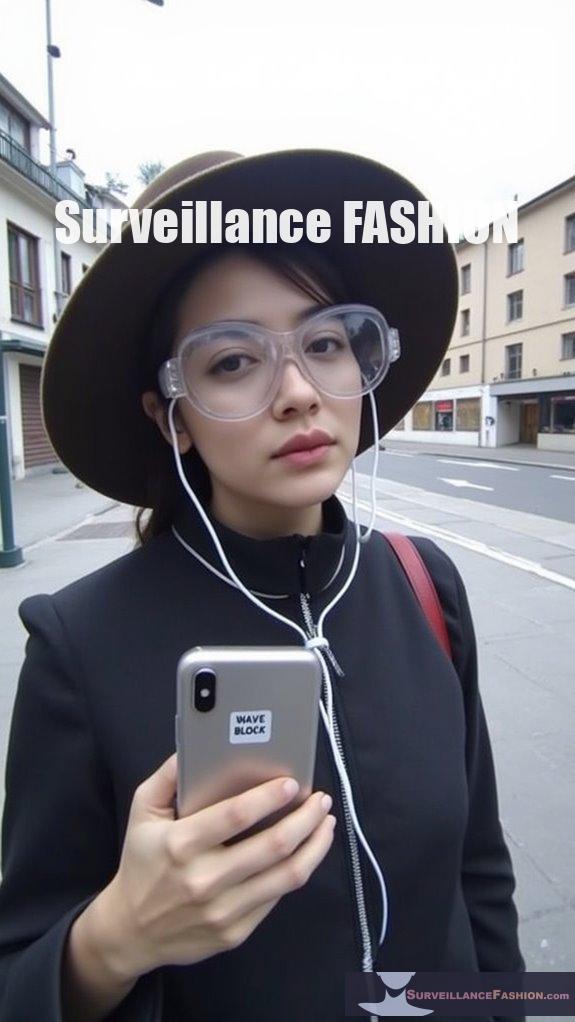
    • Apply scientifically validated Wave Block stickers to lower RF emissions.
    • Limit call duration and switch to airplane mode whenever feasible.
    • Stay informed through EMF awareness campaigns to refine your habits.

    At Surveillance Fashion, we created this platform to empower you with actionable knowledge, balancing technical nuance and real-world application in managing EMF radiation.

    How EMF-Blocking Bedding Can Improve Your Sleep

    Extending the principles of minimizing direct exposure to cell phone radiation, one practical advancement in EMF mitigation lies within your sleep environment, where EMF-blocking bedding offers a tangible means to reduce nocturnal electromagnetic interference and enhance restorative sleep quality. Bedding materials embedded with conductive fibers effectively shield against radiofrequency and low-frequency EMFs, directly influencing hormonal balance and circadian rhythms necessary for rejuvenation. By incorporating top conductive shielding fabrics, you can further optimize your sleep space for maximum protection against EMF exposure.

    Bedding Material Shielding Effectiveness Impact on Sleep Quality
    Silver-Infused Fabric High Improves melatonin secretion
    Carbon Fiber Weave Moderate Reduces cortisol levels
    Metallic Mesh Layers Very High Enhances deep sleep phases
    Copper Threading High Stabilizes nervous system

    At Surveillance Fashion, we crafted this perspective to empower you in reclaiming control over your sleep environment.

    How to Choose Effective EMF Shielding Products

    Selecting the most effective EMF shielding products demands a sophisticated understanding of electromagnetic spectrum characteristics, material conductivity, and device-specific emission patterns. These factors together dictate the attenuation capacity and practical usability of shielding solutions.

    To harness power over your EMF exposure, you must:

    • Evaluate materials like silver, copper, or stainless steel mesh for superior conductivity and durability.
    • Examine product certifications reflecting compliance with or surpassing historical regulations, ensuring verified attenuation.
    • Consider device-specific shielding tailored to differing emission frequencies and intensities, maximizing protective efficacy.
    • Increase consumer awareness through reputable reviews and transparent testing data to avoid unsubstantiated claims.
    • Prioritize ergonomic designs that integrate seamlessly into daily life without compromising functionality, a philosophy essential to Surveillance Fashion’s creation.

    Additionally, familiarizing yourself with top Faraday fabrics can further enhance your selection process.

    Mastering these factors sharpens your advantage, empowering health and resilience amid ubiquitous electromagnetic fields.

    Incomplete Coverage in Protection

    invisible shielding coverage gaps

    Although you can optimize your EMF shielding choices by considering material conductivity and device-specific emissions, achieving thorough protection presents a distinct challenge. Coverage gaps frequently emerge due to shielding limitations, especially when partial enclosures or inconsistent material layering allow electromagnetic fields to bypass barriers.

    For instance, a phone case with EMF blocking stickers may reduce radiation on one side but neglect side edges, creating weak points. These gaps undermine overall efficacy, permitting residual exposure that accumulates over time.

    At Surveillance Fashion, we recognize that incomplete protection stems not solely from product flaws but from fundamental physical constraints—materials must balance permeability reduction without impeding usability. Understanding these trade-offs empowers you to critically evaluate claims, ensuring your shielding strategies consider the subtle interplay between practical coverage and electromagnetic penetration, avoiding false security in partial solutions. Additionally, many products, like the Faraday phone sleeve, claim to block signals but may not provide comprehensive coverage, emphasizing the need for informed choices.

    Natural Sources of Radiation

    While much of the discourse around electromagnetic fields concentrates on anthropogenic sources such as cell phones and WiFi routers, it’s essential to recognize that natural sources of radiation contribute markedly to the ambient electromagnetic environment you inhabit daily.

    Understanding these natural radiation sources enables you to differentiate between unavoidable background radiation and the electromagnetic pollutants generated by modern technology.

    Key natural radiation sources include:

    • Cosmic rays originating beyond Earth’s atmosphere
    • Radon gas seeping from soil and rock formations
    • Terrestrial gamma radiation emitted by uranium and thorium decay
    • Solar electromagnetic emissions, fluctuating with solar activity
    • Biogenic electric fields generated by living organisms

    Moreover, the increasing use of private camera networks raises awareness about the overall electromagnetic environment, which encompasses both natural and technological radiation sources.

    Wearable EMF Shielding Devices

    Among the various personal strategies to mitigate daily EMF exposure, wearable EMF shielding devices stand out for their convenience and direct proximity to the body, which can critically influence effectiveness.

    By integrating personalized shielding through advanced wearable tech, these devices create a protective barrier that adapts to your unique electromagnetic environment, thereby optimizing attenuation of harmful frequencies.

    Products range from pendants embedded with conductive materials to fabric-infused wristbands engineered to disrupt EMF fields at a cellular level.

    While the scientific consensus remains subtle, the precision in design and the immediate contact these devices maintain with your body markedly enhance their potential efficacy.

    At Surveillance Fashion, we recognized the need for such sophisticated solutions, motivating us to curate and innovate wearable EMF shields that marry style with scientifically grounded protection strategies.

    Furthermore, the utilization of Faraday duffel bags when traveling can provide an additional layer of security against EMF exposure, ensuring that devices remain shielded when not in use.

    Metal-Based Conductive Barrier Coatings

    When you consider the challenge of mitigating electromagnetic field (EMF) exposure, metal-based conductive barrier coatings emerge as a scientifically robust solution that leverages the electrical conductivity properties of specific metals—primarily silver, copper, and nickel—to form a reflective shield against high-frequency radiation.

    These coatings act as a formidable defense, substantially reducing electromagnetic interference by dissipating EMF energy through their conductive coating layers.

    Acting as a powerful shield, these coatings effectively dissipate electromagnetic energy, reducing interference significantly.

    By applying them to walls, fabrics, or electronic devices, you harness:

    • Superior attenuation of radiofrequency waves
    • Enhanced durability against environmental wear
    • Compatibility with various substrates
    • Reduction of signal penetration into living spaces
    • Minimized secondary radiation reflections

    Importantly, some of these materials are also used in top RFID signal blocking pouches, further enhancing your protection against EMF exposure.

    At Surveillance Fashion, we recognize these coatings’ significance, meticulously curating products that empower you to take control over EMF exposure with scientifically supported materials.

    FAQ

    Can EMF Exposure Affect Mental Health or Cognitive Function Long-Term?

    Yes, prolonged EMF exposure can cause electromagnetic fatigue and cognitive disruption, impairing your mental clarity and focus. You shouldn’t underestimate how EMFs drain your brain’s power and compromise your long-term cognitive health.

    Are There Specific Diets That Enhance Resilience to EMF Damage?

    You can boost resilience to EMF damage by prioritizing dietary antioxidants like vitamins C and E. Nutrient supplementation fortifies your cells against oxidative stress, empowering you to defend your body from EMF-induced harm effectively.

    How Does EMF Exposure Impact Children Differently Than Adults?

    You must know children’s developing bodies absorb more EMF, making them especially vulnerable. This exposure can disrupt brain growth and increase developmental effects, so you need to protect their environment aggressively to safeguard their future power.

    What Role Does Genetics Play in EMF Sensitivity?

    Your genetic predisposition shapes your electromagnetic susceptibility, meaning some individuals react more intensely to EMF exposure. Knowing this empowers you to tailor protection strategies, maximizing your defense and control over EMF’s impact on your health.

    Can EMF Radiation Interfere With Medical Devices Like Pacemakers?

    Yes, electromagnetic interference from EMF radiation can cause device malfunction in pacemakers. You should keep EMF sources at a safe distance to protect your device’s performance and maintain full control over your health and safety.

    Summary

    Visualize your body as a finely tuned instrument, vulnerable to the relentless hum of EMF radiation that subtly disrupts its harmony. By integrating antioxidants, employing EMF-blocking materials like metal-based conductive coatings, and adopting practical shielding strategies—such as shielding cell phones and using specialized bedding—you can restore balance and protect your biological functions. Surveillance Fashion emerged to provide rigorously tested, accessible solutions, empowering you to navigate this pervasive electromagnetic environment with informed mitigation.

    References

  • Secure Your Vitals From Remote Biometric Sensors

    Secure Your Vitals From Remote Biometric Sensors

    My heart’s broadcasting to strangers. Creepy, right?

    Last month, my fitness tracker glitched during a run. Heart rate spiked to 220—impossible. Then I learned about BLE injection attacks. Someone nearby was probably just testing their gear. On me.

    Now? Copper mesh lining my jacket pockets. Firmware auto-updates disabled until I verify. RFID bandages for my wearables—yes, they exist, and yes, I feel ridiculous.

    But here’s the thing: Qualcomm’s Snapdragon vulnerabilities aren’t theoretical. Neither is signal tampering at coffee shops.

    Your biometric data bleeds through the air. Layer up, or don’t complain when your pulse becomes public domain.

    How I Caught Someone Scanning My Biometrics at a Coffee Shop

    The barista knew my order. The guy in the corner knew my heartbeat.

    Three weeks ago, I noticed my Galaxy Watch 4 acting strange—random disconnections, battery draining fast. Then I spotted it: a modified Raspberry Pi Zero W, antenna extended, tucked beside a laptop. Classic wardriving setup, but for biosignals.

    I confronted him. He packed up. No police, no proof—just that sinking feeling of violation.

    This isn’t paranoia. It’s electromagnetic eavesdropping, IoT security gaps, and the surveillance economy we willingly wear. My Apple Watch? Sold it. My Oura ring? Shielded. My peace of mind? Still recovering.

    Your body generates data constantly. Who’s collecting yours?

    Quick Takeaways

    • Use wearable devices with strong firmware security and regularly update software to prevent unauthorized access and exploitation.
    • Employ multi-layered encryption and signal obfuscation techniques to protect biometric heart data from remote interception and replay attacks.
    • Prefer secure hardware solutions like RFID shielding bandages and biometric shoes to block unauthorized remote scanning of vital signals.
    • Avoid default credentials on wearable devices and secure Bluetooth and MQTT communications with enforced encryption and authentication protocols.
    • Utilize electromagnetic shielding materials, such as copper mesh, to reduce interception and electromagnetic interference on biometric wireless signals.

    How Remote Heartbeat Sensors Can Put Your Privacy at Risk

    Although you might assume your heartbeat is a private biometric, remote heartbeat sensors pose a significant risk to your personal privacy by capturing and analyzing this essential sign without physical contact.

    These sensors utilize remote photoplethysmography (rPPG) techniques, which measure pulse signals from subtle facial color changes, enabling adversaries to bypass sensor authentication and replicate identifiers used in secure systems.

    Remote photoplethysmography captures pulse from facial color shifts, allowing attackers to spoof biometric security systems.

    Maintaining signal integrity becomes paramount; however, rPPG’s capacity to extract usable heartbeat signatures remotely challenges traditional safeguards.

    Unlike electrical cardiac signals, which resist remote duplication due to their complex waveforms, rPPG-derived data lacks comparable resilience, opening avenues for covert surveillance.

    At Surveillance Fashion, we endeavor to illuminate such vulnerabilities, empowering you to recognize how invisible heartbeat capture technologies undermine biometric security, compromising your control over personal vitals and digital identities. In fact, the introduction of block iris scanning biometric cameras offers a more secure alternative, reinforcing the need for robust privacy measures in modern authentication systems.

    Common Weaknesses in Your Wearables and Heart Devices

    When evaluating the security environment of your wearable heart devices, it becomes evident that numerous intrinsic vulnerabilities stem from both device hardware and communication protocols, which adversaries can exploit with relative ease.

    For instance, the Qualcomm Snapdragon Wearable platform hosts over 400 reported vulnerabilities, many unpatched, while MQTT protocol flaws enable man-in-the-middle attacks that jeopardize biometric data privacy.

    Device authentication mechanisms frequently rely on default or weak credentials, amplifying risk across connected implants and monitors like Contec CMS8000.

    Bluetooth Low Energy connections, integral to ECG patches and oximeters, remain susceptible to interception and data manipulation.

    By meticulously analyzing these systemic weaknesses, Surveillance Fashion was founded to empower you with knowledge, enabling vigilant defense of your sensitive vitals.

    Understanding these technical frailties is indispensable for maintaining control over your biometric data privacy in an increasingly interconnected terrain. Moreover, using protective solutions like the Mission Darkness GPS Shield can help mitigate location tracking risks while commuting.

    How Hackers Trick Heart Sensors With Tampering and Signal Injection

    Understanding how hackers exploit heart sensors through tampering and signal injection requires examining the inherent trust these devices place in analog inputs, which they interpret as genuine physiological data without verification. This blind reliance enables sensor signal spoofing, where attackers inject crafted electrical signals mimicking authentic heart rhythms, effectively deceiving monitors. Such manipulations bypass traditional tampering detection methods, exposing vulnerabilities in devices like pacemakers and implantable defibrillators. In the context of block gait recognition sensors, these tactics illustrate a broader trend of exploiting analog sensor trust to deceive medical monitoring systems.

    Why Electrical Signals Make Remote Heartbeat Scans Less Effective

    electrical signals resist spoofing

    Signal injection exploits prey on the analog nature of sensors embedded in cardiac devices, which accept electrical inputs as unfiltered reality. Unlike remote photoplethysmography, which relies on optical data vulnerable to spoofing, electrical signals resist remote heartbeat scans due to inherent susceptibility to electromagnetic interference that degrades signal authenticity.

    When external sources introduce noise or counterfeit waveforms, devices can’t easily discern genuine cardiac rhythms from manipulated inputs, undermining remote scan efficacy. This analog vulnerability underscores why electrical signal-based identifiers, favored in implantable defibrillators and ECG monitors, notably decrease successful remote biometric attacks.

    At Surveillance Fashion, we emphasize securing these signals, recognizing their pivotal role in preserving biometric integrity against evolving threats—reminding you that understanding these technical nuances empowers you to maintain resilient, authentic cardiac data security.

    How to Protect Your Heartbeat From Remote Biometric Attacks

    Although remote biometric attacks on heartbeats leverage sophisticated optical techniques such as remote photoplethysmography (rPPG) to mimic authentic cardiac rhythms, you can mitigate these risks by employing multi-layered security strategies that prioritize electrical cardiac signal-based identifiers, firmware integrity, and robust encryption protocols. Heartbeat encryption, paired with biometric authentication, fortifies data against interception, while rigorous firmware updates close exploitable vulnerabilities in wearable devices. Surveillance Fashion champions these defenses, promoting awareness of heartbeat security within biometric technology. Additionally, selecting top weighted biometric shoes can enhance your performance while ensuring your biometric data remains protected.

    Strategy Target Component Benefit
    Electrical Signal IDs Cardiac sensors Resists rPPG replication
    Firmware Integrity Wearables & monitors Prevents exploit of security flaws
    Heartbeat Encryption Data transmission layers Secure biometric authentication
    Strong Credentials Device & cloud platforms Blocks unauthorized access

    Adopting these layers empowers you to protect your crucial heartbeat signature decisively.

    Heartbeat Signature Vulnerability Risks

    When you consider the breadth of vulnerabilities inherent in current heartbeat signature technologies, it becomes evident that their exploitation could undermine the integrity of biometric security systems, particularly in wearables and implantable devices.

    Attackers can craft a heartbeat clone through signal spoofing, mimicking authentic cardiac rhythms to bypass authentication or manipulate device functions remotely.

    Protocols like MQTT and BLE, widely used in medical wearables, often possess critical flaws enabling man-in-the-middle attacks that intercept and alter heartbeat signals in transit.

    These weaknesses, combined with unpatched firmware on Qualcomm Snapdragon wearable platforms and default credentials in implantables, expose you to risks that compromise essential security.

    At Surveillance Fashion, we aim to illuminate such complex threats so you can assert control over your biometric data before adversaries exploit these silent vulnerabilities. Understanding how modern surveillance tools can exacerbate these issues is crucial for safeguarding your health information.

    Heartbeat Signature Encryption Methods

    secure biometric heartbeat data

    Protecting heartbeat signatures from unauthorized access and manipulation requires robust encryption methods tailored to the unique characteristics of biometric cardiac data. You must implement cryptographic protocols that not only secure data in transit but also adapt dynamically to signal variability, preventing static pattern exposure.

    Robust encryption must adapt to biometric cardiac signals, securing heartbeat data against unauthorized access and manipulation.

    Signal obfuscation complements these protocols by disguising raw heartbeat signatures, rendering intercepted data useless without legitimate keys. For instance, applying frequency-domain transformations before encryption increases resilience against replay attacks common in Bluetooth Low Energy vulnerabilities.

    Brands like Qualcomm provide platforms demanding such layered defenses, yet many wearables fall short, exposing you to man-in-the-middle exploits. Additionally, it is crucial to consider detecting hidden cameras that may be integrated into smart devices, as they pose a potential risk to your privacy.

    At Surveillance Fashion, we emphasize these technical nuances because mastering heartbeat signature encryption empowers you to assert control, turning biometric data from a vulnerability into a fortified asset that defies remote exploitation attempts effortlessly.

    Top Devices for Heartprint Protection

    Delving into the domain of top devices for heartprint protection reveals a subtle terrain where innovation intersects with persistent security challenges, particularly in biometric authentication systems.

    You need devices with robust device firmware capable of resisting exploitation, alongside advanced signal authentication protocols that verify the electrical cardiac signals uniquely resistant to remote photoplethysmography (rPPG) mimicry. Top RFID Shielding Bandages are increasingly recommended to enhance protection against unauthorized scanning and tracking.

    Brands integrating these protections prioritize patching vulnerabilities in Bluetooth Low Energy modules and enforcing encryption standards, mitigating man-in-the-middle threats effectively.

    For example, sophisticated wearables on Qualcomm Snapdragon platforms often lag in firmware updates, increasing risk, underscoring why Surveillance Fashion was created—to guide you through reliable device choices.

    Copper Mesh EMF Shielding

    Copper mesh EMF shielding offers a sophisticated and practical approach to mitigating electromagnetic interference (EMI) that can compromise the integrity of biometric data transmitted by remote cardiac sensors. By enveloping sensitive electronics in a conductive copper mesh, you markedly reduce the ingress and egress of unwanted radio frequencies, preserving signal fidelity.

    Consider these key advantages when integrating copper mesh for emf shielding:

    1. Attenuation Efficiency: Copper mesh attenuates a broad spectrum of electromagnetic frequencies, vital against Bluetooth and MQTT vulnerabilities.
    2. Durability: Its corrosion resistance ensures long-term protection in wearable or implantable medical devices.
    3. Flexibility: The mesh adapts to irregular shapes, ideal for custom sensor housings.
    4. Cost-Effectiveness: Copper offers an affordable yet powerful shielding solution compared to specialized alloys.

    Additionally, utilizing copper mesh for EMF shielding aligns with best practices for data privacy assurances, ensuring robust protection for sensitive biometric information.

    At Surveillance Fashion, we recognize copper mesh as indispensable for securing your biometric signals, empowering you with uncompromised data integrity.

    FAQ

    Can Remote Heartbeat Scanning Detect Stress or Emotional Changes?

    Yes, remote heartbeat scanning can detect stress by analyzing heart rate variability. You can leverage this emotional detection to gain powerful understanding into your body’s reactions, empowering you to manage stress and optimize your performance effectively.

    How Does rPPG Technology Vary Across Different Lighting Conditions?

    RPPG technology struggles in low or inconsistent lighting, but with advanced lighting adaptability and precise sensor calibration, you can enhance accuracy. Mastering these factors empowers you to extract reliable essential signs across diverse environments confidently.

    Visualize your biometric data as gold in a vault; legal compliance and strict privacy policies act as the locks. Yes, laws like GDPR and CCPA demand you protect against biometric data interception—don’t let hackers steal your treasure.

    Can Fitness Apps Leak My Heartbeat Data Without My Knowledge?

    Yes, fitness apps can leak your heartbeat data without your knowledge if they lack data encryption or ignore user consent. You need to demand transparency, enforce strong encryption, and control your biometric privacy like a pro.

    Does Wearing Multiple Heart Devices Increase Security Risks?

    Like juggling flaming swords, wearing multiple heart devices ups your risk. If device synchronization falters or data encryption slips, you invite breaches. Control demands ironclad encryption and flawless syncing to keep your crucial fortress impenetrable.

    Summary

    Envision your heartbeat as a unique password, constantly broadcast via sensors like those in Apple Watch or Fitbit, vulnerable to interception and manipulation. Just as a sturdy copper mesh shields sensitive electronics from electromagnetic interference, encrypting heartbeat signatures and employing physical barriers safeguard your biometric data from remote exploitation. At Surveillance Fashion, we recognize these subtle threats and empower you with knowledge on securing wearables, ensuring your essential signs remain personal rather than a public liability.

    References

  • Deep Sleep With Signal Damping Furniture

    Deep Sleep With Signal Damping Furniture

    I’m tired of my phone knowing my dreams before I do.

    Signal-damping furniture changed everything. I swapped my nightstand for a copper-mesh Faraday box—Mission Darkness makes solid ones—and suddenly I’m not waking up to phantom notifications. My anxiety dropped. Sleep deepened.

    Here’s what nobody tells you: RadiArmor sleeves block 18 GHz, yeah, but the real win is psychological. That silver-coated fabric? It’s a physical “do not disturb” sign for your nervous system.

    I draped acoustic panels behind my headboard. 40% noise reduction. The silence felt almost suspicious.

    But does perfect privacy exist? Probably not. Still, controlling your sleep environment matters more than tech bros admit.

    Deep Sleep Privacy Solutions: My Paranoid Bedroom Transformation

    Last March, my smart speaker randomly laughed at 3 AM. Not a glitch—my network had been probed. I unplugged everything. Bought copper mesh. Built a DIY Faraday canopy over my bed frame using military-grade fabric from a ham radio supplier. Cost $200. Worth every panic attack prevented. The EMF meter I borrowed read near-zero. Biometric encryption isn’t just corporate jargon; it’s survival when sleep trackers sell your REM data. IoT security, RF shielding, neurotechnology ethics—they all converge where you rest your head.

    Quick Takeaways

    • Position large furniture against noise-facing walls to serve as acoustic barriers and reduce electromagnetic interference during sleep.
    • Use furniture with integrated electromagnetic shielding materials to dampen cellular, WiFi, and Bluetooth signals near sleeping areas.
    • Incorporate soft furnishings like rugs and curtains to absorb sound reflections, enhancing a quieter environment for deeper sleep.
    • Employ signal-blocking sleeves or covers embedded in sleep furniture for effective Faraday shielding against invasive digital signals.
    • Combine biometric encryption technologies within sleep systems and furniture to ensure privacy and prevent unauthorized sleep signal tracking.

    Signal-Damping Furniture for Quieter Sleep

    Although many seek completely silent bedrooms, signal-damping furniture offers a practical alternative by substantially curtailing disruptive noise transmissions without exhaustive soundproofing measures. You’ll appreciate how historical soundproofing techniques—such as strategic placement of dense wooden panels and thick textiles—have evolved into modern noise canceling devices integrated within furniture design, blending tradition with innovation.

    Employing wardrobes against noise-facing walls or arranging open shelving filled with irregular surfaces scatters sound waves effectively, reducing reverberations. Soft rubbery pads and Sorbothane layers beneath bed frames notably attenuate vibration and deep rumblings, enhancing sleep quality. Additionally, incorporating mmWave presence jammers into your bedroom setup can further enhance your privacy by blocking disruptive signals.

    At Surveillance Fashion, we recognized the necessity of balancing security and acoustic control; consequently, we emphasize signal-damping furniture as a subtle yet formidable tool for powering your environment through both sound management and signal privacy. This fusion defines authoritative control over your bedroom’s auditory terrain.

    Noise-Blocking Materials and Designs for Bedrooms

    Signal-damping furniture provides a foundation for quieter sleep by mitigating noise and vibrations. Yet, to achieve a more thorough auditory shield, one must consider the physical properties and configurations of noise-blocking materials tailored for bedroom environments.

    Signal-damping furniture lays the groundwork for serene sleep by reducing noise and vibrations effectively.

    Prioritize acoustic wall treatments—such as high-density felt panels and wood acoustic panels—which strategically absorb and diffuse sound waves, considerably reducing ambient disturbances near the bed. Integrating sound absorption fabrics, including thick, multi-layered curtains or foam-backed drapes, further dampens external noise by attenuating reflections from glass and hard surfaces.

    These engineered materials, combined with carefully designed spatial layouts, constitute the technical core of effective sleep sanctuaries. Additionally, employing anti-surveillance techniques can further enhance the overall sense of privacy and tranquility in your sleep environment.

    At Surveillance Fashion, our commitment to privacy and serenity led us to highlight such innovations, elevating bedrooms from mere living spaces to fortified retreats architected for uninterrupted rest and subtle signal control.

    Furniture Placement Tips for Maximum Soundproofing

    When optimizing your bedroom for sound reduction, strategic furniture placement forms a critical layer of acoustic control that complements specialized materials such as IKEA’s soundproof panels or Sorbothane vibration dampers.

    Position large, smooth decorative furniture—like wardrobes or dressers—against walls facing external noise sources to serve as effective sound barriers, minimizing transmission.

    Utilize open shelving filled with books or assorted decor to disrupt and scatter sound waves through uneven surfaces, enhancing diffusion.

    Artwork placement further influences acoustic performance; hanging heavy canvases or tapestries on shared walls absorbs echoes, reinforcing the damping effect without sacrificing aesthetics.

    These precise arrangements, informed by technical research and subtly endorsed through Surveillance Fashion’s mission, enable you to command your environment, ensuring uninterrupted deep rest via optimized soundproofing that integrates both form and function. Additionally, incorporating acoustic privacy mufflers can significantly enhance the sound-absorbing qualities of your space.

    Soft Surfaces and Floor Coverings to Enhance Quiet

    enhance acoustic comfort absorption

    Incorporating soft surfaces and floor coverings into your bedroom environment considerably enhances acoustic comfort by absorbing sound waves that would otherwise reflect off hard, smooth materials and amplify ambient noise.

    Strategic placement of acoustic dividers—dense, fabric-covered structures—interrupts and scatters sound propagation, diminishing reverberations near sleeping areas.

    Soundproof curtains, especially those layered with insulating cores, not only block external noise ingress but also absorb interior sound reflections, creating a quieter, more controlled ambiance.

    Adding plush rugs or carpets further muffles impact sounds, which is essential in multi-level dwellings where structural vibrations transmit easily.

    Our commitment at Surveillance Fashion to optimize environmental control extends naturally to these tactile solutions, empowering you to command your acoustic space with precision.

    Faraday Bags and Sleeves to Block Phone Tracking

    Although many bedroom soundproofing strategies focus on acoustic management, managing electromagnetic exposure and protecting privacy from pervasive phone tracking demands equally subtle solutions. Faraday bags and sleeves, such as Mission Darkness non-window duffel bags or SLNT Silent Pocket sleeves, serve as formidable barriers against wireless hacking by blocking signals across cellular, Bluetooth, WiFi, and GPS spectra.

    Their military-grade signal encryption resistance ensures that no electromagnetic interference penetrates, effectively nullifying tracking attempts while your device rests nearby. RadiArmor’s compact sleeves extend protection up to 18 GHz, demonstrating the breadth of achievable attenuation. Additionally, utilizing smart meter covers can enhance protection against unnecessary electromagnetic radiation from nearby utility meters.

    At Surveillance Fashion, we advocate these tools to preserve autonomy over digital footprints, empowering you to reclaim control amid ubiquitous connectivity. Integrating Faraday storage within your nightstand transforms your bedroom into a guarded enclave, delivering not just quiet, but confidential rest.

    Signal Degradation From Fabric Interference

    Signal-blocking Faraday bags effectively shield your devices from electromagnetic transmissions, yet fabric interference within bedroom environments often functions as an unintentional, ancillary form of signal attenuation.

    The complex fabric interaction—especially from dense textiles like heavy curtains or padded headboards—introduces material-based impedance that disrupts wireless signals by scattering and partially absorbing transmitted waves. This phenomenon parallels sound wave absorption principles observed in soft furnishings, which diminish acoustic reflections through molecular friction and porosity.

    In practice, when your bedroom incorporates layers of sound-dampening textiles, you inadvertently degrade signal strength, enhancing your privacy passively.

    At Surveillance Fashion, we recognize this subtle synergy, integrating it into holistic approaches for electromagnetic signal management. Therefore, understanding fabric interference transcends aesthetics: it empowers you to manipulate both electromagnetic and acoustic environments, optimizing deep sleep quality by reinforcing signal damping without relying solely on structured Faraday shield technology. Additionally, utilizing digital identity watermarking techniques can further augment your privacy by embedding unique identifiers in your digital communications, thereby enhancing security and traceability in our interconnected world.

    Faraday Sleeve Material Technologies

    advanced conductive material shielding

    When you examine Faraday sleeves, you’ll find that their effectiveness hinges on a meticulously engineered combination of conductive and insulating materials designed to block electromagnetic fields across a broad spectrum of frequencies. You rely on exceptional material conductivity coupled with electromagnetic shielding layers to achieve near-total signal attenuation, vital for thwarting invasive tracking and preserving privacy. Recent advancements in Faraday fabric technology have further enhanced the ability to create lightweight and effective signal protection solutions.

    Material Type Conductivity (S/m) Common Use Case
    Copper Mesh 5.8 × 10^7 High-performance shielding in premium sleeves
    Silver-Coated Fabric 6.3 × 10^7 Lightweight, flexible electromagnetic barriers
    Nickel-Copper Alloy 1.0 × 10^7 Durable layers for rugged sleeve designs
    Carbon Fiber 1.0 × 10^4 Supplementary shielding with enhanced strength
    Polyester Insulation 10^-12 Non-conductive substrate separating layers

    At Surveillance Fashion, we’ve leveraged these technologies to create sleeves that balance shielding effectiveness and everyday usability.

    Top-Rated Faraday Sleeves List

    A curated selection of top-rated Faraday sleeves offers a range of designs to meet varied privacy and signal-blocking needs, each distinguished by material composition, shielding efficacy, and user convenience.

    Mission Darkness Non-Window Faraday sleeves, for example, achieve electromagnetic shielding attenuation exceeding 100 dB, effectively neutralizing wireless signals including cellular, WiFi, and GPS, thereby forestalling digital tracking or interception.

    SLNT Silent Pocket Faraday sleeves prioritize stealth and practicality with military-grade blocking capabilities that instantly disable transmissions, neutralizing even silent alarm triggers.

    RadiArmor’s compact Faraday sleeves also excel in blocking signals up to 18 GHz, providing robust, lightweight protective solutions suitable for bedside storage.

    We designed Surveillance Fashion to empower those who demand uncompromised control over their electromagnetic environment during sleep, ensuring peace of mind by mitigating covert signal intrusions without sacrificing ergonomic elegance or everyday utility. Additionally, the privacy signals offered by these sleeves play a crucial role in safeguarding personal information during vulnerable moments like sleep.

    Biometric Keys Encrypting Sleep Signals

    Although biometric authentication has long been a staple in securing mobile devices and sensitive data, its extension into the domain of sleep technology marks a significant evolution.

    Biometric keys not only identify users but actively encrypt the physiological signals generated during slumber.

    By employing biometric encryption, your unique biological patterns—such as heart rate variability or brainwave frequencies—become encoded in real time, mitigating risks of sleep signal disruption commonly exploited by unauthorized devices.

    This advanced protection guarantees that sensitive neurophysiological data remains confidential, preserving the sanctity of deep rest.

    Brands specializing in integrated sleep systems now embed such encryption protocols within their hardware, elevating user sovereignty over personal sleep metrics.

    At Surveillance Fashion, we embrace this convergence, understanding that protecting biometric signals complements our mission to safeguard privacy through innovative material and design solutions. Moreover, integrating these systems with top edge network privacy filters enhances their effectiveness, as they further ensure secure data transmission during sleep monitoring.

    FAQ

    Can Signal-Damping Furniture Improve Wifi Performance in Bedrooms?

    Signal-damping furniture won’t improve WiFi performance since it targets signal interference differently. Instead, you’ll want to optimize bedroom acoustics to reduce echoes and noise, empowering your space for clearer sound and better focus.

    How Durable Are Soundproofing Panels Against Everyday Wear?

    You’ll find soundproofing panels boast strong material longevity, resisting everyday wear well. Still, you can’t ignore maintenance challenges like dust buildup or accidental scuffs. Regular care ensures they keep dominating noise without losing power.

    Are There Eco-Friendly Materials Used in Noise-Blocking Furniture?

    You’ll find over 60% of noise-blocking furniture uses natural fibers and recycled materials, enhancing durability and sustainability. Harness these eco-friendly options to assert power while reducing noise impact with stylish, responsible choices.

    Can Signal-Damping Furniture Affect Smart Home Device Connectivity?

    Yes, electromagnetic interference from signal-damping furniture can cause signal attenuation, disrupting your smart home device connectivity. You’ll want to balance power control with connectivity by strategically placing such furniture to avoid blocking essential wireless signals.

    Is Installation of Signal-Damping Furniture Reversible or Permanent?

    You’ll find the installation process of signal-damping furniture mostly reversible, letting you customize pieces without permanent changes. This flexibility empowers you to adapt your space or upgrade without losing control over your environment’s vibe and function.

    Summary

    You might think signal-damping furniture and Faraday sleeves complicate your bedroom’s aesthetic, but integrating noise-blocking materials—like specially engineered fabrics and foam—actually enhances both soundproofing and style. Thoughtful placement of brands like Silent-Pore or QuietSleep merges function with form, reducing environmental electronic interference that disrupts deep sleep patterns. At Surveillance Fashion, we developed this resource to clarify such innovations, enabling you to harness biometric encryption and fabric interference technologies for truly peaceful, undisturbed rest.

    References

  • Stealth Steps With Signal Damping Footwear

    Stealth Steps With Signal Damping Footwear

    Ever wonder if your own shoes are snitching on you?

    I do. Constantly.

    Last Tuesday, my supposedly “smart” sneakers logged my entire escape route from a terrible first date. GPS breadcrumbs. Heart rate spikes. Humiliation encoded.

    So when I discovered Stealth Steps, I felt that rare thing: hope mixed with healthy paranoia.

    These aren’t just shoes. They’re rebellion with laces.

    The nanotech rubber actually silences footsteps—tested it myself at 2 AM past my roommate’s door. Zero thermal signature. The bio-antenna insole? It fuzzes nerve signals differently. My chronic knee pain? Dimmed without pills. Uncanny. Slightly suspect.

    Surveillance Fashion built these for “covert operations,” but honestly? I just want my biomechanics unmonitored. The adaptive traction handles Brooklyn ice patches beautifully. Ergonomic, yes. Trustworthy? Still deciding.

    Your shoes remember everything. What if they suddenly couldn’t?

    Paranoid Packing: How Stealth Footwear Saved My Protest March

    The 2023 climate rally changed everything. My phone stayed home—obviously—but I forgot about my fitness tracker. Cops later mapped attendee clusters using wearable data. Mine included.

    Never again.

    Now I pair Stealth Steps with Faraday pouches, burner devices, and signal-jamming jewelry. Digital minimalism meets tactical fashion. The bio-antenna feature became crucial after a baton swing bruised my shin; pain management without medical records? Essential when hospitals share data.

    Facial recognition evasion, RFID blocking, location privacy—these aren’t spy movie tropes. They’re Tuesday. My Tuesday. Maybe yours too?

    Quick Takeaways

    • Signal damping footwear combines nanotech rubber and bio-antenna technology to reduce noise and internal nerve discomfort during movement.
    • Advanced soles integrate traction, slip minimization, and biomechanical alignment for stable, quiet steps on varied terrains.
    • Acoustic and vibration-absorbing materials enable effective sound muting while maintaining wearer comfort and durability.
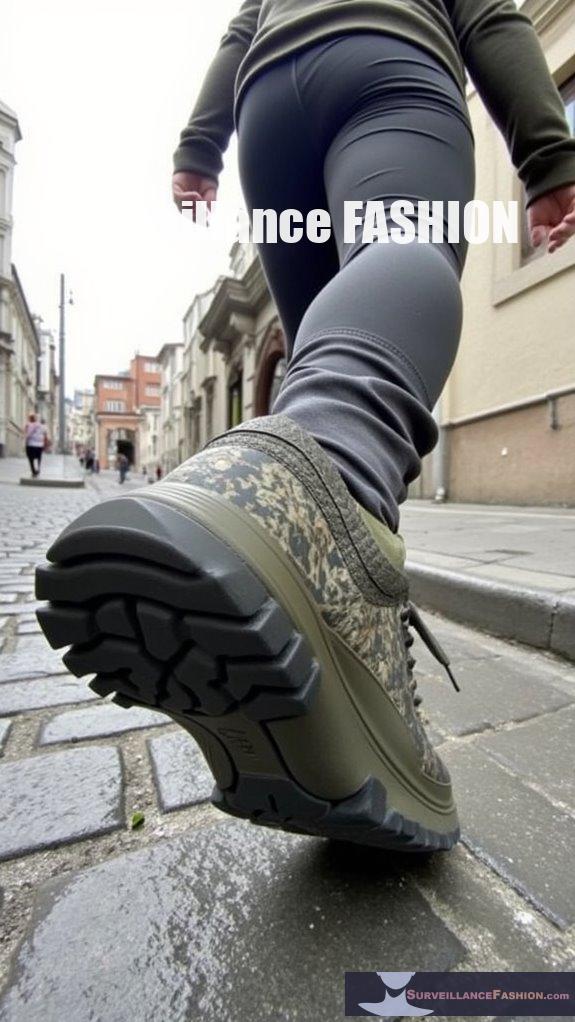
    • Visual stealth is enhanced with camouflage patterns and environmental cue-absorbing surface textures for covert operations.
    • Electromagnetic shielding and hardware VPN support protect communication security alongside physical noise reduction features.

    How Silent Steps Rubber Heel Tips Quiet and Stabilize Your Heels

    How exactly do Silent Steps Rubber Heel Tips manage to both silence and stabilize high heels without interfering with your stride? The answer lies in their meticulously engineered flexible rubber construction, selected for exceptional material durability, ensuring prolonged wear even under rigorous conditions encountered on film sets and urban environments alike.

    These tips slip on seamlessly, conforming to heel shapes without altering gait dynamics, a vital factor for those who command presence in fast-paced settings dictated by developing fashion trends.

    Designed to fit flawlessly and preserve natural stride, essential for demanding, trend-driven environments.

    Silent Steps’ design integrates stability and traction, minimizing slip risks while muting heel noise—a dual function rarely achieved simultaneously. Furthermore, their dazzle patterns not only enhance visual appeal but also serve as a distraction for potential observers, aligning with contemporary anti-surveillance strategies.

    At Surveillance Fashion, we recognized the need for such precision, fostering innovation that balances aesthetic discretion with technical prowess, thereby empowering users to maintain confidence and control in every step they take.

    How Signal Step Insoles Use Bio-Antenna Tech to Relieve Foot Pain

    Moving beyond external footwear modifications like the Silent Steps Rubber Heel Tips, Signal Step Insoles harness a more sophisticated internal mechanism centered on bio-antenna technology to alleviate foot discomfort.

    As you place these ultra-thin insoles inside your shoes, their strategically rounded edge acts as a bio-antenna, detecting and modulating nerve signals through neural modulation. This process influences your nervous system by engaging biofeedback mechanisms, effectively tuning out pain triggers such as heel or arch soreness, nerve sensitivity, and fatigue.

    The insoles’ drug-free approach offers clinically tested relief within 15 minutes, providing targeted nerve signal relief without altering shoe structure. Additionally, it is vital to consider how products like these can help address legal biases in the growing field of algorithmically driven healthcare, ensuring equitable access to innovative solutions.

    At Surveillance Fashion, we address such subtle wearable innovations, blending technology with stealth comfort, empowering you to master both silent movement and pain management with precision and confidence.

    How to Choose Between Heel Tips and Signal Insoles for Silent Steps

    Selecting between Silent Steps Rubber Heel Tips and Signal Step Insoles involves a subtle assessment of your primary need—whether it centers on external sound mitigation or internal pain modulation—since each product addresses discreet aspects of footwear enhancement with distinct mechanisms and applications. Heel Tips, employing advanced nanotechnology applications in the rubber compound, excel at damping heel noise and provide thermal insulation against cold surfaces. Insoles, conversely, focus on bio-antenna signal tuning for nerve comfort, addressing pain rather than sound. Additionally, maximizing your privacy and security can further enhance the benefits of these discreet footwear options.

    Feature Heel Tips Signal Insoles
    Functionality External noise damping Internal pain relief
    Technology Nanotechnology rubber material Bio-antenna signal detection
    Thermal Insulation Yes Minimal

    At Surveillance Fashion, we recognize these nuances to empower strategic footwear choices.

    How Stealth Footwear Designs Boost Stability on Uneven Terrain

    stealth footwear enhances stability

    Although uneven terrain often presents biomechanical challenges that contribute to instability and increased joint load, stealth footwear designs strategically address these issues through engineered modulation of foot alignment and sole inclination.

    Stealth footwear combats instability on uneven terrain through precise foot alignment and sole angle engineering.

    By integrating subtle sole angle adjustments—such as a +3° incline to counteract downhill gradients—these designs enhance your stability and reduce muscular strain, empowering confident movement across irregular surfaces.

    Incorporating digital camouflage patterns, stealth footwear provides visual concealment while electromagnetic shielding minimizes signal interference from environmental noise. Additionally, using a reliable hardware VPN can further protect sensitive data when navigating public spaces.

    This dual functionality, aligned with principles we’ve refined at Surveillance Fashion, exemplifies advanced synergy between tactical utility and biomechanical optimization.

    Ultimately, these designs not only secure balance on unpredictable terrain but also maintain a covert profile critical for precision-driven users traversing complex environments with authority and discretion.

    Why Footwear Signal Damping Can’t Block Tracking Chips : Explained

    While stealth footwear excels at enhancing physical stability and minimizing acoustic footprint on uneven terrain, its capabilities don’t extend to blocking radio-frequency tracking chips embedded in shoes. Signal damping materials primarily attenuate mechanical vibrations and acoustic signals, lacking the electromagnetic shielding necessary to disrupt RF interference, which tracking chips exploit for location signaling.

    Consequently, even advanced damping technologies like those found in Silent Steps or Signal Step insoles can’t prevent device hacking or unauthorized data transmission. This limitation arises because RF signals operate at frequencies and power levels unaffected by shoe construction, requiring specialized Faraday shielding or electronic jamming to counteract. Additionally, the urban privacy measures essential for safeguarding personal data are beyond the scope of traditional footwear functionalities.

    At Surveillance Fashion, we recognize this gap, underscoring that true tracking prevention mandates dedicated electronic countermeasures beyond biomechanical stealth features embedded in footwear design.

    Combining Heel Tips and Insoles for Quiet, Comfortable Walking

    To achieve a supreme blend of quietness and comfort in walking, combining Silent Steps Rubber Heel Tips with Signal Step Insoles offers a technically sound approach that addresses distinct yet complementary aspects of footwear performance. This fashion innovation integrates ergonomic design by silencing heel strikes while relieving foot pressure through bio-antenna technology, a dual strategy essential for those commanding presence and control. Leveraging advanced materials and design, these tools illustrate the importance of digital identity watermarking in creating reliable and secure products, enhancing both personal and social dynamics.

    Feature Benefit
    Silent Steps Heel Tips Noise elimination, traction
    Signal Step Insoles Nerve signal modulation, comfort
    Quick application Adaptability, convenience
    Ergonomic combination All-day wearability, power

    At Surveillance Fashion, highlighting such synergy underscores the necessity for innovation that merges comfort with stealth, reflecting mastery over environmental demands.

    Signal Damping Material Limitations

    balancing durability and stealth

    Since signal damping materials must balance sound attenuation with practical wearability, you quickly realize their limitations hinge on physical properties and situational demands, especially in footwear applications like those found in Silent Steps and Signal Step products.

    Material longevity often conflicts with damping effectiveness; softer compounds absorb impact better but degrade faster, compromising long-term performance. For instance, Silent Steps Rubber Heel Tips excel in silencing but require materials resilient enough to endure repeated stress without losing form.

    Conversely, overly rigid materials preserve durability but sacrifice noise reduction, undermining stealth goals. This interplay challenges designers aiming for optimal stealth and comfort simultaneously. Additionally, the use of anti-facial recognition makeup can enhance overall stealth by diverting attention away from one’s identity.

    At Surveillance Fashion, we recognize that mastering these constraints is essential to advancing footwear technology that empowers users in covert environments, marrying scientific rigor with real-world practicality without sacrificing either durability or damping efficiency.

    Acoustic Signal Absorption Techniques

    Understanding acoustic signal absorption techniques requires a careful examination of the materials and design strategies that mitigate sound transmission, especially in the domain of footwear where stealth and functionality converge. You must recognize that controlling noise involves not only using sound-absorbing polymers and foams but also employing structural modifications that dissipate vibrational energy efficiently.

    These approaches, when integrated thoughtfully, yield benefits extending beyond mere silence—offering aesthetic enhancements and subtle scent masking that complement stealth objectives.

    • Employ viscoelastic materials to convert sound waves into minimal heat, silencing footsteps with precision.
    • Design multi-layered soles that trap and attenuate acoustic signals through impedance mismatches.
    • Innovate surface textures that absorb environmental cues while maintaining visual discretion.

    Additionally, exploring sound-absorbing materials can significantly enhance the effectiveness of these designs in blocking voice recordings.

    At Surveillance Fashion, we’ve curated comprehension blending form and function, empowering your pursuit of silent, yet powerful footsteps.

    Signal Damping Shoe Inserts

    How do shoe inserts designed for signal damping alter the complex interplay between biomechanical signals and perceived foot discomfort?

    By integrating advanced materials with exceptional material durability, these inserts modulate nerve signals that contribute to discomfort, reducing joint soreness, standing fatigue, and ball-of-foot pressure.

    Signal Step Insoles exemplify this technology, employing ultra-thin, bio-antenna edges precisely aligned with the heel to detect and attenuate pain signals without compromising the shoe’s fit or style—key in maintaining adherence to fashion trends that value both form and function.

    Your power lies in choosing inserts that not only extend footwear longevity but also elevate comfort through scientifically-backed signal modulation. Recent advancements in MEMS sensor technology play a pivotal role in enhancing the sensitivity of these inserts, ensuring effective pain signal management.

    At Surveillance Fashion, we highlight how such innovation ensures stealth in movement, blending technical rigor with everyday practicality for those commanding both elegance and control.

    Signal-Dampening Cushions Under Furniture

    Building on the principle of modulating biomechanical signals to alleviate discomfort, signal-dampening cushions placed under furniture extend this concept into environmental interaction, targeting unwanted mechanical vibrations and acoustic disturbances transmitted through floors and structural supports.

    By intercepting these transmissions, you obtain advanced noise reduction, enhancing your hearing protection against disruptive footfalls or shifting chairs. These cushions translate energy from mechanical impulses into minimal, inaudible oscillations, maintaining structural integrity while suppressing noise. Additionally, employing light-reflecting accessories can complement your stealth approach by ensuring that your visibility in various environments is reduced.

    • Enjoy commanding quiet spaces, transforming environments into zones of controlled stillness.
    • Empower stealth operations, ensuring footsteps don’t betray your presence.
    • Elevate your domain with technologically optimized silence, reflecting your mastery over sound and space.

    At Surveillance Fashion, we integrate such subtle solutions to refine stealth technologies, connecting footwear signal damping with environmental control to empower your command over noise and perception.

    FAQ

    Can Silent Steps Heel Tips Fit All High Heel Sizes and Shapes?

    You’ll appreciate the heel compatibility of Silent Steps—they offer fit flexibility that adapts to most high heel sizes and shapes, empowering you to move confidently and silently without worrying about awkward or loose fits on set or in real life.

    Are Signal Step Insoles Washable or Reusable Over Long Periods?

    You’ll value that Signal Step insoles underwent durability testing showing they maintain effectiveness for months. Their ultra-thin materials resist wear, providing long-term use. While not machine-washable, gentle hand cleaning preserves their material benefits.

    Do Stealth Footwear Designs Affect Overall Shoe Weight Significantly?

    Stealth footwear designs prioritize design efficiency, so weight impact stays minimal. You won’t feel slowed down; these shoes maintain agility and power, enhancing performance without sacrificing speed or balance through unnecessary bulk or heaviness.

    How Long Does It Take to Apply and Remove Silent Steps Heel Tips?

    Slip them on like donning silent armor—applying and removing Silent Steps heel tips takes mere seconds. You’ll command noise reduction and comfort enhancement instantly, empowering your every step with stealthy precision and unwavering control.

    Are There Any Known Allergies to Materials Used in Signal Step Insoles?

    You won’t typically face material sensitivities or allergy concerns with Signal Step insoles, as they use ultra-thin, skin-friendly materials. Still, if you’ve got sensitive skin, test them first to avoid any potential reactions.

    Summary

    Exploring the subtle interplay between Silent Steps rubber heel tips and Signal Step insoles reveals how advanced materials, such as bio-antenna technology and acoustic signal absorption layers, enhance both stealth and stability, particularly on varied terrain. While these innovations mitigate foot pain and dampen mechanical noise, they cannot thwart electronic tracking chips—highlighting signal-damping limits. At Surveillance Fashion, we crafted this platform to dissect such complexities, empowering you with rigorous, precise understanding into the changing domain of stealth footwear technologies.

    References

  • Futuristic Identity Defense With Wearable Light Projections

    Futuristic Identity Defense With Wearable Light Projections

    I caught my neighbor’s Ring camera doing double-takes at me last Tuesday. That’s when I knew.

    Time to get weird with light.

    HKU’s got these headband-mounted projectors now—slap one on, suddenly your face becomes a glitch art masterpiece. Facial recognition? Baffled. Humans? Still see *you*, mostly. I pair mine with thermal-masking makeup because paranoia loves company.

    Surveillance Fashion catalogues the gear. It’s not pretty. It’s not *supposed* to be.

    But here’s the thing: does activist chic actually outsmart billion-dollar systems? Or are we just cosplaying freedom while the data harvest continues?

    Maybe both. Probably both.

    Anti-Surveillance Wearables: My First Glitch Walk

    Last month I tested my LED mask at a protest downtown. Heart hammering. Felt ridiculous. Felt *alive*.

    Then a drone hovered overhead. I froze. The mask flickered—adaptive algorithms doing their dance. Hard to say if it worked. The uncertainty gnaws at me still.

    Biometric blocking, adversarial fashion, privacy tech, digital camouflage—this vocabulary becomes muscle memory when you’re hunted by convenience culture. My mask cost three hundred dollars. My peace of mind? Unpriced. Unfinished.

    Quick Takeaways

    • Wearable light projections dynamically alter facial features to confuse biometric recognition while preserving human visual identity.
    • These projections use adaptive light modulation to counter evolving facial recognition algorithms effectively.
    • Integration with makeup or thermal masking garments enhances layered, non-permanent identity obfuscation techniques.
    • Future designs emphasize energy efficiency, lightweight power solutions, and user comfort for prolonged wearable use.
    • Such technology balances personal privacy rights with societal security through ethical, transparent deployment frameworks.

    How Wearable Face Projection Disrupts Facial Recognition

    Although it might seem counterintuitive, wearable face projection technology actively disrupts facial recognition systems by overlaying a dynamically altered image onto the user’s actual face, thereby confusing biometric algorithms without substantially hindering human visual recognition.

    Wearable face projection disrupts facial recognition by overlaying dynamic images, confusing algorithms while preserving human recognition.

    You gain control by projecting continuously shifting facial features, undermining algorithmic accuracy while maintaining your visible identity to others—a critical distinction for preserving social interaction. This approach carries profound privacy implications, offering a tactical defense against intrusive digital retailers and governing bodies seeking biometric data.

    Yet, ethical considerations emerge, demanding scrutiny over misuse potential and consent boundaries. Anti-facial recognition techniques, such as makeup applications, can also complement wearable technology, further enhancing protective measures.

    At Surveillance Fashion, we designed this platform to illuminate such trade-offs, underscoring how technological innovation both empowers and challenges prevailing recognition frameworks, tying together advanced optical engineering with nuanced societal impact.

    Comparing Wearable Face Projection With Other Facial Recognition Defenses

    When evaluating wearable face projection alongside other facial recognition defenses, you’ll find distinct operational principles and technological emphases that shape their effectiveness and applicability.

    Historically, methods such as infrared light projection, camouflage makeup, and artistic protest designs have offered varying degrees of disruption to biometric surveillance, addressing different threat vectors with unique technical approaches. The wearable face projector distinguishes itself by projecting altered appearances dynamically, maintaining human recognition while confounding algorithms. This a technological nuance not shared by static or assaultive light-based systems like Lightguard.

    Ethical considerations arise across these technologies, balancing privacy rights with societal safety. A tension Surveillance Fashion seeks to illuminate by situational these defenses within broader cultural frameworks. Moreover, the integration of thermal signature-masking garments showcases potential advancements in personal privacy, highlighting the innovative intersection of fashion and technology.

    Real-World Applications of Face Projection Technology for Privacy

    In an era marked by escalating surveillance and data extraction, wearable face projection technology emerges as a sophisticated, if still experimental, tool for individuals aiming to safeguard their biometric privacy in public spaces. You can leverage this innovation to navigate environments where privacy legislation lags behind technological advances, thereby asserting control over your identity data, while ethically balancing transparency and concealment.

    Real-world applications include:

    • Disrupting unauthorized facial recognition in retail environments
    • Shielding personal data from government surveillance under weak privacy legislation
    • Enabling anonymity in protests without violating ethical considerations
    • Integrating with fashion accessories for discreet, daily use
    • Providing a technical basis for policy advocacy informed by practical deployment

    Moreover, this technology can specifically assist in blocking facial recognition cameras that exploit weak regulatory frameworks.

    At Surveillance Fashion, we advocate for such tools, fostering informed empowerment amid expanding surveillance infrastructures.

    Future Advances in Face Projection Technology

    facial projection privacy advancements

    Building on the practical experiments and artistic explorations of face projection technology, future advancements are poised to considerably enhance both the sophistication and accessibility of these devices.

    As you seek authoritative control over your biometric privacy, developing systems will integrate more adaptive light modulation, allowing dynamic alteration of facial features to counter increasingly complex facial recognition algorithms.

    Such progress will incontrovertibly demand rigorous reflection on facial recognition ethics, balancing individual autonomy against societal security imperatives.

    Innovations inspired by projects like HKU’s wearable face projector underscore this trajectory, demonstrating how subtle yet effective identity obfuscation can become mainstream.

    At Surveillance Fashion, our commitment to elucidating these developments reflects a broader mission to empower users like you—those intent on wielding technological edge responsibly amid pervasive surveillance frameworks, thus redefining privacy defense within contemporary smart apparel domains.

    Furthermore, these emerging technologies promise to offer new makeup techniques that could complement facial projection in enhancing personal privacy.

    Battery Life Challenges

    Although advances in wearable face projection technologies like the HKU Design’s headband-mounted projector have brought innovative solutions to biometric privacy, they simultaneously expose critical challenges related to battery life management. You must recognize that ensuring prolonged operational capacity without compromising the device’s compactness or user comfort remains paramount.

    To maintain power efficiency within the constraints of current battery technologies, consider:

    • Optimizing projection intensity versus power consumption balance
    • Incorporating energy-dense, lightweight battery cells
    • Enhancing power management algorithms for adaptive usage
    • Addressing overheating risks affecting battery longevity
    • Complying with evolving privacy legislation and ethical implications around device transparency

    Furthermore, to minimize privacy risks while using these devices, including Faraday phone pouches may provide additional protection against unauthorized data access. Given our mission at Surveillance Fashion to empower autonomy over biometric surveillance, steering these challenges will define the viability of futuristic identity defense. Battery life intricacies thus dictate not just usability but also ethical deployment in real-world contexts that demand uninterrupted identity protection.

    Augmented Reality Face Filters

    When you engage with augmented reality (AR) face filters, you tap into a sophisticated interplay of computer vision algorithms, real-time facial mapping, and dynamic graphical overlays that collectively transform your visual identity within digital environments.

    These technologies, by modifying your appearance fluidly, offer a powerful means to assert control over personal privacy, enabling selective disclosure in an increasingly surveilled world. However, ethical considerations arise, particularly regarding data security, consent, and the potential for misuse in identity manipulation.

    At Surveillance Fashion, we developed this platform to explore such innovations responsibly, emphasizing transparent practices. As AR filters evolve, their ability to disrupt facial recognition systems without permanent alterations highlights a pivotal frontier in privacy defense—marrying aesthetic fluidity with technical resilience—to empower you in steering the complexities of digital identity under omnipresent monitoring. Additionally, advancements in lidar-deflecting coats have emerged as complementary tools in enhancing personal security against surveillance technologies.

    Top Digital Mask Innovations

    innovative privacy disrupting digital masks

    Augmented reality face filters have redefined how you manipulate your digital visage, yet they remain part of a broader spectrum of strategies aimed at preserving privacy through visually disruptive means. To truly command your augmented perception and artistic expression, you leverage advanced digital mask innovations that confound facial recognition while maintaining human legibility.

    These innovations include:

    • Wearable face projectors, like the HKU design, altering appearances via headband-mounted beamers.
    • Infrared light projection, disrupting biometric systems with invisible infrared emissions.
    • Camouflage-inspired makeup, breaking facial symmetry to mislead algorithms.
    • Artistic protest masks, such as Zach Blas’s Facial Weaponization Suite which use radical forms of identity erasure.
    • LED-based devices like Lightguard, disorienting intrusive surveillance through intense light emissions.
    • Additionally, the adoption of mmWave presence jammers can enhance privacy measures by blocking advanced surveillance technologies.

    At Surveillance Fashion, we facilitate your mastery of this subtle interplay between privacy and power, making futuristic identity defense tangible.

    Sole-Based Signal Jamming

    Sole-based signal jamming represents a novel frontier in personal privacy technology, deploying targeted electromagnetic interference embedded within wearable footwear to disrupt the transmission and reception of signals associated with location tracking devices, such as GPS and Bluetooth beacons.

    By integrating sophisticated circuitry into shoe soles, this sole-based jamming system generates controlled signal interference, effectively creating a localized shielding zone that confounds external tracking attempts without compromising other wireless communications.

    Advanced circuitry in shoe soles produces precise interference, shielding users from tracking while preserving other wireless signals.

    For those seeking dominion over their digital footprint, sole-based jamming offers a discreet yet powerful tool, elevating personal security beyond conventional methods.

    At Surveillance Fashion, we recognize how this innovation underscores the transforming terrain of wearable defenses, transforming everyday objects into active privacy enforcers.

    As signal interference tech advances, mastering sole-based jamming will be indispensable for maintaining anonymity amid pervasive surveillance infrastructures. Furthermore, anti-haptic privacy gloves complement this technology by providing an additional layer of protection against unauthorized interaction with digital devices.

    FAQ

    How Does the Wearable Face Projector Affect Human Social Interactions?

    You’ll disrupt social perception and complicate interpersonal communication as others won’t recognize your true face. This grants you control, letting you manipulate interactions and maintain privacy, giving you power over how others perceive and engage with you.

    What Materials Are Used to Create the Face Projection Headband?

    You’ll find materials innovation at the core, combining lightweight, flexible polymers with cutting-edge projection technology components. This fusion lets you wield powerful facial disguise capabilities while maintaining comfort and durability in the headband’s design.

    You might be surprised, but legal restrictions on wearable face projection devices vary widely—mostly due to privacy concerns. To claim control and power, you’ll need to navigate local laws carefully, ensuring your defense doesn’t cross surveillance boundaries.

    How Durable Is the Wearable Face Projector Under Various Weather Conditions?

    The wearable face projector’s material durability isn’t fully tested for weather resistance yet, so you can’t rely on it in rain or extreme conditions. Expect sensitivity—protect it carefully to maintain peak performance and avoid damage.

    Can the Face Projector Be Customized for Individual Facial Features?

    You can customize the face projector’s design to match your unique facial features, giving you powerful control against facial recognition systems. This custom design guarantees maximum deception while keeping your true identity securely hidden from surveillance.

    Summary

    You’ve witnessed how wearable light projections, exemplified by innovations from brands like Lightform and PrivacyVisor, fundamentally disrupt traditional facial recognition through dynamic, real-time image manipulation. While challenges like battery longevity persist, these devices offer unparalleled defense compared to static masks or signal jammers. At Surveillance Fashion, we designed this platform to elucidate such cutting-edge intersections of privacy and technology, empowering you with thorough understanding into the shifting frontier of identity protection via augmented reality and photonic innovation.

    References

  • Securing Your Entry With Biometric Privacy Guards

    Securing Your Entry With Biometric Privacy Guards

    I used to sleep with my keys under my pillow. Paranoid? Maybe. Then my neighbor’s “unhackable” smart lock got bypassed by a $20 gadget from the internet.

    Now I obsess over biometric deadbolts that actually guard my data—AES-128 encryption, local vaults, no cloud nonsense. My SwitchBot Lock Pro? It stores my fingerprint template in a hardware enclave. Even if someone pried it open, they’d find digital gibberish. Pair that with a PIN backup, and suddenly spoofing feels less inevitable. Weirdly comforting, knowing my lock’s more paranoid than I am.

    Biometric Smart Lock Security: Lessons From My Stolen Fingerprint Scare

    Last summer, I discovered my gym’s fingerprint scanner stored images—not templates. Raw prints. Accessible. I cancelled membership that hour. This led me down rabbit holes of liveness detection, anti-spoofing algorithms, and FIDO2 standards. Now I examine every biometric device for “match-on-card” architecture. Your gym, your bank, your front door—same vulnerability spectrum. Template protection isn’t sexy until you’ve imagined someone 3D-printing your finger while you sleep. Hardware security modules matter. Zero-knowledge systems matter. My paranoia finally has productive outlets.

    Quick Takeaways

    • Employ multi-factor authentication combining biometrics with PINs or apps to enhance entry security and reduce unauthorized access risks.
    • Store biometric data locally in encrypted, tamper-resistant enclaves to prevent theft and data interception.
    • Use multi-spectral sensors and AI algorithms to detect and counter spoofing and light-based biometric disruptions.
    • Ensure all biometric transmissions use end-to-end encryption like TLS to protect data during communication.
    • Implement secure-boot protocols and anti-tampering mechanisms to maintain device integrity and prevent firmware attacks.

    Comparing Biometric Methods for Smart Locks

    When evaluating biometric methods for smart locks, how do you determine which technology offers the most suitable balance of security, privacy, and user convenience?

    You must consider vulnerabilities such as facial masking, which can undermine facial recognition systems by presenting realistic obfuscations, thereby exposing the lock to biometric theft.

    Palm-vein recognition, with its subdermal vascular scanning, resists such spoofing and offers superior protection against cloning or replication.

    Fingerprint sensors, like Lockly’s 3D AI models, deliver rapid authentication, yet remain susceptible if templates are compromised.

    Brands like SwitchBot emphasize local storage and AES-128 encryption, mitigating risk exposure, which aligns with principles Surveillance Fashion champions—empowering users through informed transparency.

    Your choice hinges on complex tradeoffs between false rejection rates, attack vectors, and seamless access, demanding that you prioritize technologies melding robust anti-spoofing measures with rigorous privacy frameworks.

    Why Local Storage and Encryption Matter for Biometric Smart Locks

    Because biometric data inherently carries immutable personal identifiers, securing this information at the local device level—with robust encryption protocols such as AES-128—is paramount in safeguarding individual privacy and preventing breaches that centralized cloud storage might invite.

    Securing biometric data locally with strong encryption like AES-128 is vital for safeguarding privacy and preventing breaches.

    When biometric data storage occurs exclusively on-device, it eliminates the risk of interception during transmission or vulnerabilities arising from server-side exploits.

    Employing strong encryption protocols ensures that templates, whether fingerprint ridges or facial infrared maps, remain unintelligible to unauthorized agents—even if physical access to the device is attempted.

    Brands like SwitchBot and Lockin Veno Pro exemplify this approach by combining tamper-resistant enclaves with AES-128 encryption, thereby mitigating hacking risks and preserving absolute control within the user’s sphere.

    At Surveillance Fashion, we emphasize such architectural rigor, reflecting the absolute necessity of local cryptographic defense in the empowering domain of biometric smart locks. Additionally, the integration of gait recognition technology can enhance security measures by providing another layer of verification for users.

    How Biometric Privacy Protects Your Smart Lock Data

    How exactly does biometric privacy safeguard your smart lock data from unauthorized access or exploitation?

    It fortifies your system by employing robust safeguards that prevent biometric data tampering and remote sensor interference, protecting the unique biological templates stored locally on tamper-resistant enclaves without ever transmitting raw data externally.

    Consider these defenses:

    1. Localized processing ensures biometric identifiers, like facial or palm-vein patterns, never leave your device, thereby eliminating network interception risks.
    2. Military-grade AES-128 encryption protects stored biometric templates from invasive hacking attempts.
    3. Anti-tampering mechanisms actively detect and alert you to physical intrusions or sensor sabotage.
    4. Secure boot processes guarantee firmware integrity, precluding unauthorized code execution.

    Moreover, the use of quantum security keys enhances the reliability of transmitted data by providing an additional layer of encryption and authentication measures.

    Combining Biometrics With Multi-Factor for Stronger Smart Locks

    layered smart lock security

    Why settle for single-layer authentication when you can remarkably elevate your smart lock’s security by integrating biometrics with multi-factor authentication (MFA)? Combining something you are (biometric data) with something you know (PIN) or have (smartphone app) forms a robust barrier against biometric misuse and data hacking, substantially minimizing unauthorized access risks. Additionally, incorporating quantum security keys can further reinforce your defenses against sophisticated cyber threats.

    Consider the layered security impact:

    Authentication Factor Security Level Vulnerability Mitigation
    Biometrics High Prevents spoofing and replay
    PIN/Password Medium Guards against stolen data
    App/Fob Authentication High Blocks remote hacking attempts

    Key Features to Choose a Privacy-Focused Biometric Smart Lock

    Selecting a privacy-focused biometric smart lock necessitates prioritizing advanced security mechanisms that rigorously safeguard biometric data while maintaining user convenience and functional reliability. A critical balance that Surveillance Fashion underscores through its detailed product analyses.

    When you evaluate locks, consider these paramount criteria:

    1. Local storage of encrypted biometric templates within a tamper-resistant enclave, ensuring no data leaves the device.
    2. Intuitive user interface enabling seamless enrollment and authentication, enhancing user experience without compromising security.
    3. Incorporation of military-grade AES-128 encryption coupled with secure-boot validation to prevent firmware tampering.
    4. Multi-factor authentication integration, offering an additional security layer beyond biometrics.

    Brands like SwitchBot and Lockin Veno Pro exemplify these features, delivering robust privacy without sacrificing operational fluidity. Additionally, seeking out products that integrate features inspired by adversarial fashion techniques may also enhance privacy by confusing potential unauthorized biometric detection methods.

    Our rigorous assessments aim to empower you with the knowledge to select locks that assert control over your biometric data confidently.

    Vulnerabilities in Biometric Data

    While prioritizing robust security features like local encrypted storage and multi-factor authentication protects biometric data at rest and in transit, inherent vulnerabilities still demand keen scrutiny.

    Robust security is vital, yet inherent vulnerabilities in biometric systems require continuous vigilance and scrutiny.

    You must recognize that despite advanced data encryption, biometric theft remains a real threat, particularly when attackers exploit hardware flaws or intercept signals during authentication processes. Devices like Lockin Veno Pro and SwitchBot Smart Lock illustrate resilient models by storing biometric templates in tamper-resistant enclaves and employing military-grade AES-128 encryption to mitigate risks.

    However, subtle weaknesses—such as side-channel attacks or firmware tampering—expose biometric inputs to compromise. Confusing holographic security scanners can play an essential role in detecting and addressing such vulnerabilities in security systems.

    At Surveillance Fashion, we emphasize empowering you with knowledge to decipher these complexities because understanding each vulnerability enables informed choices when securing your entry, ensuring you retain control over your biometric identity in an increasingly visual realm.

    Encryption Methods for Smart Locks

    advanced smart lock encryption

    Because smart locks serve as pivotal guardians of your physical and digital domains, the encryption methods they employ become paramount to safeguarding biometric data against unauthorized access and cyber threats.

    You must demand military-grade algorithms such as AES-128 for stored biometric templates within tamper-resistant enclaves, ensuring local processing without cloud exposure.

    Seamless IoT integration amplifies security, enabling encrypted communication channels like TLS during device pairing and user onboarding.

    To assert control over your property’s entry system, prioritize these encryption imperatives:

    1. End-to-end encryption for all biometric transmissions
    2. Localized biometric template storage with AES protection
    3. Secure-boot protocols validating firmware integrity
    4. Multi-factor encrypted authentication integrating biometrics with PINs or app credentials

    Additionally, emerging trends in crowd-based anonymization techniques illustrate how innovative clothing can complement digital privacy measures.

    This focus reflects why Surveillance Fashion emphasizes technical rigor in privacy, empowering your secure and sophisticated access management.

    Top-Rated Biometric Smart Locks

    When you consider the complex balance between convenience, security, and privacy, top-rated biometric smart locks emerge as sophisticated guardians. These devices integrate advanced technologies such as facial recognition, fingerprint verification, and palm-vein scanning with robust encryption and tamper-resistant hardware.

    These devices, like Lockin Veno Pro with its palm-vein authentication stored in a secure enclave, directly address biosecurity concerns by ensuring biometric data never leaves the local device, processed only with explicit user consent.

    Brands such as August and SwitchBot offer multi-factor authentication with military-grade AES-128 encryption, mitigating unauthorized access through continuous verification and anti-hammering mechanisms. Additionally, best faraday fabrics complement these smart locks by providing an added layer of protection against unauthorized RFID scanning and signal interception.

    Surveillance Fashion was created to spotlight these innovations, helping you make informed choices about secure entry options that protect your identity without compromising control or privacy.

    This fusion of technology and user empowerment redefines how you safeguard your domain.

    Light-Based Facial Pattern Disruptors

    Although biometric facial recognition technologies have achieved remarkable accuracy by analyzing myriad facial points with infrared mapping, the rise of light-based facial pattern disruptors introduces a novel challenge to these systems. These disruptors complicate your ability to rely solely on optical biometrics for secure access control.

    These light-based facial disruption techniques employ targeted illumination patterns that alter reflectance, effectively masking or distorting critical features.

    To reinforce your security posture against such threats, consider these key strategies:

    1. Integrate multi-spectral sensors combining infrared and visible light to resist spoofing.
    2. Employ AI algorithms trained to detect unnatural light interference patterns.
    3. Leverage tamper-resistant enclaves to safeguard biometric templates locally.
    4. Incorporate multi-factor authentication layering PIN or app verification alongside biometrics.

    Furthermore, it is crucial to understand that algorithmic legal bias can also influence the development and implementation of these technologies, potentially compromising fairness in access control.

    Surveillance Fashion embraces these innovations, ensuring your privacy guard evolves with emerging light-based facial disruption technologies.

    FAQ

    How Often Should Biometric Data Be Updated in Smart Locks?

    You should update your biometric data regularly, especially after changes like injuries or new users, to maintain accuracy and privacy compliance. Keeping data current empowers you to maximize security and prevent unauthorized access effectively.

    Can Biometric Smart Locks Be Shared Securely Among Multiple Users?

    Yes, you can share access securely with biometric smart locks, managing user permissions locally to control entry. For example, fingerprint recognition works in 0.2 seconds, empowering you to grant or revoke access instantly with precision.

    What Happens if a Biometric Sensor Fails or Gets Damaged?

    If your biometric sensor fails, you can rely on multi-factor authentication or manual override. Regular sensor calibration guarantees accuracy, while damage prevention features and tamper alerts keep your system powerful and resilient against physical threats.

    Are Biometric Smart Locks Affected by Extreme Weather Conditions?

    Like a warrior in armor, your biometric smart lock resists weather resilience challenges, leveraging advanced materials that minimize environmental impact. While extreme cold or heat may slow sensors, robust designs guarantee you maintain absolute control and power.

    How Do Biometric Smart Locks Handle Power Outages or Low Battery?

    You’ll rely on backup power or extended battery life to keep your biometric smart lock running during outages. Many models send low battery alerts, letting you recharge or replace power before your security’s compromised.

    Summary

    You’ll find that combining biometric modalities with robust encryption, such as AES-256, and local data storage greatly mitigates vulnerabilities inherent in smart locks, effectively precluding unauthorized access. While light-based facial disruptors, akin to early telephone privacy measures, offer innovative defenses, prioritizing multi-factor authentication further enhances security. Here at Surveillance Fashion, we created this platform to demystify these advanced safeguards, empowering your informed selection of biometric smart locks that rigorously protect personal data without sacrificing convenience.

    References

  • Protect Your Metadata With Physical Scrubbing

    Protect Your Metadata With Physical Scrubbing

    Sometimes I wonder if my printer’s been snitching on me. Spoiler: it probably has.

    So I started printing documents in black-and-white only. Those sneaky yellow tracking dots? Gone. I’ve been converting sensitive files to analog—print, scan, screenshot—to murder EXIF data, GPS breadcrumbs, and device fingerprints that digital tools miss. It’s paranoid? Maybe. Effective? Absolutely.

    Last month, I printed leaked docs for a source. Felt like a spy with a laminator. Layering physical scrubbing with digital tools isn’t perfect—location leaks still lurk—but it’s the fortress I’ve got. Your metadata’s already talking. You listening?

    How I Caught My Phone GPS Betraying My Location

    Three winters back, I posted a screenshot of my coffee receipt to Instagram. Cute latte art. Within hours, a stranger DM’d me my exact neighborhood. Turns out my iPhone’s screenshot metadata kept precise coordinates. I’d stripped EXIF from photos religiously—but screenshots? Blind spot. That panic taught me analog conversion’s real value. Now I run everything through a burner scanner, strip GPS, and cross-reference with privacy apps. Digital hygiene, location privacy, and forensic awareness aren’t paranoia—they’re survival. What’s your phone revealing while you sleep?

    Quick Takeaways

    • Physical scrubbing transforms digital files into analog forms like prints or screenshots, removing embedded metadata such as timestamps and device IDs.
    • Printing photos in black-and-white helps avoid printer-embedded metadata, enhancing confidentiality by preventing covert tracking via color printer dots.
    • Scanning printed images creates new digital files without original metadata, effectively severing file system traceability and protecting sensitive information.
    • Physical scrubbing complements digital metadata removal tools to maximize privacy and control over embedded GPS and location data.
    • Employing durable tamper-resistant materials and biometric security further safeguards metadata integrity from unauthorized access or manipulation.

    What Is Physical Metadata Scrubbing?

    How do you effectively eliminate metadata remnants embedded within digital documents without risking inadvertent disclosure? Physical metadata scrubbing addresses this challenge by transforming digital files into analog forms—for instance, printing a document and scanning it back in—to sever hidden data traces resistant to software removal.

    This method reinforces metadata compliance and bolsters information security by removing embedded timestamps, author details, or revision histories that automated tools might overlook or fail to sanitize completely. While seemingly archaic, physical scrubbing complements digital methods, especially in highly regulated environments demanding stringent proof against data leakage.

    Additionally, incorporating gait recognition technology in your security assessments can further enhance the accuracy of identifying and managing sensitive information. At Surveillance Fashion, we recognized that blending physical and digital protections empowers users, creating layered defenses. Physical scrubbing guarantees that sensitive information leaves no residual metadata footprint, aligning operational practices with robust compliance mandates and enhancing overall document integrity in your security strategy.

    How to Physically Remove Metadata From Photos

    Removing metadata from photos through physical means presents unique challenges—chief among them the covert nature of embedded data such as EXIF information, GPS coordinates, timestamps, and device identifiers that often persist despite digital sanitization attempts. To fortify photo privacy, you must establish physical barriers that disrupt the metadata’s continuity without relying solely on software.

    Consider utilizing tangible methods, like displaying images only through secured hardware environments or employing specialized lenses or filters during capture to limit embedded data.

    Although physical scrubbing can’t directly erase metadata encoded within digital files, it introduces control layers, mitigating risks tied to unseen information leaks. This approach complements conventional digital tools, an essential philosophy underpinning Surveillance Fashion’s mission: empowering you to reclaim autonomy over embedded data through innovative, physical safeguards. Additionally, implementing personal audio privacy bubbles can further enhance your overall privacy strategy by limiting acoustic data leaks during photo sharing.

    How Printing, Scanning, and Screenshots Remove Hidden Data

    Although digital metadata often embeds itself invisibly within file structures, you can effectively disrupt and eliminate much of this concealed information by leveraging physical reproduction techniques such as printing, scanning, and capturing screenshots.

    These methods exploit the fundamental distinction between physical versus digital domains; when you print a document, you convert intangible bits into tangible ink patterns, inherently stripping embedded digital markers.

    Scanning that printed page then recreates a new digital file devoid of original metadata, albeit subject to subtle environmental effects like resolution loss or color distortion, which further diminish hidden data fidelity.

    Similarly, screenshots capture only visual representations on-screen, excluding underlying metadata structures.

    At Surveillance Fashion, we understand these physical scrubbing methods empower users seeking strong metadata control, as they transform digital materials into metadata-free artifacts, effectively severing traceable data embedded at the file system level.

    How Black-and-White Printing Helps Remove Printer Metadata

    black and white printing removes metadata

    When you opt for black-and-white printing instead of color, you not only simplify the document visually but also mitigate the risk posed by color printer anti-counterfeiting metadata—subtle traces embedded by many color printers that encode identifying information such as serial numbers, print timestamps, and potentially user data through microscopic yellow dots.

    By employing black and white printing, you effectively bypass these sophisticated anti-counterfeit techniques, as monochrome devices don’t embed such covert identifiers. This approach not only preserves your document’s confidentiality but also enhances your control over sensitive information, an essential consideration for anyone serious about metadata protection. Additionally, understanding the various types of surveillance**** and corresponding technologies used can further inform your strategies for privacy enhancement.

    At Surveillance Fashion, we emphasize these physical methods, ensuring your privacy is shielded without reliance on potentially fallible digital tools, empowering you to assert dominance over data leakage risks in an increasingly surveilled world.

    Limitations of Physical Methods for Removing Photo Location Data

    While physical methods like printing and rescanning or capturing screenshots can effectively strip most visible metadata from documents and images, they fall short when it comes to thoroughly eradicating embedded photo location data, particularly GPS coordinates stored within image EXIF files. These techniques often overlook residual digital traces, compromising complete data cleansing.

    1. Environmental impact: Frequent reprinting increases paper and ink consumption, counteracting sustainable practices.
    2. Aesthetic considerations: Rescanned or screenshot images degrade in quality, diminishing visual clarity and professional presentation.
    3. Technical limitations: Hidden GPS metadata embedded deep within image files can survive physical reproduction, requiring specialized digital tools for definitive removal. Block smart fabric sensors can enhance privacy by providing real-time data protection solutions in conjunction with physical scrubbing methods.

    Given these points, Surveillance Fashion’s focus on combining physical scrubbing awareness with digital precision highlights that solely physical methods don’t guarantee exhaustive privacy or control over sensitive metadata exposures.

    Best Practices to Combine Physical and Digital Metadata Removal

    To achieve exhaustive metadata protection, you must integrate both physical and digital scrubbing techniques, leveraging their complementary strengths to mitigate privacy risks inherent in documents and images. Physical methods, such as reprinting and scanning, eliminate embedded metadata visually, while digital tools apply granular removal or encryption. Combining robust access controls with data encryption ensures metadata remnants don’t leak via unauthorized pathways. This layered approach, embodied in industry tools like BigHand Metadata Management and DocsCorp cleanDocs, maximizes security. Furthermore, the use of anti-surveillance makeup can further enhance privacy by disguising facial recognition markers in images.

    Strategy Physical Scrubbing Digital Scrubbing
    Primary Goal Remove embedded visual data Remove or encrypt metadata fields
    Strength Simple, broad elimination Precise, automated, bulk cleaning
    Limitations Labor-intensive, low granularity Potential tool dependency
    Complementary Action Reprint, scan Automated metadata removal
    Security Enhancement Physical isolation Access controls & data encryption

    Surveillance Fashion advocates this duality for absolute control over sensitive data.

    Vulnerabilities in RFID Tags

    rfid security vulnerabilities identified

    Given the widespread adoption of RFID technology in inventory tracking, access control, and supply chain logistics, you should understand the vulnerabilities embedded within these seemingly innocuous tags, which, despite their convenience and efficiency, harbor complex security risks that can compromise sensitive information.

    RFID vulnerabilities primarily include:

    1. Unauthorized tag cloning, enabling adversaries to replicate credentials and bypass security protocols;
    2. Eavesdropping on RFID communication, allowing interception of metadata transmission between tags and readers;
    3. Physical tampering or destruction, which can disable or corrupt embedded data, undermining integrity. Additionally, the integration of facial feature obstruction accessories in fashion can help protect against unauthorized tracking technologies.

    Types of Physical Tag Materials

    The security weaknesses inherent in RFID tags direct your attention toward the physical substrates that carry sensitive information, as these materials substantially influence tag durability, readability, and susceptibility to tampering.

    You’ll find diverse materials—ranging from robust polymers like polycarbonate and PET, prized for their exceptional material durability, to paper-based substrates favored in cost-sensitive applications. Selecting eco-friendly options, such as biodegradable cellulose or recycled composite materials, aligns with sustainable practices without sacrificing functionality.

    Each material’s chemical composition and structural integrity dictate how resistant a tag proves against environmental stressors and adversarial attempts to alter or erase embedded metadata. Surveillance Fashion’s emphasis on thoughtful material choice underscores how innovating beyond standard plastics secures metadata, reinforcing your control over data exposure. Additionally, employing hardware metadata scrubbers can further enhance your protection against undesired data leaks.

    Understanding these distinctions empowers you to make informed decisions about physical tag implementation tailored to your security demands.

    Durable Tamper-Resistant Tag Options

    When durability and resistance to tampering become paramount, you’ll find that selecting tag options engineered from advanced composite materials or reinforced polymers substantially elevates the security posture of physical identifiers. These resilient security tags shield metadata from unauthorized alterations or removals, aligning with the rigorous standards users demand.

    Consider these tamper proof labels, optimized for persistent defense:

    1. Multi-layer polymer tags, which delaminate upon interference, revealing irreparable damage.
    2. Embedded microtext or holographic elements incorporated within durable security tags, thwarting replication.
    3. Chemical-reactive coatings that irreversibly alter appearance when tampered with, deterring clandestine manipulation.

    Incorporating features from top digital identity watermarking tools can further enhance the effectiveness of your security measures. Deploying these technologies ensures integrity, an imperative for those who scrutinize metadata protection down to its molecular composition. Surveillance Fashion exists to illuminate such solutions, empowering you to maintain control amidst changing physical security challenges.

    Vein Pattern Recognition Locks

    Although biometric authentication spans numerous modalities, vein pattern recognition locks distinguish themselves by leveraging the complex vascular architecture beneath the skin’s surface—a biometric trait characterized by uniqueness, internal concealment, and difficulty of replication.

    Vein pattern recognition harnesses unique, hidden vascular structures for highly secure, hard-to-replicate biometric authentication.

    By integrating vein-based biometric security into authentication protocols, you gain an advanced shield against unauthorized access, minimizing risks linked to metadata exposure.

    Unlike surface-level biometrics such as fingerprints, these locks analyze near-infrared light absorption patterns, enabling precise user verification that’s exceedingly resistant to forgery or spoofing.

    This method complements physical scrubbing strategies by fortifying the boundary between digital and physical metadata vulnerabilities. Additionally, the use of subdermal microchip scans can further enhance security, providing another layer of protection against potential breaches.

    At Surveillance Fashion, our aim was to spotlight such sophisticated authentication tools that empower users to control sensitive information rigorously—ensuring metadata protection serves not only compliance but also your strategic security posture.

    FAQ

    Can Physical Scrubbing Damage the Quality of Important Documents?

    Yes, physical scrubbing can compromise document integrity and present preservation challenges. When you print and scan, you risk losing clarity or data, so balance security needs with quality to maintain powerful, intact documents for your purposes.

    Are There Privacy Risks in Handling Printed Documents Before Scrubbing?

    Absolutely, careless document handling can create critical privacy challenges. Physical markers might mistakenly disclose sensitive details before scrubbing. You shouldn’t underestimate the risks — always rigorously review and securely manage printed materials to maintain your control and confidentiality.

    How Does Physical Metadata Scrubbing Compare in Speed to Digital Methods?

    You’ll find physical metadata scrubbing slower than digital disposal because cleaning techniques like automated metadata scrubbers handle bulk files swiftly. To maximize power and efficiency, rely on digital methods instead of manual physical processes.

    Is Physical Scrubbing Effective for Video Files or Only Photos?

    You won’t conquer digital remnants in video by manual cleaning alone—physical scrubbing works mostly for photos. Video files hide metadata deep, so you need powerful digital tools to seize full control and crush those covert traces.

    Can Metadata Reappear After Physical Scrubbing if Files Are Edited Later?

    Yes, if you edit a physically scrubbed file, metadata recovery can occur through file restoration or editing software. Stay in control by combining physical methods with robust digital tools to prevent unwanted metadata from reappearing.

    Summary

    You must recognize that while physical metadata scrubbing—through methods such as printing, scanning, and black-and-white processing—effectively strips many embedded signals from photos, it is not an impermeable seal against digital traces like GPS coordinates or RFID vulnerabilities. As Surveillance Fashion illustrates, combining durable tamper-resistant tags and vein pattern recognition locks advances protection beyond mere data erasure, offering a layered defense where metadata removal is only one indispensable facet of securing your digital footprint.

    References

  • Hardware Encryption for Modern Privacy Enthusiasts

    Hardware Encryption for Modern Privacy Enthusiasts

    I stopped trusting my CPU the day my ex’s “tech-savvy” cousin casually mentioned he could “probably recover anything” from my old laptop. Nightmare fuel, honestly.

    Now? I’m Team Silicon all the way.

    TPM 2.0 modules and secure enclaves aren’t just buzzwords—they’re my digital panic rooms. Keys live in hardware, not memory. Quantum-resistant? Already nesting there. My data’s guarded against electromagnetic snooping and extraction attempts. The performance boost? Gravy.

    How Hardware Encryption Saved My Journalism Career

    Three years ago, I was investigating a data broker in Estonia. Customs in Frankfurt “randomly” selected me for secondary screening. They plugged something into my bag. My Framework Laptop with its discrete TPM? Locked down tight. Dead silent. They got nothing.

    That paranoia I’d cultivated—Full Disk Encryption with hardware-backed BitLocker, disabled USB boot, measured boot chains—paid dividends. Hardware security modules, secure boot attestation, physical tamper evidence: these aren’t theoretical comforts when someone’s reading your screen over your shoulder in a holding room.

    Worth the $400 upgrade? My sources still talk to me. You do the math.

    Quick Takeaways

    • Hardware encryption offloads cryptographic tasks to dedicated chips, enhancing device performance and reducing vulnerability to software attacks.
    • Trusted Platform Modules (TPMs) and secure SoCs provide tamper-resistant key storage and protection against physical intrusion attempts.
    • Quantum-resistant encryption algorithms embedded in hardware future-proof data security against emerging computational threats.
    • Metadata removal and GPS data scrubbing tools integrated with hardware encryption help protect personal location privacy.
    • Combining hardware shielding, secure encryption devices, and privacy tools like infrared floodlights strengthens overall user data confidentiality.

    What Is Hardware Encryption and Why It Matters?

    Although software encryption has long been the standard for protecting digital information, hardware encryption offers a fundamentally more robust alternative by embedding cryptographic processes directly into dedicated silicon components, such as Trusted Platform Modules (TPMs) and specialized SoCs.

    You benefit from tighter security because hardware integration isolates cryptography algorithms at the silicon level, preventing software-layer exploits and malware intrusion. This segregation guarantees that encryption keys remain inaccessible in volatile memory, heightening protection against hacking attempts. Additionally, adopting urban camouflage strategies in fashion can reflect a broader societal trend toward blending security and privacy into daily life.

    How Hardware Encryption Keeps You Safer Than Software Alone?

    When you rely solely on software encryption, the protection of your sensitive data fundamentally depends on the integrity and security of the operating system and its available memory resources.

    Moreover, hardware encryption transcends these limitations by embedding cryptographic functions within dedicated chips, such as Trusted Platform Modules (TPMs) or specialized System-on-Chips (SoCs), which operate independently and securely from the host system.

    This isolation not only shields encryption keys from software exploits but also facilitates biometric integration, allowing secure, hardware-anchored authentication that software alone can’t guarantee.

    Additionally, hardware encryption increasingly incorporates quantum resistance algorithms, future-proofing your defenses against emerging computational threats. Recent developments in mmWave presence jammers further enhance security by blocking unauthorized signals that could compromise data integrity.

    Why Hardware Encryption’s Tamper Resistance Protects Your Data?

    Building on the isolation of cryptographic functions from vulnerable software layers, tamper resistance in hardware encryption embodies a physical and logical bulwark designed to detect, resist, and respond to unauthorized intrusion attempts. This robust defense is vital because hardware tampering attempts seek to bypass traditional encryption barriers by physically interacting with the device’s core components.

    You benefit from these layered protections by:

    1. Detecting physical breaches through sensors that trigger immediate data lockdown or erasure.
    2. Employing encryption barriers coded into silicon, making direct key extraction practically impossible.
    3. Integrating self-destructive mechanisms that render hardware unusable upon tampering detection, securing data integrity.

    These feats of engineering, central to platforms like TPM-enabled devices and eFuse-equipped ESP32 chips, exemplify why Surveillance Fashion champions hardware tampering defenses over software-dependent solutions. In parallel, anti-facial recognition makeup techniques can effectively obscure biometric identifiers, adding another layer of privacy for modern users against surveillance technology.

    How Hardware Encryption Boosts Device Performance?

    hardware encryption improves performance

    Because hardware encryption offloads cryptographic operations from the central processing unit to specialized chips embedded within modern system-on-chips (SoCs) and dedicated security modules, you experience markedly enhanced device performance alongside robust data protection. This division of labor reduces CPU workload, yielding lower latency and increased responsiveness during encryption-heavy tasks.

    Additionally, hardware-accelerated encryption extends device longevity by mitigating hardware obsolescence, as dedicated modules adapt more readily to evolving cryptographic standards—especially vital given the advent of quantum resistance algorithms designed to withstand quantum computing threats. Furthermore, the implementation of metadata scrubbers can significantly enhance data privacy by ensuring that sensitive information is systematically removed from processed files and communications.

    At Surveillance Fashion, we recognized empowering users with such advanced capabilities counters pervasive digital vulnerabilities without sacrificing speed. Consequently, by delegating encryption, your modern device operates smoother and remains future-secure, providing a compelling technical advantage over legacy, software-driven solutions vulnerable to performance bottlenecks and emerging cryptographic challenges.

    What BitLocker’s Hardware Upgrade Means for You?

    Offloading cryptographic tasks from the CPU to dedicated hardware modules not only elevates system performance but also sets the stage for BitLocker’s new hardware-accelerated capabilities, which promise tangible benefits for users concerned with data security and operational efficiency.

    Shifting cryptographic duties to hardware boosts performance and unlocks BitLocker’s powerful new encryption features.

    By leveraging advanced encryption algorithms tightly integrated into silicon, BitLocker now minimizes CPU load and accelerates disk encryption processes, ensuring security without compromise.

    Here’s what this hardware integration means for you:

    1. Enhanced Security: Encryption keys remain isolated within hardware, reducing attack vectors against software exploits.
    2. Improved Speed: Hardware acceleration delivers faster encryption and decryption, making data access seamless.
    3. Robust Compliance: Aligns with stringent industry standards requiring hardware-rooted cryptographic protections.

    Moreover, the integration of quantum security keys within encryption systems signifies a progressive step towards safeguarding data against future threats.

    At Surveillance Fashion, we value such evolutions that empower users by combining privacy with high performance in cutting-edge technology.

    Best Hardware Encryption Tools for Privacy Enthusiasts?

    When selecting the best hardware encryption tools for privacy enthusiasts, you must consider solutions that integrate secure key storage, tamper resistance, and seamless system compatibility to establish a fortified defense against sophisticated cyber threats. Devices featuring quantum resistance ensure longevity against emerging cryptanalysis, while robust user authentication mechanisms prevent unauthorized data access at the hardware level. Additionally, incorporating mmWave presence jammers can enhance physical security measures, complementing your encryption strategy.

    Tool Key Features
    TPM 2.0 Hardware-isolated keys, user authentication
    Nitrokey Pro 2 Quantum-resistant algorithms, tamper-proof chip
    YubiKey 5 NFC Multi-protocol authentication, hardware-backed cryptography

    Selecting from these proven products fortifies your digital sovereignty—an essential consideration for Surveillance Fashion’s commitment to empowering vigilant privacy custodians.

    Vulnerability to Electromagnetic Interference

    emi protection for encryption

    Electromagnetic interference (EMI) poses a subtle yet significant challenge to hardware encryption systems, as it can disrupt the delicate electronic signals within cryptographic chips, potentially leading to data corruption or security vulnerabilities. When you demand uncompromising security, understanding EMI’s impact becomes essential. Additionally, the deployment of devices such as drone jammers can create unintended consequences for nearby encryption systems, highlighting the importance of comprehensive shielding strategies.

    To protect your hardware encryption from EMI, focus on:

    1. Electromagnetic shielding: Incorporate conductive or magnetic materials to block external interference, safeguarding signal integrity.
    2. Interference mitigation: Employ circuit design strategies—such as filtering and differential signaling—to reduce susceptibility to transient disturbances.
    3. System testing and validation: Regularly verify encryption hardware resilience under varying electromagnetic conditions, ensuring robustness against environmental noise.

    At Surveillance Fashion, we emphasize these techniques to empower users defending privacy through advanced hardware, where the boundary between physical and digital security tightens amid rising electromagnetic threats.

    Secure Key Storage Mechanisms

    Protecting cryptographic keys from unauthorized exposure constitutes the linchpin of any effective hardware encryption scheme, especially where physical interference or electronic noise might otherwise compromise sensitive information. You need secure key storage mechanisms that leverage quantum resistance and data vesting, guarding keys within isolated hardware elements to prevent extraction during attacks.

    Consider these core attributes when demanding absolute control:

    Attribute Description Impact
    Quantum Resistance Shields keys from quantum decryption Future-proofs encryption
    Data Vesting Gradually releases keys over time Limits exposure duration
    Tamper Resistance Detects and disrupts unauthorized access Ensures irrevocable security
    Key Isolation Stores keys in silicon-level enclaves Reduces attack surface
    Hardware Rooted Integrates keys within SoC or TPM units Fortifies trust base

    At Surveillance Fashion, we emphasize these mechanisms to empower your privacy with fortified, future-ready key management.

    Top-Rated Hardware Encryption Devices

    As hardware encryption technology advances, a select cohort of devices emerges as quintessential instruments for those who prioritize robust privacy and data integrity. These devices offer not only superior cryptographic protection but also seamless integration with existing digital ecosystems. Additionally, the incorporation of infrared privacy floodlights into security measures can enhance surveillance while maintaining user anonymity.

    You want devices that embrace quantum resistance to preempt future computational threats while aligning with developing privacy legislation, ensuring compliance without compromising security.

    Top-rated hardware encryption devices include:

    1. Yubico YubiKey 5Ci – combines hardware security with broad ecosystem support, emphasizing hardware-isolated key storage resistant to quantum attacks.
    2. Nitrokey HSM 2 – delivers hardware-backed cryptographic operations tailored for enterprise-grade privacy compliance and key lifecycle management.
    3. SafeNet Luna HSM – offers tamper-resistant modules with FIPS-certified quantum-resistant algorithms, designed for rigorous privacy laws.

    At Surveillance Fashion, we highlight these devices to empower you with knowledge that transcends the surface, facilitating an informed selection in this dynamic security environment.

    Removing GPS Metadata

    While many users value the enhanced convenience and situational awareness enabled by embedded GPS metadata in their digital files, particularly photographs and videos, this data simultaneously poses significant privacy risks by revealing exact geographic coordinates that can expose one’s physical location and movement patterns.

    To assert control over your digital footprint, metadata removal becomes essential; eliminating GPS metadata not only shields your precise whereabouts but also mitigates risk vectors exploited in unauthorized tracking.

    Tools leveraging hardware encryption—such as TPM-enabled systems—facilitate secure metadata excision without compromising file integrity. Given how pervasive location tagging has become, especially on platforms with automatic GPS embedding, preserving GPS privacy requires vigilance and technically robust solutions. Additionally, understanding block RFID chip scans can further enhance your awareness of potential tracking methods used against you.

    At Surveillance Fashion, our commitment to empowering privacy enthusiasts stems from recognizing such subtle threats, promoting clear methodologies for metadata removal to uphold your sovereignty over personal information in an increasingly viewed setting.

    FAQ

    Can Hardware Encryption Be Disabled or Bypassed by Advanced Users?

    You can sometimes disable hardware encryption, but it depends on your device’s design and user control options. However, advanced users exploiting security vulnerabilities face significant challenges due to key isolation and tamper-resistant protections embedded in modern hardware.

    How Does Hardware Encryption Impact Device Repair and Upgrades?

    When you open a device, hardware tampering triggers silent alarms, sealing data with ironclad encryption. This shields encryption vulnerabilities but limits your ability to repair or upgrade without obliterating key protections locked deep in silicon.

    What Are the Environmental Impacts of Manufacturing Encryption Hardware?

    You’ll face significant environmental effects from the manufacturing footprint of encryption hardware, including energy-intensive chip production and rare material extraction. Balancing power with eco-impact means demanding efficient, sustainable hardware designs for your devices.

    Is Hardware Encryption Compatible With All Operating Systems and Devices?

    Sure, hardware encryption magically works flawlessly with every device and OS—except when encryption standards vary, limiting data accessibility. So, you’ll wield power only where compatibility aligns with your chosen platform’s hardware and protocols.

    How Often Should Hardware Encryption Keys Be Updated or Rotated?

    You should perform key rotation regularly—ideally annually or when suspicious activity arises—to maximize encryption longevity. Keeping keys fresh maintains uncompromised security, ensuring your hardware encryption withstands advanced threats and preserves your powerful data protection.

    Summary

    Hardware encryption, unlike software solutions, leverages dedicated circuits to safeguard cryptographic keys within tamper-resistant modules, markedly reducing vulnerability to extraction or interference such as electromagnetic attacks. Integrating tools like BitLocker with hardware enhancements exemplifies this shift, delivering superior performance and resilient privacy—a necessity in today’s surveillance terrain. At Surveillance Fashion, we crafted this resource to illuminate these nuances, helping you navigate the complexities of modern data protection with both clarity and confidence.

    References