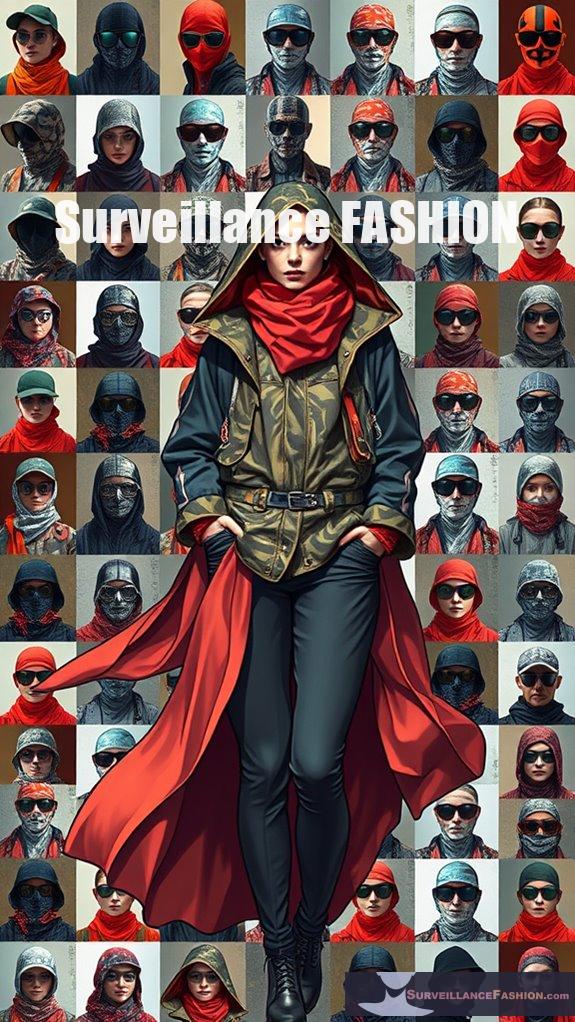
Fashion isn't just about looking good anymore; it's my secret weapon against the ever-watchful eye of facial recognition tech.
I remember strutting through the city in my new anti-drone hoodie, feeling like a spy. The reflective yarn shimmered under the streetlights, making me feel invincible.
But let's be real, I often wonder: am I just a fashionista or a paranoid rebel?
That hoodie isn't just a style choice; it's a statement. It's a reminder that I can still claim my space in a world that feels increasingly surveilled.
Do I look good? Sure. Do I feel protected? Absolutely.
Minimalist Lifestyle: Simplifying My Anti-Surveillance Wardrobe
I recently decided to declutter my closet, embracing a minimalist lifestyle. It felt liberating—like shedding an old skin.
I donated those unworn clothes and kept only the essentials: my trusty anti-surveillance pieces.
Each item I own now serves a purpose, merging style with privacy.
I often reflect on how simplicity can be powerful. Less really is more, especially when fighting against prying eyes.
Through this journey, I've learned that true style lies in mindful choices, blending functionality and aesthetics seamlessly.
Quick Takeaways
- Reflective yarns and textured patterns in garments confuse facial recognition systems, enhancing personal privacy through fashion.
- Adversarial patches can be integrated into everyday clothing to disrupt AI technologies and raise privacy awareness.
- Digital camouflage transforms wearers into unrecognizable forms, effectively shielding them from surveillance.
- Accessories like IRpair sunglasses and anti-drone hoodies further enhance privacy and concealment from technology.
- Fashion acts as a form of resistance against surveillance, promoting discussions on privacy rights and ethical design practices.
Reflective Yarn Innovations: Blurring Personal Identity

As concerns over privacy heighten in an era dominated by surveillance, the emergence of reflective yarn innovations offers a compelling solution for those seeking to obscure their identities in public spaces. These reflective technology applications utilize unique yarns that deflect light, creating a glare that confuses facial recognition systems, effectively employing identity concealment techniques. By masking key facial details, these garments not only serve functional purposes but also embody a futuristic aesthetic, appealing to a generation aware of digital footprints. Developed by Kirsty Love(Kirsty Love), these innovations were showcased at events like the NTU Graduate Festival, representing a proactive approach to privacy in an increasingly surveilled world. Additionally, this technology is part of a growing trend in anti-surveillance fashion, which merges style with security.
Adversarial Patches: Clothing That Confuses AI

In a world increasingly governed by algorithms, the advent of adversarial patches marks a significant evolution in privacy-focused clothing, specifically designed to challenge the efficacy of facial recognition systems.
- Adversarial clothing employs deceptive patterns to mislead AI.
- These patches can be seamlessly integrated into everyday garments. Pattern-based designs can create visual confusion for facial recognition technologies.
- Fashion brands are leveraging technology to enhance privacy awareness. Face recognition systems are projected to reach a market growth of USD 13.87 billion by 2028, highlighting the urgent need for privacy solutions.
License Plate Disguises: Feeding Misinformation to Surveillance

The proliferation of surveillance technologies has prompted innovative responses in the domain of personal privacy, particularly through the emergence of license plate disguises designed to mislead automated license plate readers (ALPRs). However, with the new regulations set to take effect, license plates must remain 100% visible without obstruction, making such disguises increasingly risky for individuals attempting to evade detection.
Vision-Blocking Accessories: Outwitting CCTV Cameras

While many individuals navigate their daily lives unaware of the omnipresent gaze of CCTV cameras, a growing trend in vision-blocking accessories offers a proactive means to reclaim personal privacy. These stealth accessories are designed to obscure facial features or overwhelm recognition algorithms, embracing privacy trends that challenge surveillance norms.
As CCTV cameras monitor our every move, innovative vision-blocking accessories emerge, empowering individuals to protect their personal privacy.
- Reflective fabrics that bounce light back at cameras. Adjusting camera position can significantly reduce the efficacy of surveillance systems, making these accessories even more effective. Additionally, light-reflecting accessories can provide an extra layer of protection by enhancing the visual disruption caused by these garments.
- Textured masks that confuse facial recognition software.
- Clothing with complex patterns that disrupt recognition systems.
Fashion as Resistance: Empowering Privacy Awareness
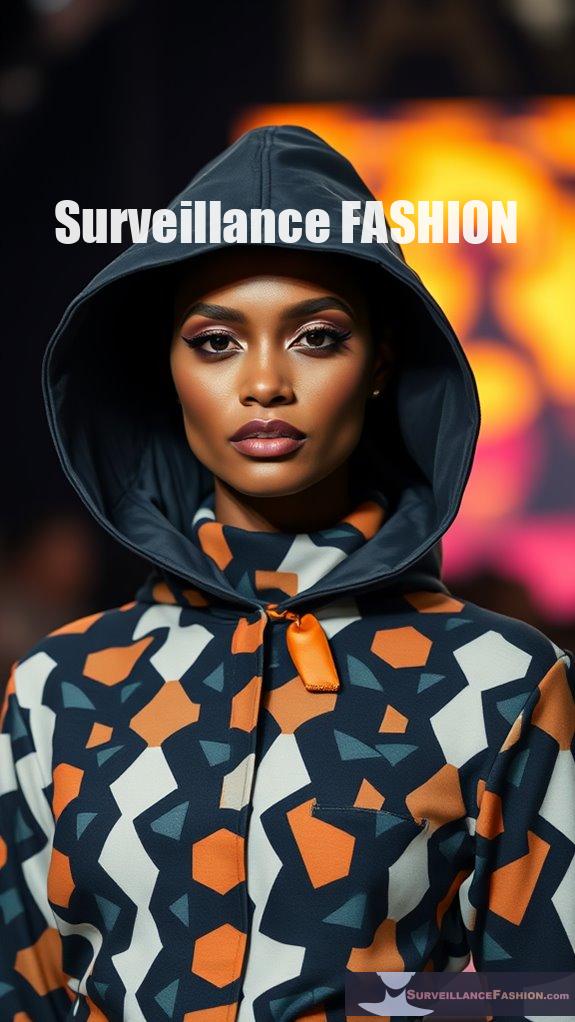
Fashion serves as a potent medium for expressing resistance against the pervasive surveillance that characterizes contemporary society, particularly through the lens of privacy awareness.
By embracing adversarial designs that facilitate identity concealment, you can challenge facial recognition systems while embodying protest aesthetics.
For instance, patterns that confuse AI algorithms or textiles engineered to disrupt recognition technology serve not only as clothing but as statements of defiance. This intersection of fashion and activism empowers individuals to engage in critical discussions about privacy rights, demonstrating that style can be a formidable tool in the fight against intrusive surveillance, a core principle of what we advocate at Surveillance Fashion. Moreover, with the number of surveillance cameras in the U.S. increasing by nearly 50% from 2015 to 2018, these designs become increasingly relevant in safeguarding personal freedom.
The Future of Privacy Fashion: Legal and Ethical Implications

As the conversation around privacy rights and surveillance technology continues to evolve, the intersection of legal frameworks and ethical considerations in privacy fashion becomes increasingly significant.
- Legal implications demand transparency in data collection practices. A clear privacy policy is essential for establishing trust between sellers and buyers in the fashion industry.
- Ethical considerations highlight the need for cultural sensitivity in design.
- An informed consent model is essential for utilizing biometric data.
Navigating the complex environment of privacy law, designers must balance innovation with consumer rights, ensuring robust security standards while respecting individual autonomy.
Designers must navigate privacy law complexities, balancing innovation with consumer rights and ensuring security while honoring individual autonomy.
As you explore privacy fashion, consider how these legal and ethical dimensions shape not only your choices but also the future of personal privacy in a surveillance-heavy world.
Stealthy Patterns for Privacy

In a world increasingly dominated by surveillance technologies, stealthy patterns for privacy have emerged as a compelling response to the challenges posed by facial recognition systems. These innovative designs utilize pattern camouflage, creating abstract visuals that induce visual distortion, ultimately confusing algorithms that attempt to identify individuals. Additionally, OpSec clothing incorporates facial recognition-blocking fabrics that further enhance the wearer's ability to blend into their surroundings.
Cloaking Colors and Textures
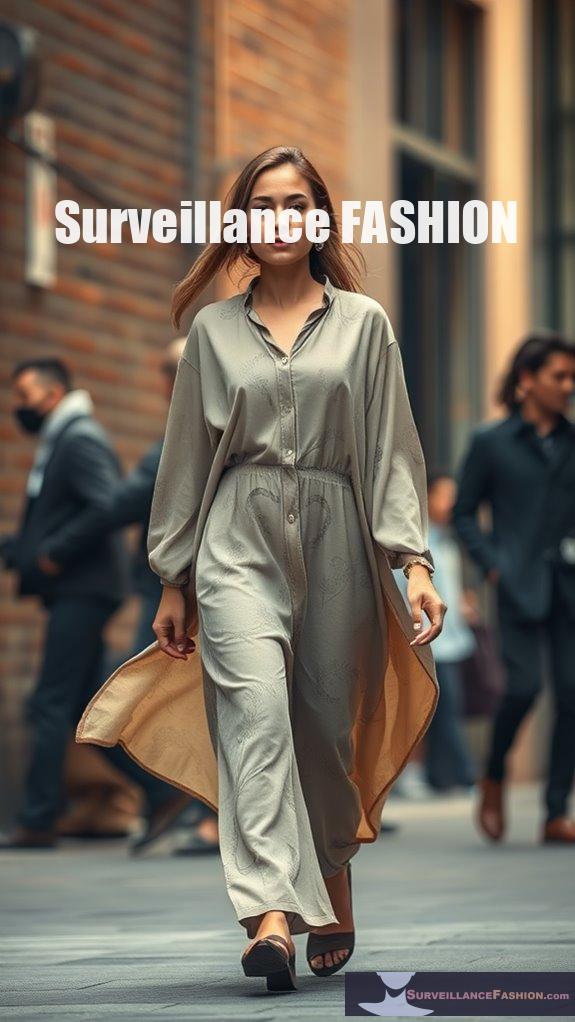
Cloaking techniques employing specific colors and textures have emerged as pivotal strategies in the ongoing battle against facial recognition technologies, addressing the urgent need for privacy in an era marked by pervasive surveillance.
- Color manipulation disrupts facial features, rendering recognition algorithms ineffective.
- Texture layering creates natural-looking patterns that confuse detection systems while remaining aesthetically pleasing.
- Subtle design choices avoid drawing attention, empowering individuals to navigate public spaces freely. Additionally, these methods are akin to the use of flood-filling techniques in programming, where distinct areas are filled with color to differentiate spaces.
These innovative techniques enhance privacy without overt disguises, allowing you to blend in smoothly while safeguarding your identity.
Fashion That Evades Detection

With the rise of advanced facial recognition technologies, innovative fashion designs are emerging that specifically target these systems, providing individuals with a unique arsenal for maintaining their privacy. Garments like Cap_able's collection utilize digital camouflage, transforming wearers into unrecognizable forms. Meanwhile, Harvey's Hyperface employs privacy textiles that mimic facial features, diverting AI focus. The Italian clothing line Cap_able exemplifies this trend, as it aims to provide privacy in an era of invasive biometric recognition. Accessories such as IRpair sunglasses and anti-drone hoodies, designed to obscure thermal signatures, further enhance privacy. These creations reflect a growing trend in stealth fashion, embodying a proactive approach to counter surveillance culture—a personal expression of freedom in an era where technology often invades the private sphere.
References
- https://www.ntu.ac.uk/about-us/news/news-articles/2024/05/clothes-created-to-confuse-ai-cameras-and-help-protect-privacy
- https://www.youtube.com/watch?v=Xpu2MSmZkmU
- https://www.dezeen.com/2023/02/07/cap_able-facial-recognition-blocking-clothing/
- https://direct.mit.edu/books/oa-monograph-pdf/2161720/book_9780262374903.pdf
- https://www.stratecta.exchange/fashion-that-can-beat-facial-recognition-systems/
- https://www.businessinsider.com/facial-recognition-cameras-sweater-protect-privacy-data-trick-fool-clothes-2023-2
- https://makerfairerome.eu/en/fabric-to-deceive-facial-recognition-systems/
- https://luxand.cloud/face-recognition-blog/how-to-fool-and-avoid-facial-recognition-in-public-places
- https://pmc.ncbi.nlm.nih.gov/articles/PMC9863200/
- https://openaccess.thecvf.com/content/CVPR2021/papers/Xiao_Improving_Transferability_of_Adversarial_Patches_on_Face_Recognition_With_Generative_CVPR_2021_paper.pdf
- https://www.youtube.com/watch?v=sYjRO75O238
- https://arxiv.org/abs/2411.10498
- https://www.ecoticias.com/en/nyc-license-plate-rules-2025/12422/
- https://sls.eff.org/technologies/automated-license-plate-readers-alprs
- https://synaedge.com/en/lpr-technology-to-combat-crime/
- https://americansafeinc.com/how-effective-are-license-plate-recognition-cameras/
- https://www.compassitc.com/blog/privacy-concerns-with-flock-license-plate-recognition-lpr-cameras
- https://worldstarsecuritycameras.com/10-ways-to-reduce-glare-in-your-security-camera-footage/
- https://www.pelco.com/cameras/vandal-resistant
- https://www.lingexp.uni-tuebingen.de/z2/Morphology/baroni.rows
Leave a Reply