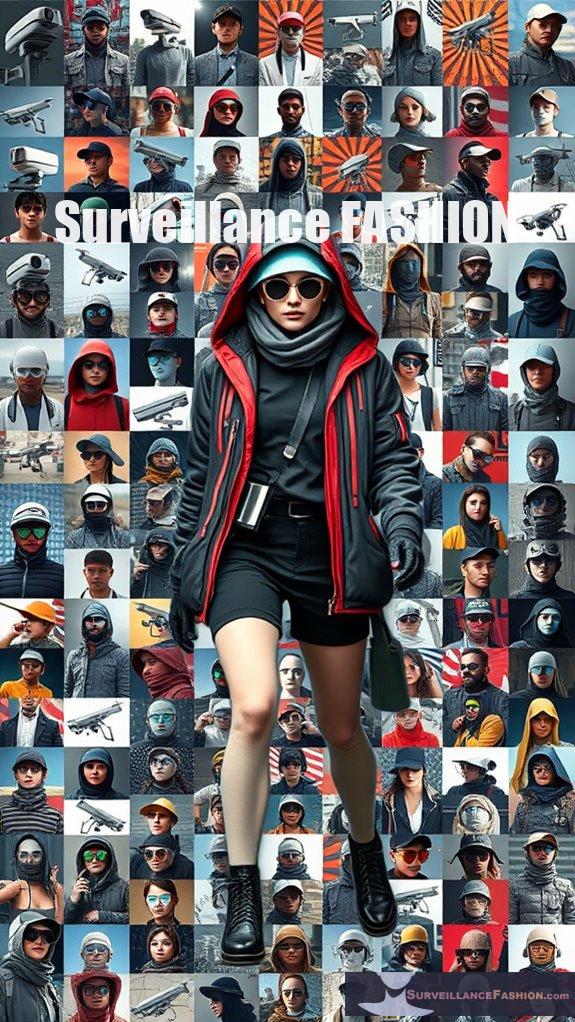
Ever tried to outsmart the digital eye with fashion?
I recently donned a CV Dazzle mask and felt like a secret agent—until my friend cracked up, calling me an "art installation gone wrong."
But let me tell you, these quirky pieces really throw AI for a loop!
Reflective surfaces and wild patterns? They're like a magician's smoke and mirrors, making facial recognition algorithms stumble.
Sure, it's a bit darkly funny, but isn't it wild how something so stylish can keep prying eyes at bay?
The fight for privacy in our surveilled world is real, and I'll take my fashion risks anytime to blend in with the shadows.
My Experience with Anti-Surveillance Fashion: A Disguise with a Twist
Last summer, I attended a music festival in a city rumored to have facial recognition tech everywhere. I decided to wear a chroMorphous jacket that changed colors based on the light. As I danced, I noticed a group of friends struggling to find me in the crowd.
I chuckled, realizing my jacket was doing its job. The thrill was palpable!
While I blended in, it got me thinking—how often do we let ourselves be seen? This experience reshaped my view on privacy and the lengths we go to guard it. It's not just about the aesthetics; it's about reclaiming our identities in a world that's always watching.
Quick Takeaways
- Privacy accessories often use complex patterns and asymmetrical designs that confuse AI algorithms, hindering accurate facial recognition.
- Reflective surfaces and light-reflecting materials distort images, making it difficult for AI systems to identify faces.
- Makeup techniques that incorporate unconventional colors further obscure facial features, challenging AI's ability to create a unique faceprint.
- Camouflage patterns adapt to environments, disrupting visual recognition systems and complicating AI detection efforts.
- Advanced technologies, such as chroMorphous fabrics, dynamically change appearance, making it hard for AI to maintain consistent recognition.
The Mechanics of Facial Recognition Technology

While you might think of facial recognition technology as a modern marvel primarily reserved for high-security environments, its underlying mechanics are both complex and fascinating, engaging a variety of algorithms and processes that work seamlessly together.
The system starts with face detection, utilizing methods like the Viola-Jones algorithm to pinpoint facial features. Additionally, advancements in infrared-reflecting materials can be used in anti-facial recognition clothing to disrupt these technologies. Following this, facial feature analysis measures key landmarks, creating a unique faceprint. Facial recognition technology is increasingly being integrated into various applications, from unlocking smartphones to enhancing airport security protocols.
However, face identification challenges, such as algorithmic vulnerability, arise due to biases inherent in these systems, affecting recognition accuracy across demographics. By understanding these intricacies, you can appreciate how technology intersects with privacy, a concern central to our mission at Surveillance Fashion.
How Face-Obscuring Accessories Disrupt AI Detection

As facial recognition technology continues to advance, the rise of face-obscuring accessories presents a unique intersection of innovation and privacy concerns. These accessories, designed to confuse AI systems, utilize mask effectiveness through complex patterns or asymmetrical designs, like CV Dazzle, to obscure facial features. For instance, masks resembling pixelated faces or those employing infrared technology disrupt identification by overloading recognition algorithms with visual noise. Additionally, makeup techniques that incorporate unconventional colors and shapes can further enhance the effectiveness of these accessories. While these design innovations provide a temporary shield against detection, they're not infallible. As we explore these advancing tools on Surveillance Fashion, it's clear that the ongoing creativity reflects a broader desire for privacy and personal expression in an increasingly surveilled world. Notably, over half of adult Americans' faces are logged in police databases, highlighting the urgency of these privacy accessories.
The Role of Reflective Surfaces in Privacy Accessories

Reflective surfaces play an important role in the design and functionality of privacy accessories, offering innovative solutions to the pervasive challenges of surveillance and visual monitoring. By utilizing reflective surface materials, privacy screen design effectively distorts or prevents vision through micro-louvre structures that manipulate light transmission. When viewed from wider angles, these surfaces enhance privacy by greatly increasing reflection, thereby limiting visibility. Additionally, the integration of these materials with advanced technologies can disrupt AI systems, particularly in facial recognition, illustrating how reflective surfaces serve as essential components in safeguarding personal privacy rights while complementing digital measures within the framework of Surveillance Fashion. This aligns with the concept of privacy safeguarding, which emphasizes the need for innovative solutions to protect individuals from unwanted surveillance. The incorporation of light-reflecting accessories provides an additional layer of defiance against prying eyes, making them a vital part of contemporary privacy strategies.
Ethical Considerations of Misinformation Devices

The ethical considerations surrounding misinformation devices have become increasingly critical, especially given the pervasive impact they've on society's perception of truth and trust.
Misinformation ethics necessitate accountability frameworks that hold creators and distributors responsible for the content they propagate. The potential for AI to perpetuate biases exacerbates this challenge, as misinformation can distort public understanding, particularly during elections or health crises. Maintaining user trust is essential in addressing these ethical dilemmas and ensuring that accurate information prevails in the digital landscape.
Promoting transparency and developing robust legal standards are essential to mitigating harm. As creators of resources like Surveillance Fashion, we recognize the importance of ethical responsibility in combating misinformation, ensuring that technology serves society positively rather than undermining trust in essential institutions.
Balancing Functionality and Privacy in AI Systems

While steering through the complex terrain of artificial intelligence, one must grapple with the dual imperatives of functionality and privacy, which often seem at odds with one another. AI's reliance on vast datasets for effectiveness raises critical data ethics concerns, particularly regarding user consent and the potential for unauthorized data collection. To strike a balance, AI systems should integrate privacy features from inception, ensuring data minimization and secure handling. Robust anonymization techniques are essential to mitigate risks associated with the collection and use of personal information.
Camouflage Patterns for Privacy Gear
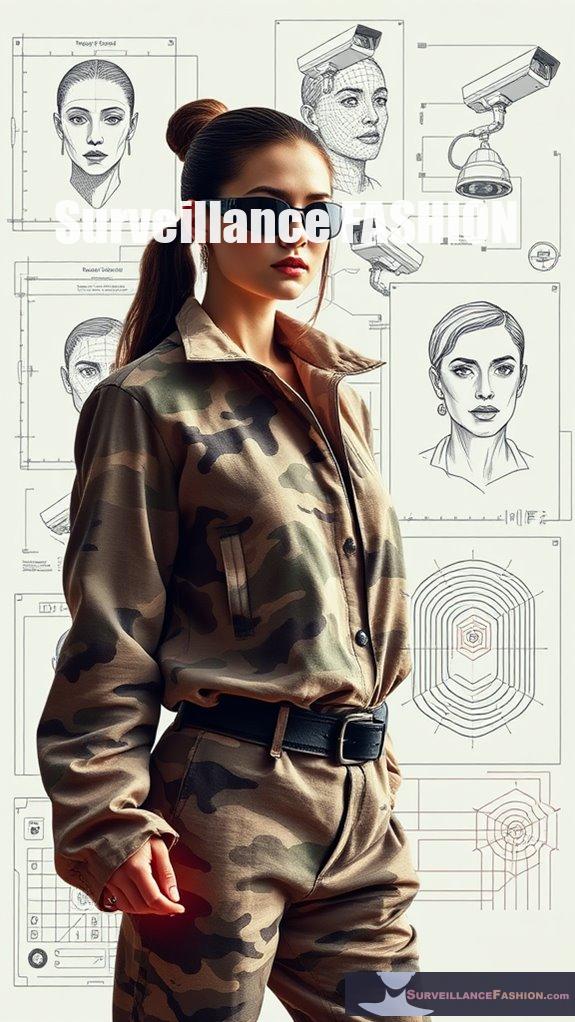
Incorporating camouflage patterns into privacy gear not only enhances concealment but also aligns with the growing demand for personal security in an increasingly surveilled world. The effectiveness of camouflage relies on the ability to adapt patterns to specific environments, whether urban, woodland, or desert. Such adaptation disrupts visual recognition, making it difficult for onlookers to focus on the wearer. For instance, digital camouflage, with its pixelated designs, offers versatility across various terrains. Additionally, various camouflage patterns are tailored for specific environments, ensuring optimal concealment based on the setting.
Adaptive Color-Changing Fabrics

Adaptive color-changing fabrics represent a remarkable advancement in textile technology, seamlessly merging functionality with aesthetic versatility.
Employing sophisticated chroMorphous technology, these fabrics utilize micro-wires and temperature-sensitive pigments to create dynamic color changes based on various stimuli, enhancing color dynamics in fashion, home decor, and automotive upholstery. The innovative color-changing fabric technology allows users to activate different color patterns, adding further personalization to their experience.
Sophisticated chroMorphous technology enables fabrics to dynamically change color, revolutionizing fashion, home decor, and automotive upholstery.
You can control these innovative textiles electronically, deciding when and how to alter their appearance, which exemplifies the intersection of creativity and practicality.
In our ongoing exploration of privacy accessories, the potential for adaptive fabrics becomes apparent, inviting collaborations that enhance user experience while addressing privacy concerns.
This reinforces our commitment to merging innovation with societal needs.
Definition of Privacy-Oriented Clothing

Privacy-oriented clothing, designed to blur the lines between personal expression and protective functionality, serves a critical role in today's increasingly surveilled society.
This unique category of clothing aims to address privacy concerns, offering practical solutions against invasive surveillance methods.
- Conceals body parts while adhering to social norms
- Utilizes innovative fabrics to evade detection
- Incorporates anti-surveillance designs like complex patterns
- Heightens societal awareness regarding privacy issues
As you explore privacy clothing, consider its profound societal impact, reflecting a growing demand for self-protection and individual expression in an age of pervasive surveillance, which inspired the creation of our website, Surveillance Fashion.
References
- https://granica.ai/blog/data-privacy-tools-grc
- https://www.mckinsey.com/de/~/media/mckinsey/industries/advanced electronics/our insights/how artificial intelligence can deliver real value to companies/mgi-artificial-intelligence-discussion-paper.pdf
- https://www.dezeen.com/2019/09/14/privacy-roundup-digital-data-technology-surveillance-ai-facial-recognition/
- https://statmodeling.stat.columbia.edu/2017/10/18/beyond-power-pose-using-replication-failures-better-understanding-data-collection-analysis-better-science/
- https://i-pro.com/products_and_solutions/en/surveillance/solutions/technologies/edge-ai-solutions/ai-privacy-guard
- https://builtin.com/articles/facial-recognition-technology-explained
- https://www.wearecapicua.com/blog/how-does-ai-affect-privacy
- https://www.kaspersky.com/resource-center/definitions/what-is-facial-recognition
- https://www.isaca.org/resources/news-and-trends/newsletters/atisaca/2022/volume-51/facial-recognition-technology-and-privacy-concerns
- https://www.aratek.co/news/how-does-facial-recognition-work
- https://www.businessinsider.com/clothes-accessories-that-outsmart-facial-recognition-tech-2019-10
- https://amsconsulting.com/articles/ai-privacy-concerns/
- https://www.liberties.eu/en/stories/anti-facial-recognition-mask/43570
- https://www.youtube.com/watch?v=js_BOiGyvj4
- https://www.theregister.com/2025/01/15/make_up_thwart_facial_recognition/
- https://peasedoors.com/products/window-privacy-and-uv-reflective-film
- https://assets.thermofisher.com/TFS-Assets/CAD/Application-Notes/AN54663-angle-dependent-reflection-analysis-evo-app-note-en.pdf
- https://rpc.cfainstitute.org/sites/default/files/-/media/documents/article/rf-brief/ai-and-big-data-in-investments.pdf
- https://www.lowes.com/pl/window-treatments/window-film-applicators/window-film/reflective/4294398490-4294776789
- https://consensus.app/questions/what-ethical-considerations-digital-manipulation-media/
Leave a Reply