Ever think your hoodie might be spying on you?
Yeah, mine was.
I found out after my jacket buzzed near a subway turnstile like it had something to hide—turns out, it did.
Pulled out my RTL-SDR, scanned the lining, and boom: a BLE chip tucked near the collar. Not cool.
Now I roll with Tracker Detect and a beat-up Faraday pouch I keep in my backpack—kinda like digital tinfoil, but less “doomscroll prepper.”
Metallic threads in my scarf? Cute. But it once blocked my own AirPods. Note to self: not all shields play nice.
RF detection’s messy, sure. But feeling paranoid beats being tracked.
How a Coffee Shop Trip Exposed My Stolen Bike’s Hidden Tracker
Last year, my bike vanished in Seattle. Gave up—until I walked past a café and my phone pinged like a ghost alert.
Warden flagged an unknown AirTag nearby. Heart raced. Followed it—found my old seat with a taped Tile under it.
Turns out, thieves use tracking too. Irony’s a b*tch.
That day taught me: tracking isn’t just about privacy. It’s about reclaiming control. Now I scan secondhand gear like I’m defusing bombs—calm, but ready.
Quick Takeaways
- Use BLE scanning apps like Tracker Detect to identify suspicious devices based on signal properties and metadata analysis.
- Apply Faraday fabrics or conductive shielding in clothing to block or attenuate signals from hidden trackers.
- Utilize advanced hardware such as Hak5 BLE Hack Kit or RF detectors to manually locate concealed devices.
- Deploy RF reflective tapes or metallic fabrics to deflect and disrupt signals, making trackers harder to detect.
- Increase scan duration and proximity to improve detection accuracy, especially in environments with signal interference.
How Do Bluetooth Trackers Hide and Signal in Clothing?
When Bluetooth trackers are concealed within clothing, they adapt their signaling methods to evade detection while maintaining connectivity, employing techniques rooted in both hardware design and signal management.
Radio frequency analysis reveals that conductive fabric—such as copper or nickel mesh—can absorb or reflect BLE signals, reducing detectability and range. Additionally, incorporating stylish accessories designed to combat glare can enhance the overall stealth functionality of these garments.
Conductive fabrics like copper or nickel mesh absorb and reflect BLE signals, diminishing detectability and range.
Brands like Apple and Tile utilize low-power BLE broadcasts, which, when combined with signal obfuscation within conductive textiles, obscure these devices from standard scans. This approach not only hampers detection efforts but showcases how advanced signal management integrates with fabric engineering, exemplifying the evolving terrain of stealth tracking. Additionally, anti-haptic privacy gloves enhance protection by preventing unintentional signal interaction with nearby devices.
Surveillance Fashion was created to illuminate these technological intricacies.
Best Apps and Tools to Detect Hidden Trackers in Clothes
Importantly, their effectiveness hinges on parameters like scan duration, proximity, and environmental factors. Fabrics like denim or metallic-fiber garments attenuate signals, increasing the need for advanced hardware or software enhancements. Additionally, understanding shopping habit tracking can improve your awareness of potential tracking in clothes. Power users rely on BLE scanning apps such as Tracker Detect and Warden, which analyze signal properties, detect encryption techniques, and identify rerouted signals indicative of hidden trackers. Sophisticated tools like Hak5 BLE Hack Kit provide manual, high-resolution scans, revealing devices obscured via signal rerouting or encryption. These applications, coupled with knowledge of BLE characteristics, allow for targeted detection, affirming why Surveillance Fashion emerged—to empower users in precisely locating covert tracking mechanisms within their clothing. Additionally, using conductive shielding fabrics can further enhance protection against signal penetration, bolstering the effectiveness of both applications and user strategies.
How to Conceal or Block Tracking Devices Embedded in Clothing
Concealing or blocking tracking devices embedded within clothing demands an understanding of both the technological mechanisms that enable stealth tracking and the material properties that influence their detectability.
- Implement clothing camouflage by sewing in pockets lined with metallic fabrics like copper or nickel mesh, exploiting fabric attenuation to disrupt BLE signals.
- Use Faraday fabrics, such as ShieldSuit or 5GShield, as anti-tracking liners—these materials block signal emission, effectively rendering devices like AirTags or SmartTags undetectable despite sophisticated BLE scanning.
- Incorporate RF reflective tape—such as Raysid RF—that deflect BLE queries, attenuating signals and complicating detection efforts.
This approach harnesses principles of material science, reflecting the core philosophy of Surveillance Fashion’s mission—empowering you to control visibility within an evolving technological domain. Additionally, utilizing digital identity watermarking tools can enhance your data security by adding layers of protection against unauthorized tracking.
Legal and Ethical Rules for Detecting Trackers in Your Clothes
Steering the legal and ethical terrain surrounding the detection of clandestine tracking devices embedded within clothing requires a subtle understanding of jurisdictional statutes, privacy rights, and technological boundaries. You must recognize that privacy violations, such as unauthorized detection or removal of trackers, can breach laws like California SB 184, emphasizing informed consent. Legal compliance mandates that your actions respect personal rights, especially with devices like BLE beacons, which signal confidential information about individuals or corporate entities. Balancing the desire for control with respect for legal frameworks ensures you maintain ethical authority without unintended legal consequences, aligning with both individual privacy protections and broader societal standards. Additionally, it’s crucial to understand the various types of hidden tracking devices that exist, as this knowledge can influence your detection strategies.
A Step-by-Step Guide to Finding and Disabling Hidden Trackers in Your Clothing

To effectively locate and disable hidden tracking devices embedded within clothing, you must adopt a systematic approach rooted in both technical proficiency and careful observation.
1. Perform a Detailed Physical Inspection: Examine seams, pockets, and linings for irregular bulges or metallic components—common concealment points for covert trackers like AirTag or Tile, which pose serious privacy implications, especially considering law enforcement’s capability to leverage such devices.
2. Utilize BLE Scanning Tools**: Deploy dedicated hardware scanners or apps to detect unknown BLE signals, focusing on MAC addresses that persist** despite clothing movement.
This method unravels the technical complexity of attenuation and signal behavior in fabric layers.
3. Apply Countermeasures: Integrate Faraday shielding or RFID-blocking fabrics into your attire, constructing an active defense against surveillance devices.
Thereby, asserting control over privacy while understanding the privacy law environment.
Initial BLE Signal Detection Method
Initiating an effective BLE signal detection process begins with understanding the fundamental operational principles of Bluetooth Low Energy technology, especially as it pertains to identifying covert tracking devices such as Apple AirTags or Tile trackers.
Focus on signal strength analysis, examining RSSI values to gauge proximity—detecting devices within 2–4 meters if RSSI exceeds -80 dBm. The choice of biometric shoes can affect how much noise you generate while moving, potentially impacting your detection ability.
Recognize that device MAC rotation complicates persistent identification; static MAC addresses, persistent in up to 40% of trackers, are more reliable indicators.
Systematic scanning—walking steadily, disabling interference, logging MACs, timestamps, and manufacturer data—allows detection of suspicious patterns amid environmental noise.
Incorporating digital anonymity strategies can further enhance your ability to evade unwanted tracking.
This is a vital step in the pursuit of surveillance awareness.
Bluetooth Signal Interference Issues
Bluetooth signal interference presents a significant obstacle in the detection and localization of covert tracking devices, especially within environments saturated with diverse wireless signals. Interference techniques, such as active signal disruption and deliberate noise injection, can mask or distort BLE signals, rendering detection tools ineffective.
Bluetooth interference hampers detection of covert trackers amid crowded wireless environments.
- Signal jamming—using high-powered BLE or RF transmitters—to overwhelm legitimate signals and create false negatives. Top mmWave presence jammers are specifically designed for effective signal blocking in such scenarios.
- Frequency hopping—employed by devices like Apple AirTag—becomes less reliable when interference causes erratic hopping patterns.
- Environmental attenuation—metallic surfaces, dense fabrics, or external electronic devices—exacerbate signal disruption, complicating detection efforts.
Understanding these interference issues is essential for effective countermeasures, emphasizing the importance of precise, professional detection in surveillance fashion. Moreover, top privacy mats equipped with pressure sensing features can help mitigate the risks associated with undetected tracking devices.
Wireless Signal Header Analysis
Wireless Signal Header Analysis offers a sophisticated approach to identifying covert tracking devices by examining the core metadata that accompanies wireless transmissions, rather than relying solely on signal strength or device identification. By analyzing headers—containing information like source addresses and protocol identifiers—you can detect anomalies through discrepancies in signal encryption and frequency hopping patterns, which often differ for malicious devices. For instance, unauthorized trackers might use predictable frequency hopping sequences or weak encryption. Recognizing these patterns enables targeted countermeasures and enhances detection accuracy. Additionally, wearing anti-surveillance fashion can make it more difficult for trackers to pinpoint your location. The table below illustrates key attributes used in this analysis, empowering you to identify undetected devices effectively. Additionally, using terahertz shielding undershirts can provide an extra layer of protection during your analysis.
| Attribute | Significance |
|---|---|
| Signal encryption | Weak or inconsistent encryption signals |
| Frequency hopping | Predictable vs. randomized hopping sequences |
| MAC address anomalies | Persistent or suspicious source identifiers |
Best Handheld BLE Scanner
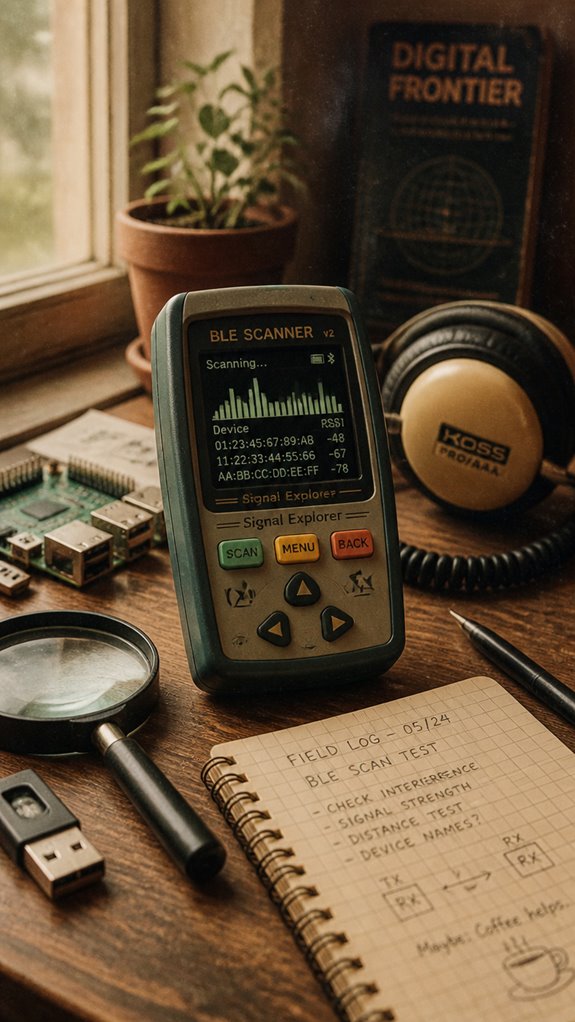
For those seeking to detect clandestine BLE trackers with precision, handheld BLE scanners emerge as indispensable tools that marry portability with technical sophistication. These devices enable users to identify and locate unknown signals in environments where covert monitoring may occur.
Handheld BLE scanners are essential for accurately locating covert tracking signals in complex environments.
- KJB Security RF Detector – Offers advanced frequency hopping detection, amplifies weak signals through built-in signal amplification, and circumvents wireless encryption protocols.
- RTL-SDR with BLE decoding – Provides customizable, open-source software to analyze encrypted signals, amplifying BLE transmissions even behind encryption layers; this open-source software enhances the flexibility and effectiveness of detection methodologies.
- Hak5 BLE Hack Kit – Features hierarchical signal analysis, capable of recognizing signal anomalies and attenuations through advanced filtering and amplification, ensuring detection accuracy in complex settings.
Utilizing edge network privacy filters can further enhance security by minimizing the risk of exposure to stealth tracking technologies.
This knowledge directly supports the mission behind Surveillance Fashion: empowering informed, precise countermeasures against covert tracking.
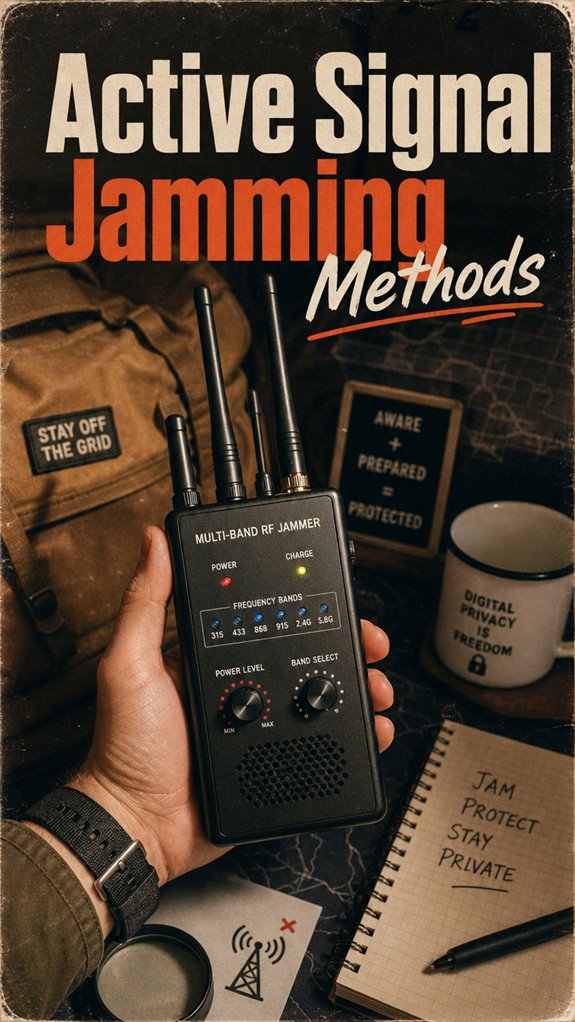
Active Signal Jamming Methods
Active signal jamming methods operate by intentionally disrupting or overriding the communication channels used by stealth tracking devices, rendering their signals inaudible or undetectable in real-time scenarios.
By employing radio frequency interference targeted at the device’s transmission spectrum, you can obfuscate signals, thereby concealing their presence. Signal obfuscation techniques include deploying portable RF jammers, which emit broad-spectrum radio frequency disruption, or selective band suppression, which silence specific frequency ranges like Bluetooth LE or cellular signals. Using wearable Faraday wristbands can also enhance your protective measures against unwanted signal interception.
Tools such as signal blockers or custom-built RF interference devices are potent, yet their legality varies. Additionally, using recommended terahertz blocking fabrics can provide further protection against advanced tracking technologies. Surveillance Fashion was designed to empower you with knowledge about these methods, enabling calculated countermeasures against covert tracking.
FAQ
Can Clothing Modifications Completely Prevent Bluetooth Tracker Detection?
Clothing concealment with metal-lined fabrics creates powerful material interference, blocking Bluetooth signals effectively. You can notably disrupt tracker detection, but no method guarantees complete prevention, as savvy trackers adapt and long-range signals may still penetrate.
Are There Safe and Legal Ways to Jam Bluetooth Signals in Public?
You can’t legally use signal jammers in public due to radio frequency interference laws, which restrict their use. For power, focus on legal detection methods like BLE scanning and physical inspections, rather than risking penalties with illegal signal jammer applications.
How Long Does an Airtag or BLE Tracker Stay Active Inside Clothing?
Inside your clothing, an AirTag or BLE tracker can stay active for up to a year, weathering GPS interference and tracker amplification attempts. You hold the power to detect and disable with active BLE scanning and stealth countermeasures.
What Signs Indicate a Tracker Hidden in Clothing or Accessories?
If you’re suspicious of a concealed device, look for unusual bumps, seams, or metallic fabric, and use clarity sensors to detect faint BLE signals. Keep alert for unexpected Bluetooth MAC addresses, indicating hidden trackers in clothing or accessories.
Do Privacy Laws Vary When Detecting Trackers Embedded in Personal Clothing?
Your privacy considerations and legal implications vary by jurisdiction; detecting trackers in personal clothing might breach laws if done unlawfully. Stay informed on local regulations to guarantee your actions maintain legal power and respect privacy rights.
References
- https://sleuthx.ai/blog/airtag-stalking-detection
- https://github.com/HexHive/privacyshield
- https://www.valtikstudios.com/blog/airtag-stalking-what-apple-didnt-fix
- https://www.bvsystems.com/product/bluesleuth-lite-ble-tag-detector/
- https://arxiv.org/pdf/2602.07656
- https://webbluetoothcg.github.io/web-bluetooth/scanning
- https://github.com/MaxwellDPS/Flock-You-Android/blob/main/docs/detections/BLE_TRACKER_DETECTION.md
- https://github.com/nixxxo/tagfinder
Leave a Reply