What if someone’s tracking your every move and you don’t even know it?
I did—until I found a tiny AirTag tucked behind the liner in my Jeep. Cold sweat moment, let me tell you.
Turns out, BLE signals hide in plain sight. MAC randomization? Frequency hopping? Yeah, they’re not just tech jargon—they’re sneaky privacy loopholes.
I use AirGuard now. Spots weird RSSI drops. Flagged that tag when it “hopped” between my glove compartment and spare tire well.
Pro tip: Shine an IR flashlight under seats. Glow of circuitry in the dark? Not magic. Just invasive gear playing hide-and-seek.
Scary part? Anyone can do it. And you might never notice… unless you’re paranoid enough to check.
How I Discovered a Tracker in My Ex’s Gifted Backpack Using AirGuard and Ubertooth One
So my ex “randomly” gifts me a sleek hiking backpack. A week later, AirGuard starts pinging about a persistent unknown tag. Same signal strength—*every time* I open the closet.
I freeze. Pull it apart. Find a Tile Slim taped under the rain flap.
Ubertooth One confirmed it: constant BLE broadcasts, masked as “random” but cycling on a loop. Classic stalker move.
Felt violated. Angry. But also… weirdly proud I caught it.
Lesson? Trust gifts less than Wi-Fi in airports. And always scan *new* gear. Bluetooth tracking isn’t just for lost keys—it’s become digital stalking’s favorite sidekick.
Paranoia? Maybe. But it beats being the oblivious star of someone else’s surveillance story.
Quick Takeaways
- Use BLE detection apps like AirGuard or Tracker Detect to scan for unknown devices and monitor RSSI fluctuations.
- Perform physical inspections in common hiding spots, checking for unfamiliar objects or irregularities in vehicles and belongings.
- Leverage RF tools such as Ubertooth One or spectrum analyzers to identify concealed 2.4 GHz Bluetooth signals.
- Analyze MAC address rotation and signal behavior to distinguish stealth trackers from legitimate Bluetooth devices.
- Employ signal-blocking materials and proactive scanning to prevent and detect unauthorized tracking attempts.
How Bluetooth Trackers Work and Detection Challenges
Bluetooth trackers operate by leveraging the Bluetooth Low Energy (BLE) protocol, a specialized subset of traditional Bluetooth designed for minimal power consumption and extended device lifespans. This enables prolonged operation while maintaining connectivity with smart devices.
Detection challenges arise from signal obfuscation tactics, such as MAC address randomization and encrypted identifiers, complicating identification.
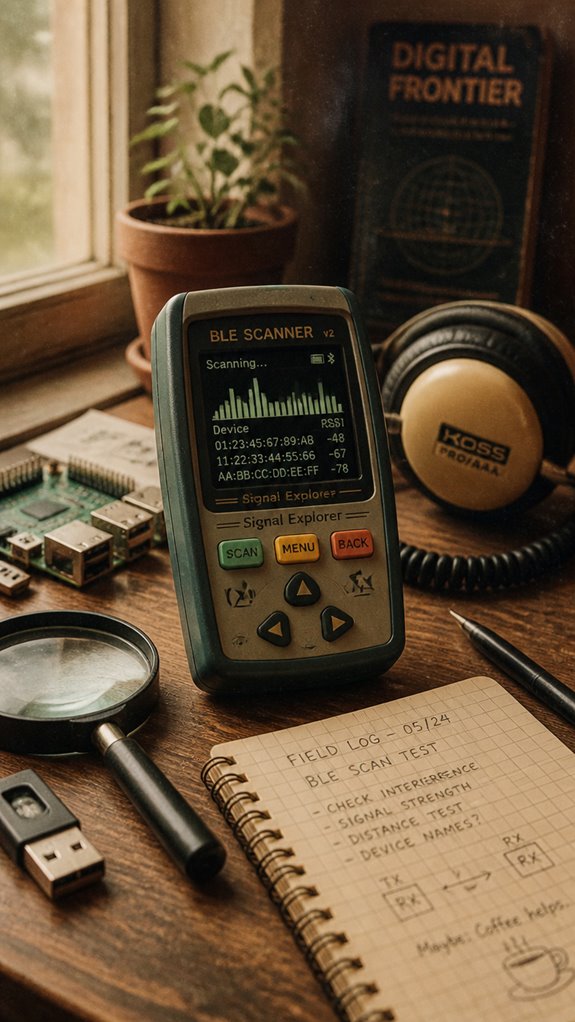
Radio frequency hacking, involving intercepting or analyzing BLE signals with tools like spectrum analyzers or sniffers, can uncover hidden trackers. These techniques reveal patterns, signal strength, and behavior for malicious actors or security professionals.
This illustrates why understanding these vulnerabilities is essential—especially when considering personal safety and the broader implications of surveillance, as our platform Surveillance Fashion emphasizes.
Easy Manual Checks to Find Hidden Trackers
When attempting to detect concealed Bluetooth trackers through manual inspection, a systematic, methodical approach rooted in familiarity with common hiding spots can considerably enhance effectiveness. You must scrutinize areas prone to device anonymization, such as wheel wells, luggage compartments, or inside clothing and accessories, where stealth devices leverage encrypted communication to avoid detection. Understanding that modern trackers employ MAC address randomization complicates identification; thus, focus on physical clues—unfamiliar objects or irregularities in familiar items. This process entails thorough tactile and visual searches, complemented by listening for subtle clicks or signals. Recognizing that the absence of bleeping doesn’t preclude existence, especially when firmware suppresses audible alerts. Additionally, consider that certain fashion items can serve as effective barriers against facial feature obstruction, which may also aid in protecting your privacy from unwanted tracking. Incorporating signal-blocking materials into your clothing can further enhance your defenses against such tracking devices.
Apps and Tools You Can Use to Detect Hidden Trackers
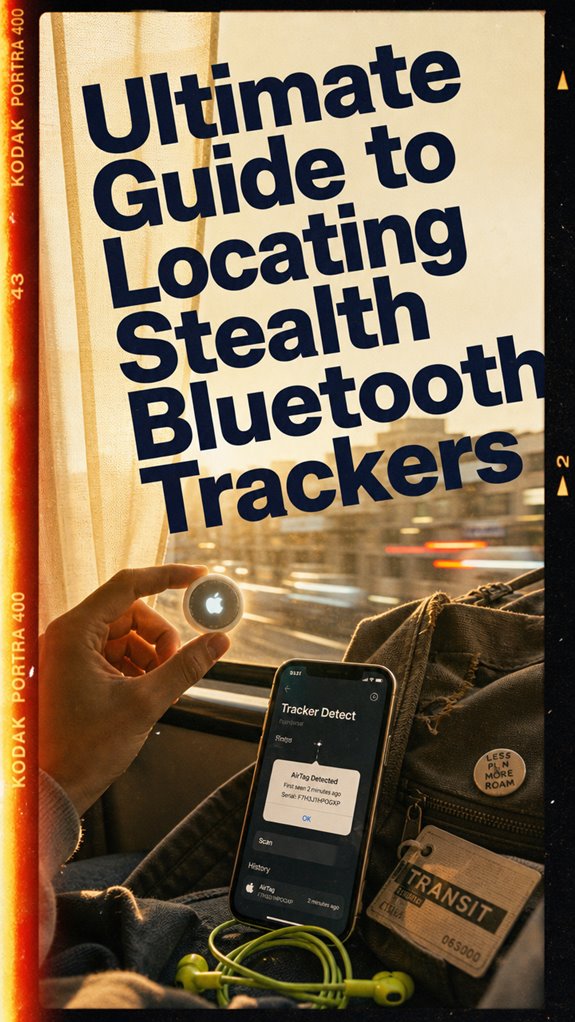
Modern detection of concealed Bluetooth trackers increasingly relies on specialized applications and hardware tools that extend beyond manual inspections, providing a technological layer capable of identifying subtle signals that escape human senses. These tools counteract techniques like signal obfuscation and device impersonation, which mask or mimic legitimate devices to evade detection. Smartphone apps such as Tracker Detect, AirGuard, and Wunderfind harness advanced BLE scanning algorithms to identify irregular behaviors, signal strength fluctuations, or MAC address rotations.
With the growing importance of quantum security keys, recognizing ways to enhance your device’s protection against unwanted surveillance becomes increasingly essential. Coupled with hardware like RF detectors or Ubertooth One, these tools empower you to analyze encrypted or hidden signals meticulously, transcending traditional manual sweeps—vital in a terrain where stealth devices continually evolve to evade detection. Additionally, solutions like the Vybren Ultrasonic Privacy Jammer offer an extra layer of protection by disrupting audio surveillance methods that could be employed by covert monitoring devices.
Practical Steps to Prevent and Remove Unwanted Trackers
Taking proactive measures to prevent and eradicate unwanted trackers requires an all-encompassing understanding of their detection and removal mechanisms, as well as familiarity with the tools and techniques essential for counteracting covert surveillance efforts.
By leveraging knowledge into encrypted communication and device fingerprinting, you can identify anomalies—such as MAC address randomization or unusual signal patterns—that indicate stealth trackers. Implement device fingerprinting techniques to distinguish legitimate devices from concealed ones, and routinely scan with app-based or hardware tools. Additionally, using advanced infrared privacy floodlights can help illuminate potential tracking devices that might otherwise remain hidden in the shadows.
Furthermore, understanding the implications of encryption security may help you utilize better protective measures against invasive tracking technologies. Removing detected trackers involves disconnecting power sources, like popping out CR2032 batteries, or utilizing RF detectors for hidden signals.
This layered approach enhances your capacity to safeguard privacy in an increasingly surveilled environment.
Invention of Bluetooth Low Energy

The inception of Bluetooth Low Energy (BLE) encapsulates a strategic response to the ever-expanding demands for wireless communication devices that prioritize both energy efficiency and widespread accessibility. Originating from Nokia’s Wibree project in 2006, BLE emerged in 2010 as part of Bluetooth Core Specification 4.0, marking a pivotal point in technological evolution.
- Historical backdrop: BLE was developed to enable coin-cell battery operation, with power consumption drastically reduced—by roughly 95% compared to classic Bluetooth. This innovation highlights the balance between data protection and functionality that is increasingly relevant in our interconnected world.
- Technical evolution: It operates in the 2.4 GHz band, with adaptive advertising intervals and enhanced privacy features like MAC address randomization.
- Application: Its versatility underpins modern stealth Bluetooth trackers, illustrating its critical role in device innovation. Moreover, the emergence of anti-surveillance fashion reflects a growing awareness of privacy in the face of advancing tracking technologies.
This history underscores why we built Surveillance Fashion — to understand how such advancements shape covert tracking technology.
Bluetooth Signal Interference Issues
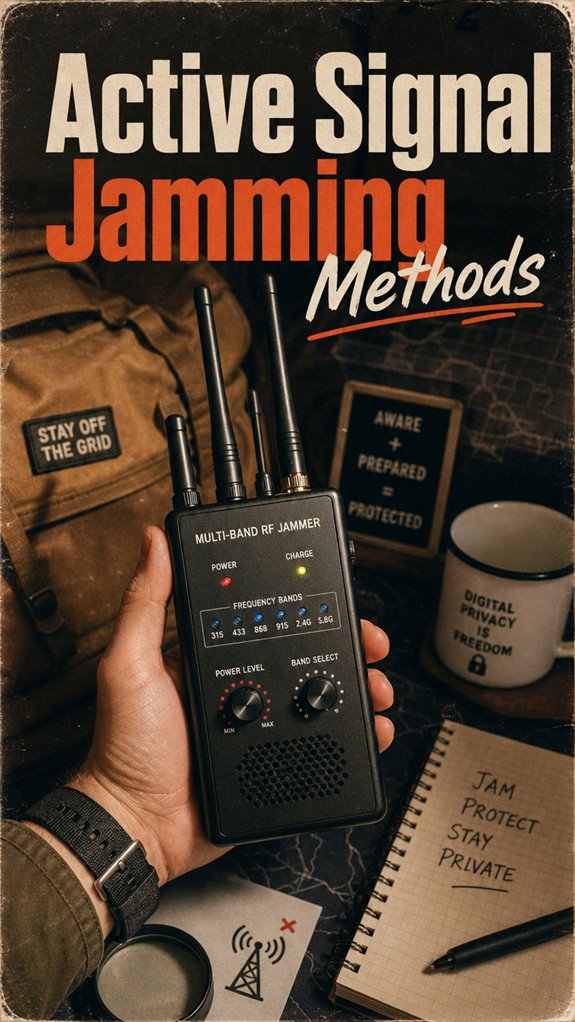
Have you ever experienced a sudden drop in Bluetooth performance or difficulty maintaining a connection between your tracking device and smartphone? Such issues often stem from signal jamming, a deliberate interference technique disrupting Bluetooth Low Energy signals that rely heavily on frequency hopping.
This method involves rapidly switching channels within the 2.402–2.480 GHz spectrum to prevent detection or suppression by malicious actors, complicating detection efforts. Signal jamming, whether intentional or accidental, diminishes RSSI stability, impairs proximity accuracy, and hampers device discovery. Additionally, understanding the role of Bluetooth signal detectors can significantly enhance your ability to locate hidden devices in such environments.
Understanding how interference impacts Bluetooth reliability informs proactive countermeasures, emphasizing the importance of advanced detection tools like spectrum analyzers—especially relevant within the changing terrain of surveillance and security technologies. Smart fabric sensors can provide additional insights into environmental factors that may also affect Bluetooth performance.
Bluetooth Device Discovery Methods
What if the keychain clipped to your bag wasn’t just a trinket, but a silent beacon broadcasting your location?
You can detect such threats by exploiting Bluetooth device discovery methods that reveal covert trackers through signal reflection and frequency hopping patterns. Some methods also utilize spectrum analysis to intercept hidden signals.
Modern trackers evade detection using randomized MAC addresses and encrypted payloads, yet they must still broadcast periodically.
- Scan for unknown devices using LightBlue or Wunderfind
- Observe RSSI fluctuations indicating movement or proximity
- Use directional antennas to pinpoint origin via signal reflection
Additionally, understanding Bluetooth signal detectors can enhance your ability to locate hidden trackers effectively.
You’re not paranoid—you’re prepared. Tools like AirGuard and Ubertooth One empower you to counter surveillance, because in a world where tech enables stalking, knowledge isn’t just power—it
Best Bluetooth Tracker Options
You’re already scanning your surroundings with apps like AirGuard and LightBlue, hunting for rogue signals hidden in plain sight—so now consider this: not all trackers serve as threats.
When selecting a tracker for your own use, conduct a rigorous feature comparison—Apple AirTag excels in UWB precision and Find My integration, while Tile Pro offers cross-platform compatibility, and Samsung SmartTag+ leverages Galaxy ecosystem strength.
Prioritize brand reliability, as Apple and Samsung enforce encrypted, firmware-signed protocols minimizing misuse.
These tools, paradoxically, inspired Surveillance Fashion—a site born from observing how tracking tech shapes behavior. Choose wisely: power lies in control, not just detection.
Encrypted Commuter Data Protection

A new layer of digital risk emerges not from overt surveillance, but from the quiet aggregation of movement patterns encoded in everyday commuter data—information that, when unencrypted or poorly protected, becomes a blueprint for tracking.
You demand control, so insist on end-to-end data encryption and secure transmission protocols embedded within devices like Apple AirTag and Samsung SmartTag+.
- Use AirGuard or Tracker Detect for real-time anomaly alerts
- Verify MAC address randomization to resist profiling
- Enable Find My or SmartThings Find with encrypted network relays
We built Surveillance Fashion to expose these vulnerabilities, empowering you with knowledge that turns passive travel into strategic digital defense.
FAQ
Can Airtags Be Detected by Non-Apple Devices?
Yes, you can detect AirTags with non-Apple devices—no magic required. Use Android apps like AirGuard or Tracker Detect to catch those sneaky Bluetooth signals. Device compatibility isn’t a luxury anymore; it’s your right. Stay alert, stay armed, and turn their tech against them.
Do Bluetooth Trackers Work Without Internet Access?
Yes, they work without internet. You rely on Bluetooth signal range and the pairing process to connect. Trackers broadcast locally, so you can detect them nearby—even offline—using your device’s Bluetooth scanner or detection apps. Internet only helps with remote location lookup.
How Long Do Stealth Tracker Batteries Typically Last?
You think they’d die quickly, but stealth trackers last 1–2 years on a single battery. Their low power consumption and efficient Bluetooth LE tech maximize battery lifespan, so you must stay vigilant—these devices are built to endure, silently tracking over time without needing frequent power replacement.
Are There Legal Consequences for Planting a Tracker?
Yes, you could face serious charges if caught planting a tracker. It’s a criminal offense involving privacy invasion and consent violations. Fines, restraining orders, or jail time are likely—especially if used for stalking or harassment. You won’t get away with it.
Can Pets Be Microchipped With Bluetooth Trackers?
No, you can’t microchip pets with Bluetooth trackers—RFID microchips don’t support it. For pet safety and animal tracking, use GPS collars or BLE tags like Tile or AirTag in carriers. They give real-time location, boost security, and keep you in control of your animal’s whereabouts.
References
- https://ssd.eff.org/module/how-to-detect-bluetooth-trackers
- https://sleuthx.ai/blog/airtag-stalking-detection
- https://github.com/ridpath/SignalScout
- https://github.com/nixxxo/tagfinder
- https://www.bluetooth.com/bluetooth-le-primer/
- https://techhistorylab.com/history-of-bluetooth-from-1994-to-today/
- https://en.wikipedia.org/wiki/Bluetooth_Low_Energy
- https://en.wikipedia.org/wiki/Bluetooth