Tag: privacy protection

  • Anonymous Relaxation With Smart Furniture Privacy Mats

    Anonymous Relaxation With Smart Furniture Privacy Mats

    I used to think my IKEA sofa was just aggressively beige. Turned out? It was also aggressively chatty.

    Smart furniture tracks pressure, movement, breathing patterns. Creepy, right? So I started layering. Elegant Comfort microfiber, Mocassi reversible mats—basically turning my living room into a cozy Faraday cage. Skid-proof backing stops the slippage. Textured layers scramble sensor signals. Surveillance Fashion taught me that comfort and paranoia aren’t mutually exclusive.

    My apartment looks curated now. Pinterest-friendly. Meanwhile? The algorithms think I’m a ghost.

    How I Hid From My Smart Mattress and Other Privacy Wins

    Last winter, my SleepNumber started texting me sleep scores. Unsolicited. At 6 AM. That betrayal led me down a rabbit hole of EMF shielding, faraday fabrics, and biohacking communities where people take their privacy almost as seriously as their magnesium intake. I discovered pressure-mapping disruption through textile layering—same principle used in anti-surveillance fashion and wearable privacy tech. The mattress never figured out I was marathon-reading true crime until 3 AM. Small victories. Smart home security, data minimization, and analog living aren’t fringe anymore. They’re survival skills.

    Quick Takeaways

    • Smart privacy mats use multilayered materials and textured protectors to disrupt pressure sensor signals, enhancing anonymous relaxation in shared spaces.
    • Modular folding privacy mats with 360-degree hinges create flexible, discreet zones, supporting privacy in public and office environments.
    • Integration with smart lighting and signal-blocking tech like RFID shielding and ultrasonic disruptors strengthens overall electronic and physical privacy.
    • Durable, stain-resistant materials combined with skid-proof backings ensure comfortable, stable, and safe furniture setups that conceal user presence.
    • Active countermeasures, including noise injection, electromagnetic interference, and adaptive algorithms, complement mats to prevent advanced sensor hacking attempts.

    Create Private Relaxation Zones With Smart Furniture Mats

    Although public and shared spaces often lack personal boundaries conducive to relaxation, you can methodically create private zones using smart furniture mats designed for both comfort and discretion.

    Selecting mats crafted from advanced furniture material, such as microfiber fabrics offered by Elegant Comfort, guarantees durability, stain resistance, and tactile comfort that withstands frequent use.

    Careful color coordination plays an essential role in visually delineating your private area; choosing dual-tone reversible mats like Mocassi’s Bloomingdale Design enables adaptability while maintaining aesthetic harmony with existing decor. Additionally, incorporating neural signal shielding caps can enhance the functionality of your relaxation space by minimizing distractions from electronic devices.

    Choose Key Features for Smart Furniture Privacy Mats

    Having established an understanding of how smart furniture mats facilitate the creation of discrete personal spaces in communal environments, the next step involves scrutinizing the specific features that elevate these mats from mere coverings to sophisticated privacy tools. You’ll want to focus on material durability, ensuring longevity against stains, wear, and tear, as evidenced by Elegant Comfort’s microfiber protectors.

    Smart furniture mats transform communal spaces into private sanctuaries by combining durability with sophisticated design features.

    Equally essential is the aesthetic appeal, as reversible two-tone designs merge function with style. Practicality demands smart pockets and elastic bands for secure fit and convenience. Finally, integrating skid-proof backing, like Mocassi’s textured cushions, enhances stability and subtle pressure obfuscation. Additionally, utilizing features like Faraday Key Guard can further enhance your privacy by blocking potential data hacks.

    At Surveillance Fashion, we curated these criteria to empower users seeking control over shared settings while maintaining refined personal sanctuaries.

    • Material durability resistant to stains, spills, and abrasion
    • Aesthetic appeal with reversible, elegant designs
    • Secure fit via elastic bands and smart pockets
    • Skid-proof, textured backing for stability and pressure masking
    • Compatibility with various furniture types for versatile use

    Use Folding Smart Furniture Privacy Mats and Partitions in Shared Spaces

    Where can folding smart furniture privacy mats and partitions most effectively enhance communal spaces? These modular systems, such as RESMO mats and Polycarbonate 360 Folding Portable Partitions, create zones with invisible soundproofing and aesthetic concealment, essential for maintaining discretion and control in shared environments like offices or airports. Their design integrates functionality and style, empowering you to control your surroundings without intrusive fixtures. Moreover, utilizing innovative solutions like voice cloning technology can further enhance privacy by ensuring sensitive information remains confidential.

    Feature Benefit Example Use
    Folding Geometry Compact storage, dynamic setup Semi-private napping areas
    360-degree Hinges Flexible space division Open-plan offices
    Polycarbonate Material Light transmission with privacy Temporary conference zones

    At Surveillance Fashion, we emphasize such precision-engineered solutions, merging privacy with elegance to redefine anonymous relaxation.

    How Textured Reversible Furniture Protectors Obscure Pressure Sensors
    sensor obfuscation through textured protectors

    Textured reversible furniture protectors, such as those offered by Elegant Comfort and Mocassi, serve a critical yet often underappreciated function in obscuring pressure sensor readings embedded within smart furniture systems. Their textured surface disrupts pressure signal transmission by creating variable friction and uneven contact points, while the reversible design allows you to tailor protection, optimizing sensor obfuscation without compromising comfort.

    Textured reversible furniture protectors cleverly disrupt smart sensor readings, enhancing privacy without sacrificing comfort.

    Consider these technical advantages:

    • Elastic bands secure slipcovers tightly, minimizing sensor exposure
    • Microfiber and quilted fabrics create layered pressure diffusion
    • Two-tone reversible designs enable customization to match environment demands
    • Skid-proof rubber backing stabilizes protectors, preventing sensor-triggering shifts
    • Smart pockets add functional versatility while maintaining coverage

    Such innovations reflect why Surveillance Fashion emphasizes these protectors, empowering you to reclaim privacy in increasingly monitored spaces. Additionally, using anti-facial recognition techniques can further enhance your personal security in environments equipped with advanced monitoring systems.

    Combine Privacy Mats With Smart Lighting and Furniture Setup

    Although privacy mats serve as foundational barriers that obscure unwanted surveillance and sensor detection, integrating them with strategically arranged smart lighting and thoughtfully positioned furniture exponentially enhances spatial control over privacy and comfort.

    By aligning Bluetooth interference-emitting devices near Elegant Comfort reversible smart furniture protectors, you can disrupt unauthorized signal tracking while complementing ultrasonic disruption technologies embedded within select smart lighting systems to mask ambient audio capture.

    Position couches back-to-back or use folding partitions like Polycarbonate 360 to create effective physical and sensor-obfuscating barriers.

    Smart lighting adjusts intensity or shifts wavelengths, reinforcing privacy zones signaled through visual cues, reducing inadvertent data leaks. Additionally, incorporating RFID shielding bandages can further protect against unauthorized scanning and tracking.

    Surveillance Fashion advocates these layered defenses, empowering your environment strategically, mitigating smart sensor vulnerabilities, and cultivating a commanding, serene space that benefits your autonomy and sensory discretion.

    Choose Fire-Resistant Smart Furniture Mats for Safe Relaxation

    Choosing fire-resistant smart furniture mats becomes vital when balancing the dual priorities of privacy protection and safety, particularly in environments where prolonged relaxation or work occurs.

    These mats must possess exceptional material durability, guaranteeing resistance against wear, tear, and potential ignition sources. Furthermore, they should maintain minimal wireless interference to preserve seamless connectivity between devices, a pivotal feature for smart furniture applications.

    Consider these factors when selecting your mat:

    • Opt for heavy rubber-based materials to enhance fire resistance and suppress ignition.
    • Verify compatibility with smart furniture to prevent wireless interference that could disrupt privacy functions.
    • Prioritize mats with integrated smart pockets, like Elegant Comfort’s microfiber protector, for added utility.
    • Guarantee shrink and fade resistance to uphold long-term material durability.
    • Choose reversible designs for versatility without compromising safety.

    At Surveillance Fashion, we emphasize such rigorous selections to empower your relaxation with uncompromised security. Additionally, top Faraday phone pouches can provide enhanced protection against unwanted electronic surveillance during your downtime.

    Limitations of Obfuscation Methods
    obfuscation has limitations

    Balancing fire resistance with effective privacy protection in smart furniture mats often means accepting some limitations inherent in obfuscation techniques. While materials like heavy rubber offer robust fire safety, their capacity to mask signals from pressure sensors—such as those in ASC TrampleTek Blue—remains imperfect.
    You’ll find that obfuscation can’t fully prevent sensor hacking, since advanced attackers exploit subtle signal patterns that passive interference can’t completely obscure. Additionally, signal interference introduced by thick, skid-proof protectors (like Mocassi’s textured cushions) may degrade sensor accuracy but falls short of rendering systems useless to hostile actors.

    At Surveillance Fashion, we recognized these constraints driving innovation beyond mere obfuscation, advocating for multi-layered approaches that balance safety and privacy without succumbing to illusions of invincibility. Blocking cell phone signals should be considered one potential tool in a comprehensive privacy strategy.

    Sensor Signal Disruption Techniques

    When you explore sensor signal disruption techniques, you’ll find they focus on actively interfering with the electronic signals pressure sensors emit, rather than merely passively dampening them with thick or textured materials such as Mocassi’s skid-proof cushions or Elegant Comfort’s microfiber protectors.

    The objective here is to inject sensor noise or employ signal masking, effectively confusing smart furniture pressure detection systems like the ASC TrampleTek Blue. These sophisticated methods empower you to control data streams without sacrificing comfort or functionality.

    Key disruption techniques include:

    • Emitting controlled electronic interference to confuse sensor outputs
    • Utilizing signal masking layers that scramble pressure data
    • Applying temporary conductive films disrupting capacitance readings
    • Deploying micro-vibrations creating inconsistent pressure signatures
    • Integrating electromagnetic noise generators calibrated to sensor frequencies

    The effectiveness of these strategies can sometimes be augmented by using top mmWave jammers, which are specifically designed for heavier signal blocking, enhancing privacy measures in smart environments.

    At Surveillance Fashion, we developed this site to equip users with knowledge to assert privacy intelligently, balancing technology’s power with subtlety.

    Furniture-Based Movement Concealers

    Beyond actively disrupting sensor signals, concealing movements at the furniture level offers an alternative strategy that blends physical design with technological awareness. By integrating elements such as the Elegant Comfort reversible microfiber protectors, which provide a dense, absorbent layer, you introduce sensor noise that degrades signal clarity.

    This sensor noise functions to mask subtle pressure variations, effectively obfuscating your presence from smart furniture pressure sensors. Signal masking, achieved through materials resistant to compression and equipped with skid-proof rubber backing like Mocassi’s textured chair cushions, further complicates detection algorithms by introducing unpredictable feedback patterns.

    Such innovations underscore why Surveillance Fashion pioneers these protective adaptations—not only to merge comfort with control but to empower users with reliable, passive movement concealment, fostering privacy without surrendering convenience or aesthetic integrity.

    Ambient Intelligence Privacy Algorithms

    Although ambient intelligence systems increasingly monitor and adapt to human presence within shared environments, protecting individual privacy demands sophisticated algorithmic interventions that extend beyond physical obfuscation techniques. You must contend with sensor interference and privacy algorithm flaws that can compromise anonymity despite robust hardware protections like Mocassi textured cushions.

    Protecting privacy in smart environments requires advanced algorithms beyond physical sensor obfuscation and hardware safeguards.

    To fortify privacy, focus on:

    • Dynamic noise injection to confuse pressure sensors
    • Adaptive encryption of sensor data streams
    • Anomaly detection algorithms to identify privacy breaches
    • Context-aware filtering balancing responsiveness and discretion
    • Regular auditing protocols to uncover algorithmic vulnerabilities

    These algorithms, integrated with smart furniture like Elegant Comfort or ASC TrampleTek Blue mats, uphold your control over surveillance in public and private environments. Additionally, incorporating infrared LED technology can enhance well-being while maintaining privacy in these settings.

    This layered defense exemplifies why we created Surveillance Fashion: to empower you with technology that respects and reinforces your privacy in an increasingly monitored world.

    FAQ

    How Do Washable Smart Furniture Protectors Hold up After Repeated Cleaning?

    You’ll find washable smart furniture protectors maintain strong durability after repeated cleaning, thanks to rigorous durability testing. Their cleaning effectiveness stays consistent, resisting shrinkage and fading, so you confidently keep your furniture pristine and powerful-looking.

    Can Smart Furniture Mats Be Used Outdoors or in Extreme Weather?

    You might think smart furniture mats excel outdoors, but their outdoor durability and weather resistance vary. Most aren’t designed for extreme weather; you’ll need heavy-duty, weatherproof options to guarantee lasting protection and maintain their smart features reliably.

    Are There Eco-Friendly Materials Used in Smart Furniture Privacy Mats?

    You can find smart furniture privacy mats crafted from sustainable materials, blending durability with eco conscious manufacturing. Choosing these empowers your lifestyle while protecting the planet, letting you relax confidently without compromising environmental responsibility or performance.

    Do Smart Privacy Mats Work With All Types of Pressure Sensor Brands?

    Pressure sensor compatibility varies vastly, so you can’t count on seamless brand integration. You’ll need to calibrate carefully and choose mats designed to dampen signals effectively, ensuring your setup empowers precise control without unpredictable interference.

    Can These Privacy Solutions Be Customized for Specific Furniture Sizes?

    You can customize these privacy solutions to fit your exact furniture size. Many options offer versatile designs and adjustable features, empowering you with control and protection tailored precisely to your space and personal style.

    Summary

    You might think smart furniture privacy mats are just padded décor; instead, they’re sophisticated tools weaving signal obfuscation, textured reversible surfaces, and ambient intelligence algorithms to carve out private zones within public chaos. As you integrate these mats with folding partitions and smart lighting, you subtly disrupt sensor arrays, a feat Surveillance Fashion champions for modern autonomy. Though limitations persist, leveraging furniture-based movement concealment exemplifies subtle engineering, balancing invisibility and comfort in an increasingly surveilled environment.

    References

  • Futuristic Identity Defense With Wearable Light Projections

    Futuristic Identity Defense With Wearable Light Projections

    I caught my neighbor’s Ring camera doing double-takes at me last Tuesday. That’s when I knew.

    Time to get weird with light.

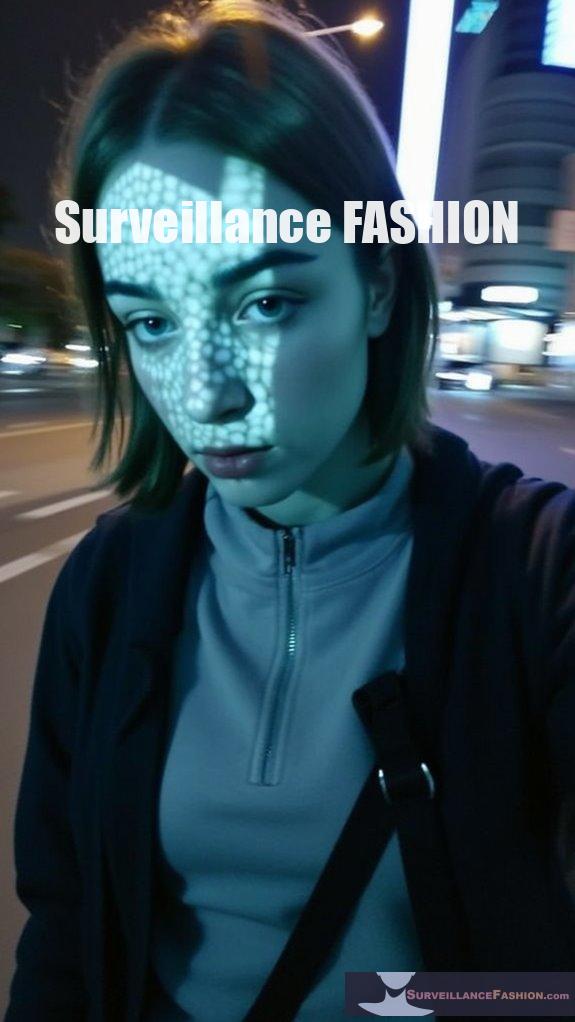
    HKU’s got these headband-mounted projectors now—slap one on, suddenly your face becomes a glitch art masterpiece. Facial recognition? Baffled. Humans? Still see *you*, mostly. I pair mine with thermal-masking makeup because paranoia loves company.

    Surveillance Fashion catalogues the gear. It’s not pretty. It’s not *supposed* to be.

    But here’s the thing: does activist chic actually outsmart billion-dollar systems? Or are we just cosplaying freedom while the data harvest continues?

    Maybe both. Probably both.

    Anti-Surveillance Wearables: My First Glitch Walk

    Last month I tested my LED mask at a protest downtown. Heart hammering. Felt ridiculous. Felt *alive*.

    Then a drone hovered overhead. I froze. The mask flickered—adaptive algorithms doing their dance. Hard to say if it worked. The uncertainty gnaws at me still.

    Biometric blocking, adversarial fashion, privacy tech, digital camouflage—this vocabulary becomes muscle memory when you’re hunted by convenience culture. My mask cost three hundred dollars. My peace of mind? Unpriced. Unfinished.

    Quick Takeaways

    • Wearable light projections dynamically alter facial features to confuse biometric recognition while preserving human visual identity.
    • These projections use adaptive light modulation to counter evolving facial recognition algorithms effectively.
    • Integration with makeup or thermal masking garments enhances layered, non-permanent identity obfuscation techniques.
    • Future designs emphasize energy efficiency, lightweight power solutions, and user comfort for prolonged wearable use.
    • Such technology balances personal privacy rights with societal security through ethical, transparent deployment frameworks.

    How Wearable Face Projection Disrupts Facial Recognition

    Although it might seem counterintuitive, wearable face projection technology actively disrupts facial recognition systems by overlaying a dynamically altered image onto the user’s actual face, thereby confusing biometric algorithms without substantially hindering human visual recognition.

    Wearable face projection disrupts facial recognition by overlaying dynamic images, confusing algorithms while preserving human recognition.

    You gain control by projecting continuously shifting facial features, undermining algorithmic accuracy while maintaining your visible identity to others—a critical distinction for preserving social interaction. This approach carries profound privacy implications, offering a tactical defense against intrusive digital retailers and governing bodies seeking biometric data.

    Yet, ethical considerations emerge, demanding scrutiny over misuse potential and consent boundaries. Anti-facial recognition techniques, such as makeup applications, can also complement wearable technology, further enhancing protective measures.

    At Surveillance Fashion, we designed this platform to illuminate such trade-offs, underscoring how technological innovation both empowers and challenges prevailing recognition frameworks, tying together advanced optical engineering with nuanced societal impact.

    Comparing Wearable Face Projection With Other Facial Recognition Defenses

    When evaluating wearable face projection alongside other facial recognition defenses, you’ll find distinct operational principles and technological emphases that shape their effectiveness and applicability.

    Historically, methods such as infrared light projection, camouflage makeup, and artistic protest designs have offered varying degrees of disruption to biometric surveillance, addressing different threat vectors with unique technical approaches. The wearable face projector distinguishes itself by projecting altered appearances dynamically, maintaining human recognition while confounding algorithms. This a technological nuance not shared by static or assaultive light-based systems like Lightguard.

    Ethical considerations arise across these technologies, balancing privacy rights with societal safety. A tension Surveillance Fashion seeks to illuminate by situational these defenses within broader cultural frameworks. Moreover, the integration of thermal signature-masking garments showcases potential advancements in personal privacy, highlighting the innovative intersection of fashion and technology.

    Real-World Applications of Face Projection Technology for Privacy

    In an era marked by escalating surveillance and data extraction, wearable face projection technology emerges as a sophisticated, if still experimental, tool for individuals aiming to safeguard their biometric privacy in public spaces. You can leverage this innovation to navigate environments where privacy legislation lags behind technological advances, thereby asserting control over your identity data, while ethically balancing transparency and concealment.

    Real-world applications include:

    • Disrupting unauthorized facial recognition in retail environments
    • Shielding personal data from government surveillance under weak privacy legislation
    • Enabling anonymity in protests without violating ethical considerations
    • Integrating with fashion accessories for discreet, daily use
    • Providing a technical basis for policy advocacy informed by practical deployment

    Moreover, this technology can specifically assist in blocking facial recognition cameras that exploit weak regulatory frameworks.

    At Surveillance Fashion, we advocate for such tools, fostering informed empowerment amid expanding surveillance infrastructures.

    Future Advances in Face Projection Technology

    facial projection privacy advancements

    Building on the practical experiments and artistic explorations of face projection technology, future advancements are poised to considerably enhance both the sophistication and accessibility of these devices.

    As you seek authoritative control over your biometric privacy, developing systems will integrate more adaptive light modulation, allowing dynamic alteration of facial features to counter increasingly complex facial recognition algorithms.

    Such progress will incontrovertibly demand rigorous reflection on facial recognition ethics, balancing individual autonomy against societal security imperatives.

    Innovations inspired by projects like HKU’s wearable face projector underscore this trajectory, demonstrating how subtle yet effective identity obfuscation can become mainstream.

    At Surveillance Fashion, our commitment to elucidating these developments reflects a broader mission to empower users like you—those intent on wielding technological edge responsibly amid pervasive surveillance frameworks, thus redefining privacy defense within contemporary smart apparel domains.

    Furthermore, these emerging technologies promise to offer new makeup techniques that could complement facial projection in enhancing personal privacy.

    Battery Life Challenges

    Although advances in wearable face projection technologies like the HKU Design’s headband-mounted projector have brought innovative solutions to biometric privacy, they simultaneously expose critical challenges related to battery life management. You must recognize that ensuring prolonged operational capacity without compromising the device’s compactness or user comfort remains paramount.

    To maintain power efficiency within the constraints of current battery technologies, consider:

    • Optimizing projection intensity versus power consumption balance
    • Incorporating energy-dense, lightweight battery cells
    • Enhancing power management algorithms for adaptive usage
    • Addressing overheating risks affecting battery longevity
    • Complying with evolving privacy legislation and ethical implications around device transparency

    Furthermore, to minimize privacy risks while using these devices, including Faraday phone pouches may provide additional protection against unauthorized data access. Given our mission at Surveillance Fashion to empower autonomy over biometric surveillance, steering these challenges will define the viability of futuristic identity defense. Battery life intricacies thus dictate not just usability but also ethical deployment in real-world contexts that demand uninterrupted identity protection.

    Augmented Reality Face Filters

    When you engage with augmented reality (AR) face filters, you tap into a sophisticated interplay of computer vision algorithms, real-time facial mapping, and dynamic graphical overlays that collectively transform your visual identity within digital environments.

    These technologies, by modifying your appearance fluidly, offer a powerful means to assert control over personal privacy, enabling selective disclosure in an increasingly surveilled world. However, ethical considerations arise, particularly regarding data security, consent, and the potential for misuse in identity manipulation.

    At Surveillance Fashion, we developed this platform to explore such innovations responsibly, emphasizing transparent practices. As AR filters evolve, their ability to disrupt facial recognition systems without permanent alterations highlights a pivotal frontier in privacy defense—marrying aesthetic fluidity with technical resilience—to empower you in steering the complexities of digital identity under omnipresent monitoring. Additionally, advancements in lidar-deflecting coats have emerged as complementary tools in enhancing personal security against surveillance technologies.

    Top Digital Mask Innovations

    innovative privacy disrupting digital masks

    Augmented reality face filters have redefined how you manipulate your digital visage, yet they remain part of a broader spectrum of strategies aimed at preserving privacy through visually disruptive means. To truly command your augmented perception and artistic expression, you leverage advanced digital mask innovations that confound facial recognition while maintaining human legibility.

    These innovations include:

    • Wearable face projectors, like the HKU design, altering appearances via headband-mounted beamers.
    • Infrared light projection, disrupting biometric systems with invisible infrared emissions.
    • Camouflage-inspired makeup, breaking facial symmetry to mislead algorithms.
    • Artistic protest masks, such as Zach Blas’s Facial Weaponization Suite which use radical forms of identity erasure.
    • LED-based devices like Lightguard, disorienting intrusive surveillance through intense light emissions.
    • Additionally, the adoption of mmWave presence jammers can enhance privacy measures by blocking advanced surveillance technologies.

    At Surveillance Fashion, we facilitate your mastery of this subtle interplay between privacy and power, making futuristic identity defense tangible.

    Sole-Based Signal Jamming

    Sole-based signal jamming represents a novel frontier in personal privacy technology, deploying targeted electromagnetic interference embedded within wearable footwear to disrupt the transmission and reception of signals associated with location tracking devices, such as GPS and Bluetooth beacons.

    By integrating sophisticated circuitry into shoe soles, this sole-based jamming system generates controlled signal interference, effectively creating a localized shielding zone that confounds external tracking attempts without compromising other wireless communications.

    Advanced circuitry in shoe soles produces precise interference, shielding users from tracking while preserving other wireless signals.

    For those seeking dominion over their digital footprint, sole-based jamming offers a discreet yet powerful tool, elevating personal security beyond conventional methods.

    At Surveillance Fashion, we recognize how this innovation underscores the transforming terrain of wearable defenses, transforming everyday objects into active privacy enforcers.

    As signal interference tech advances, mastering sole-based jamming will be indispensable for maintaining anonymity amid pervasive surveillance infrastructures. Furthermore, anti-haptic privacy gloves complement this technology by providing an additional layer of protection against unauthorized interaction with digital devices.

    FAQ

    How Does the Wearable Face Projector Affect Human Social Interactions?

    You’ll disrupt social perception and complicate interpersonal communication as others won’t recognize your true face. This grants you control, letting you manipulate interactions and maintain privacy, giving you power over how others perceive and engage with you.

    What Materials Are Used to Create the Face Projection Headband?

    You’ll find materials innovation at the core, combining lightweight, flexible polymers with cutting-edge projection technology components. This fusion lets you wield powerful facial disguise capabilities while maintaining comfort and durability in the headband’s design.

    You might be surprised, but legal restrictions on wearable face projection devices vary widely—mostly due to privacy concerns. To claim control and power, you’ll need to navigate local laws carefully, ensuring your defense doesn’t cross surveillance boundaries.

    How Durable Is the Wearable Face Projector Under Various Weather Conditions?

    The wearable face projector’s material durability isn’t fully tested for weather resistance yet, so you can’t rely on it in rain or extreme conditions. Expect sensitivity—protect it carefully to maintain peak performance and avoid damage.

    Can the Face Projector Be Customized for Individual Facial Features?

    You can customize the face projector’s design to match your unique facial features, giving you powerful control against facial recognition systems. This custom design guarantees maximum deception while keeping your true identity securely hidden from surveillance.

    Summary

    You’ve witnessed how wearable light projections, exemplified by innovations from brands like Lightform and PrivacyVisor, fundamentally disrupt traditional facial recognition through dynamic, real-time image manipulation. While challenges like battery longevity persist, these devices offer unparalleled defense compared to static masks or signal jammers. At Surveillance Fashion, we designed this platform to elucidate such cutting-edge intersections of privacy and technology, empowering you with thorough understanding into the shifting frontier of identity protection via augmented reality and photonic innovation.

    References

  • Hardware Encryption for Modern Privacy Enthusiasts

    Hardware Encryption for Modern Privacy Enthusiasts

    I stopped trusting my CPU the day my ex’s “tech-savvy” cousin casually mentioned he could “probably recover anything” from my old laptop. Nightmare fuel, honestly.

    Now? I’m Team Silicon all the way.

    TPM 2.0 modules and secure enclaves aren’t just buzzwords—they’re my digital panic rooms. Keys live in hardware, not memory. Quantum-resistant? Already nesting there. My data’s guarded against electromagnetic snooping and extraction attempts. The performance boost? Gravy.

    How Hardware Encryption Saved My Journalism Career

    Three years ago, I was investigating a data broker in Estonia. Customs in Frankfurt “randomly” selected me for secondary screening. They plugged something into my bag. My Framework Laptop with its discrete TPM? Locked down tight. Dead silent. They got nothing.

    That paranoia I’d cultivated—Full Disk Encryption with hardware-backed BitLocker, disabled USB boot, measured boot chains—paid dividends. Hardware security modules, secure boot attestation, physical tamper evidence: these aren’t theoretical comforts when someone’s reading your screen over your shoulder in a holding room.

    Worth the $400 upgrade? My sources still talk to me. You do the math.

    Quick Takeaways

    • Hardware encryption offloads cryptographic tasks to dedicated chips, enhancing device performance and reducing vulnerability to software attacks.
    • Trusted Platform Modules (TPMs) and secure SoCs provide tamper-resistant key storage and protection against physical intrusion attempts.
    • Quantum-resistant encryption algorithms embedded in hardware future-proof data security against emerging computational threats.
    • Metadata removal and GPS data scrubbing tools integrated with hardware encryption help protect personal location privacy.
    • Combining hardware shielding, secure encryption devices, and privacy tools like infrared floodlights strengthens overall user data confidentiality.

    What Is Hardware Encryption and Why It Matters?

    Although software encryption has long been the standard for protecting digital information, hardware encryption offers a fundamentally more robust alternative by embedding cryptographic processes directly into dedicated silicon components, such as Trusted Platform Modules (TPMs) and specialized SoCs.

    You benefit from tighter security because hardware integration isolates cryptography algorithms at the silicon level, preventing software-layer exploits and malware intrusion. This segregation guarantees that encryption keys remain inaccessible in volatile memory, heightening protection against hacking attempts. Additionally, adopting urban camouflage strategies in fashion can reflect a broader societal trend toward blending security and privacy into daily life.

    How Hardware Encryption Keeps You Safer Than Software Alone?

    When you rely solely on software encryption, the protection of your sensitive data fundamentally depends on the integrity and security of the operating system and its available memory resources.

    Moreover, hardware encryption transcends these limitations by embedding cryptographic functions within dedicated chips, such as Trusted Platform Modules (TPMs) or specialized System-on-Chips (SoCs), which operate independently and securely from the host system.

    This isolation not only shields encryption keys from software exploits but also facilitates biometric integration, allowing secure, hardware-anchored authentication that software alone can’t guarantee.

    Additionally, hardware encryption increasingly incorporates quantum resistance algorithms, future-proofing your defenses against emerging computational threats. Recent developments in mmWave presence jammers further enhance security by blocking unauthorized signals that could compromise data integrity.

    Why Hardware Encryption’s Tamper Resistance Protects Your Data?

    Building on the isolation of cryptographic functions from vulnerable software layers, tamper resistance in hardware encryption embodies a physical and logical bulwark designed to detect, resist, and respond to unauthorized intrusion attempts. This robust defense is vital because hardware tampering attempts seek to bypass traditional encryption barriers by physically interacting with the device’s core components.

    You benefit from these layered protections by:

    1. Detecting physical breaches through sensors that trigger immediate data lockdown or erasure.
    2. Employing encryption barriers coded into silicon, making direct key extraction practically impossible.
    3. Integrating self-destructive mechanisms that render hardware unusable upon tampering detection, securing data integrity.

    These feats of engineering, central to platforms like TPM-enabled devices and eFuse-equipped ESP32 chips, exemplify why Surveillance Fashion champions hardware tampering defenses over software-dependent solutions. In parallel, anti-facial recognition makeup techniques can effectively obscure biometric identifiers, adding another layer of privacy for modern users against surveillance technology.

    How Hardware Encryption Boosts Device Performance?

    hardware encryption improves performance

    Because hardware encryption offloads cryptographic operations from the central processing unit to specialized chips embedded within modern system-on-chips (SoCs) and dedicated security modules, you experience markedly enhanced device performance alongside robust data protection. This division of labor reduces CPU workload, yielding lower latency and increased responsiveness during encryption-heavy tasks.

    Additionally, hardware-accelerated encryption extends device longevity by mitigating hardware obsolescence, as dedicated modules adapt more readily to evolving cryptographic standards—especially vital given the advent of quantum resistance algorithms designed to withstand quantum computing threats. Furthermore, the implementation of metadata scrubbers can significantly enhance data privacy by ensuring that sensitive information is systematically removed from processed files and communications.

    At Surveillance Fashion, we recognized empowering users with such advanced capabilities counters pervasive digital vulnerabilities without sacrificing speed. Consequently, by delegating encryption, your modern device operates smoother and remains future-secure, providing a compelling technical advantage over legacy, software-driven solutions vulnerable to performance bottlenecks and emerging cryptographic challenges.

    What BitLocker’s Hardware Upgrade Means for You?

    Offloading cryptographic tasks from the CPU to dedicated hardware modules not only elevates system performance but also sets the stage for BitLocker’s new hardware-accelerated capabilities, which promise tangible benefits for users concerned with data security and operational efficiency.

    Shifting cryptographic duties to hardware boosts performance and unlocks BitLocker’s powerful new encryption features.

    By leveraging advanced encryption algorithms tightly integrated into silicon, BitLocker now minimizes CPU load and accelerates disk encryption processes, ensuring security without compromise.

    Here’s what this hardware integration means for you:

    1. Enhanced Security: Encryption keys remain isolated within hardware, reducing attack vectors against software exploits.
    2. Improved Speed: Hardware acceleration delivers faster encryption and decryption, making data access seamless.
    3. Robust Compliance: Aligns with stringent industry standards requiring hardware-rooted cryptographic protections.

    Moreover, the integration of quantum security keys within encryption systems signifies a progressive step towards safeguarding data against future threats.

    At Surveillance Fashion, we value such evolutions that empower users by combining privacy with high performance in cutting-edge technology.

    Best Hardware Encryption Tools for Privacy Enthusiasts?

    When selecting the best hardware encryption tools for privacy enthusiasts, you must consider solutions that integrate secure key storage, tamper resistance, and seamless system compatibility to establish a fortified defense against sophisticated cyber threats. Devices featuring quantum resistance ensure longevity against emerging cryptanalysis, while robust user authentication mechanisms prevent unauthorized data access at the hardware level. Additionally, incorporating mmWave presence jammers can enhance physical security measures, complementing your encryption strategy.

    Tool Key Features
    TPM 2.0 Hardware-isolated keys, user authentication
    Nitrokey Pro 2 Quantum-resistant algorithms, tamper-proof chip
    YubiKey 5 NFC Multi-protocol authentication, hardware-backed cryptography

    Selecting from these proven products fortifies your digital sovereignty—an essential consideration for Surveillance Fashion’s commitment to empowering vigilant privacy custodians.

    Vulnerability to Electromagnetic Interference

    emi protection for encryption

    Electromagnetic interference (EMI) poses a subtle yet significant challenge to hardware encryption systems, as it can disrupt the delicate electronic signals within cryptographic chips, potentially leading to data corruption or security vulnerabilities. When you demand uncompromising security, understanding EMI’s impact becomes essential. Additionally, the deployment of devices such as drone jammers can create unintended consequences for nearby encryption systems, highlighting the importance of comprehensive shielding strategies.

    To protect your hardware encryption from EMI, focus on:

    1. Electromagnetic shielding: Incorporate conductive or magnetic materials to block external interference, safeguarding signal integrity.
    2. Interference mitigation: Employ circuit design strategies—such as filtering and differential signaling—to reduce susceptibility to transient disturbances.
    3. System testing and validation: Regularly verify encryption hardware resilience under varying electromagnetic conditions, ensuring robustness against environmental noise.

    At Surveillance Fashion, we emphasize these techniques to empower users defending privacy through advanced hardware, where the boundary between physical and digital security tightens amid rising electromagnetic threats.

    Secure Key Storage Mechanisms

    Protecting cryptographic keys from unauthorized exposure constitutes the linchpin of any effective hardware encryption scheme, especially where physical interference or electronic noise might otherwise compromise sensitive information. You need secure key storage mechanisms that leverage quantum resistance and data vesting, guarding keys within isolated hardware elements to prevent extraction during attacks.

    Consider these core attributes when demanding absolute control:

    Attribute Description Impact
    Quantum Resistance Shields keys from quantum decryption Future-proofs encryption
    Data Vesting Gradually releases keys over time Limits exposure duration
    Tamper Resistance Detects and disrupts unauthorized access Ensures irrevocable security
    Key Isolation Stores keys in silicon-level enclaves Reduces attack surface
    Hardware Rooted Integrates keys within SoC or TPM units Fortifies trust base

    At Surveillance Fashion, we emphasize these mechanisms to empower your privacy with fortified, future-ready key management.

    Top-Rated Hardware Encryption Devices

    As hardware encryption technology advances, a select cohort of devices emerges as quintessential instruments for those who prioritize robust privacy and data integrity. These devices offer not only superior cryptographic protection but also seamless integration with existing digital ecosystems. Additionally, the incorporation of infrared privacy floodlights into security measures can enhance surveillance while maintaining user anonymity.

    You want devices that embrace quantum resistance to preempt future computational threats while aligning with developing privacy legislation, ensuring compliance without compromising security.

    Top-rated hardware encryption devices include:

    1. Yubico YubiKey 5Ci – combines hardware security with broad ecosystem support, emphasizing hardware-isolated key storage resistant to quantum attacks.
    2. Nitrokey HSM 2 – delivers hardware-backed cryptographic operations tailored for enterprise-grade privacy compliance and key lifecycle management.
    3. SafeNet Luna HSM – offers tamper-resistant modules with FIPS-certified quantum-resistant algorithms, designed for rigorous privacy laws.

    At Surveillance Fashion, we highlight these devices to empower you with knowledge that transcends the surface, facilitating an informed selection in this dynamic security environment.

    Removing GPS Metadata

    While many users value the enhanced convenience and situational awareness enabled by embedded GPS metadata in their digital files, particularly photographs and videos, this data simultaneously poses significant privacy risks by revealing exact geographic coordinates that can expose one’s physical location and movement patterns.

    To assert control over your digital footprint, metadata removal becomes essential; eliminating GPS metadata not only shields your precise whereabouts but also mitigates risk vectors exploited in unauthorized tracking.

    Tools leveraging hardware encryption—such as TPM-enabled systems—facilitate secure metadata excision without compromising file integrity. Given how pervasive location tagging has become, especially on platforms with automatic GPS embedding, preserving GPS privacy requires vigilance and technically robust solutions. Additionally, understanding block RFID chip scans can further enhance your awareness of potential tracking methods used against you.

    At Surveillance Fashion, our commitment to empowering privacy enthusiasts stems from recognizing such subtle threats, promoting clear methodologies for metadata removal to uphold your sovereignty over personal information in an increasingly viewed setting.

    FAQ

    Can Hardware Encryption Be Disabled or Bypassed by Advanced Users?

    You can sometimes disable hardware encryption, but it depends on your device’s design and user control options. However, advanced users exploiting security vulnerabilities face significant challenges due to key isolation and tamper-resistant protections embedded in modern hardware.

    How Does Hardware Encryption Impact Device Repair and Upgrades?

    When you open a device, hardware tampering triggers silent alarms, sealing data with ironclad encryption. This shields encryption vulnerabilities but limits your ability to repair or upgrade without obliterating key protections locked deep in silicon.

    What Are the Environmental Impacts of Manufacturing Encryption Hardware?

    You’ll face significant environmental effects from the manufacturing footprint of encryption hardware, including energy-intensive chip production and rare material extraction. Balancing power with eco-impact means demanding efficient, sustainable hardware designs for your devices.

    Is Hardware Encryption Compatible With All Operating Systems and Devices?

    Sure, hardware encryption magically works flawlessly with every device and OS—except when encryption standards vary, limiting data accessibility. So, you’ll wield power only where compatibility aligns with your chosen platform’s hardware and protocols.

    How Often Should Hardware Encryption Keys Be Updated or Rotated?

    You should perform key rotation regularly—ideally annually or when suspicious activity arises—to maximize encryption longevity. Keeping keys fresh maintains uncompromised security, ensuring your hardware encryption withstands advanced threats and preserves your powerful data protection.

    Summary

    Hardware encryption, unlike software solutions, leverages dedicated circuits to safeguard cryptographic keys within tamper-resistant modules, markedly reducing vulnerability to extraction or interference such as electromagnetic attacks. Integrating tools like BitLocker with hardware enhancements exemplifies this shift, delivering superior performance and resilient privacy—a necessity in today’s surveillance terrain. At Surveillance Fashion, we crafted this resource to illuminate these nuances, helping you navigate the complexities of modern data protection with both clarity and confidence.

    References

  • Physical Shielding for Subdermal Chip Privacy

    Physical Shielding for Subdermal Chip Privacy

    They can scan you without consent. Creepy, right?

    I learned this the hard way at a tech conference in 2023. Felt that weird tingle near my hand, and suddenly my encrypted medical implant’s signature was floating on some stranger’s tablet. Violating. Infuriating.

    Here’s the fix: copper mesh sleeves or carbon-polymer fabric—these kill RFID dead through Faraday shielding. I’ve tested Everything from janky aluminum foil (works, barely) to a $200 Faraday glove that feels like spy gear. Worth it? My biometric data stays mine.

    Protection fails when it’s uncomfortable though. Nobody wears a tinfoil hat twice. Find gear you’ll forget you’re wearing.

    How I Caught a Skimmer at DEF CON Using DIY Shielding

    Last summer I wrapped my implant site in copper tape before hitting Vegas. Good thing—my homemade mesh detected a rogue reader in the hotel elevator. The read attempt spiked my cheap RF detector. I reported it, security found the device. Paranoia validated, justice served. Now I layer: shielding plus jamming, plus constant vigilance. Privacy isn’t paranoia when the threat’s real.

    Quick Takeaways

    • Physical shielding uses materials like copper mesh and metallic fabrics to block unauthorized RFID scans on subdermal chips.
    • Everyday items such as aluminum foil or RFID-blocking wallets provide practical, cost-effective shielding for implanted chips.
    • Effective shielding balances lightweight materials and electromagnetic cloaking to maintain comfort while securing biometric data.
    • Regular testing and maintenance ensure shielding integrity against signal leakage and unauthorized data capture risks.
    • Combining physical shields with signal jamming enhances privacy by preventing both interception and unauthorized scanning of chips.

    Why You Need to Shield Your Subdermal Chip From Unauthorized Scans

    Although subdermal microchips offer convenient access to personal data and services, you need to shield your implant to prevent unauthorized scans that compromise your privacy and security.

    Legal considerations surrounding these implants emphasize protecting individuals from data breaches and unlawful surveillance, necessitating proactive measures to block illicit access.

    Ethical implications also arise, as widespread unauthorized scanning challenges personal autonomy and invites misuse of sensitive biometric information.

    For innovators pursuing seamless integration of technology within the body, understanding these dimensions is essential.

    At Surveillance Fashion, we recognize that safeguarding your implant aligns with both compliance and ethical stewardship, prompting carefully designed shielding solutions.

    This dual focus ensures that while your microchip enhances daily functionality, it doesn’t inadvertently expose you to vulnerabilities from undetected remote readings or data interception efforts.

    To effectively counter these threats, consider implementing NFC shielding techniques that provide a robust defense against unauthorized scans.

    Best Materials for Effectively Blocking Chip Scans

    When deciding on the best materials to effectively block unauthorized scans of your subdermal chip, you must consider the electromagnetic properties that disrupt radio frequency identification (RFID) signals, which enable such contactless interactions.

    Materials with high electrical conductivity, like copper and aluminum, excel by creating electromagnetic cloaking layers that absorb or reflect scanning frequencies. Similarly, specialized fabrics embedded with metallic fibers offer biometric censoring capabilities, neutralizing attempts to read embedded data silently. For those pursuing innovative privacy methods, multilayer composites incorporating conductive polymers further enhance shielding without bulk. At Surveillance Fashion, we emphasize materials that balance practicality with cutting-edge electromagnetic cloaking techniques, allowing you to safeguard your biometric identity innovatively.

    In addition, tools like camera detection devices can provide extra assurance against surveillance threats while using these protective materials.

    Everyday Items That Shield Your Subdermal Chip

    While the technical nuances of electromagnetic shielding might seem abstract, you can harness everyday items to create practical barriers against unauthorized subdermal chip scans, effectively reducing the risk of data interception without resorting to specialized gear.

    For instance, aluminum foil, often overlooked, exhibits conductive properties that disrupt signal transmission, serving as an accessible shield when carefully wrapped around the implant area.

    Similarly, lined wallets or purses incorporate metallic threading designed to block RFID signals, providing passive protection without drastic measures like implant removal.

    Ethical considerations remain paramount; shielding your chip respects personal privacy without infringing on bodily autonomy or resorting prematurely to removal.

    At Surveillance Fashion, we acknowledge these pragmatic choices, empowering users through everyday innovations that marry convenience with robust, responsible privacy safeguards. Additionally, it is vital to understand how digital theft of biometric data can compromise your privacy and security, highlighting the importance of protective measures.

    Build or Buy a Faraday Cage for Your Implant

    If you’re committed to protecting the data housed within your subdermal implant, constructing or acquiring a personal Faraday cage provides one of the most reliable methods to prevent unauthorized electromagnetic access. Whether choosing to build a custom enclosure or purchasing a ready-made option, the cage blocks signals that might bypass biometric authentication or require implant removal for security breaches. Additionally, incorporating anti-facial recognition makeup techniques can further enhance your overall privacy strategy.

    Here’s a comparison table to guide your decision:

    Aspect Build Your Own Buy Pre-Made
    Customization High, tailor to implant size Limited, fixed dimensions
    Material Options Variety: copper, aluminum, steel Pre-selected, tested metals
    Portability Variable, depends on design Typically compact, ready to use
    Technical Expertise Required for assembly & testing Minimal, plug-and-play
    Cost Potentially lower, depending on source Higher, includes brand reliability

    At Surveillance Fashion, we emphasize innovation that balances privacy with seamless lifestyle integration.

    How to Test and Maintain Your Chip Shielding

    systematic shielding verification process

    Ensuring the effectiveness of your chip shielding demands a systematic approach that combines both diagnostic testing and routine maintenance, thereby preserving the integrity of your implant’s electromagnetic barrier over time. To verify that your shielding supports robust implant authentication and biometric encryption, you should:

    1. Conduct periodic signal detection scans using specialized RFID/NFC readers to confirm no unauthorized data transmission occurs, thereby ensuring the shield blocks external interrogation attempts.
    2. Inspect your Faraday cage or shielding materials for physical degradation—such as tears or oxidation—that could compromise their conductive continuity or magnetic attenuation.
    3. Recalibrate your biometric encryption layers integrated with the implant to detect any shielding-induced interference affecting authentication protocols.

    Additionally, employing effective hidden camera detectors can enhance your overall privacy strategy by providing an extra layer of security against unauthorized surveillance.

    At Surveillance Fashion, these steps reflect our commitment to advancing privacy innovation that protects individuals from invasive scanning technologies, merging practical upkeep with cutting-edge security standards.

    Signal Interference and Data Leaks

    Because subdermal chips rely on radio frequency signals to transmit data, the presence of signal interference—whether from environmental electromagnetic noise, physical obstructions, or deliberate jamming—can compromise both the integrity and confidentiality of the information contained within the implant. Such disruptions may lead to unauthorized access or data leaks, threatening your biometric authentication processes and exposing your digital identity. Additionally, utilizing techniques like UV face paint patterns can serve as a creative method to confuse surveillance algorithms and enhance privacy.

    Interference Source Effect on Signal Security Risk
    Environmental Noise Signal degradation Data corruption
    Physical Obstruction Signal attenuation Interruption in authentication
    Deliberate Jamming Signal blocking Unauthorized data capture
    Nearby Devices Signal overlap False data readings
    Poor Shielding Signal leakage Exposure of private biometrics

    At Surveillance Fashion, we explore how innovation tackles these risks through advanced shielding solutions.

    Shielding Cases and Materials

    Building on the vulnerabilities posed by signal interference and data leaks, you’ll find that effective physical shielding offers a tangible defense against unauthorized scanning of subdermal chips. Shielding cases and materials act as barriers that protect essential biometric data embedded within these chips, reducing risks related to invasive medical diagnostics breaches.

    To innovate in this space, consider these three key materials:

    1. Metallic Mesh Enclosures – These utilize conductive metals like copper or aluminum to create a Faraday cage effect, blocking electromagnetic fields.
    2. Carbon-Infused Polymers – Lightweight and flexible, these materials disrupt signal pathways without compromising wearability.
    3. Multi-Layer Laminates – Combining metallic foils and dielectric layers, these optimize attenuation across a broad frequency spectrum.

    Moreover, choosing the best Faraday copper mesh ensures high effectiveness in preventing signal penetration and maintaining privacy.

    At Surveillance Fashion, we’re inspired to fuse technical shielding advances with wearable design, empowering users to guard their digital identities discreetly.

    RFID Signal Jamming Methods

    How can one actively disrupt unwanted RFID signals that penetrate subdermal chips, thereby safeguarding sensitive biometric data from covert scans? RFID signal jamming methods generate controlled electromagnetic interference to neutralize the radio frequencies used for data communication, effectively preventing unauthorized reads.

    While implant security traditionally relies on data encryption for confidentiality, jamming provides an additional layer by physically blocking signal transmission. This dual approach is vital as encrypted data remains vulnerable if interception occurs before encryption applies.

    Innovators employ specialized jammers emitting noise within RFID frequency bands, though regulatory constraints and power consumption limit their practicality for everyday use. Incorporating RFID signal blocking pouches can enhance the effectiveness of these security measures by providing portable shielding options.

    At Surveillance Fashion, we recognize the necessity of combining signal jamming with physical shielding to create exhaustive privacy solutions that preserve both technological advancement and personal security without compromising usability or style.

    FAQ

    Can Shielding My Chip Affect Its Medical or Identification Functions?

    Yes, shielding your chip can cause signal interference, potentially disrupting medical or ID functions. While data encryption protects information, physical barriers might block communication. You’ll want innovative shielding solutions that balance privacy without compromising performance.

    Are There Any Health Risks From Using Physical Shielding on Implants?

    You won’t face health risks using effective, durable shielding materials designed for implants; they’re built to protect without interfering with your device or skin. Just make sure your shielding maintains durability to keep reliability in innovative setups.

    How Long Does Physical Shielding Protection Typically Last?

    You’ll find physical shielding’s durability lifespan varies but typically lasts years, depending on material effectiveness and wear. Innovative materials like conductive fabrics or metallic films maintain protection, so choosing quality shielding guarantees sustained privacy for your implant.

    Will Shielding Interfere With Emergency Responders Reading My Chip?

    You won’t want shielding blocking emergency responders’ scans, but it can create security vulnerabilities if left unprotected. Balancing privacy concerns with accessibility drives innovative designs that let you control when your chip’s readable—smart, secure, and user-friendly.

    You won’t face legal restrictions blocking subdermal chip scans, thanks to privacy laws and legal exemptions supporting your right to control personal data. Embrace innovation confidently while respecting regulations designed to protect your privacy.

    Summary

    In an era where unauthorized scans exploit every digital vulnerability, neglecting physical shielding for your subdermal chip is akin to leaving crucial data exposed on a crowded street. Employing materials like mu-metal or conductive fabrics, or using Faraday cages, isn’t merely precaution—it’s essential for safeguarding privacy. At Surveillance Fashion, we recognize that mastering such technical defenses transforms your implant from a potential liability into a secure asset, ensuring that your personal data remains rigorously protected against persistent signal interference and invasive breaches.

    References

  • Futureproof Your Style With Adversarial Knitwear

    Futureproof Your Style With Adversarial Knitwear

    I used to smile for cameras. Then I learned they smile back—permanently.

    Now I wear chaos. Literally.

    My Cap_able sweater looks like a glitch in the matrix because it is. Those metallic fibers? Tiny middle fingers to facial recognition systems. I tested it at a corporate checkpoint last month. The algorithm hiccupped. Beautiful.

    Thermal imaging? Scattered. Infrared? Confused.

    Does it work forever? Probably not. Neural networks evolve faster than my wardrobe budget. But buying time matters when privacy feels like a burning bridge.

    My

    Adversarial Fashion Experience: Testing Privacy-First Clothing in Real Surveillance Environments

    Three weeks ago, I wore my infrared-reflective scarf through an airport biometric checkpoint. The system flagged me as “temperature anomaly.” Security pulled me aside. I stood there, sweating legitimate anxiety, while they checked my passport manually. The delay? Twelve minutes of beautiful bureaucratic friction. That scarf—woven with copper-coated nylon from Adversarial Apparel—cost me $180 and my place in the automated fast lane. Worth it. Related: biometric opt-out strategies, thermal evasion techniques, algorithmic accountability, sousveillance culture. Sometimes being invisible costs more than being seen.

    Quick Takeaways

    • Choose adversarial knitwear combining AI-driven adaptive patterns and infrared-blocking fibers to stay effective against evolving facial and thermal recognition systems.
    • Opt for garments made with durable metallic fibers and advanced knitting techniques to maintain infrared reflectivity and pattern clarity over time.
    • Incorporate detachable accessories with infrared-reflective inserts for customizable, multi-threat privacy protection adaptable to different surveillance environments.
    • Regularly replace or refresh adversarial patterns to counteract neural network adaptations and ensure ongoing disruption of surveillance algorithms.
    • Support ethical brands like Cap_able or Adversarial Apparel that blend technological efficacy with style and transparency in privacy-enhancing knitwear.

    How Adversarial Knitwear Blocks Surveillance Technology

    How exactly does adversarial knitwear manage to block surveillance technologies that have grown increasingly sophisticated? You tap into an emerging intersection where fashion trends meet privacy activism, utilizing carefully crafted patterns and materials to subvert algorithmic detection.

    For instance, brands like Adversarial Apparel deploy computer-generated motifs that introduce visual noise, effectively confusing facial recognition software primarily based on older classifiers. Meanwhile, reflective fabrics incorporated into Cap_able garments disrupt thermal imaging by scattering infrared signals, therefore preventing heat signature capture without compromising aesthetics.

    By strategically placing these elements within wearable art, adversarial knitwear challenges pervasive surveillance systems, marrying personal expression with technical defense. The impact of workplace surveillance on employees’ mental well-being often raises ethical questions about privacy, compliance, and individual rights in a rapidly digitizing work environment.

    Our website Surveillance Fashion arose from the desire to educate those innovating at this crossroads, ensuring you remain not only style-forward but also guarded against expanding monitoring capabilities that otherwise erode individual autonomy.

    The Science Behind Adversarial Knitwear Patterns and Facial Recognition

    Although adversarial knitwear might appear as mere aesthetic innovation, its design intricately manipulates the visual inputs recognized by facial recognition algorithms, exploiting their inherent vulnerabilities through calculated pattern arrangement and spatial frequency modulation.

    You’ll notice that brands like Adversarial Apparel and pieces such as Ottilia Westerlund’s Hyperface sweater employ these techniques to distort algorithmic feature extraction, embedding disruptive visual noise within fashion aesthetics without diminishing style.

    This approach leverages technological limitations inherent in classical facial recognition systems—those dependent on edge detection and template matching—by presenting misleading cues that confuse recognition processes. Moreover, these garments serve as a countermeasure against GPS signal jamming by providing an additional layer of privacy and security, catering to those increasingly concerned about surveillance.

    What Adversarial Knitwear Can and Can’t Do

    While adversarial knitwear offers an innovative fusion of style and surveillance countermeasures, you should recognize its operational boundaries shaped by both technological progression and material constraints. Rooted in historical espionage techniques—such as steganographic knitting used in World War II—the textile innovation embedded in adversarial knitwear effectively disrupts older facial recognition algorithms and thermal imaging through pattern-induced visual noise and reflective materials.

    However, these garments struggle against advanced neural networks and continually developing surveillance systems, limiting their protective scope. Additionally, the effectiveness of adversarial knitwear hinges on understanding drone camera surveillance and its evolving capabilities.]

    Though brands like Cap_able and designers employing Adam Harvey’s Hyperface demonstrate practical applications, adversarial knitwear can’t guarantee comprehensive invisibility. At Surveillance Fashion, we emphasize these nuances, helping you navigate the realistic strengths and limitations of integrating privacy with personal expression in an era of escalating algorithmic scrutiny.

    How to Choose Effective Adversarial Knitwear for Your Needs

    Determining which adversarial knitwear best aligns with your privacy needs requires an informed evaluation of the specific surveillance techniques you aim to counteract, as well as a subtle understanding of each product’s technical capabilities and limitations. For instance, Cap_able garments employ infrared-blocking fibers essential against thermal imaging, yet they might not disrupt modern neural network facial recognition effectively. Adversarial Apparel, utilizing patterned fabrics, targets facial recognition but varies widely in efficacy and price. Additionally, selecting the right knitwear can enhance your defense against light-reflecting accessories used for photo disruption.

    Product Surveillance Countered Price Range
    Cap_able Thermal Imaging $300–$600
    Adversarial Apparel Facial Recognition Varied
    Hyperface Sweater Viola-Jones Detection Mid-range

    Your choice also entails cultural implications and ethical considerations, which we at Surveillance Fashion address to balance innovation with responsibility.

    DIY Adversarial Knitwear Patches and Accessories

    diy privacy enhancing knitwear accessories

    For anyone seeking to enhance their adversarial knitwear without committing to full garments, DIY patches and accessories offer a pragmatic, customizable approach to privacy protection that balances cost, creativity, and technical viability. These modular additions extend fashion versatility by integrating algorithm-disrupting patterns or infrared-blocking fibers into strategic areas. Consider:

    1. Embroidering patches with pixelated adversarial patterns derived from open-source designs, effectively confusing older facial recognition models without replacing entire garments.
    2. Incorporating small, infrared-reflective inserts that limit thermal imaging exposure on wrists or collars, areas often targeted by surveillance technology.
    3. Creating detachable accessories—scarves or beanies—with hybrid fabrics that combine aesthetic appeal and privacy implications, facilitating adaptive responses to varying environmental conditions. Additionally, these accessories can be designed to mimic the irregularities that disrupt facial recognition algorithms, enhancing their effectiveness in evading detection.

    Where to Buy Infrared-Blocking and Patterned Knitwear

    Expanding beyond DIY patches and accessories, you’ll find a growing market dedicated to infrared-blocking and patterned knitwear that integrates adversarial technologies at a garment scale, enhancing both style and privacy protection. Brands like Cap_able and Adversarial Apparel exemplify this fashion innovation, employing metallic fibers that block thermal imaging alongside complexly designed, algorithmically derived patterns that disrupt facial recognition systems.

    Purchasing these garments offers not only advanced privacy integration but also elevated aesthetics grounded in technical sophistication. While prices vary—from the $300 to $600 range of Cap_able to more accessible options—each piece functions as both a protective asset and a statement.

    Our Surveillance Fashion platform curates such selections to facilitate informed choices, blending sophisticated technology with wearable art for those who value both autonomy and design.

    Garment Durability and Algorithmic Flaws

    Numerous adversarial knitwear pieces, including those from Cap_able and Adversarial Apparel, endure the physical demands of regular wear, yet their protective efficacy encounters subtle limitations tied to both material robustness and changing algorithmic sophistication.

    While garment longevity benefits from advanced knitting techniques and durable infrared-blocking fibers, you must recognize inherent algorithmic vulnerabilities that evolve beyond static pattern disruption.

    Specifically, consider:

    1. Progressive updates in neural network architectures increasingly diminish static pattern effectiveness.
    2. Mechanical wear, such as stretching or abrasion, compromises pattern clarity crucial for adversarial disruption.
    3. Environmental exposure accelerates material degradation, reducing infrared reflectivity over time.

    Moreover, ethical discussions around government surveillance programs highlight the critical importance of designing garments that resist evolving detection methods.

    Our Surveillance Fashion initiative arose from the need to bridge garment durability with algorithmic adaptability, helping you futureproof your style as both textile science and surveillance algorithms advance.

    AI-Enhanced Knitwear Selections

    Acknowledging the intertwined challenges of maintaining knitwear’s protective properties amid developing neural networks and environmental wear, the emergence of AI-enhanced knitwear selections offers a sophisticated response, harnessing algorithmic understanding to refine adversarial design beyond static patterns.

    By integrating machine learning models that simulate changing surveillance algorithms, these selections optimize pattern complexity and material combinations, enhancing fashion versatility without sacrificing efficacy. You’ll appreciate that such AI-driven approaches not only elevate textile innovation but also address ethical considerations, emphasizing transparency in data use and sustainable production. Furthermore, the incorporation of infrared-resistant fabrics enhances these garments’ protective features, ensuring wearers are shielded from unwanted surveillance.

    Brands like Adversarial Apparel leverage this technology to create garments that adapt swiftly to new identification systems, a necessity Surveillance Fashion recognizes as essential for preserving personal autonomy.

    Balancing style, functionality, and responsibility, AI-enhanced knitwear redefines how privacy-conscious consumers engage with adversarial fashion.

    Infrared-Disrupting Knit Patterns

    infrared blocking knit technology

    While traditional adversarial knitwear primarily focuses on obstructing facial recognition through visual patterns, infrared-disrupting knit patterns directly target thermal imaging technologies by utilizing specialized metallic or reflective fibers. These fibers cloak body heat emissions without compromising the garment’s aesthetic appeal or tactile qualities.

    This fusion of fashion innovation and privacy protection enables you to remain visually expressive while minimizing detection via thermal cameras.

    Consider these core advantages:

    1. Metallic yarns create a thermal barrier by reflecting and dispersing infrared radiation, effectively masking your heat signature.
    2. Unlike bulky insulating materials, these fibers integrate seamlessly, preserving garment flexibility and comfort.
    3. Brands like Cap_able demonstrate commercially viable infrared-shielding apparel, reinforcing that privacy can coexist with cutting-edge style.

    At Surveillance Fashion, we aim to advance such technologies, responding to escalating surveillance by empowering you with scientifically grounded, wearable countermeasures.

    FAQ

    Who First Invented Adversarial Knitwear Concepts?

    You’ll want to credit artist-technologist Kate Rose for inventing adversarial knitwear concepts. She balances material durability with ethical implications, pushing innovation while protecting privacy, letting you explore anti-surveillance fashion without compromising on style or substance.

    How Much Does Cap_Able Infrared-Blocking Knitwear Typically Cost?

    Sure, you can snag cap_able infrared-blocking knitwear for $300 to $600—because nothing says “affordable” like futuristic privacy woven into pricey, durable materials. Pricing trends embrace innovation, rewarding your style and stealth with lasting quality.

    Can Adversarial Fashion Be Stylish Without Compromising Privacy?

    You can totally embrace fashion privacy without sacrificing style by choosing adversarial fashion that uses wearable obfuscation techniques. These innovative designs blend aesthetics with smart protections, letting you make bold statements while securing your digital footprint.

    What Historical Ties Does Knitwear Have to Espionage?

    You’ll find knitwear deeply rooted in spy fashion, using covert textiles during WWII for steganography. These patterns cleverly concealed messages, blending innovation with secrecy—a legacy inspiring today’s adversarial designs that protect privacy stylishly.

    Which Designers Are Known for Adversarial Knitwear Innovations?

    You’ll want to check out Kate Rose, who leads adversarial knitwear innovation, blending sustainable yarns with color-changing fabrics. Ottilia Westerlund also pushes boundaries, creating designs that challenge surveillance while prioritizing eco-friendly, tech-forward style.

    Summary

    You’ve seen how adversarial knitwear—through infrared-disrupting patterns and algorithmic interference—acts as a technical shield against facial recognition systems, rendering surveillance less precise. Choosing or crafting such garments requires understanding their material science and digital efficacy, a pursuit that inspired us to create Surveillance Fashion as a resource. While not infallible, these textiles represent a sophisticated blend of fashion and function, enabling you to futureproof your style in an era where data and identity often overlap like shadows in shifting light.

    References

  • Silent Conversations With Ultrasonic Jamming Wear

    Silent Conversations With Ultrasonic Jamming Wear

    Ever feel like your coffee shop confessionals become unsolicited podcasts? I did—until a bracelet became my paranoia’s best friend.

    My ultrasonic wearable exploits MEMS microphone flaws, blasting signals above 20 kHz that microphones greedily convert into gibberish. No audible noise. Just sweet, invisible chaos.

    Circular transducers move with me. Hidden recorder under that plant? Nuked. The Surveillance Fashion concept feels almost stylish—if tinfoil hats finally got a glow-up.

    Does it work everywhere? Probably not. Do I sleep better? Absolutely.

    Sometimes privacy means embracing the ridiculous.

    How Ultrasonic Audio Jamming Saved My Job Interview

    Last March, I wore mine to a “casual chat” at a tech firm—except competitor plants in potted ferns aren’t casual. Mid-conversation, my bracelet pulsed. The recruiter’s pen recorder later captured only static. Digital forensics, IoT security, and counter-surveillance wearables converged that day. I landed the role. They never knew why their device “malfunctioned.” Paranoia pays dividends. Smart home privacy, microphone vulnerability research, and wearable tech now dominate my reading list. Trust but verify—and carry portable verification.

    Quick Takeaways

    • Ultrasonic jamming wear uses inaudible ultrasonic waves to disrupt voice recording by exploiting microphone hardware nonlinearities silently and effectively.
    • Circular transducer arrays in wearables ensure omni-directional ultrasonic emission, covering hidden or obstructed microphones from multiple angles.
    • User motions dynamically adjust ultrasonic emissions to maintain continuous privacy protection during natural movements and avoid blind spots.
    • These wearable devices discreetly integrate advanced jamming technology into fashion accessories, enabling seamless personal voice privacy without noise pollution.
    • Combining ultrasonic jamming with sound masking offers comprehensive, silent privacy tools to prevent unauthorized voice capture in daily environments.

    Why Voice Privacy Is Vulnerable and How Ultrasonic Jamming Helps

    The vulnerability of voice privacy largely stems from the widespread integration of commodity MEMS microphones into everyday devices, where their inherent nonlinear hardware properties inadvertently allow ultrasonic signals—frequencies above 20 kHz, inaudible to human ears—to intrude upon the audible spectrum. This leakage enables ultrasonic jamming to disrupt voice recordings effectively, despite the presence of typical ambient noise such as conversations or street sounds.

    As privacy legislation struggles to keep pace with rapidly *progressing* surveillance technologies, you must recognize how these microphones’ physical characteristics create unexpected security gaps. Innovations like wearable ultrasonic jamming devices, designed in part to inspire platforms such as Surveillance Fashion, leverage your natural gestures and proximity to counteract these vulnerabilities, ensuring your voice remains private by exploiting nonlinear microphone behaviors otherwise overlooked in consumer electronics. Furthermore, the development of anti-facial recognition clothing highlights a broader trend towards personal privacy solutions in an increasingly monitored society.

    How Ultrasonic Jamming Blocks Microphone Recordings

    Although you might assume that blocking microphone recordings requires audible interference or physical obstruction, ultrasonic jamming achieves this by exploiting the intrinsic nonlinearities of commodity MEMS microphones, which are embedded ubiquitously in devices ranging from smartphones to smart home assistants. These microphones, sensitive to ultrasonic signals above 20 kHz—inaudible to human ears—convert such signals into disruptive noise within the audible range, effectively scrambling recorded speech.

    This method generates no noise pollution or audible distractions, offering a form of auditory camouflage that preserves your environment’s tranquility while preventing unauthorized recordings. By deploying this silent ultrasonic interference, devices like wearable jammers create a protective acoustic bubble, ensuring your voice remains private without the intrusive side effects common in traditional countermeasures—an innovative approach we emphasize at Surveillance Fashion to balance security with everyday comfort. Additionally, top USB data blockers are becoming increasingly important in creating a comprehensive security strategy for personal devices.

    Why Wearable Microphone Jammers Work Better Than Static Devices

    Because wearable microphone jammers like the circular ultrasonic transducer bracelet maintain close proximity to the speaker’s voice, they exploit both spatial and kinetic advantages that static devices can’t replicate, resulting in markedly superior performance. You benefit from a dynamic jamming field that adapts with your natural gestures, ensuring more consistent disruption of microphones, even those concealed beneath fabrics. This proximity is critical when tackling biometric authentication systems, as it prevents voice sampling without noticeable interference.

    Additionally, wearable jammers address legal privacy concerns by operating discreetly and only within close range, reducing unwanted signal spillover common in static jammers. Furthermore, incorporating features from top legal data auditing tools can enhance the effectiveness of privacy measures, ensuring compliance with regulations and providing a comprehensive approach to data protection.

    At Surveillance Fashion, we envisioned this innovation to seamlessly blend privacy protection into daily wear, empowering users to safeguard conversations with subtle yet effective ultrasonic technology.

    How Circular Transducer Layout and User Motion Extend Jamming Coverage

    Following the advantage that wearable microphone jammers hold by staying in close proximity to the speaker, their circular transducer layout further enhances jamming efficacy through multidirectional ultrasonic emission, which surrounds nearby microphones with overlapping signal fields.

    This transducer arrangement minimizes directional gaps common in planar arrays, ensuring thorough ultrasonic coverage regardless of environmental orientation.

    Moreover, your natural user movement—gestures, walking, subtle wrist rotations—blurs residual blind spots by dynamically shifting the emission pattern, effectively extending jamming range beyond static configurations.

    Such synergy between mechanical design and human kinetics underpins the superior word error rates achieved in evaluations, as overlapping ultrasonic beams saturate microphones from multiple angles.

    At Surveillance Fashion, we recognize that integrating circular transducer arrays with user movement represents a pivotal innovation in privacy wearables, turning subtle motion into an active, continuous shield against invasive recording technologies. Additionally, the effectiveness of such innovations can be heightened by incorporating Adobe Content Credentials, which verify content authenticity and combat synthetic identity theft.

    How This Technology Protects Hidden and Covered Microphones

    ultrasonic obstruction and coverage

    To effectively neutralize clandestine audio capture, the wearable ultrasonic jammer leverages its omni-directional transducer array and dynamic user motion to penetrate obstructions such as fabric, paper, or concealed microphone housings, ensuring robust disruption of hidden or covered recording devices.

    By inducing targeted electromagnetic interference within the ultrasonic spectrum, this technology bypasses traditional acoustic camouflage methods that typically shield covert microphones. The circular transducer layout emits signals omni-directionally, while natural user gestures mitigate blind spots, enhancing jamming efficacy even when microphones are obscured beneath clothing or embedded inside common objects.

    This innovation exemplifies why we developed Surveillance Fashion—to integrate advanced privacy tools seamlessly into everyday wearables, empowering you with sophisticated defense mechanisms against unseen audio surveillance, where conventional solutions fall short. Additionally, these devices are among the top portable ultrasonic jammers available for personal security, offering users enhanced protection.

    Real-World Results: Voice Privacy You Can Trust

    Although voice privacy challenges continue to evolve amid increasingly pervasive audio surveillance, real-world trials with the wearable ultrasonic jammer demonstrate consistent and verifiable protection for users’ spoken content. Its circular transducer array, enhanced by natural user motion, effectively overcomes ambient noise interference, maintaining robust jamming despite varying conditions shaped by recent privacy legislation. Furthermore, similar to the Stealth Wear Umbrella, which aims to counteract surveillance from satellite cameras, this technology underscores the growing importance of personal privacy tools in modern society.

    Scenario Jamming Effectiveness User Feedback
    Quiet Indoor Space >90% speech disruption Perceived high privacy
    Noisy Public Venue 80-85% disruption Confidence in protection
    Mixed Ambient Noise 85-90% disruption Comfortable, discreet use

    At Surveillance Fashion, we designed this technology to seamlessly integrate real-time privacy with everyday life, responding to escalating demands for innovative, portable voice privacy solutions.

    Interference With Speech Recognition

    How exactly does ultrasonic jamming interfere with speech recognition systems, and why does it matter for your everyday privacy? By exploiting the nonlinear response of MEMS microphones, ultrasonic signals create interference that elevates word error rates dramatically, effectively garbling voice inputs. This disruption—critical for safeguarding personal conversations—occurs silently, invisible to human ears, yet devastating for automated transcription.

    Consider these mechanisms behind this interference:

    1. Ultrasonic waves convert into audible noise within microphones, corrupting audio signals.
    2. The wearable jammer’s omni-directional array maximizes coverage, minimizing blind spots.
    3. User motion increases efficacy by dynamically broadening interference zones.
    4. Design prioritizes aesthetic appeal and user comfort, integrating privacy seamlessly into daily life.

    In light of increasing concerns about data security, protecting autonomous vehicle data is becoming essential to prevent unauthorized access to sensitive information.

    At Surveillance Fashion, we emphasize creating elegant solutions that harmonize advanced technology with discreet wearability for authentic privacy protection.

    Ultrasonic Microphone Jammer Devices

    Understanding the capabilities and configurations of ultrasonic microphone jammer devices sheds light on not only their functional sophistication but also their practical utility in everyday scenarios. These devices exploit hardware nonlinearities within commodity MEMS microphones by emitting ultrasonic frequency signals—typically above 20kHz—that remain inaudible to humans but leak into the audible spectrum, causing effective interference.

    Wearable designs, such as circular transducer arrays embedded in bracelets, optimize omni-directional coverage by leveraging user motions, which help blur blind spots.

    Feature Description Benefit
    Ultrasonic Frequency Signals >20kHz Inaudible, effective jamming
    Nonlinear Hardware MEMS microphone response distortion Disrupts recognition accuracy
    Wearable Form Factor Circular transducer array bracelets Motion-enhanced, discreet

    At Surveillance Fashion, we sought to highlight this intersection of innovation and privacy protection. Moreover, the integration of conductive shielding fabrics can enhance the effectiveness of these wearable devices by minimizing external signal interference.

    Frequency-Shifted Sound Masking

    frequency shifted sound masking

    When you need to protect sensitive conversations without resorting solely to ultrasonic jamming, frequency-shifted sound masking offers an alternative approach by deliberately altering the acoustic environment to hinder speech recognition systems.

    This method introduces controlled acoustic interference by shifting ambient sound frequencies, creating dynamic signal masking that disrupts automated voice capture without affecting human listeners markedly.

    You’ll appreciate these key aspects:

    1. Frequency shifts modify predictable speech patterns, confusing recognition algorithms.
    2. Acoustic interference is carefully engineered to avoid discomfort or distraction.
    3. Masking signals occupy overlapping spectral bands, maximizing jamming efficiency.
    4. It’s deployable in wearable or ambient devices, enhancing privacy unobtrusively.

    Additionally, this innovative technique draws upon concepts similar to obscuring facial recognition methods, showcasing the potential for light-based solutions.

    At Surveillance Fashion, integrating frequency-shifted masking with ultrasonic jamming innovates holistic voice privacy solutions, advancing discreet, effective conversation protection beyond traditional devices.

    FAQ

    How Long Does the Wearable Jammer’s Battery Typically Last?

    You can expect the wearable jammer’s battery life to last several hours, balancing power consumption with continuous ultrasonic emission. Its efficient design guarantees you enjoy reliable, innovation-driven jamming without frequent recharging interruptions.

    Is the Ultrasonic Jamming Safe for Pets and Hearing Aids?

    You’d love to shout “safe as a lullaby” for pet safety and hearing impairment, right? Luckily, ultrasonic jamming is inaudible and harmless to pets and hearing aids, letting you innovate boldly without worrying about harm.

    Can the Wearable Jammer Be Used Simultaneously With Bluetooth Devices?

    You won’t face wireless interference using the wearable jammer with Bluetooth devices, as it operates ultrasonically and maintains strong device compatibility. You can seamlessly innovate without worrying about disrupting your wireless connections.

    What Materials Affect the Jammer’s Effectiveness Beyond Cloth and Paper?

    You won’t find a material that’s an impenetrable fortress, but dense metals or electromagnetic shielding drastically reduce the jammer’s reach, causing material interference that disrupts ultrasonic waves far more than cloth or paper ever could.

    How Durable Is the Circular Transducer Bracelet in Daily Use?

    You’ll find the circular transducer bracelet boasts strong material durability, designed to resist daily wear and tear. Its innovative design aesthetics blend sleekness with functionality, making it both a resilient and stylish companion for your active lifestyle.

    Summary

    You face escalating risks as voice privacy increasingly succumbs to sophisticated recording methods, yet ultrasonic jamming wearables, with their circular transducer arrays and adaptive user mobility, act as a dynamic shield—obliterating microphone capture zones like a sonic fog. By integrating frequency-shifted sound masking, these devices safeguard concealed microphones more effectively than static counterparts. Surveillance Fashion emerged to illuminate such innovations, providing you with critical understanding into technologies defending personal privacy amid a pervasive monitoring environment.

    References

  • Shield Your Identity With Optical Disruption Gear

    Shield Your Identity With Optical Disruption Gear

    I used to smile for cameras. Then I learned they smile back with data permanence.

    Optical disruption gear changed my game. I rock Zenni ID Guard™ frames—765nm NIR reflection bouncing off titanium-coated lenses. My buddy got flagged by a rental car kiosk’s 3D mapping; I walked through invisible. These aren’t fashion statements. They’re survival mechanisms disguised as accessories.

    Reflectacles I tested last year. Aluminum oxide coating, scrambles depth perception before the algorithm even blinks. The style part? Secondary. The not-being-a-data-point part? Priceless.

    Biometric surveillance doesn’t negotiate. Your face gets harvested every 7.4 seconds in urban corridors. Maybe I’m paranoid. Maybe I’m prepared. Which side feels heavier?

    When My Coffee Shop’s Face Recognition Spilled My Routine

    The algorithm knew my morning order before I spoke. Chain location in Portland, 2019—supposedly “loyalty optimization.” It tracked my arrival patterns, mapped my emotional state through micro-expressions, sold aggregate mood data to third parties. I felt physically exposed. Switched to cash, balaclava weather, then discovered NIR-blocking eyewear. Privacy isn’t abstraction when your behavioral DNA gets commodified. Surveillance capitalism weaponizes convenience. Resilience requires adaptation.

    Quick Takeaways

    • Optical disruption gear reflects or absorbs near-infrared light to prevent accurate facial recognition and biometric mapping.
    • Devices like Zenni ID Guard™ and Reflectacles use advanced coatings and reflective materials to scramble infrared signals protecting privacy.
    • Fashion elements, such as makeup and infrared-emitting accessories, distort facial patterns to confuse detection algorithms.
    • Adaptive lenses and multi-layered defenses maintain protection across varying lighting conditions and advanced biometric sensors.
    • Combining optical disruption with synthetic masks and biometric encryption offers enhanced, multidimensional identity shielding.

    How Optical Disruption Gear Blocks Facial Recognition Cameras

    Although most casual observers may remain unaware of the sophisticated inner workings of facial recognition systems (FRS), understanding how optical disruption gear blocks these cameras reveals a subtle interplay of light physics and biometric technology.

    When you wear devices like Zenni ID Guard™ or Reflectacles, you actively interfere with the near-infrared (NIR) light vital for FRS algorithms to map facial features accurately, thereby undermining biometric spoofing attempts that rely on reproducing authentic data patterns. This technology is particularly valuable in a world where privacy concerns continue to grow.

    This optical interference effectively scrambles the data input before it reaches the system’s data encryption processes, rendering encrypted biometric templates unreliable.

    By strategically reflecting or absorbing infrared illumination, you thwart both 2D and 3D facial mapping methods. Additionally, the implementation of community-based strategies for identity protection can enhance personal privacy efforts and create collective awareness against surveillance.

    At Surveillance Fashion, we emphasize such gear to empower users in reclaiming biometric privacy through scientifically validated optical disruption techniques.

    How Optical Disruption by Infrared Reflection Blocks Facial Mapping

    Building on how optical disruption gear interrupts the facial recognition system’s input stage, the mechanism by which infrared reflection specifically blocks facial mapping relies on manipulating the near-infrared (NIR) spectrum—typically invisible to the human eye but indispensable to biometric cameras. The increasing use of facial jewelry in everyday life has further complicated these biometric measurements.

    By customizing infrared wavelength reflections—such as those integrated into Zenni ID Guard™ lenses—you effectively create a reflective barrier that confuses 3D facial scanners, which depend on NIR illumination for accurate depth and contour mapping. This infrared wavelength customization thwarts biometric spoofing attempts by preventing the system from capturing consistent NIR patterns, which are essential for generating reliable facial templates.

    In crafting Surveillance Fashion, we recognized that precise control of NIR reflection offers a superior defense, disrupting even advanced systems like iPhone Face ID, ultimately undermining the biometric algorithms’ capacity to authenticate or track faces. Additionally, similar to the VoiceMuff V2 used for audio privacy, these innovations in optical disruption significantly enhance user security against emerging threats.

    CV Dazzle: Fashion-Based Optical Disruption Techniques to Evade Face Detection

    When you engage with CV Dazzle’s approach to optical disruption, you encounter a technique that leverages fashion’s transformative potential to confound facial recognition systems at their earliest operational stage—face detection. Rooted in fashion innovation, CV Dazzle employs aesthetic customization through makeup, asymmetric hairstyles, and infrared-emitting accessories, deliberately disrupting Viola-Jones haarcascade’s pattern recognition. This is particularly relevant as AI data training increasingly raises questions about consent and privacy in surveillance.

    By altering facial contrast and geometry, it occludes key detection points, effectively halting subsequent identification or emotion analysis phases.

    This method, pioneered as an anti-surveillance strategy, exemplifies how tailored visual modifications integrate artistry with computer vision countermeasures. Optical disruption techniques are integral to the ongoing fight for privacy in increasingly surveilled public spaces.

    At Surveillance Fashion, we highlight CV Dazzle’s role because it underscores the subtle interplay between appearance and algorithmic perception, offering you a pioneering means to reclaim visual privacy through deliberate, technically informed style adaptations.

    Top Optical Disruption Products for Privacy Protection

    In exploring the terrain of optical disruption products designed to safeguard your privacy, you’ll find a diverse array of innovations that manipulate near-infrared (NIR) light to confound facial recognition systems. Mastery entails recognizing options that balance efficacy with privacy compliance and legal considerations.

    1. Zenni ID Guard™ integrates an advanced lens coating reflecting up to 80% of NIR wavelengths, disrupting infrared-based biometric tracking while maintaining clarity and durability. This technology is inspired by the need to protect against data hacks that can compromise personal information.
    2. Reflectacles’ Phantom model employs reflective frames and infrared-blocking lenses to counteract both 2D and 3D FRS, including Apple’s Face ID, offering robust anti-surveillance functionality.
    3. Affordable reflective hats—such as the $13 Amazon variant—provide a practical, cost-effective approach, reflecting infrared light to blind low-light facial recognition cameras.

    Our Surveillance Fashion initiative curates these products, aiming to empower users with scientifically tested gear that respects legal constraints, ensuring sustainable privacy solutions. Additionally, understanding how to create a signal-free room can further enhance your privacy and limit data exposure.

    Comparing Glasses, Hats, and Reflective Gear for Facial Recognition Defense

    infrared disruption optical devices

    Although a variety of optical disruption tools target facial recognition systems (FRS), comparing glasses, hats, and reflective gear reveals distinct mechanisms, efficiencies, and use cases rooted in their ability to manipulate near-infrared (NIR) wavelengths critical to these technologies.

    Glasses like Zenni ID Guard™ leverage advanced lens coatings, combining material durability and refined aesthetic design to reflect up to 80% of NIR while maintaining everyday wearability.

    Reflective hats, often simpler in construction, prioritize broad infrared scatter but may sacrifice subtlety and long-term resilience.

    Reflectacles’ frames integrate reflective materials strategically to disrupt 3D IR mapping, balancing high durability with distinctive styling that appeals to privacy-conscious users.

    At Surveillance Fashion, understanding these nuances empowers you to select gear that aligns with both technical needs and personal expression, advancing mastery of biometric defense without compromising appearance. Notably, wearables designed for smart safety have gained traction as a vital component in protecting against invasive technologies.

    Choosing and Using Optical Disruption Gear Effectively

    Selecting and deploying optical disruption gear demands a subtle understanding of both the underlying biometric technologies and the specific environmental settings in which facial recognition systems operate, as this interplay dictates the effectiveness of devices like Zenni ID Guard™ lenses or Reflectacles frames. Additionally, being aware of deepfake image risks is crucial in this evolving technological landscape.

    To choose and utilize these tools effectively, consider:

    1. Facial expression variability—ensure your chosen gear doesn’t inhibit natural expressions, which sophisticated FRS analyze beyond static features.
    2. Lighting conditions—since near-infrared operates variably under diverse lighting, opt for adaptive lenses like EyeQLenz™ to maintain consistent disruption indoors and outdoors.
    3. Environmental setting—reflective frames excel in low-light, while Zenni’s NIR-blocking coatings perform reliably across multiple environments.

    Surveillance Fashion’s guidelines emphasize mastering these nuances to optimize protection without compromising everyday wear, empowering you with informed resistance against changing recognition technologies. Additionally, using Ridge Aluminum RFID Wallet can further enhance your security by protecting cards from remote scanning.

    Optical Disruption Limitations and Challenges

    Once you’ve understood how to match optical disruption gear with your environment and expression dynamics, it becomes evident that no solution offers flawless concealment from facial recognition systems, particularly given the rapid evolution of biometric technologies.

    You’ll face challenges such as synthetic illumination—advanced infrared sources that adapt dynamically to counteract reflective lenses like Zenni ID Guard™ or Reflectacles. These systems manipulate near-infrared spectra, enabling the capture of biometric data even when standard optical disruption methods are in use.

    Additionally, diverse algorithms increasingly fuse multiple data streams—visible light, thermal imaging, and depth mapping—demanding multi-layered defenses beyond simple NIR reflection.

    This complexity inspired us to create Surveillance Fashion, exploring hybrid approaches to optimize concealment. Mastery requires continuous adaptation and granular understanding of both hardware limits and emerging synthetic illumination techniques, underscoring that optical disruption is a critical tool but not yet a perfect shield. Furthermore, the effectiveness of signal blocking technology is essential in disrupting unwanted data collection by such systems, illustrating the interconnected nature of various privacy-enhancing methods.

    Advanced Optical Disruption Devices

    How do advanced optical disruption devices elevate the efficacy of privacy defenses amid accelerating biometric innovations? These devices transcend mere reflection, integrating synthetic facial masks with biometric encryption protocols, creating multidimensional defense layers. Additionally, implementing smart meter covers can enhance protective barriers against various forms of surveillance.

    When you employ them, you confront biometric systems’ reliance on near-infrared patterns using:

    1. Synthetic facial masks that mimic or distort facial topology, thwarting 3D mapping techniques.
    2. Biometric encryption embedded in optical elements, which scramble infrared signals and impede sensor recognition.
    3. Multi-spectral materials, like those found in Zenni ID Guard™, reflecting and complicating biometric scans simultaneously.

    From our Surveillance Fashion initiative, we grasp mastery demands blending disruptive innovation with wearability. This approach competes effectively against evolving facial recognition systems, ensuring you maintain privacy through technologically complex, scientifically validated means—offering a robust, discreet optical shield tailored for the proactive defender of identity. Additionally, understanding the principles of eye protection from biometric scans is crucial in utilizing these advanced devices effectively.

    Frequency Modulation to Block Sensors

    frequency modulation sensor interference

    Frequency modulation as a method to block sensors introduces a subtle layer of complexity in the arms race against biometric surveillance technologies, leveraging dynamic light wave manipulation to interfere with sensor readings. By modulating the frequency of reflected or emitted infrared signals rapidly, you create deliberate sensor interference that confounds facial recognition systems relying on near-infrared (NIR) mapping. This signal jamming disrupts the consistent data streams these sensors expect, effectively degrading their accuracy without outright signal blocking.

    Brands like Reflectacles utilize such principles, combining reflective materials with controlled frequency shifts to induce this jamming, complicating OpenCV or FaceNet algorithms. Additionally, studies have shown that ultrasonic audio jammers can further enhance your privacy protection by obstructing audio recording devices from capturing clear sound.

    At Surveillance Fashion, we recognize how mastering frequency modulation techniques extends beyond static reflection by offering adaptive, active protection—an essential advancement to outwit increasingly sophisticated biometric sensors. Additionally, the effectiveness of this approach is complemented by the use of one-way privacy window films, which offer an additional layer of discretion and protection against prying eyes.

    FAQ

    Are Optical Disruption Lenses Safe for Daily Wear and UV Protection?

    Yes, optical disruption lenses guarantee optical compatibility and daily usability, offering UV protection and durability. You won’t compromise comfort or vision, making them safe and practical for everyday wear while safeguarding your identity effectively.

    How Durable Are Optical Disruption Coatings Against Scratches and Weather Exposure?

    Visualize a fortress shielding your vision—Zenni ID Guard’s surface resilience and coating durability stand strong against scratches and weather’s assault, keeping your optical disruption gear reliable and battle-ready for everyday challenges without compromise.

    Can Optical Disruption Gear Be Combined With Other Privacy Methods?

    Yes, you can combine optical disruption gear with encryption techniques and social privacy settings to strengthen your defenses. This layered approach enhances protection against facial recognition while securing your data and online presence simultaneously.

    Do Optical Disruption Products Affect Normal Vision or Camera Use?

    You won’t experience significant vision impacts using optical disruption products, but evaluate effectiveness carefully since some styles may introduce glare or color shifts. Address privacy concerns without compromising normal camera use for seamless protection.

    You face legal regulations, privacy concerns, and societal norms when using optical disruption devices in public. While most places allow them, some jurisdictions restrict usage, so you must research local laws diligently to avoid unintended consequences.

    Summary

    You deploy optical disruption gear not merely as a shield but as a calculated countermeasure against pervasive facial recognition technologies; by engaging methods like infrared reflection, CV Dazzle patterns, and frequency modulation, you precisely interrupt sensor algorithms that underpin digital surveillance. This subtle interplay between advanced science and personal privacy inspired Surveillance Fashion, whose mission is to demystify and democratize these techniques, empowering you to navigate an increasingly monitored world with informed discretion and technological understanding.

    References

  • 10 Tips: Smart Wearables Outsmart Surveillance Cameras

    10 Tips: Smart Wearables Outsmart Surveillance Cameras

    Ever felt like you’re in a movie where everybody’s watching your every move?

    I have, and trust me, it’s unsettling.

    Wearing my anti-surveillance gear made me feel like a secret agent. Picture this: an outfit made of infrared-blocking fabric and a pair of funky digital glasses that scramble facial recognition.

    I mean, why not mess with the system while looking stylish, right?

    Those “spy-chic” outfits? They genuinely work! A quick stroll downtown and—poof!—I vanished from their prying eyes.

    Who knew fashion could be my ultimate cloak and dagger?

    But let’s be real: no solution is foolproof. Technology evolves, and so must we.

    We can’t ignore the paranoia that comes with all this—it’s a fine line we walk.

    My Encounter with Smart Wearables: A Lesson in Disguise

    Last summer, I attended a tech expo where one of the exhibitors flaunted a wearable that could confuse facial recognition tech. Curious, I walked by their booth dressed in my best “anti-observer” ensemble—black with a touch of shimmer for the fun.

    Suddenly, I noticed a dozen cameras glaring at me. A surge of anxiety washed over me, but I remembered my outfit’s capabilities.

    I stood straighter, wearing a grin that might have said, “Catch me if you can!”

    Using their demo, I saw how my look scrambled the algorithms like bad Wi-Fi.

    It was a thrill to realize that a fusion of fashion and technology could afford me a sense of security, all while mixing with gadgets that were as trendy as my favorite jeans.

    But I learned one thing: enjoying this freedom, while knowing the surveillance game’s never-ending, was bittersweet.

    Quick Takeaways

    • Utilize smart wearables with embedded displays that confuse sensor readings, enhancing personal privacy and reducing surveillance capture chances.
    • Wearables with infrared LED technology can blind thermal cameras, making it difficult for surveillance systems to track individuals.
    • Incorporate patterned clothing made from reflective materials, disrupting sensors and obscuring personal identity from recognition algorithms.
    • Opt for accessories designed to block infrared detection, such as specialized sunglasses, to further evade facial recognition technologies.
    • Employ wearables that incorporate AI-generated patterns, confusing recognition systems with dynamic designs inspired by animals or abstract visuals.

    Understanding Smart Wearables and Their Capabilities

    revolutionizing health monitoring technology

    As you step into the developing world of smart wearables, you may find it fascinating how these devices have transcended their initial functions, becoming essential tools for health and wellness monitoring.

    With advanced wearable capabilities, these devices now seamlessly integrate health data, utilizing AI to offer personalized perspectives.

    For instance, smart rings and patches provide medical-grade biosensing, ensuring accuracy while maintaining smart design for discreet use.

    Additionally, AI-enhanced sleep bands not only assess sleep quality but also suggest behavioral optimizations, demonstrating a shift from passive tracking to active coaching.

    Such innovations underscore the power of wearables in revolutionizing personal health management, as advances in health monitoring sensors continue to make these devices increasingly essential for health-conscious consumers.

    The Rise of Anti-Surveillance Fashion

    In light of increasing concerns surrounding personal privacy and data exploitation, anti-surveillance fashion has emerged not merely as a trend but as an essential response to the pervasive growth of surveillance technologies.

    The cultural significance is palpable, as individuals gravitate towards clothing that embodies not only a rejection of invasive monitoring practices but also a fashionable rebellion against societal norms.

    With ethical implications woven throughout, this innovative style incorporates patterns that mislead facial recognition algorithms, alongside accessories like reflective sunglasses designed to evade thermal detection. Additionally, mastering nonverbal cues plays a crucial role in how individuals can modify their body language to further enhance their anonymity in public spaces.

    Ultimately, anti-surveillance fashion represents an empowering stance, reclaiming autonomy in an age dominated by unobtrusive scrutiny from ubiquitous surveillance systems.

    Techniques Used to Counteract Surveillance

    The scenery of counter-surveillance techniques is diverse and multifaceted, reflecting the urgent need for individuals to address the omnipresence of monitoring technologies.

    Utilizing wearable technologies is paramount; projection devices can distort facial features, confusing facial recognition systems, while metallized fabrics block RF signals, enhancing data privacy. Additionally, the emergence of surveillance-blocking wearables brings innovative solutions that advance personal security.

    Moreover, bug detectors and network scanners safeguard against unauthorized access, revealing potential breaches.

    Developing situational awareness—observing surroundings and varying movement patterns—can deter surveillance efforts.

    Thus, by integrating such sophisticated strategies, individuals empower themselves in the continuous battle against surveillance, reinforcing why we created this website, Surveillance Fashion, to navigate the complex terrain of personal freedom.

    Health Tracking Wearables as Surveillance Tools

    wearables health data surveillance

    Despite their primary marketing as tools for health improvement, health tracking wearables frequently serve as passive surveillance instruments, quietly gathering extensive physiological and behavioral data.

    These devices engage in continuous passive monitoring, collecting information on heart rate, sleep patterns, and even location through GPS, thereby constructing detailed health analytics profiles.

    With the ability to detect conditions like atrial fibrillation or patterns indicating infectious diseases, wearables extend their use beyond personal health, facilitating broader population surveillance.

    This aggregation of data not only empowers individual health management but also paves the way for potentially intrusive institutional oversight, revealing the dual-edged nature of such technology. Moreover, the use of wearables raises significant concerns over digital footprint security, necessitating a careful consideration of privacy implications.

    Privacy Risks Associated With Wearable Technology

    While you might view wearable technology primarily as a personal assistant in achieving health goals, the reality encompasses significant privacy risks that necessitate critical examination.

    Data Collection RisksImpact on Users
    Extensive health trackingBiometric privacy concerns arise
    Data sharing with third partiesErosion of data consent awareness
    Security vulnerabilitiesIncreased risks of identity theft
    Lack of regulatory protectionsLimited safeguards against misuse

    With around 90% of devices collecting sensitive health data, you must scrutinize consent, especially given the unclear data-sharing practices that infringe upon individual privacy expectations.

    Integrating Disruption Technology Into Wearables

    Integrating cutting-edge disruption technology into wearable devices marks a transformative shift in both functionality and privacy management, enhancing user experience while addressing escalating surveillance concerns.

    By embedding multi-modal sensors and intelligent AI algorithms, wearables can deploy sophisticated disruption strategies, such as selective data masking or real-time situation-aware adjustments.

    For instance, augmented reality capabilities may disrupt facial recognition systems, while blockchain guarantees secure, auditable management of personal data.

    As you embrace wearable innovation, you’ll find that these advancements not only elevate convenience but also empower you to navigate an increasingly monitored world, precisely aligning with the mission of Surveillance Fashion to bolster user privacy.

    The Role of Urban Activism in Wearable Design

    wearable technology for activism

    Urban activism has increasingly shaped the design and functionality of wearable technology, as individuals seek to merge personal expression with collective advocacy in increasingly monitored cities.

    By emphasizing urban visibility and facilitating wearable communication, activists transform garments into powerful statements, conveying solidarity and promoting social change.

    For instance, custom wearables integrated with QR codes allow users to share essential information related to local causes, while participatory data gathering empowers communities, particularly youth.

    As urban activists leverage technology, they’re not only enhancing safety and engagement but also repositioning fashion as a vehicle for activism, highlighting the essence of this mission through platforms like Surveillance Fashion.

    Balancing Benefits and Privacy Concerns

    As smart wearables increasingly infiltrate daily life, individuals often find themselves guiding through the delicate balance between health benefits and privacy concerns inherent in these ubiquitous devices.

    While wearable ethics advocate for user consent and data minimization, the privacy trade-offs are significant; for example, continuous health monitoring enables timely interventions but complicates consent protocols.

    Furthermore, advanced features like anonymization and real-time alerts enhance safety yet raise complex questions about data ownership and surveillance exposure.

    Ultimately, maneuvering through this domain of benefits and risks exemplifies the necessity of informed decision-making—as encapsulated by our mission with Surveillance Fashion to empower users in the age of surveillance.

    Real-World Applications of Anti-Surveillance Wearables

    In a terrain increasingly dominated by surveillance technologies, where your every move can be monitored through various digital lenses, anti-surveillance wearables have emerged as innovative solutions that prioritize personal privacy.

    These real-world applications exemplify the intersection of wearable innovation and privacy fashion:

    1. Infrared LED-Embedded Garments: Hoodies blind cameras using invisible light, thwarting voyeuristic prying.
    2. AI-Generated Patterned Clothing: Animal-inspired designs confuse recognition algorithms, ensuring anonymity in urban spaces.
    3. Metallized Shielding Clothing: Coats block tracking signals while creating dynamic visual obfuscation.

    Such products not only enhance individual protection but also empower you to assert your privacy in an increasingly surveilled world.

    empowering privacy through wearables

    Advancements in smart wearables continue to reshape our interaction with technology, particularly in response to the pervasive surveillance that pervades everyday life.

    As wearable ecosystems evolve, privacy enhancing features are making headway, catalyzed by AI integration and connectivity enhancements. For instance, the capability to detect unusual health changes is paired with real-time data analysis, reshaping health privacy.

    Additionally, military-grade designs and seamless biometric wearability guarantee durability while reinforcing user anonymity.

    Such innovations not only empower individuals but also signify a growing resistance against surveillance technologies. By embracing this trend, we foster a more secure environment where personal autonomy thrives.

    Facial Recognition Technology Deployment

    Facial recognition technology (FRT) deployment has transformed numerous sectors, enabling a range of applications that streamline operations and enhance security measures.

    Here are three notable scenarios employing FRT:

    1. Corporate and Healthcare: Automating identification and access control to sensitive areas.
    2. Airports: Expediting passenger processing by matching faces against watchlists.
    3. Law Enforcement: Rapidly locating suspects and deterring crime through integration with police databases.

    Yet, the growing reliance on FRT raises critical concerns about facial recognition ethics and varying surveillance regulations globally. This requires robust frameworks to guarantee responsible deployment while maximizing security benefits.

    Fashion for Identity Concealment

    As you navigate a world increasingly dominated by surveillance technology, the evolution of fashion for identity concealment emerges as a compelling response to the pervasive threat of digital monitoring. Urban clothing trends now incorporate identity concealment techniques, utilizing innovative materials and designs that thwart surveillance systems.

    TechniqueDescriptionExample
    Specialized GarmentsHoodies and scarves to obstruct visibilityOversized hoodies
    Smart WearablesEmbedded displays and emitters to confuse sensorsLED jackets
    Optical IllusionsContrasting makeup patterns to mislead AIAsymmetrical designs
    Infrared-Blocking FabricsFabrics that evade infrared detectionCamouflage fabrics
    Patterned MaterialsReflective materials that overload sensorsDisruptive patterns

    Anti-Surveillance Fashion as Urban Activism

    anti surveillance urban activism fashion

    The emergence of anti-surveillance fashion as a form of urban activism represents a collective response to an ever-present digital gaze that permeates contemporary life.

    This movement, infused with design ethics and activist aesthetics, seeks to challenge the normalization of surveillance through impactful visual statements.

    1. Garments obstruct facial recognition, utilizing patterns that confuse technological systems.
    2. Accessories, like specialized sunglasses, effectively block infrared cameras.
    3. Initiatives to replicate designs foster community solidarity against surveillance.

    Such innovative expressions not only raise awareness but also redefine public spaces, empowering individuals while reinforcing a collective stance against data privacy erosion.

    Eyes Everywhere: Anti-Surveillance Ebook review

    In “Eyes Everywhere,” readers encounter an extensive analysis of the vast surveillance networks that intertwine government and corporate interests, creating a pervasive infrastructure of monitoring that routinely collects and processes personal data from various aspects of everyday life.

    Surveillance AspectImpact
    Government SurveillanceEnables data privacy erosion
    Corporate SurveillancePromotes wearable ethics challenges
    Global Data SharingCreates an opaque web of unchecked power

    The ebook’s critical observations reveal how mass data collection targets dissent and impacts marginalized communities, underscoring the urgent need for awareness in this dominant surveillance era and informing your strategic decisions about privacy and technology engagement.

    Share Your Own Story

    In an era where surveillance permeates urban spaces, embracing anti-surveillance fashion emerges as both a personal and collective statement. For instance, consider a hypothetical scenario in which an individual dons a reflective, light-diffusing jacket designed to disrupt facial recognition algorithms—effectively shielding their identity while attending a public event. Such innovations highlight the necessity for individuals to actively engage in the protection of their privacy, a motivation underpinning the creation of resources like Surveillance Fashion, which aim to equip users with essential knowledge in this transforming environment.

    Share your own story!

    References

  • Anti-Surveillance Fashion as Urban Activism

    Anti-Surveillance Fashion as Urban Activism

    Ever found yourself wondering who’s watching you?

    Let me tell you, in a world where every corner feels like a Big Brother episode, I stumbled upon anti-surveillance fashion.

    The first time I wore my facial recognition-blocking jacket, I felt like a secret agent, maybe even James Bond! But, you know, on a tighter budget.

    It’s both wild and comforting to hide in plain sight while others catch the watchful eyes of the world. Who knew fabrics could make a statement?

    Privacy and style? A match made in activist heaven.

    Seriously, are we the rebels of our time?

    H2: My Unexpected Encounter with Survival Mode****

    Once, while walking through a crowded market, I caught my reflection in a store window—decked out in my anti-surveillance gear. I felt like I was part of some dystopian film.

    In that moment, a vendor nudged me and asked where I got my jacket. He pointed out how surveillance was creeping into every part of our lives, and I couldn’t help but nod.

    It was empowering to share that story with him, alongside themes of privacy and urban freedom. So, are we becoming fashion warriors? Perhaps!

    Quick Takeaways

    • Anti-surveillance fashion empowers activists by providing tools to resist and mitigate monitoring during protests and public gatherings.
    • Innovative garments challenge facial recognition technology, enabling individuals to reclaim their anonymity in increasingly surveilled environments.
    • Practical attire, such as masks and sunglasses, fosters group cohesion and signifies resistance against normalized surveillance practices.
    • The rise of privacy garments reflects public concern about monitoring, blending style with protective features for individual rights.
    • Future designs focus on adapting to advanced surveillance methods, emphasizing urban activism through innovative materials that confuse monitoring technologies.

    The Evolution of Surveillance Technologies and Urban Resistance

    surveillance resistance privacy advocacy

    As surveillance technologies have evolved from their rudimentary beginnings in the 1940s to the sophisticated systems we encounter today, urban resistance to these pervasive practices has emerged as a critical countercurrent, reflecting the tension between state power and individual autonomy.

    The lineage of surveillance history underscores not just technological advancement but also the necessity for urban privacy. Modern video surveillance technology features advanced analytics capabilities, which has provoked greater public concern regarding surveillance and individual rights. This tension has catalyzed discussions around data protection measures and the ethical implications of mass surveillance.

    With the shift from analog to digital surveillance in the 1990s, you witness a change that redefined monitoring, enabling remote access and real-time visibility. Consequently, urban citizens began advocating for privacy-focused innovations, giving rise to anti-surveillance fashion as a form of activism against unchecked surveillance dynamics.

    Key Innovations in Privacy Garments

    In an era where personal privacy is frequently compromised by advanced monitoring technologies, key innovations in privacy garments are emerging as both a practical necessity and a form of resistance. Integrating sophisticated privacy technology, these garments incorporate cctv defeating features that empower individuals to reclaim their anonymity in public spaces.

    Impact of Anti-Surveillance Fashion on Social Movements

    The emergence of anti-surveillance fashion greatly shapes social movements by providing activists with tools to mitigate the risks of being monitored during protests. Through garments like masks and sunglasses, you create a protest identity that resists the normalization of surveillance, consequently embodying resistance symbolism.

    This practical attire not only enhances your safety but also amplifies collective dissent against state and corporate oversight. By adopting these visual markers, you foster group cohesion and signal a unified challenge to pervasive data tracking. Additionally, fashion items like hoodies designed to counter facial recognition technology serve as innovative layers of protection in public spaces.

    Ultimately, such fashion operates at the intersection of identity reclamation and empowerment, asserting agency within a surveilled environment.

    The Intersection of Creativity and Activism in Urban Spaces

    anti surveillance fashion resistance techniques

    Although urban spaces often serve as stages for artistic expression and political dissent, the confluence of creativity and activism can be particularly evident in the domain of anti-surveillance fashion.

    This movement emerges as a potent reflection of urban identity, leveraging design to reclaim autonomy over personal visibility. By employing techniques like disruptive patterns and wearable technology, individuals creatively express opposition to invasive surveillance systems.

    Clothing such as Hyperface textiles and Computer Vision Dazzle makeup transform everyday garments into tools of resistance, thereby redefining the role of fashion in public discourse and fostering a collective sense of empowerment within their urban environments.

    As individuals increasingly seek to assert control over their visibility in an era dominated by surveillance technology, they encounter a labyrinth of legal challenges that complicate the anti-surveillance fashion movement.

    • Privacy concerns arising from biometric compliance
    • Design challenges essential for effective anti-surveillance attire
    • Legal implications involving consumer consent and intellectual property

    Anti-surveillance fashion faces pressing issues, such as surveillance regulations threatening its functionality and potential criminalization due to legislative pushback.

    Activist responses emphasize the need for thoughtful clothing design that prioritizes legal compliance, while balancing the complexities of consumer data protection and intellectual property rights to navigate this changing environment.

    The Future of Resistance: Adapting to Evolving Surveillance Methods

    Progressing surveillance methods necessitate an agile response from anti-surveillance fashion, where innovation must thrive amid advancing technologies capable of real-time analysis and monitoring.

    Your approach should encompass counter strategy development, integrating adaptive materials that challenge the sophisticated AI algorithms and multi-sensor technologies employed in modern surveillance.

    Imagine wearing garments designed to confuse thermal and low-light cameras, embodying a proactive resistance against predictive surveillance techniques.

    As you navigate an increasingly monitored environment, these innovations could facilitate your empowerment, employing dynamic fabrics that not only shield you from prying eyes but also assert your agency in a world ripe with digital oversight.

    Facial Recognition Cameras Downtown

    surveillance impact on communities

    Facial recognition cameras have become an ubiquitous presence in downtown areas, fundamentally altering how urban spaces function and how individuals navigate them.

    • Over 70,882 cameras in NYC, impacting privacy concerns
    • Discriminatory practices intensified in non-white communities
    • Integration of public and private camera networks increases surveillance

    As powerful surveillance mechanisms, these cameras raise critical questions related to facial recognition ethics.

    While proponents argue they enhance safety, the pervasive monitoring of marginalized neighborhoods evokes serious privacy concerns and systemic bias.

    The implications are profound; you must understand this transformation in urban life, as it shapes both your freedom and personal agency within the city milieu.

    Modern Clothing as Data Shield

    How does modern clothing emerge as a significant tool in the fight against pervasive surveillance technologies? It transforms everyday wear into formidable biometric shields through the use of patterned textiles designed to confuse algorithms.

    These complexly woven designs can generate hundreds of false identifications, thereby sabotaging facial recognition efforts. Moreover, garments featuring reflective materials serve to obscure thermal signatures, complicating drone monitoring.

    Anti-Surveillance Fashion as Urban Activism

    Anti-surveillance fashion emerges as a critical form of urban activism, reflecting a tangible response to the encroachment of surveillance technologies in public spaces.

    You can actively engage with this movement by:

    • Wearing garments that disrupt facial recognition systems and promote digital privacy.
    • Participating in community workshops that empower individuals with knowledge about surveillance.
    • Supporting designers who challenge corporate data practices through innovative designs.

    Eyes Everywhere: Anti-Surveillance Ebook review

    surveillance technologies impact privacy

    In a world increasingly dominated by pervasive surveillance technologies, the ebook “Eyes Everywhere” presents an incisive examination of the complex web woven by government and corporate interests, collectively referred to as a “government-corporate surveillance hydra.”

    Through its twelve thoughtful chapters, the author explores how multifaceted surveillance modalities intertwine to create a vast monitoring network that extends into the minutiae of daily life, tracking personal communications—ranging from phone calls to social media interactions—and extending surveillance inquiries to more public domains such as vehicle tracking via CCTV and toll systems.

    You’ll gain deeper understanding into the surveillance implications on privacy rights and the broader societal consequences of this encroaching omnipresence.

    Share Your Own Story

    In contemplating the duality of anti-surveillance fashion as a form of urban activism, one realizes that individuals can simultaneously become both creators and critics of societal norms. This intersection of creativity and resistance manifests vividly in garments specifically designed to counteract surveillance technologies, such as facial recognition systems prevalent in urban environments. By fostering a dialogue around privacy through wearable art, you contribute to a larger discourse; after all, fashion can be an evocative medium for social change in an increasingly intrusive world.

    Share your own story!

    References

  • 7 Tips to Address Unauthorized Recording Privacy Risks

    7 Tips to Address Unauthorized Recording Privacy Risks

    Ever had that sinking feeling like someone’s watching?

    Yeah, me too!

    I can’t tell you how many times I’ve seen someone rocking a smartwatch that seems more like a mini spying device.

    With my privacy radar on high alert, I’ve started using visible warning signs to draw lines.

    It’s like playing a game of “guess what you can’t record here.” And let me tell you, I’ve turned some heads.

    Two-factor authentication is my best friend, ensuring my smartwatch data stays under wraps. Who needs surprise guests in their life, right?

    Speaking of surprises, have you checked out the hidden dangers of high-tech shades?

    They’re not just for looking cool; they can be capturing everything, too.

    I discovered this firsthand when a friend casually mentioned their Meta Ray-Ban smartwatch. Can’t say it didn’t freak me out a bit!

    Keeping an eye out for concealed cameras in everyday items has turned into a hobby for me. Why? Because the world of tech can be a sneaky place!

    Do you ever wonder what uninvited guests might be lurking behind all that fancy tech?

    The Dangers of the Meta Ray-Ban Smartwatch: When Tech Gets Too Close for Comfort

    So there I was, sipping coffee in a local café, minding my own business, when my friend sat down, proudly wearing their Meta Ray-Ban smartwatch.

    At first, I thought, “Cool shades!” But my inner skeptic kicked in. What was this handy all-seeing device really capturing?

    As the sun hit just right, I couldn’t shake the doom-laden thought that my mundane conversations might suddenly become the next trending topic online.

    Ever heard of that infamous incident where someone recorded a private conversation without consent?

    Chilling, right?

    The thought kept me up at night, replaying every detail. And since tech doesn’t nap, why should I?

    Next time you’re out, take a moment to consider what those stylish gadgets may reveal—hidden privacy risks lurk just beneath the surface.

    Quick Takeaways

    • Install comprehensive video surveillance detection systems and regularly scan for hidden recording devices in sensitive areas.
    • Post clear warning signs prohibiting unauthorized recording and outline specific consequences for violations.
    • Implement strict employee training programs on privacy rights, consent requirements, and proper incident reporting procedures.
    • Deploy end-to-end encryption and AI-assisted content desensitization to protect sensitive information from unauthorized capture.
    • Establish written recording policies that specify prohibited areas and require documented consent for any workplace monitoring.

    Establishing Clear Recording Boundaries and Policies

    establishing recording privacy policies

    While the proliferation of smart glasses and wearable recording devices has created unprecedented privacy challenges in public and private spaces, establishing clear recording boundaries and extensive policies serves as an essential first line of defense against unauthorized surveillance.

    You’ll need to implement strict protocols defining where recording is explicitly prohibited, such as private offices and medical facilities. The rise of workplace recording incidents makes it critical to obtain written employee consent for any monitoring activities. Additionally, understanding that many jurisdictions are enacting government regulation on privacy further underscores the importance of well-defined policies.

    At Surveillance Fashion, we’ve observed that vague policies often create legal vulnerabilities. Instead, craft unambiguous written guidelines that outline permissible recording scenarios while protecting proprietary information and employee privacy.

    Ensure your policies incorporate sector-specific considerations and maintain compliance with federal and state recording laws.

    Recall to explicitly state consent requirements and establish clear consequences for violations, creating a framework that balances innovation with privacy protection.

    Implementing Visual Warning Signs and Notice Systems

    Beyond establishing recording policies, organizations must implement clear visual warning systems that alert individuals to potential surveillance risks. You’ll want to verify signs employ bold, high-contrast colors and universally recognized icons to maximize visibility and understanding at entry points.

    Sign Type Key Elements Legal Requirements
    Video Only Camera icon, red/white contrast Local surveillance laws
    Audio Only Microphone symbol, consent notice Explicit permission needed
    Combined Both icons, broad warning Multi-jurisdictional compliance

    When implementing warning systems, focus on weather-resistant materials for outdoor placement and incorporate specific legal citations to strengthen compliance. These visual deterrents not only help prevent unauthorized recording but also support potential enforcement actions by demonstrating adequate notification was provided. At Surveillance Fashion, we’ve found that strategic sign placement dramatically reduces privacy violations while fostering safer environments. Additionally, fostering awareness of community surveillance culture can enhance individuals’ understanding of their rights and the importance of these warning systems.

    Leveraging Technology Solutions for Privacy Protection

    As organizations increasingly deploy smart devices with recording capabilities, implementing robust technological safeguards has become essential for protecting individual privacy rights.

    We’ve discovered through our research at Surveillance Fashion that combining multiple security layers provides the most effective defense against unauthorized recording.

    • Deploy end-to-end encryption with AES-256 standards for securing stored media and transmissions, ensuring your data remains protected both at rest and in transit.
    • Implement AI-assisted content desensitization to automatically detect and blur sensitive information in real-time, preventing exposure of confidential details.
    • Utilize dynamic watermarking technology that embeds traceable user information while varying positions and timing, making unauthorized capture and distribution considerably more difficult.

    These technological solutions, when properly implemented, create a robust framework for maintaining privacy in an increasingly connected world.

    Training Personnel on Privacy Rights and Enforcement

    Despite technological safeguards playing an essential role in privacy protection, extensive personnel training remains the cornerstone of preventing unauthorized recording in today’s device-saturated environment.

    You’ll need to implement thorough training programs that cover legal frameworks, privacy rights, and proper enforcement protocols.

    Start by ensuring your teams understand federal and state recording laws, including consent requirements specific to your jurisdiction.

    At Surveillance Fashion, we’ve found that scenario-based training helps personnel identify and respond to unauthorized recording incidents effectively.

    You should also establish clear documentation procedures for privacy violations while avoiding hasty enforcement actions that could infringe on protected labor rights.

    Regular compliance updates on secure data handling, retention policies, and incident response protocols will strengthen your organization’s privacy culture and minimize legal risks.

    Conducting Regular Privacy Compliance Checks

    privacy compliance audit strategy

    While smart glasses and wearable recording devices proliferate in public spaces, implementing regular privacy compliance checks becomes essential for protecting both individual and organizational interests.

    At Surveillance Fashion, we’ve observed that systematic audits help prevent unauthorized data collection and maintain trust in emerging technologies.

    Your compliance monitoring strategy should incorporate these critical elements:

    • Deploy automated tools that detect and flag unauthorized recording attempts in real-time, with particular attention to consent management and data redaction.
    • Conduct thorough technical security reviews of encryption methods, access controls, and secure storage environments.
    • Verify that consent protocols align with jurisdiction-specific requirements like GDPR and HIPAA, while maintaining clear documentation of all recording activities.

    Regular assessments help identify vulnerabilities before they become breaches, ensuring both innovation and privacy coexist responsibly in our increasingly augmented world.

    Setting Up Physical Access Controls and Restrictions

    Securing physical spaces against unauthorized recording devices requires implementing robust access control systems that go beyond traditional locks and keys.

    You’ll want to deploy multi-factor authentication combining keycards with biometrics, while integrating video surveillance for real-time identity verification at entry points.

    Install centralized Physical Access Control Systems (PACS) to monitor and manage permissions across your facility.

    You’ll gain the ability to automatically track who enters restricted areas and when, while quickly revoking access if needed.

    Implement behavioral analytics to detect unusual patterns, like repeated failed entry attempts or off-hours access.

    At Surveillance Fashion, we’ve found that combining electronic locks with continuous monitoring helps prevent unauthorized recording devices from entering sensitive spaces where privacy matters most.

    Establishing robust legal frameworks for unauthorized recording requires careful consideration of both existing statutes and advancing technologies that challenge traditional privacy boundaries.

    As smart devices proliferate, you’ll need to understand the complex interplay between consent requirements, statutory penalties, and changing legal precedents.

    • One-party vs. all-party consent laws vary by jurisdiction, with California’s CIPA mandating universal consent and imposing criminal penalties up to $2,500
    • Federal wiretapping statutes criminalize unauthorized interception of communications, particularly when audio recording is involved
    • Legal exceptions exist for recordings that document unlawful conduct or protect personal safety, though these require clear justification

    While surveilling others through smart glasses raises serious privacy concerns that drove us to create Surveillance Fashion, you must carefully navigate the legal environment to protect both your rights and those of others around you.

    Wearable Surveillance Cameras Conceal Recording

    Beyond the legal frameworks governing recording rights, a concerning reality emerges in the sophisticated concealment capabilities of modern surveillance devices.

    You’ll encounter cameras cleverly hidden within everyday accessories – from innocent-looking shirt buttons and neckties to eyeglass frames and watches. These miniaturized systems, often featuring HD resolution and night vision, can record continuously without drawing attention.

    At Surveillance Fashion, we’re particularly troubled by how these devices blend seamlessly into common attire.

    When you’re in public spaces, be aware that recording equipment measuring just 3-4 inches can capture your actions from up to 32 feet away. The integration of one-touch activation and live streaming capabilities means someone’s smartwatch or tie clip could be documenting your every move without your knowledge.

    Unauthorized Recording Concerns With Ray-Ban Meta Glasses in Public Privacy Contexts

    privacy risks from recording

    Three distinct privacy concerns emerge from Ray-Ban Meta’s smart glasses, which we’ve extensively analyzed at Surveillance Fashion to understand their impact on public spaces.

    The glasses’ conventional sunglasses appearance enables discreet recording without subjects’ awareness, despite the inclusion of an LED indicator light that may not be visible in all conditions.

    • The glasses’ multiple microphones can capture conversations without explicit consent, potentially violating privacy in both public and private settings.
    • Meta’s updated policies now permanently enable AI features with camera functionality, limiting user control over data collection.
    • The device’s recording capabilities raise significant risks in sensitive locations like medical offices, locker rooms, and places of worship.

    We’ve dedicated ourselves to examining these surveillance risks as wearable technology becomes increasingly normalized in our daily lives.

    Secure Your Private Smartwatch Data

    While smartwatches have revolutionized personal connectivity and health tracking, their pervasive data collection capabilities demand rigorous security measures to protect sensitive information from unauthorized access.

    You’ll need to prioritize devices from trusted manufacturers that regularly issue security updates and implement robust encryption protocols.

    To safeguard your data, enable two-factor authentication where available, set strong PIN codes, and carefully manage device permissions.

    Enable robust security measures like two-factor authentication and strong PINs to protect your smartwatch data from unauthorized access.

    Disable unnecessary wireless features when not in use, and regularly review privacy settings across your smartwatch ecosystem.

    At Surveillance Fashion, we’ve observed how critical it’s to verify encryption protocols for both stored and transmitted data, while limiting automatic syncing to third-party services unless absolutely necessary and thoroughly vetted for security compliance.

    Framed: The Dark Side of Smart Glasses – Ebook review

    A disturbing reality emerges from our thorough review of “Framed: The Dark Side of Smart Glasses,” which meticulously examines how these seemingly innocuous devices pose unprecedented surveillance risks in our increasingly connected world.

    The book’s detailed analysis reveals several concerning capabilities that demand your attention:

    • Smart glasses can covertly record video and audio without visible indicators, enabling surreptitious surveillance in sensitive environments.
    • Cloud storage of captured data exposes footage to potential breaches and unauthorized access.
    • AI-powered features enable real-time facial recognition and personal information gathering without consent.

    This extensive examination of smart glasses’ privacy implications led us to create Surveillance Fashion, as we recognized the urgent need to educate users about protecting themselves in an era where wearable surveillance devices become increasingly normalized.

    The regulatory framework remains worryingly inadequate to address these emerging threats.

    FAQ

    How Can Individuals Detect if Someone Is Secretly Recording With Smart Glasses?

    You’ll spot recording glasses by checking for LED lights, using flashlights to detect lens reflections, scanning Wi-Fi networks, and watching for unusual head positioning or prolonged direct glances from wearers.

    You can sue for invasion of privacy, defamation, or copyright infringement, depending on your jurisdiction. File takedown requests with platforms and consult a privacy attorney to protect your rights.

    Do Smart Glasses Record Automatically When Facial Recognition Detects Certain People?

    You’ll find that many smart glasses can automatically start recording when they detect specific faces, though the exact triggers vary by model and manufacturer’s software implementation.

    Can Smart Glasses Recordings Be Manipulated or Edited in Real-Time?

    While you might expect real-time editing, today’s smart glasses can’t manipulate recordings as they’re captured. They’ll process AI features like translation and captions, but actual video editing happens after recording.

    Are There Specific Locations Where Smart Glasses Are Completely Banned Worldwide?

    You’ll find smart glasses banned in government buildings, courts, healthcare facilities, and some schools worldwide. Many private venues, like theaters and cruise ships, also prohibit their use entirely.

    References