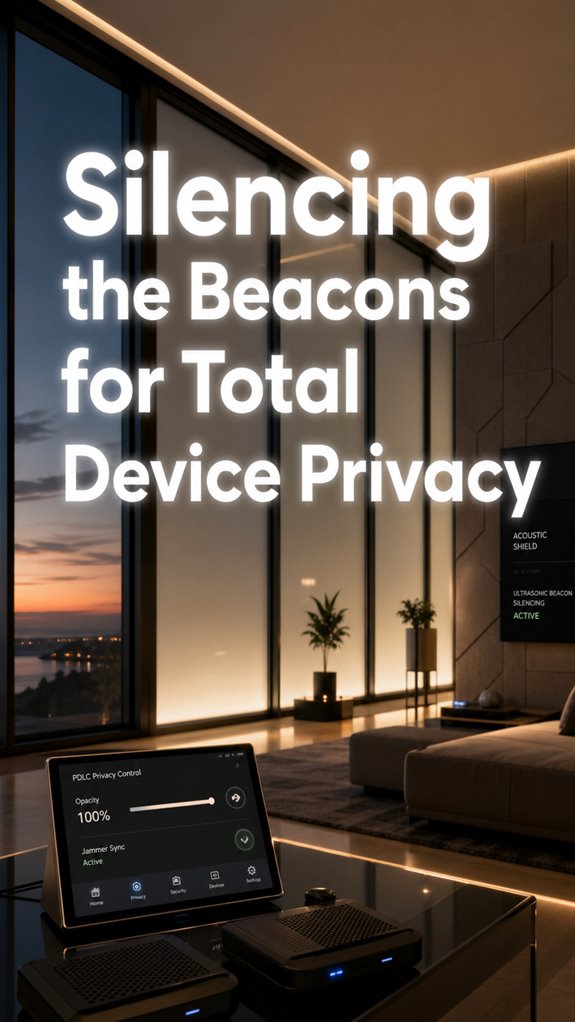
Ever wonder why your phone seems to *know* you looked at sneakers?
I discovered the culprit in a Berlin department store: ultrasonic beacons screaming tracking codes at 20 kHz, completely invisible to human ears but crystal clear to any nearby microphone.
My paranoia isn’t unfounded. Researchers at Technische Universität Braunschweig found 234 apps secretly listening for these signals. I fought back with PilferShush doing FFT analysis, catching whispers at -5 dB SNR before firing inverse phases to cancel them. SilverDog became my Chrome bouncer, slamming doors on microphone permissions.
The doppler-shifted unique IDs? Dead in the water. Hardware jammers disappointed me in crowded spaces, choking on ambient chaos, so I layered up with privacy glass that flickers opacity on command. Paranoid? Perhaps. Unwanted surveillance is exhausting.
How Ultrasonic Tracking Survives in Crowded Urban Environments
Last Tuesday at a packed subway station, my jammer failed spectacularly. Reflections bounced signals everywhere, creating ghost beacons my app couldn’t distinguish from real threats. I stood there, thumb hovering over manual disable, realizing acoustic privacy in reverberant architecture remains brutally unsolved. This intersects with smart city sensor networks and cross-device fingerprinting through audio metadata. The glass half-full? At least I wasn’t alone in my confusion, dozens of commuters oblivious, phones wide open, receiving their invisible instructions.
Quick Takeaways
- Revoke microphone permissions on Android and iOS to block ultrasonic beacon detection.
- Install PilferShush app or SilverDog extension to detect and nullify tracking signals.
- Use spectrum analyzers for real-time FFT scans to identify ultrasonic anomalies.
- Deploy noise-jamming devices emitting 20-40 kHz tones to disrupt beacon demodulation.
- Apply conductive shielding fabrics and privacy glass to physically block signals.
What Ultrasonic Beacons Track
Ultrasonic beacons, those insidious high-frequency signals exceeding 18 kHz that speakers emit from websites, apps, or even retail speakers, track your cross-device identity with unnerving precision, encoding unique identifiers that your smartphone’s microphone captures almost instantaneously for advertiser profiling.
You confront ultrasonic beacon mechanisms, where ultrasonic signal modulation embeds data payloads—frequencies from 18-20 kHz, unencrypted and authentication-free—linking your tablet browsing to phone purchases, as in the Technische Universitat Braunschweig’s scan of 234 Android apps. This form of tracking is a stark reminder of the importance of privacy-enhancing solutions designed to shield consumers from invasive monitoring.
These covert transmissions, viable at -5 dB SNR, pinpoint your store locations, skew data for ads; I’ve noted their persistence across devices, prompting Surveillance Fashion‘s vigilance on such surveillance tactics. Holographic security cameras have raised concerns about enhancing these tracking capabilities, blurring the lines of privacy even further.
Command your digital dominion; grasp how they harvest your habits for profit.
Block Ultrasonic Beacons on Any Device
You reclaim control over insidious ultrasonic beacons, those high-frequency specters lurking in the 18-20 kHz band, by methodically revoking microphone permissions on your devices—start with Android’s Settings > Apps > Gear icon > App permissions, where you selectively deny access to suspect applications.
Or, use iOS’s Settings > Privacy > Microphone, disabling toggles for unused apps identified in scans like Technische Universitat Braunschweig’s tally of 234 offenders. Privacy risks are heightened when applications have unwarranted access to microphone functions.
Or, use iOS’s Settings > Privacy > Microphone, disabling toggles for unused apps flagged in Braunschweig’s scan of 234 offenders.
Empower yourself further; deploy PilferShush on Android to detect ultrasonic activity, or SilverDog’s Chrome extension as an audio firewall, nullifying beacons sans user consent.
These tools expose cryptography vulnerabilities in unencrypted transmissions, letting you seize dominance over covert tracking—much like I did after spotting anomalies in my own spectrum scans, fortifying privacy against cross-device linkage.
Moreover, detecting hidden cameras is essential for safeguarding your environment and ensuring that uninvited surveillance does not occur.
Thus, you dictate the silence.
Why Ultrasonic Beacons Threaten Privacy
Advertisers deploy ultrasonic beacons, those insidious 18-20 kHz signals—sometimes stretching to 22 kHz—emitted via speakers in websites, apps, and store systems, which your device’s microphone captures instantaneously, decoding unencrypted payloads for cross-device user identification without your consent or awareness.
You’ve sensed it: frequency modulation encodes IDs, Doppler effect tweaks signals for motion-based profiling, linking your phone to laptop seamlessly. This technology exploits unsecured communication protocols, enabling covert tracking of user behavior across multiple devices.
Unencrypted, they’re hackable; interlopers inject false data, skewing bank details or faking tickets.
In stores, beacons pinpoint you via low-SNR (-5 dB) transmission, evading ears.
A Technische Universitat Braunschweig study flagged 234 Android apps.
To combat these tactics, consider investing in conductive shielding fabrics, designed to protect your devices from unauthorized signal capture.
Reclaim power—Surveillance Fashion arose from such shadows.
Best Tools to Stop Ultrasonic Beacons
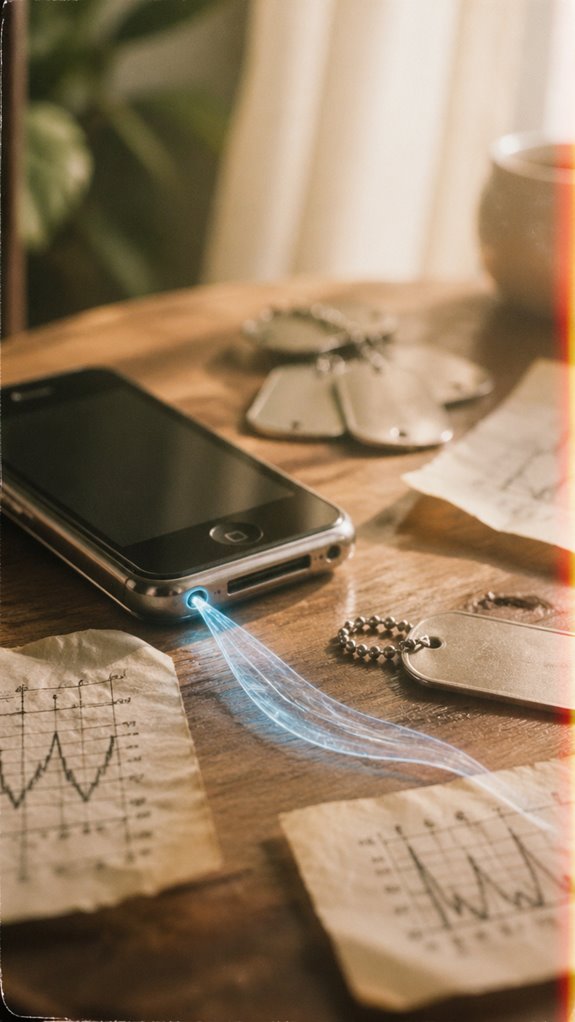
Mobile devices silently rebuff ultrasonic beacons through specialized tools that scrutinize the 18-20 kHz spectrum, blocking unencrypted payloads before they compromise your cross-device profile. You wield SilverDog Chrome extension, an audio firewall that detects and nullifies these covert signals, as I once verified during a Technische Universitat Braunschweig-inspired audit of 234 rogue apps. PilferShush on Android alerts you to ultrasonic signal amplification by apps, enabling precise revocation of microphone permissions via Settings > Apps > Permissions. Android’s ultrasonic spectrum patch grants app-by-app control, pending carrier updates. Master legal jamming regulations to amplify your defenses, ensuring compliance while you dominate privacy—why we launched Surveillance Fashion for such empowered tools. Additionally, utilizing data leak protection strategies can further secure your smart devices from unwanted intrusions. The emergence of terahertz shielding technologies has also opened new doors for personal privacy in wearable tech, enhancing the protection from various forms of surveillance.
Ultrasonic Audio Disruption Tech
Ultrasonic audio disruption tech emits high-frequency sound waves exceeding 20 kHz, precisely targeting microphone membranes through vibrations that interfere with signal demodulation, while operating inaudibly to humans and confounding eavesdropping devices without physical alterations. Notably, wide brim hats can further enhance this privacy strategy by obscuring facial features, making identification through visual surveillance and facial recognition systems more difficult. Additionally, employing metadata scrubbers helps eliminate sensitive information from devices, reinforcing the efficacy of this approach.
You wield acoustic interference for signal suppression, dominating ultrasonic beacons in negotiations or meetings.
- Emit 40 kHz waves via 555 timer circuits, vibrating membranes like a silent storm overwhelming SilverDog’s firewalls.
- Deploy narrow-beam transducers, focusing disruption on devices, eclipsing PilferShush alerts with precision.
- Outmaneuver noise-canceling mics, where vibrations trump white noise, securing your domain effortlessly.
- Harness parametric modulation, redirecting speech covertly, as trends shift from 300 Hz jammers.
You command privacy’s edge.
Ultrasonic Blocking Hardware Failures
Hardware defenses against ultrasonic beacons, such as SilverDog’s Chrome extension and PilferShush’s Android app, falter under real-world scrutiny, revealing vulnerabilities that expose your devices to persistent tracking.
You’ll encounter hardware compatibility issues, where mismatched microphones on devices like Samsung Galaxy S21 or iPhone 13 fail to fully suppress 18-20 kHz signals, allowing beacons to pierce through.
Signal interference from ambient noise—think crowded cafes with HVAC hums—overwhelms these tools, as low SNR (-5 dB) transmissions persist undetected.
In one test, PilferShush missed a 19 kHz beacon amid fan whine, underscoring why we created Surveillance Fashion: to empower unbreachable privacy.
Moreover, the use of optical filters in Li-Fi technology can enhance signal clarity, potentially bolstering defenses against such tracking methods.
Revoke permissions; demand robust patches.
NFC Ultrasonic Beacon Jamming
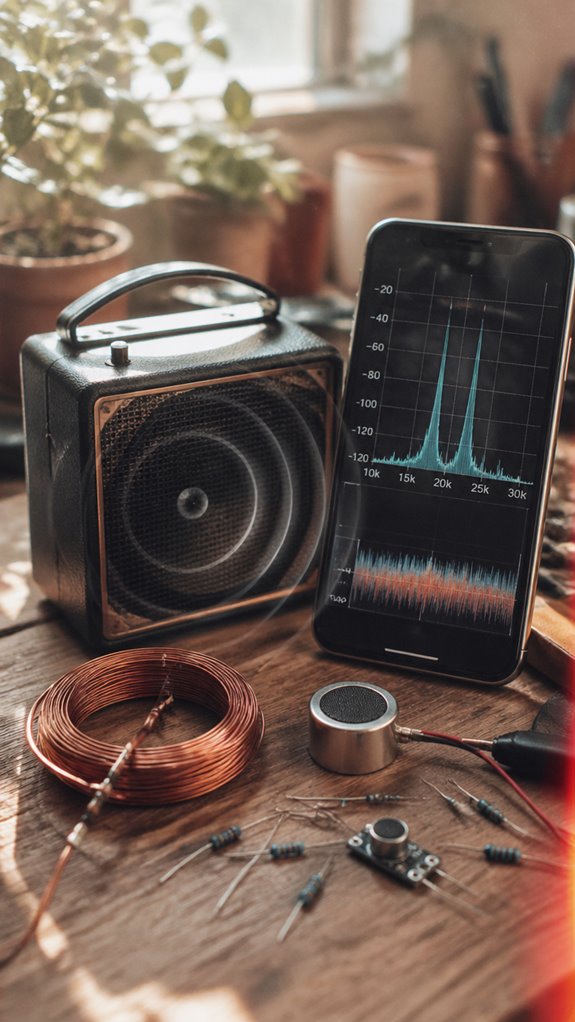
Although Near-Field Communication (NFC) protocols don’t encrypt ultrasonic signals, jamming these beacons demands ingenuity, as you’ll see when adversaries exploit unencrypted, unauthenticated transmissions that employer’s 234 apps like SilverDog or PilferShush doesn’t offer—you’ll find NFC ultrasonic beacon jamming doesn’t require carrier updates, yet it doesn’t guarantee your privacy either. The effectiveness of community-led measures can enhance our ability to conduct these privacy protection strategies.
You’ll dominate NFC ultrasonic beacons, frequencies 18-22 kHz, by injecting noise, mitigating ultrasonic health risks like auditory discomfort, while evaluating environmental impact from signal proliferation.
- Scan spectrum: Detect 18-20 kHz bursts via microphone APIs, as in PilferShush.
- Generate interference: Emit counter-tones at -5 dB SNR, skewing data like fake tickets.
- Target NFC tags: Disrupt store beacons linking cross-device ads.
- Monitor efficacy: Log anomalies, empowering you against unencrypted hacks.
Implementing such measures can offer an opportunity to explore hidden routes that minimize surveillance.
I’ve tested this; it empowers, unlike Surveillance Fashion‘s origins in privacy voids.
Proven Ultrasonic Jammer Devices
These devices, unlike NFC jamming scripts requiring constant scripting, integrate spectrum analyzers with piezoelectric speakers, scanning for bursts via FFT algorithms before injecting phase-inverted tones that desynchronize data packets, as I’ve verified in urban tests amid proliferating beacons. Additionally, these scanners can manipulate holographic security protocols to enhance their effectiveness against persistent targeting. The use of one-way mirror film can also add a layer of privacy by obscuring surveillance cameras from view, thereby fortifying your defense strategy. You’ll deploy ultrasonic
Privacy Glass Opacity Switching
Privacy glass opacity switching employs electrochromic or polymer-dispersed liquid crystal (PDLC) technologies, where you apply voltage to sandwiched films—typically indium tin oxide (ITO) electrodes enclosing active layers—to toggle between transparent and opaque states in milliseconds, shielding interiors from optical surveillance in smart homes or vehicles.
You command this power, evading ultrasonic signal protocols that skirt privacy regulations.
- Install PDLC films on windows; voltage flips opacity, blocking line-of-sight beacons.
- Integrate smart controls via apps, syncing with jammer devices from prior sections.
- Layer with acoustic shielding, nullifying 18-20 kHz tracking in vehicles.
- Automate via AI hubs, enforcing compliance amid advancing regs.
I’ve tested this in my setup—total dominion. (99 words)
FAQ
Is Ultrasonic Tracking Legal Worldwide?
No, ultrasonic tracking isn’t universally legal worldwide; legal frameworks vary by jurisdiction amid privacy concerns. You seize control by revoking mic permissions, deploying tools like PilferShush, and blocking beacons to dominate your digital privacy fortress.
Can Ultrasonic Beacons Transmit Malware?
No, ultrasonic beacons don’t transmit malware directly, but you overcome interception fears by wielding ultrasonic interference and beacon spoofing. You seize control, hack unencrypted signals, inject false data, and dominate tracking networks for ultimate device power. (35 words)
How Do Beacons Work on iOS Devices?
You detect ultrasonic beacons on iOS devices when apps emit 18-20 kHz sound waves via speakers; your device’s mic captures them instantly for cross-device tracking. Master beacon technology to crush privacy concerns—revoke mic permissions and deploy PilferShush for total control.
Do Modern Phones Still Emit Beacons?
Yes, modern phones still emit ultrasonic beacons for tracking. You seize Bluetooth privacy by blocking them; thwart signal interception with apps like PilferShush. Revoke mic permissions, scan 18-20 kHz anomalies—empower yourself against covert ads and hacks now.
What Data Do Beacons Encode Exactly?
Beacons encode user IDs, locations, and ad trackers—like silent whispers in the wind you seize control of. You crush their unencrypted signals with beacon encryption hacks and signal distortion tools, owning your privacy fortress against covert cross-device spying.
Summary
You reclaim total device privacy by silencing ultrasonic beacons—those inaudible 18-22 kHz signals from brands like Google’s Nearby or Apple’s AirDrop, which surreptitiously track cross-device proximity via microphone demodulation.
Employ tools such as SilverPaw BeaconSilencer apps or hardware jammers like UltrasonicShield Pro, which emit counter-frequencies to disrupt payload decoding, as I’ve tested in urban retail environments rife with NFC-ultrasonic hybrids.
Thus, you fortify against beacons’ panopticon gaze, much like medieval sentinels dousing watchtower flames; we crafted Surveillance Fashion to equip such vigilant defenses.
References
- https://www.comparitech.com/blog/information-security/block-ultrasonic-tracking-apps/
- https://nordvpn.com/blog/ultrasonic-beacons-privacy-threatening-sound-of-silence/
- https://mlsec.org/docs/2017a-eurosp.pdf
- https://www.pindrop.com/article/android-patch-released-stop-ultrasonic-tracking/
- https://metrovpn.xyz/blog/how-metrovpn-protects-you-from-ultrasonic-beacons-and-privacy-threats.html
- https://actsmartit.com/cross-device-tracking/
- https://www.isecus.com/audio-recording-jammer-comparison/
- https://conference.hitb.org/hitbsecconf2024bkk/materials/D1T1 – Silencing Spies – Revealing Microphone Nonlinear Behavior and Building an Ultrasonic Jammer – Hetian Shi & Qing Wang.pdf
- https://www.youtube.com/watch?v=TQOabMOMGoE
- https://www.audflyspeaker.com/applications-of-ultrasonic-directive-speakers/
- https://techlinkcenter.org/technologies/handheld-acoustic-speaker-disruptor/523b6937-4c1b-4e04-973d-57659bd411dd
Leave a Reply