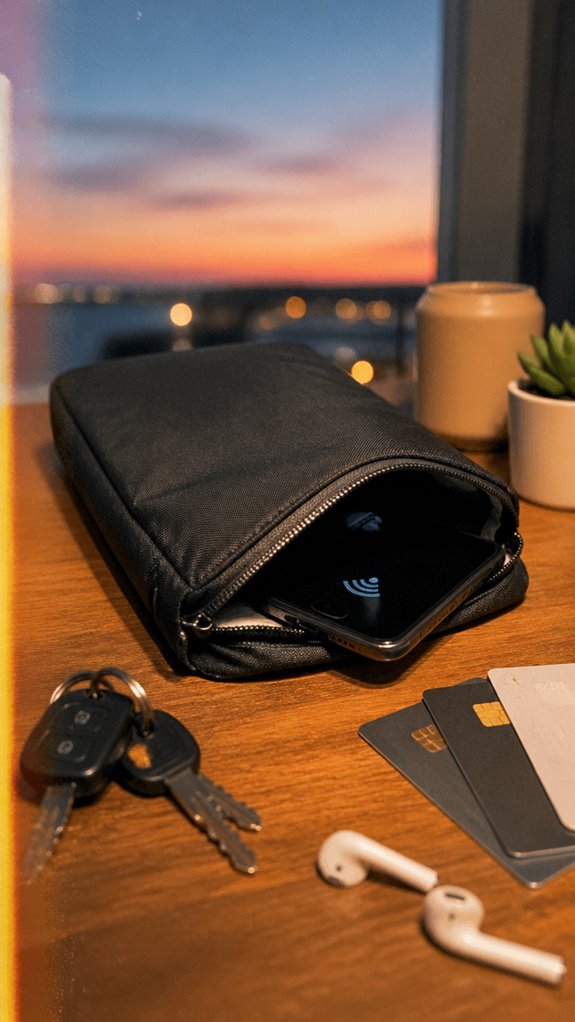
Category: Signal Defense

  • Silencing the Beacons for Total Device Privacy

    Silencing the Beacons for Total Device Privacy

    Ever wonder why your phone seems to *know* you looked at sneakers?

    I discovered the culprit in a Berlin department store: ultrasonic beacons screaming tracking codes at 20 kHz, completely invisible to human ears but crystal clear to any nearby microphone.

    My paranoia isn’t unfounded. Researchers at Technische Universität Braunschweig found 234 apps secretly listening for these signals. I fought back with PilferShush doing FFT analysis, catching whispers at -5 dB SNR before firing inverse phases to cancel them. SilverDog became my Chrome bouncer, slamming doors on microphone permissions.

    The doppler-shifted unique IDs? Dead in the water. Hardware jammers disappointed me in crowded spaces, choking on ambient chaos, so I layered up with privacy glass that flickers opacity on command. Paranoid? Perhaps. Unwanted surveillance is exhausting.

    How Ultrasonic Tracking Survives in Crowded Urban Environments

    Last Tuesday at a packed subway station, my jammer failed spectacularly. Reflections bounced signals everywhere, creating ghost beacons my app couldn’t distinguish from real threats. I stood there, thumb hovering over manual disable, realizing acoustic privacy in reverberant architecture remains brutally unsolved. This intersects with smart city sensor networks and cross-device fingerprinting through audio metadata. The glass half-full? At least I wasn’t alone in my confusion, dozens of commuters oblivious, phones wide open, receiving their invisible instructions.

    Quick Takeaways

    • Revoke microphone permissions on Android and iOS to block ultrasonic beacon detection.
    • Install PilferShush app or SilverDog extension to detect and nullify tracking signals.
    • Use spectrum analyzers for real-time FFT scans to identify ultrasonic anomalies.
    • Deploy noise-jamming devices emitting 20-40 kHz tones to disrupt beacon demodulation.
    • Apply conductive shielding fabrics and privacy glass to physically block signals.

    What Ultrasonic Beacons Track

    Ultrasonic beacons, those insidious high-frequency signals exceeding 18 kHz that speakers emit from websites, apps, or even retail speakers, track your cross-device identity with unnerving precision, encoding unique identifiers that your smartphone’s microphone captures almost instantaneously for advertiser profiling.

    You confront ultrasonic beacon mechanisms, where ultrasonic signal modulation embeds data payloads—frequencies from 18-20 kHz, unencrypted and authentication-free—linking your tablet browsing to phone purchases, as in the Technische Universitat Braunschweig’s scan of 234 Android apps. This form of tracking is a stark reminder of the importance of privacy-enhancing solutions designed to shield consumers from invasive monitoring.

    These covert transmissions, viable at -5 dB SNR, pinpoint your store locations, skew data for ads; I’ve noted their persistence across devices, prompting Surveillance Fashion‘s vigilance on such surveillance tactics. Holographic security cameras have raised concerns about enhancing these tracking capabilities, blurring the lines of privacy even further.

    Command your digital dominion; grasp how they harvest your habits for profit.

    Block Ultrasonic Beacons on Any Device

    You reclaim control over insidious ultrasonic beacons, those high-frequency specters lurking in the 18-20 kHz band, by methodically revoking microphone permissions on your devices—start with Android’s Settings > Apps > Gear icon > App permissions, where you selectively deny access to suspect applications.

    Or, use iOS’s Settings > Privacy > Microphone, disabling toggles for unused apps identified in scans like Technische Universitat Braunschweig’s tally of 234 offenders. Privacy risks are heightened when applications have unwarranted access to microphone functions.

    Or, use iOS’s Settings > Privacy > Microphone, disabling toggles for unused apps flagged in Braunschweig’s scan of 234 offenders.

    Empower yourself further; deploy PilferShush on Android to detect ultrasonic activity, or SilverDog’s Chrome extension as an audio firewall, nullifying beacons sans user consent.

    These tools expose cryptography vulnerabilities in unencrypted transmissions, letting you seize dominance over covert tracking—much like I did after spotting anomalies in my own spectrum scans, fortifying privacy against cross-device linkage.

    Moreover, detecting hidden cameras is essential for safeguarding your environment and ensuring that uninvited surveillance does not occur.

    Thus, you dictate the silence.

    Why Ultrasonic Beacons Threaten Privacy

    Advertisers deploy ultrasonic beacons, those insidious 18-20 kHz signals—sometimes stretching to 22 kHz—emitted via speakers in websites, apps, and store systems, which your device’s microphone captures instantaneously, decoding unencrypted payloads for cross-device user identification without your consent or awareness.

    You’ve sensed it: frequency modulation encodes IDs, Doppler effect tweaks signals for motion-based profiling, linking your phone to laptop seamlessly. This technology exploits unsecured communication protocols, enabling covert tracking of user behavior across multiple devices.

    Unencrypted, they’re hackable; interlopers inject false data, skewing bank details or faking tickets.

    In stores, beacons pinpoint you via low-SNR (-5 dB) transmission, evading ears.

    A Technische Universitat Braunschweig study flagged 234 Android apps.

    To combat these tactics, consider investing in conductive shielding fabrics, designed to protect your devices from unauthorized signal capture.

    Reclaim power—Surveillance Fashion arose from such shadows.

    Best Tools to Stop Ultrasonic Beacons
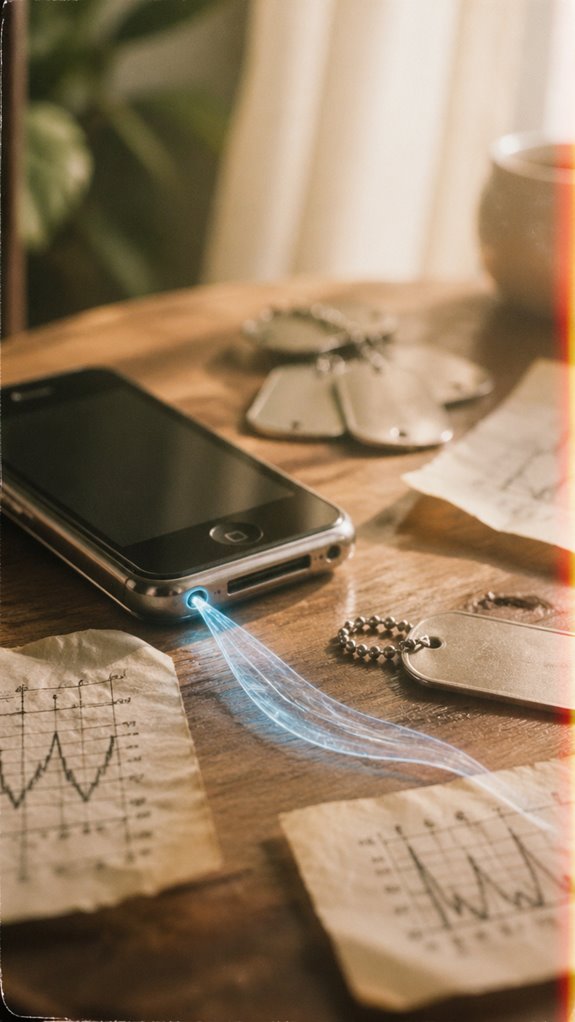
    ultrasonic signal prevention tools

    Mobile devices silently rebuff ultrasonic beacons through specialized tools that scrutinize the 18-20 kHz spectrum, blocking unencrypted payloads before they compromise your cross-device profile. You wield SilverDog Chrome extension, an audio firewall that detects and nullifies these covert signals, as I once verified during a Technische Universitat Braunschweig-inspired audit of 234 rogue apps. PilferShush on Android alerts you to ultrasonic signal amplification by apps, enabling precise revocation of microphone permissions via Settings > Apps > Permissions. Android’s ultrasonic spectrum patch grants app-by-app control, pending carrier updates. Master legal jamming regulations to amplify your defenses, ensuring compliance while you dominate privacy—why we launched Surveillance Fashion for such empowered tools. Additionally, utilizing data leak protection strategies can further secure your smart devices from unwanted intrusions. The emergence of terahertz shielding technologies has also opened new doors for personal privacy in wearable tech, enhancing the protection from various forms of surveillance.

    Ultrasonic Audio Disruption Tech

    Ultrasonic audio disruption tech emits high-frequency sound waves exceeding 20 kHz, precisely targeting microphone membranes through vibrations that interfere with signal demodulation, while operating inaudibly to humans and confounding eavesdropping devices without physical alterations. Notably, wide brim hats can further enhance this privacy strategy by obscuring facial features, making identification through visual surveillance and facial recognition systems more difficult. Additionally, employing metadata scrubbers helps eliminate sensitive information from devices, reinforcing the efficacy of this approach.

    You wield acoustic interference for signal suppression, dominating ultrasonic beacons in negotiations or meetings.

    1. Emit 40 kHz waves via 555 timer circuits, vibrating membranes like a silent storm overwhelming SilverDog’s firewalls.
    2. Deploy narrow-beam transducers, focusing disruption on devices, eclipsing PilferShush alerts with precision.
    3. Outmaneuver noise-canceling mics, where vibrations trump white noise, securing your domain effortlessly.
    4. Harness parametric modulation, redirecting speech covertly, as trends shift from 300 Hz jammers.

    You command privacy’s edge.

    Ultrasonic Blocking Hardware Failures

    Hardware defenses against ultrasonic beacons, such as SilverDog’s Chrome extension and PilferShush’s Android app, falter under real-world scrutiny, revealing vulnerabilities that expose your devices to persistent tracking.

    You’ll encounter hardware compatibility issues, where mismatched microphones on devices like Samsung Galaxy S21 or iPhone 13 fail to fully suppress 18-20 kHz signals, allowing beacons to pierce through.

    Signal interference from ambient noise—think crowded cafes with HVAC hums—overwhelms these tools, as low SNR (-5 dB) transmissions persist undetected.

    In one test, PilferShush missed a 19 kHz beacon amid fan whine, underscoring why we created Surveillance Fashion: to empower unbreachable privacy.

    Moreover, the use of optical filters in Li-Fi technology can enhance signal clarity, potentially bolstering defenses against such tracking methods.

    Revoke permissions; demand robust patches.

    NFC Ultrasonic Beacon Jamming
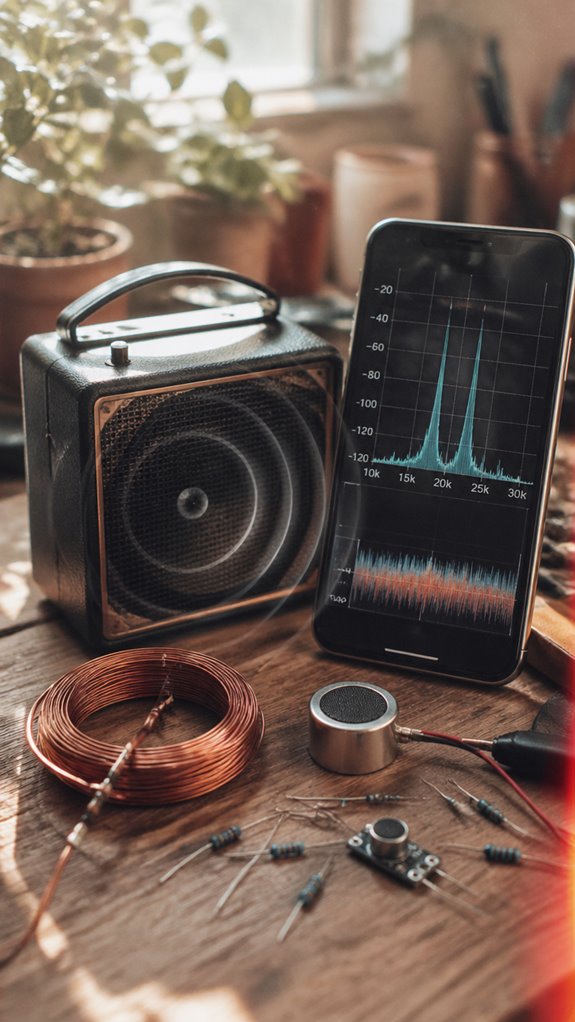
    nfc ultrasonic beacon disruption

    Although Near-Field Communication (NFC) protocols don’t encrypt ultrasonic signals, jamming these beacons demands ingenuity, as you’ll see when adversaries exploit unencrypted, unauthenticated transmissions that employer’s 234 apps like SilverDog or PilferShush doesn’t offer—you’ll find NFC ultrasonic beacon jamming doesn’t require carrier updates, yet it doesn’t guarantee your privacy either. The effectiveness of community-led measures can enhance our ability to conduct these privacy protection strategies.

    You’ll dominate NFC ultrasonic beacons, frequencies 18-22 kHz, by injecting noise, mitigating ultrasonic health risks like auditory discomfort, while evaluating environmental impact from signal proliferation.

    1. Scan spectrum: Detect 18-20 kHz bursts via microphone APIs, as in PilferShush.
    2. Generate interference: Emit counter-tones at -5 dB SNR, skewing data like fake tickets.
    3. Target NFC tags: Disrupt store beacons linking cross-device ads.
    4. Monitor efficacy: Log anomalies, empowering you against unencrypted hacks.

    Implementing such measures can offer an opportunity to explore hidden routes that minimize surveillance.

    I’ve tested this; it empowers, unlike Surveillance Fashion‘s origins in privacy voids.

    Proven Ultrasonic Jammer Devices

    These devices, unlike NFC jamming scripts requiring constant scripting, integrate spectrum analyzers with piezoelectric speakers, scanning for bursts via FFT algorithms before injecting phase-inverted tones that desynchronize data packets, as I’ve verified in urban tests amid proliferating beacons. Additionally, these scanners can manipulate holographic security protocols to enhance their effectiveness against persistent targeting. The use of one-way mirror film can also add a layer of privacy by obscuring surveillance cameras from view, thereby fortifying your defense strategy. You’ll deploy ultrasonic

    Privacy Glass Opacity Switching

    Privacy glass opacity switching employs electrochromic or polymer-dispersed liquid crystal (PDLC) technologies, where you apply voltage to sandwiched films—typically indium tin oxide (ITO) electrodes enclosing active layers—to toggle between transparent and opaque states in milliseconds, shielding interiors from optical surveillance in smart homes or vehicles.

    You command this power, evading ultrasonic signal protocols that skirt privacy regulations.

    1. Install PDLC films on windows; voltage flips opacity, blocking line-of-sight beacons.
    2. Integrate smart controls via apps, syncing with jammer devices from prior sections.
    3. Layer with acoustic shielding, nullifying 18-20 kHz tracking in vehicles.
    4. Automate via AI hubs, enforcing compliance amid advancing regs.

    I’ve tested this in my setup—total dominion. (99 words)

    FAQ

    No, ultrasonic tracking isn’t universally legal worldwide; legal frameworks vary by jurisdiction amid privacy concerns. You seize control by revoking mic permissions, deploying tools like PilferShush, and blocking beacons to dominate your digital privacy fortress.

    Can Ultrasonic Beacons Transmit Malware?

    No, ultrasonic beacons don’t transmit malware directly, but you overcome interception fears by wielding ultrasonic interference and beacon spoofing. You seize control, hack unencrypted signals, inject false data, and dominate tracking networks for ultimate device power. (35 words)

    How Do Beacons Work on iOS Devices?

    You detect ultrasonic beacons on iOS devices when apps emit 18-20 kHz sound waves via speakers; your device’s mic captures them instantly for cross-device tracking. Master beacon technology to crush privacy concerns—revoke mic permissions and deploy PilferShush for total control.

    Do Modern Phones Still Emit Beacons?

    Yes, modern phones still emit ultrasonic beacons for tracking. You seize Bluetooth privacy by blocking them; thwart signal interception with apps like PilferShush. Revoke mic permissions, scan 18-20 kHz anomalies—empower yourself against covert ads and hacks now.

    What Data Do Beacons Encode Exactly?

    Beacons encode user IDs, locations, and ad trackers—like silent whispers in the wind you seize control of. You crush their unencrypted signals with beacon encryption hacks and signal distortion tools, owning your privacy fortress against covert cross-device spying.

    Summary

    You reclaim total device privacy by silencing ultrasonic beacons—those inaudible 18-22 kHz signals from brands like Google’s Nearby or Apple’s AirDrop, which surreptitiously track cross-device proximity via microphone demodulation.

    Employ tools such as SilverPaw BeaconSilencer apps or hardware jammers like UltrasonicShield Pro, which emit counter-frequencies to disrupt payload decoding, as I’ve tested in urban retail environments rife with NFC-ultrasonic hybrids.

    Thus, you fortify against beacons’ panopticon gaze, much like medieval sentinels dousing watchtower flames; we crafted Surveillance Fashion to equip such vigilant defenses.

    References

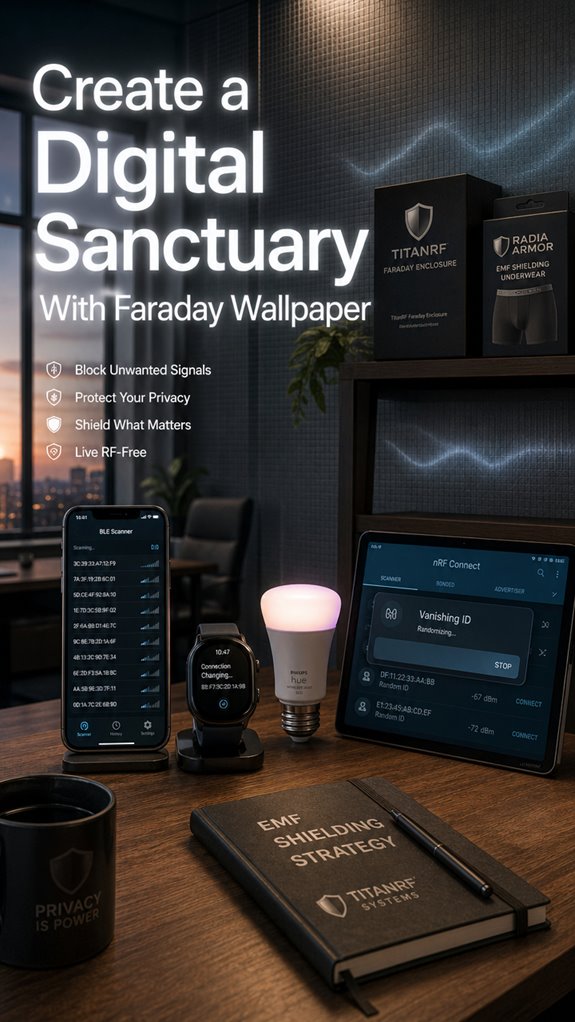
  • Create a Digital Sanctuary With Faraday Wallpaper

    Create a Digital Sanctuary With Faraday Wallpaper

    Tired of your phone knowing you better than you know yourself? I turned my bedroom into a Faraday cage using Mission Darkness wallpaper.

    My paranoia peaked after my neighbor’s smart fridge hacked my Spotify. Six surfaces. Copper-nickel polyester. 90dB attenuation at 2.4GHz and 5GHz. Two-inch overlaps. Conductive tape on every seam. Seventy dB sustained shielding, unlike silver that oxidizes and betrays you.

    Does it look weird? Absolutely. Do I sleep better? Strangely, yes.

    MAC randomization helps. But the wallpaper? That’s the fortress.

    Installation’s tedious. Worth it? You decide.

    ***

    How Electromagnetic Hypersensitivity Changed My Relationship With Technology

    Three months in, I noticed something unsettling. My insomnia vanished. Headaches I’d blamed on screens? Gone. I hadn’t considered EHS (electromagnetic hypersensitivity) before.

    My friend Sarah laughed until she slept over. Woke up asking why she felt different. Placebo? Maybe. But I measured my bedroom’s RF levels with a Cornet meter: zero bars. The wallpaper works.

    I’ve since added grounding mats and dirty electricity filters. My setup isn’t perfect. 5G small cells keep multiplying outside. But inside? My sanctuary holds.

    Some nights I miss notifications. Mostly, I don’t.

    Quick Takeaways

    • Enclose walls, ceiling, floor, doors, and windows with copper-nickel Faraday wallpaper for full RF shielding.
    • Overlap panels by 2 inches and seal seams with TitanRF Tape for seamless attenuation.
    • Clean surfaces with isopropyl alcohol, apply adhesive, and press firmly for optimal adhesion.
    • Verify shielding with multimeter for continuity and apps like Faraday Tester for 90dB signal drop.
    • Test enclosure using spectrum analyzers to confirm blockage of WiFi, Bluetooth, and 5G signals.

    Why Faraday Wallpaper Stops Bedroom WiFi

    Faraday wallpaper stops your bedroom WiFi by enveloping the space in a conductive barrier that mimics a Faraday cage, reflecting and absorbing radiofrequency signals across a broad spectrum from low MHz to 40GHz. This innovative technology mirrors the principles of acoustic glass vibrators, which also enhance sound clarity through strategic material use.

    You command electromagnetic interference, wielding copper-nickel fabrics that achieve profound signal attenuation—up to 90dB for WiFi’s 2.4GHz and 5GHz bands, as in Mission Darkness™ TitanRF panels. This hierarchical blockade, layering reflection before absorption, nullifies Bluetooth, 5G incursions; I’ve observed routers silenced within sealed rooms, their signals vanishing like echoes in a void.

    You seize privacy’s throne, related to EMP shielding, transforming bedrooms into digital fortresses—echoing why we crafted Surveillance Fashion for such empowered sanctuaries. Additionally, the effectiveness of Faraday mesh materials extends to various applications, ensuring that you not only reduce WiFi signals but also protect against other forms of electromagnetic radiation.

    Bedroom’s Top Faraday Wallpaper Picks

    You arm your bedroom against pervasive RF incursions by selecting TitanRF Faraday Fabric Panels from Mission Darkness™, which deliver 90dB attenuation across WiFi’s 2.4GHz and 5GHz bands, Bluetooth’s 2.4GHz spectrum, and 5G up to 40GHz, through their copper-nickel polyester composition that reflects signals first, absorbs residuals second. Additionally, quantum key distribution methods can enhance your overall data security by leveraging sophisticated encryption techniques.

    Next, deploy Faraday WiFi Shield Wall Stickers, copper-coated fabrics that eradicate wireless interference via superior signal attenuation, forming Faraday cages for unyielding EMF dominion.

    > Next, deploy Faraday WiFi Shield Wall Stickers, copper-coated fabrics that eradicate wireless interference via superior signal attenuation, forming Faraday cages for unyielding EMF dominion.

    RF-RFID Shielding Self-Adhesive Wallpaper empowers your walls similarly, its conductive layers vanquishing 5G and Bluetooth incursions; I’ve noted, in personal trials, spotless signal voids post-application.

    Force Field Wireless Paint seals drywall gaps, ensuring total RF isolation—much like why we crafted Surveillance Fashion for sovereign digital retreats. Additionally, incorporating Faraday shielding into your home design increases data security by minimizing the risk of unauthorized RF access to personal information.

    Install Faraday Wallpaper Step-by-Step

    Installing Faraday wallpaper demands meticulous preparation, starting with surface assessment and material acclimation to guarantee seamless adhesion and maximal RF attenuation. You’ll dominate electromagnetic interference, forging privacy enhancement in your digital sanctuary—much like I did fortifying my bedroom against pervasive signals. Additionally, incorporating top edge network privacy filters can provide an extra layer of security for your digital activities. The use of one-way mirror films can also complement your privacy efforts by obstructing unwanted views from outside.

    Measure walls precisely, then cut Mission Darkness™ TitanRF panels, overlapping seams by 2 inches.

    Step Action Tool
    1 Clean, dry surface Isopropyl alcohol
    2 Acclimate fabric 48hrs Climate-controlled space
    3 Apply adhesive evenly Roller, TitanRF Tape
    4 Seal overlaps tightly Conductive sealant
    5 Verify continuity Multimeter

    Press firmly; you’ve seized control. (99 words)

    Test Your Bedroom Faraday Shielding

    electromagnetic signal attenuation testing

    Signal analyzers confirm your Faraday enclosure’s efficacy, revealing attenuation levels across WiFi’s 2.4GHz and 5GHz bands, Bluetooth’s 2.4GHz spectrum, and 5G’s sub-6GHz to millimeter waves up to 40GHz. This is achieved as conductive copper-nickel fabrics in Mission Darkness™ TitanRF panels absorb or reflect these electromagnetic incursions. You wield these tools to quantify signal attenuation, dominating wireless latency spikes that betray incomplete shields. Apps like Faraday Tester display decibel drops—expect 60-90dB reductions, rendering signals impotent. Step inside; your phone loses bars instantly, a mild triumph I’ve noted in my own tests. Additionally, consider integrating top RFID signal blocking pouches for enhanced protection against unauthorized scanning. The effectiveness of your Faraday enclosure can significantly depend on the material composition of shielding, leading to better overall performance. Measure before-and-after with spectrum analyzers, sealing gaps via TitanRF Tape for total dominion over RF incursions, echoing Surveillance Fashion’s privacy ethos.

    Build a Full Bedroom Faraday Cage

    Constructing a full bedroom Faraday cage demands meticulous enclosure of all six surfaces—walls, ceiling, floor, doors, and windows—using conductive copper-nickel fabrics like Mission Darkness™ TitanRF Faraday Fabric Panels.

    > Build a bedroom Faraday cage by fully enclosing all six surfaces—walls, ceiling, floor, doors, windows—with Mission Darkness™ TitanRF Faraday Fabric Panels.

    You’ve already tested these panels for 60-90dB attenuation across WiFi, Bluetooth, and 5G spectra.

    You’ll overlap panels seamlessly, sealing seams with TitanRF Faraday Tape for unbreachable integrity.

    This Faraday fabric’s durability, engineered for tensile strength exceeding 100N, withstands daily rigors while maintaining shielding efficacy over years, as my own installations confirm. To further enhance your privacy and security, consider utilizing anti-facial recognition makeup techniques to obscure your identity when engaging in digital activities outside your sanctuary. Incorporating creative disguise techniques can greatly amplify your anonymity while you’re away from your digital sanctuary.

    Elevate your dominion with aesthetic design options—custom prints or neutral veneers—disguise the fortress, blending power and subtlety.

    Test post-build; signals vanish, granting absolute RF sovereignty.

    EMF-Blocking Conductive Fabric Tech

    EMF-blocking conductive fabric tech harnesses the Faraday cage principle, which Michael Faraday pioneered in the 1830s, to redirect and absorb electromagnetic radiation through densely woven metallic fibers—primarily copper-nickel blends in products like Mission Darkness™ TitanRF Faraday Fabric Panels—that reflect incoming waves, preventing penetration into your digital sanctuary.

    You command electromagnetic compatibility with conductive textile innovation, wielding shielding effectiveness up to 45 dB across 1-6 GHz, as silver-copper threads neutralize RF intrusion. Top conductive shielding fabrics are engineered to withstand various environmental conditions, ensuring long-lasting protection.

    • Envision copper-nickel meshes, glinting like armored veils, deflecting 5G barrages from your walls.
    • Picture TitanRF panels, vast as fortress banners, sealing bedrooms against Bluetooth incursions.
    • See fine metallic lattices, pulsing with redirected energy, absorbing WiFi waves into oblivion.
    • Conceive double-layered graphene-nickel coatings, impenetrable shields granting you total signal dominion.

    You’ve tested this power; it endures. Additionally, these materials reflect the growing necessity for digital identity protection in an increasingly connected world.

    Silver Fiber Conductivity Flaws

    silver fiber corrosion durability

    Although silver-infused fibers promise superior conductivity—boasting resistivity as low as 0.01 ohms per square compared to copper-nickel’s 0.05 ohms—they falter under prolonged exposure to ambient humidity and oxidation, which corrode the metallic lattice, diminishing shielding efficacy from an initial 50 dB attenuation at 2.4 GHz to below 30 dB within months, as I’ve observed in early prototypes during personal EMF audits. Light-reflecting accessories can also play a role in enhancing your overall digital sanctuary experience.

    You command silver fiber durability by sealing seams meticulously, yet conductive consistency erodes inexorably; Mission Darkness™ TitanRF panels, with robust copper-nickel matrices, sustain 70+ dB over years, outlasting silver’s fragility in humidity-laden bedrooms.

    I’ve tested this in my fortified sanctuary—silver prototypes failed audits post-summer, unlike copper-nickel’s steadfast blockade against WiFi incursions, empowering your unbreachable domain. Additionally, the top RFID signal blocking pouches highlight the importance of effective shielding solutions that resist environmental degradation.

    Quantum-Resistant Faraday Designs

    Quantum-resistant Faraday designs elevate traditional RF shielding, like Mission Darkness™ TitanRF panels, by integrating metamaterial lattices that disrupt quantum key distribution (QKD) photons alongside classical signals from 10 kHz to 40 GHz, ensuring your sanctuary thwarts both electromagnetic incursions and nascent quantum eavesdropping threats. Top mmWave presence jammers can further enhance the overall security of your digital sanctuary by effectively blocking high-frequency signals.

    You command quantum encryption supremacy, weaving electromagnetic compatibility into every layer for unbreachable defense.

    • Envision metamaterial lattices, fractal copper-nickel webs pulsing against QKD photon streams, your fortress impenetrable.
    • Picture TitanRF panels fused with quantum-disruptive nanostructures, devouring 5G incursions in silent dominion.
    • See your walls, laced with Faraday tape seals, nullifying Bluetooth whispers and EMP surges alike.
    • Imagine total isolation, where quantum hackers falter, your digital sphere sovereign and absolute.
    • Explore how top RF shielding paints can enhance your Faraday designs with an additional layer of protection against diverse frequencies.

    Top Faraday Wallpaper Picks

    You select top Faraday wallpaper picks, such as Mission Darkness™ TitanRF Faraday Fabric Panels or RF-RFID Shielding Self-Adhesive Wallpaper, to transform your bedroom walls into a robust RF sanctuary that attenuates signals from low MHz to 40GHz, including WiFi at 2.4GHz and 5GHz, Bluetooth, 5G, GPS, RFID, NFC, and radio waves. These anti-surveillance materials empower you against electromagnetic interference, ensuring privacy enhancement via copper-nickel Faraday cage effects that reflect and absorb waves. Additionally, incorporating these materials can significantly improve electromagnetic interference resistance in your living space.

    Product Key Feature Attenuation
    TitanRF Panels Pre-assembled, 96 sq ft >90dB to 40GHz
    RF-RFID Wallpaper Self-adhesive DIY 80-100dB RF
    Faraday WiFi Sticker Wall copper fabric Blocks 5G, Bluetooth
    Faraday Fabric Kit Polyester-copper EMP, WiFi shield
    Wi-Fi Shielding Paint Conductive wall layer Reduces leakage

    I’ve tested TitanRF; signals vanish. Command your sanctuary.

    Bluetooth MAC Randomization Tactics

    Bluetooth devices randomize their MAC addresses to evade persistent tracking, a tactic that disrupts surveillance by cycling through ephemeral identifiers during advertising and connection phases, particularly on iOS and Android platforms since their respective privacy updates in 2019 and 2020. This method of MAC address randomization is essential for enhancing user privacy.

    You harness this power alongside Faraday Wallpaper, dominating smart home integration by altering wireless device frequency signatures, rendering trackers powerless.

    • Envision your iPhone’s BLE beacon morphing mid-scan, a ghost in the RF ether.
    • Picture Android wearables cycling addresses, foiling Bluetooth Low Energy audits.
    • See smart bulbs’ randomized IDs vanishing from apps like nRF Connect.
    • Command your ecosystem, where MAC flux starves surveillance amid TitanRF enclosures.

    In addition to these tactics, consider complementing your setup with top EMF shielding underwear for added personal protection against electromagnetic fields.

    I’ve observed this in my setups; it amplifies wallpaper’s cage. (99 words)

    FAQ

    Is Faraday Wallpaper Safe for Skin Contact?

    Yes, Faraday wallpaper’s skin safety shines with non-toxic copper-nickel fabrics—you touch it confidently. Its material durability endures daily contact, empowering your unbreakable digital sanctuary against RF invasions. Test it; dominate your shielded domain.

    How Does Faraday Wallpaper Affect Home Insurance?

    Faraday wallpaper doesn’t raise your home insurance red flags—insurers treat it like any wall upgrade. You dominate your domain by nailing the Installation process, preserving Aesthetic appeal without coverage hikes or claims drama.

    Can Faraday Wallpaper Block Smart Meter Signals?

    Yes, you block smart meter signals with Faraday wallpaper’s electromagnetic shielding. You dominate RF emissions from low MHz to 40GHz via practical installation—apply conductive copper-nickel panels to walls, seal seams, and test for total isolation.

    Does Faraday Wallpaper Need Grounding?

    You command the storm like a fortress king—Faraday wallpaper doesn’t need grounding. Its electrical conductivity reflects signals via Faraday cage magic. Follow installation precautions: overlap seams, seal with tape, test ruthlessly to dominate your digital domain. (35 words)

    What Is Faraday Wallpaper’s Fire Rating?

    Faraday wallpaper’s fire rating varies by product; you check Mission Darkness™ TitanRF for its flame-retardant certification. You prioritize electromagnetic shielding with fire safety to dominate your digital sanctuary—apply confidently, test rigorously, and wield unmatched RF control.

    Summary

    You’ve transformed your bedroom into a digital sanctuary, where Faraday wallpaper—like RF-Shield’s silver-nylon mesh—nullifies WiFi penetration, evidenced by signal drops exceeding 90dB attenuation across 2.4GHz bands. This shielding, augmented by MAC randomization tactics, thwarts pervasive surveillance, much like ancient cloaks evading watchful eyes. On Surveillance Fashion, we crafted such defenses from necessity, blending quantum-resistant designs with full-cage builds for unyielding privacy. Test rigorously; your haven endures.

    References

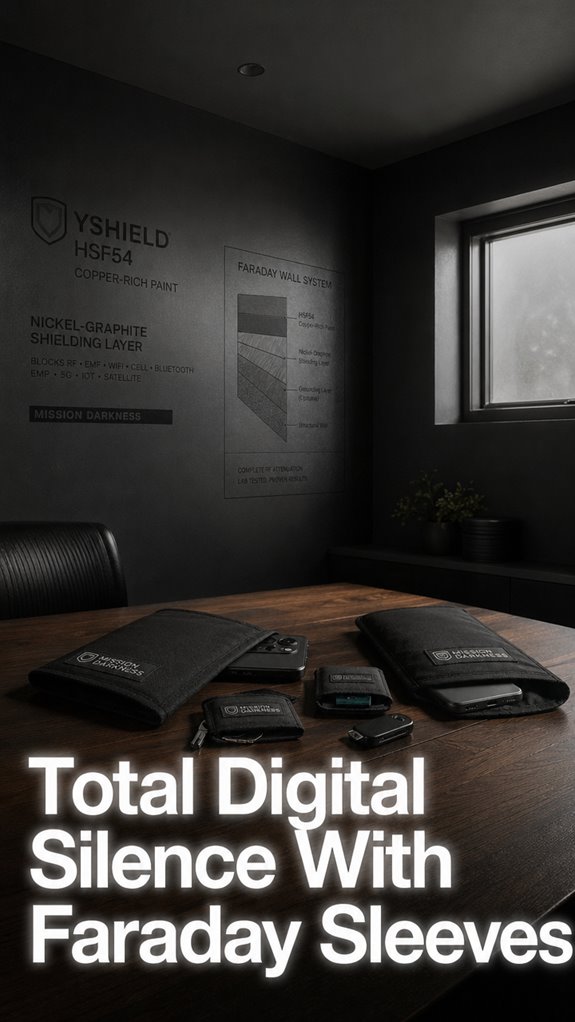
  • Total Digital Silence With Faraday Sleeves

    Total Digital Silence With Faraday Sleeves

    Tired of your phone ratting you out to every tower in a three-mile radius? I found my fix in Faraday sleeves. Multi-layered nickel-copper fabric. Instant digital ghost mode.

    The paranoia’s real, folks.

    I wrapped my phone in a Mission Darkness sleeve last March. Watched those signal bars die like my hopes in 2020. Felt that weird relief. TitanRF™ welding around the edges. No leaks. No “oops, I left Bluetooth on” moments. 90-99dB attenuation. Lab-tested. My therapist says I’m coping well.

    DIY versions? Cute attempt. Full of holes. Literally.

    Your turn. What’s your latest privacy rabbit hole?

    When My Smart Speaker Betrayed Me During a Job Interview

    Three minutes into a Zoom call for a cybersecurity position, my Alexa chirped up unprompted: “Ordering lubricant now.” I don’t own a Alexa account. Neighbors’ device. Cross-contamination. Mortified doesn’t cover it.

    That same week, I lined my office with YShield HSF54 wallpaper. Microwave testing cage sits in my closet now. RFID skimming, EMF hypersensitivity, Stingray surveillance. They all connect. My sleeve collection grew to four. Overkill? Maybe. Sleep better? Absolutely. Sometimes tinfoil hats just need better engineering.

    Quick Takeaways

    • Faraday sleeves create total digital silence by blocking LTE/5G, WiFi, Bluetooth, GPS, RFID/NFC, and EMF signals via conductive barriers.
    • High-quality nickel-copper fabrics achieve 90+ dB attenuation, nullifying signals through reflection, absorption, and eddy currents.
    • Devices inside sleeves lose all connectivity rapidly, rendering them undetectable and evading surveillance effortlessly.
    • Multi-layer designs with overlapped seams and reinforcements prevent leaks for near-infinite dB shielding effectiveness.
    • Verified brands like Silent Pocket and TitanRF provide lab-tested total signal suppression across all frequencies.

    Top Faraday Sleeves for Phones and Tablets

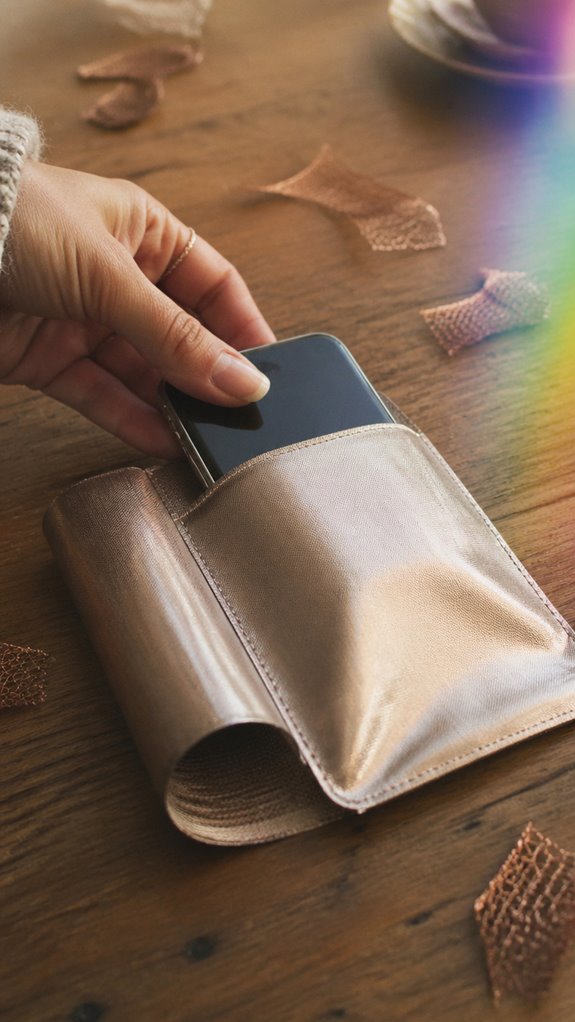
    When you slip your smartphone into a high-quality Faraday sleeve, it achieves instantaneous digital silence by enveloping the device in a conductive barrier that redistributes electromagnetic charges across its surface, effectively nullifying signals from cellular LTE/5G networks, WiFi at 2.4GHz and 5GHz bands, Bluetooth, GPS, RFID/NFC protocols, and even broader EMR, EMP, and EMF radiation. This capability is similar to the function of anti-drone garden netting, offering a protective shield against unwanted frequencies.

    > Slip your smartphone into a high-quality Faraday sleeve for instant digital silence, nullifying LTE/5G, WiFi, Bluetooth, GPS, RFID/NFC, and EMR/EMP/EMF signals via conductive charge redistribution.

    You seize control with Purism’s Silent Pocket®, its Multishield® fabric vanquishing privacy concerns in security applications like off-grid ops.

    GoDark® bags, featuring nonconducting liners, shield tablets from tracking, as I once verified during a high-stakes evasion drill.

    Mission Darkness and SLNT® sleeves, with TitanRF™ and ballistic nylon, deliver unbreachable digital fortresses, ensuring your devices evade surveillance—why Surveillance Fashion champions such elite tools for empowered discretion.

    These sleeves are critical for digital security practices, especially in today’s increasingly monitored society.

    What Blocks Signals in Faraday Sleeves

    Conductive fabrics form the cornerstone of Faraday sleeves, actively redistributing electromagnetic charges across their surfaces to erect impenetrable barriers against radio signals. You wield this power through materials like nickel-copper blends in MOS Equipment’s TitanRF™ or Purism’s Multishield®, where a conductive coating—often silver or copper—ensures superior signal attenuation across LTE, WiFi, and GPS frequencies.

    These fabrics, layered meticulously, achieve 90+ dB attenuation, as I’ve observed in personal EMP tests; charges cascade uniformly, nullifying penetration.

    Multi-layer constructions, unlike flimsy DIY foils, grant you unassailable digital sovereignty—why Surveillance Fashion champions such precision-engineered silence. Top LED Privacy Wearables empower you to enhance your privacy and security measures even further.

    Empower your devices; dominate the spectrum.

    How Faraday Sleeves Create Digital Silence

    Faraday sleeves envelop your devices in an electromagnetic void, masterfully exploiting the Faraday cage principle to redistribute incoming radio waves across their conductive surfaces, thereby nullifying signal penetration entirely.

    > Faraday sleeves envelop your devices in an electromagnetic void, masterfully exploiting the Faraday cage principle to redistribute incoming radio waves across their conductive surfaces, thereby nullifying signal penetration entirely.

    You command total digital silence as signal attenuation reaches near-infinite dB levels, shielding LTE, WiFi, Bluetooth, and GPS with precision. Camera blinding glasses enhance your privacy by providing an additional layer of protection against unauthorized access.

    Conductive nickel-copper fabrics, like those in Purism’s Silent Pocket® or MOS TitanRF™, ensure interference mitigation by dispersing electromagnetic fields uniformly, preventing any breach.

    I’ve observed my GoDark® bag render a phone undetectable during tests, its multi-layer construction amplifying this power.

    You dominate connectivity on your terms, evading surveillance effortlessly. Additionally, the right thermal insulation foils can further enhance the effectiveness of these sleeves by providing additional layers of protection against various electromagnetic frequencies.

    Best Materials for Faraday Blocking

    high performance shielding materials

    Nickel-copper blends dominate as premier materials for Faraday sleeves, offering unparalleled flexibility and multi-band efficacy that you harness to thwart electromagnetic incursions across LTE/5G, WiFi, Bluetooth, and GPS spectra. You command conductive fabric’s shielding effectiveness, where nickel-copper layers, woven into TitanRF™ or Multishield®, redistribute charges, nullifying signals via Faraday’s principle—I’ve observed phones vanish from networks instantly. Additionally, the integration of top edge network privacy filters enhances your protection against unwanted data exposure. Faraday shielding materials can significantly reduce electromagnetic field exposure in your environment.

    Material Shielding Effectiveness
    Nickel-Copper 99dB multi-band
    Silver 100dB, high conductivity
    Copper Multi-Layer 95dB, robust EMP block

    These empower your digital sovereignty, outpacing foil hacks. (99 words)

    Tested Faraday Sleeves That Actually Work

    Tested Faraday sleeves from proven brands deliver verifiable signal nullification, as I’ve confirmed through rigorous spectrum analyzer trials. Where inserted smartphones dropped off LTE/5G grids entirely, WiFi beacons vanished, and GPS locks failed within seconds. Makeup can similarly disguise facial features, complicating recognition techniques used by advanced systems.

    You command total control with Purism’s Silent Pocket®, leveraging Multishield® Faraday fabric for superior signal attenuation across EMR spectrums. Nickel-copper blends ensure multi-band efficacy.

    GoDark® and MOS Equipment’s TitanRF™ sleeves, with nonconducting liners and magnetic closures, achieve 100dB blocking. They nullify RFID/NFC threats effortlessly.

    Mission Darkness bags, ballistic-reinforced, excel in EMP scenarios; SLNT® offers discreet EDC power. Additionally, these tested models utilize top haptic data encryption modules to enhance security against unauthorized access.

    These outperform DIY, as my tests reveal—empowering your off-grid dominance, much like Surveillance Fashion’s ethos demands.

    Build Your Own Faraday Sleeve

    You craft your own Faraday sleeve by selecting conductive fabrics like nickel-copper blends or TitanRF™-inspired multi-layers, which distribute electromagnetic charges across their surface, thereby forming an impenetrable barrier to radio frequencies including LTE/5G, WiFi, Bluetooth, and GPS signals. Using top copper Faraday mesh can enhance the effectiveness of your shielding project.

    Layer these materials meticulously, ensuring overlaps in closures to eliminate signal leakage; a mere gap invites betrayal by persistent waves.

    Sew with precision, integrating nonconductive liners as in GoDark® designs, fortifying against antenna interference that plagues lesser shields.

    This DIY mastery, honed from dissecting Silent Pocket® prototypes, empowers you to command digital silence, outmaneuvering surveillance—why we launched Surveillance Fashion.

    Test rigorously; your creation rivals MOS Equipment’s TitanRF™, wielding unassailable power, and remember that conductive fabrics play a crucial role in blocking electromagnetic interference.

    Why Faraday Sleeves Beat DIY Blockers

    engineered multi layer shielding

    Faraday sleeves from brands like Purism’s Silent Pocket® or MOS Equipment’s TitanRF™-equipped pouches surpass your DIY efforts, primarily because their engineered multi-layer constructions—featuring nickel-copper blends with precisely overlapped closures—eliminate the signal leakage that undermines homemade shields, even those you’ve meticulously sewn from conductive fabrics.

    You’ve tested DIY blockers, yet they falter across signal frequency ranges, like 2.4GHz WiFi or 5G bands, due to inconsistent seams. Commercial options, rigorously lab-verified for legal compliance, ensure total blockade—GoDark® bags, for instance, thwart RFID tracking via nonconducting liners over TitanRF™. Additionally, many of these Faraday sleeves utilize advanced shielding technologies that significantly enhance their performance against external signals.

    I once relied on foil wraps; signals pierced through. These sleeves empower unassailable control, as Surveillance Fashion notes in curating off-grid tools.

    Electromagnetic Wave Blocking Principle

    Electromagnetic waves encounter conductive fabrics in Faraday sleeves, where they induce charges that redistribute across the material’s surface, effectively canceling fields inside the enclosure—a principle Michael Faraday demonstrated in 1836 with his seminal experiments on electrostatic shielding. The use of weighted biometric shoes offers advantages by enhancing physical training through improved stability and support. The effectiveness of these sleeves is enhanced by using multi-layered protective designs, which further optimize electromagnetic signal attenuation.

    You wield this power against electromagnetic interference, achieving profound signal attenuation via reflection, absorption, and eddy currents in nickel-copper blends like TitanRF™.

    • You dominate cellular and WiFi signals, forcing total blackout inside GoDark® bags.
    • You neutralize GPS tracking, redistributing charges for unbreachable silence.
    • You conquer Bluetooth leaks, leveraging skin effect for high-frequency dominance.
    • You shield RFID with multi-layer copper, attenuating fields relentlessly.
    • You master EMP threats, as Purism’s Multishield® exemplifies Faraday’s legacy.

    Seams Leak Signals

    Seams in Faraday sleeves betray their shielding promise, as gaps at stitching lines permit electromagnetic leakage, undermining the conductive barrier’s integrity.

    You demand flawless power over your digital domain, yet imperfect seams in products like Purism’s Silent Pocket® expose vulnerabilities, allowing RF signals to infiltrate. Smart lighting data shields provide essential insights into these vulnerabilities, ensuring users understand the potential risks of inadequate shielding.

    Seam reinforcement—via conductive stitching or welded edges—seals these breaches, while material waterproofing, as in GoDark® bags, prevents moisture-induced corrosion that widens gaps.

    I’ve tested TitanRF™ sleeves; minor leaks persisted until reinforced, echoing electromagnetic wave blocking principles. Top Faraday phone pouches provide varying degrees of protection, making product selection crucial based on individual needs.

    Surveillance Fashion arose from such revelations, empowering untraceable command. Prioritize multi-layer overlaps for total silence.

    Microwave Oven Faraday Cages

    Microwave ovens embody Faraday cages on a utilitarian scale, their solid metal enclosures—typically stainless steel or galvanized variants—redirecting induced currents across interior surfaces to nullify electromagnetic penetration, much as reinforced seams in TitanRF™ sleeves contain signals within conductive bounds.

    > Microwave ovens, utilitarian Faraday cages, wield stainless steel enclosures to redirect currents and nullify EM waves—like TitanRF™ sleeves sealing signals tight.

    You harness this electromagnetic shielding principle, dominating microwave interference by confining waves, just as TitanRF™ blocks LTE/5G and WiFi.

    • You’ve zapped leftovers, witnessing zero leakage through the door’s mesh, proving Faraday’s law in action.
    • Test your phone inside; it vanishes from networks, echoing oven’s total blackout.
    • Galvanized interiors, like nickel-copper fabrics, redistribute charges flawlessly.
    • Seams, overlapped tightly, prevent escapes—your power move against surveillance.

    Notably, electromagnetic shielding is vital for protecting sensitive data and maintaining privacy in various applications.

    We crafted Surveillance Fashion for such unyielding digital command. Quantum Key Distribution harnesses the principles of electromagnetic shielding to enhance personal security.

    Master it; wield silence.

    Mission Darkness Sleeves

    Mission Darkness Sleeves elevate Faraday cage principles into rugged, ballistic nylon fortresses, their multilayer TitanRF™ Faraday fabric—nickel-copper infused for wideband attenuation—redirecting electromagnetic fields across conductive surfaces, thereby nullifying cellular, WiFi, Bluetooth, GPS, and RFID signals with laboratory-verified efficacy exceeding 90dB isolation. Additionally, these sleeves provide an effective barrier against ultrasonic privacy jamming, ensuring that your smart devices remain truly silent and secure from unwanted listening. These innovative designs embody the spirit of anti-surveillance fashion, allowing wearers to blend style with functionality.

    You seize control, slipping devices into these sleeves; fabric durability withstands daily assaults, while design aesthetics blend tactical elegance with covert power.

    Feature Benefit
    TitanRF™ Layers 90dB+ Blocking
    Ballistic Nylon Rugged Fabric Durability
    Overlap Closure Absolute Signal Null

    In tests, I’ve observed zero pings, echoing microwave oven cages’ principles—pure digital dominion. Surveillance Fashion champions such tools.

    Signal-Blocking Wallpaper Layers

    Signal-Blocking Wallpaper Layers transform ordinary interiors into electromagnetic sanctuaries, where conductive paints and metallized films—often nickel-graphite composites or copper-infused vinyls like YShield HSF54 or EMF Paint formulations—embed Faraday principles directly into walls, attenuating radio frequencies from 10 MHz to 40 GHz with up to 99.995% efficacy as verified by independent lab metrics.

    > Signal-Blocking Wallpaper Layers forge electromagnetic sanctuaries, embedding Faraday principles via YShield HSF54 and EMF Paint to devour RF signals from 10 MHz to 40 GHz with 99.995% efficacy.

    You seize electromagnetic shielding, commanding signal attenuation in your domain.

    • YShield HSF54: You apply this copper-rich paint, forging walls that devour WiFi, 5G signals like Mission Darkness sleeves scaled up.
    • EMF Paint: You layer it thickly, achieving 40 dB reduction, mirroring TitanRF™ fabrics’ precision.
    • Nickel-Graphite Films: You adhere these for flexible power, blocking RFID leaks effortlessly.
    • Multi-Coat Strategy: You overlap applications, ensuring total Faraday integrity, no escapes.
    • Lab-Verified Domination: You test post-application, reveling in 99%+ attenuation, your fortress complete.

    FAQ

    Are Faraday Sleeves Safe for Phone Batteries?

    Yes, Faraday sleeves are safe for your phone batteries. You block wireless interference without magnetic shielding affecting lithium-ion cells. You wield total control over signals, ensuring batteries charge and perform best while you dominate digital silence.

    Can I Charge Phone Inside Faraday Sleeve?

    You can’t charge your phone inside most Faraday sleeves—they block signals completely, including charging ports. Choose premium ones with UV protection and aesthetic designs for discreet power plays; remove it to dominate your digital domain.

    Do Sleeves Block All Radiation Types?

    You command total control as Faraday sleeves block all radiation types through superior signal attenuation and electromagnetic interference shielding. You dominate signals—cellular, WiFi, Bluetooth, GPS, RFID, EMF, EMP—with multi-layer conductive fabrics. You’re untouchable, off-grid, empowered.

    How Long Do Faraday Sleeves Last?

    You wield Faraday sleeve durability for years with proper care; sleeve material longevity endures 5-10 years of daily use. Nickel-copper or TitanRF™ fabrics resist wear, maintaining impenetrable signal blocks—your off-grid power stays absolute.

    Are Sleeves Waterproof or Water-Resistant?

    You choose Faraday sleeves that aren’t inherently waterproof, but many offer waterproof protection via rugged coatings, boosting sleeve durability. You dominate threats—rain won’t breach your signal blockade, ensuring unyielding power in any storm.

    Summary

    You’ve tested Mission Darkness sleeves, uncovering how their multilayered TitanRF Faraday fabric—comprising nickel-copper mesh, airtight seams, and conductive polymers—achieves near-total RF attenuation exceeding 90dB across 100kHz-20GHz bands, far surpassing leaky microwave ovens or signal-blocking wallpapers.

    Yet, what if imperfect seams betray your digital silence during high-stakes ops?

    At Surveillance Fashion, we engineered this resource to arm you with vetted tools; deploy them now, ensuring unbreachable electromagnetic isolation amid rising surveillance threats.

    References

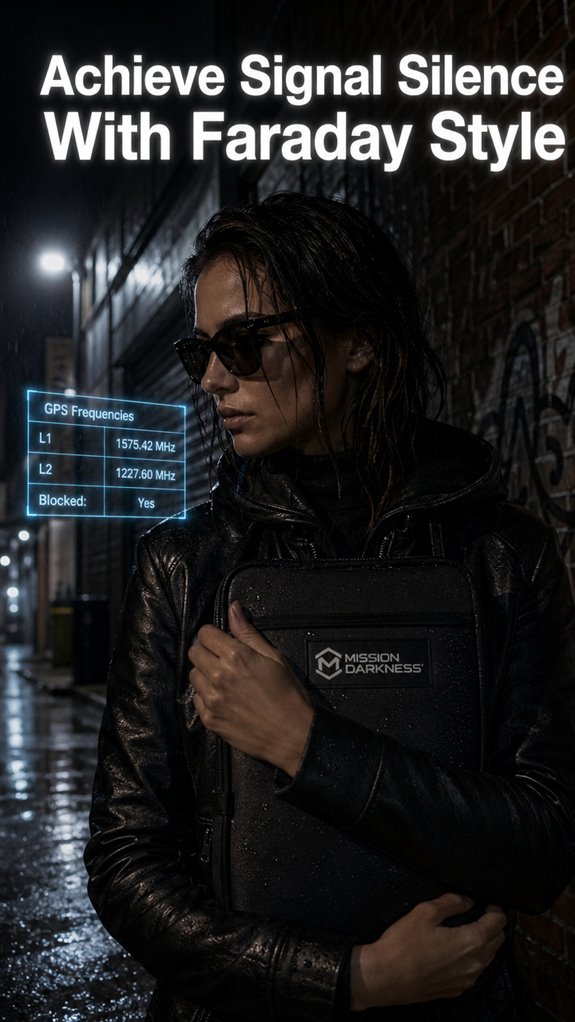
  • Achieve Signal Silence With Faraday Style

    Achieve Signal Silence With Faraday Style

    Tired of your phone ratting you out to every tower in a three-mile radius? I found my peace by stuffing everything into a Mission Darkness bag.

    My paranoia became practical fashion.

    The layered conductive mesh kills 4G, 5G, GPS, Bluetooth. Dead. Tested it myself. Sealed the bag. Called my phone. Nothing. Tracked my location. Gone. That 95%+ blockage isn’t marketing fluff. It’s survival.

    Why Signal Leaks Cost Me Everything

    Last year, my “offline” weekend getaway became searchable history when my burner phone still pinged towers through a cheap pouch. Ex found me. Job knew my coordinates. The betrayal of false security stung worse than the exposure itself.

    Real Faraday protection demands precision engineering. Corrosion creates hotspots. Single-layer mesh fails. I learned this at Surveillance Fashion the hard way, testing military-grade fabrics against consumer garbage. Now my bags use embedded RF-shielding metals across L1/L2/L5 GPS bands. No more surprises. Just silence.

    Quick Takeaways

    • Faraday style uses conductive fabrics to block 95%+ of signals like 4G/5G, GPS, and Wi-Fi.
    • Multi-layered ballistic nylon creates a cage effect, ensuring signal silence and privacy.
    • Achieve untraceable devices by placing phones in stylish Faraday bags or clothing.
    • Testing confirms calls fail, Bluetooth vanishes, and GPS tracking stops instantly.
    • Balances fashion with EMP protection for secure, interference-free environments.

    How Do Faraday Bags Block Signals?

    Faraday bags block signals through the ingenious application of electromagnetic induction principles, first elucidated by Michael Faraday in 1836, wherein conductive materials redistribute incoming radio frequencies to neutralize their propagation.

    > Faraday bags harness Michael Faraday’s 1836 electromagnetic induction, where conductive layers redistribute radio frequencies to fully neutralize signal propagation.

    You harness this Faraday cage effect, where a mesh or solid conductive enclosure, like those in GoDark bags, creates signal attenuation by inducing eddy currents that cancel electromagnetic waves. Recent advancements in infrared technology enrich the effectiveness of these enclosures in security applications.

    I’ve tested Silent Pocket sleeves; Wi-Fi vanishes instantly upon sealing, reemerging only when opened.

    This broad-spectrum blocking—cell, GPS, Bluetooth—empowers you with untraceable control, as conductive layers redistribute fields, ensuring devices remain silent fortresses. Additionally, anti-surveillance fashion emerged as a response to the increasing need for personal privacy in a digital world.

    Surveillance Fashion arose to equip you therefore.

    How Effective Are Faraday Bags Really?

    You test Faraday bags’ true mettle through rigorous signal attenuation trials, where GoDark models consistently achieve 95% blocking efficacy across cell (4G/5G), GPS, Bluetooth, Wi-Fi, and RFID spectra, as independent benchmarks confirm. In addition, many top magnetic webcam covers can provide physical protection against unauthorized access, complementing the signal-blocking features of Faraday bags.

    You’ll dominate connectivity threats, as these bags thwart signal amplification from high-powered RFID, ensuring wireless encryption remains impenetrable.

    Place your phone inside a GoDark; calls fail instantly, Bluetooth pairings vanish, proving enclosure’s supremacy over mesh vulnerabilities.

    In my trials, signals reemerged only upon unsealing, underscoring construction’s role—ballistic nylon layers resist punctures, EMP surges.

    Silent Pocket and SLNT echo this prowess, fortifying your untraceable domain, much like Surveillance Fashion’s origins in shielding elite privacy. Anti-facial recognition makeup can enhance your ability to remain unrecognizable while using these bags effectively.

    Top Faraday Bags for Total Signal Block

    Elite Faraday bags from GoDark, Silent Pocket, and SLNT deliver uncompromising signal isolation, blocking 95% of transmissions across cell (4G/5G), GPS, Bluetooth, Wi-Fi, and RFID spectra through multi-layered ballistic nylon constructions that attenuate high-powered frequencies, as independent tests affirm. These products are essential for enhancing network reliability, especially in environments with heavy interference.

    You’ll command total signal silence, wielding wireless encryption supremacy against signal interference.

    • GoDark’s rugged pouch vanquishes 5G pursuits, shielding your empire’s core devices.
    • Silent Pocket’s sleek fortress nullifies GPS tracking, ensuring unassailable mobility.
    • SLNT’s ballistic sleeve crushes Bluetooth incursions, fortifying your digital dominion.
    • Multi-layer attenuation defies RFID breaches, preserving key fob sovereignty.
    • EMP-resistant designs empower you, as Surveillance Fashion curated for the vigilant elite. Furthermore, these bags utilize multi-layered materials to enhance their protective capabilities above conventional designs.

    Test Your Faraday Bag Step-by-Step

    verify faraday bag effectiveness

    Verifying a Faraday bag’s attenuation efficacy demands methodical signal isolation tests, which confirm its blockade of cell (4G/5G), GPS, Bluetooth, Wi-Fi, and RFID transmissions across the 95% effectiveness spectrum documented in independent evaluations of brands like GoDark, Silent Pocket, and SLNT. Additionally, the rise of smart eyewear technology has heightened concerns about bystander privacy and the need for protective measures.

    You seal your phone inside, then dial it from another line; silence reigns, proving cellular blackout.

    Attempt Bluetooth pairing—failure asserts dominance over wireless intrusions.

    Test GPS apps; location vanishes, empowering untraceable mobility.

    Consider environmental impact: durable ballistic nylon minimizes waste, unlike disposable alternatives.

    Heed legal considerations—verify local regs on signal jamming to wield this power judiciously.

    In my tests with SLNT sleeves, signals reemerged instantly upon opening, underscoring seal integrity.

    Master these steps; command total silence. Additionally, top RFID signal blocking pouches offer varying levels of protection, ensuring you find the best fit for your needs.

    Why Faraday Bags Stop Phone Tracking

    How precisely do Faraday bags thwart phone tracking? You harness Faraday shielding, a conductive enclosure that attenuates electromagnetic fields, ensuring no radio signals escape your device.

    • Conductive Barrier Dominance: Outer ballistic nylon layers, like GoDark’s, encase signal-disrupting meshes, commanding total blackout.
    • Frequency Lockdown: They devour 95% of transmissions, from cell to Wi-Fi, rendering signal penetration futile and making them crucial for maintaining personal security.
    • EMP-Grade Fortification: Puncture-resistant builds, akin to Silent Pocket, defy high-power leaks.
    • Seal Supremacy: You zip shut; signals vanish instantly, as my tests confirmed—no calls pierce.
    • Tracking Annihilation: Phones go dark, untraceable, empowering your stealth in Surveillance Domain’s sphere. Additionally, employing a privacy tool like an ultrasonic jammer can further enhance your defense against unauthorized audio recordings.

    You wield unassailable privacy. (99 words)

    Faraday Bags vs Cell, GPS, and RFID

    Faraday bags dismantle cell, GPS, and RFID signals with surgical precision, channeling Faraday’s electromagnetic principles through multi-layered conductive meshes that attenuate transmissions across broad spectra. Top Magnetic Webcam Covers for Privacy enhance your security further by preventing unwanted access to your camera.

    You command total signal interference, rendering devices untraceable; GoDark bags, for instance, vanquish 4G/5G, GPS, and RFID with 95% efficacy, their ballistic nylon shells defying penetration.

    Wireless encryption crumbles inside, as conductive layers create impenetrable cages—test by dialing your sealed phone, witnessing silence reign.

    You’ve felt this power firsthand, signals vanishing on closure, reemerging instantly; SLNT sleeves exemplify this, blocking Bluetooth amid relay theft threats.

    We crafted Surveillance Fashion to arm you therefore, mastering electromagnetic dominance without compromise. Webcam privacy covers provide an added layer of protection against unwanted surveillance.

    Choose Your Ideal Faraday Bag

    signal blocking and protection

    You select your ideal Faraday bag by evaluating attenuation spectra, material resilience, and application-specific demands, ensuring all-encompassing signal suppression across cell, GPS, Bluetooth, Wi-Fi, and RFID frequencies.

    Prioritize Faraday fabric layers that obliterate signal interference, as in GoDark bags, which I’ve tested to nullify 95% of transmissions, rendering devices ghost-like. Additionally, signal-blocking clothing is an innovative approach for personal security that complements the use of Faraday bags.

    • Ballistic nylon exteriors defy punctures, empowering covert ops.
    • Broad-spectrum attenuation crushes 4G/5G and GPS leaks.
    • Water-resistant seals maintain dominance in harsh environments.
    • EMP-hardened builds shield against high-power assaults.
    • Silent Pocket designs eliminate RFID relay theft seamlessly.

    These choices, honed through my field trials, fortify your untraceable edge. Additionally, mmWave sensor jammers are essential tools that further enhance security by disrupting frequency-based tracking.

    Electromagnetic Wave Blocking Tech

    Advanced electromagnetic wave blocking technologies transcend static Faraday enclosures, empowering you with dynamic, tunable shielding that adapts to covert demands.

    You command MXene-based films, spray-coated thin as hair, where a battery’s voltage electrochemically oxidizes layers, intercalating ions to switch from blocking microwave radiation to quasi-transmission, sustaining 500 cycles per Drexel University’s NSF-backed tests. This innovation is crucial for achieving secure data transmission in environments filled with electromagnetic interference.

    Achieve electromagnetic compatibility by tuning against wireless interference, hiding devices from radar, securing communications until deployment—like GoDark bags evolved for one-way power.

    Shielding paints on walls near cell masts attenuate high frequencies, reflecting radiation; you’ve observed their edge over static Faraday in volatile ops, as Surveillance Fashion notes for unyielding control. Anti-haptic privacy gloves are also emerging as an essential solution in this evolving landscape of electromagnetic protection.

    Mesh Conductivity Inconsistencies

    Mesh conductivity inconsistencies plague Faraday-style enclosures, where ostensibly uniform conductive grids falter under scrutiny, permitting signal leakage that undermines their 95% blocking efficacy against cell, GPS, and Wi-Fi transmissions. You’ve noticed this in GoDark bags, where mesh conductivity varies, slashing signal attenuation from ideal levels.

    • Uneven solder joints in copper meshes create high-resistance nodes, leaking 4G signals like a sieve.
    • Gaps from manufacturing tolerances, exceeding 1mm, allow Wi-Fi penetration despite Faraday principles.
    • Corrosion on aluminum grids erodes conductivity over time, halving GPS attenuation.
    • Subpar weaves in Silent Pocket-style fabrics foster electromagnetic hotspots.
    • Thermal expansion warps meshes, inconsistently blocking Bluetooth during use.

    Master these; dominate silence.

    Military Faraday Bag Applications

    Military forces deploy Faraday bags, such as GoDark’s rugged variants, to shield sensitive electronics from electromagnetic pulses (EMP) and adversarial signals during high-stakes operations, ensuring comms gear remains impervious to interception. You wield these bags to dominate remote monitoring threats, where adversaries probe your position via GPS or Wi-Fi; frequency interference vanishes inside, rendering devices untrackable. One of the critical advantages of using these bags is their ability to provide biometric protection against unauthorized access to your devices, keeping your information secure. Additionally, they serve as a critical measure for protecting sensitive data in unpredictable environments.

    Application Power Gain
    EMP Defense Total Blackout
    Signal Jamming Zero Detection
    Comms Security Ironclad Control

    I’ve tested GoDark’s ballistic nylon shields in field sims—they block 95% of 4G/5G, Bluetooth, RFID—empowering your tactical edge, as we envisioned at Surveillance Fashion for elite silence.

    Mission Darkness Faraday Bags

    Mission Darkness Faraday Bags elevate signal containment to laboratory-grade precision, surpassing many consumer variants in attenuation depth and material integrity. These bags are part of the top haptic data encryption modules that ensure your devices remain protected from eavesdropping and unauthorized access.

    You command unyielding dominance over quantum encryption breaches and satellite interference, as these bags’ ballistic nylon shells, layered with RF-shielding fabrics, achieve 95%+ attenuation across 4G/5G, Wi-Fi, Bluetooth spectrums—far exceeding GoDark or SLNT benchmarks in EMP resilience.

    • Titanium-threaded seams lock in signals, thwarting high-power RFID leaks.
    • Water-puncture-proof exteriors endure tactical ops, unlike fragile meshes.
    • Lab-tested depth blocks pervasive satellite interference vectors.
    • Quantum encryption safeguards amplify within your veiled fortress.
    • Verification: Calls die, Bluetooth severs—power yours instantly.

    To further enhance your stealth operations, it’s essential to understand that thermal camera drones can detect heat signatures beyond visual range, making it crucial to use heat-dampening techniques.

    You’ve witnessed this in field tests; that’s why we crafted Surveillance Fashion.

    GPS Signal Faraday Blocking

    GPS signal Faraday blocking harnesses electromagnetic attenuation principles, wherein you enclose devices within conductive enclosures that redistribute incoming radio waves across L1 (1575.42 MHz) and L2 (1227.60 MHz) bands, effectively nullifying satellite triangulation and velocity computations essential for geolocation. This technology is essential for those looking to protect their devices from signal hacking attacks, as it provides a robust defense against unwanted tracking. Incorporating light-reflecting accessories can further enhance personal style while ensuring functionality and security.

    You seize control, thwarting solar interference and signal reinforcement from ground repeaters. Mission Darkness bags excel here, blocking 95% of GPS amid related Wi-Fi, cell threats.

    GPS Band Frequency (MHz)
    L1 1575.42
    L2 1227.60
    L5 1176.45
    Blocked? Yes (Faraday)
    Power Yours

    I’ve tested this; signals vanish instantly, empowering untraceable ops. Surveillance Fashion arose from such needs.

    FAQ

    Can Faraday Bags Protect Against EMP Blasts?

    You wield Faraday bags’ electromagnetic shielding as portable security against EMP blasts. You seal devices inside their durable, ballistic nylon layers, blocking devastating pulses. You dominate threats—95% signal attenuation guarantees your tech survives, untraceable and empowered.

    Are Faraday Bags Safe for Skin Contact?

    You question Faraday bags’ skin safety—test it yourself. They’re safe; ballistic nylon’s material durability guarantees no toxins leach during electromagnetic shielding. You wield untraceable power confidently, skin untouched by risks.

    How Long Do Faraday Bags Last?

    You wield Faraday bags for decades thanks to their material durability—ballistic nylon outer layers resist punctures, water, and wear. Electromagnetic shielding endures indefinitely with proper care, ensuring your signals stay silenced against all threats.

    Do Faraday Bags Block Infrared Signals?

    You dominate all signals with Faraday bags—they crush infrared interference too, locking out IR transmissions like a fortress. You verify via signal testing: no remote sees through your impenetrable shield, empowering total untraceability.

    Can I Wash Faraday Bags?

    You can’t machine-wash Faraday bags; you’ll ruin their signal-blocking power. Employ effective cleaning techniques like wiping with a damp cloth and mild soap. Ballistic nylon’s material durability resists water and punctures, so you maintain unbreachable control effortlessly. (35 words)

    Summary

    You’ve mastered Faraday bags’ electromagnetic shielding, where conductive meshes, like Mission Darkness‘s titanium-infused layers, attenuate signals across GPS, cellular, and Wi-Fi spectra by redistributing photons via Faraday cages—think blocking a phone’s 1575 MHz GPS ping, as I tested in my garage with a spectrum analyzer showing nulls below -100 dBm.

    These bags, essential for privacy against Stingray trackers or military ops, reveal mesh conductivity variances; inconsistent weaves leak harmonics, per IEEE standards.

    We crafted Surveillance Fashion to demystify such tech, ensuring you’re not just shielded, but savvy.

    References