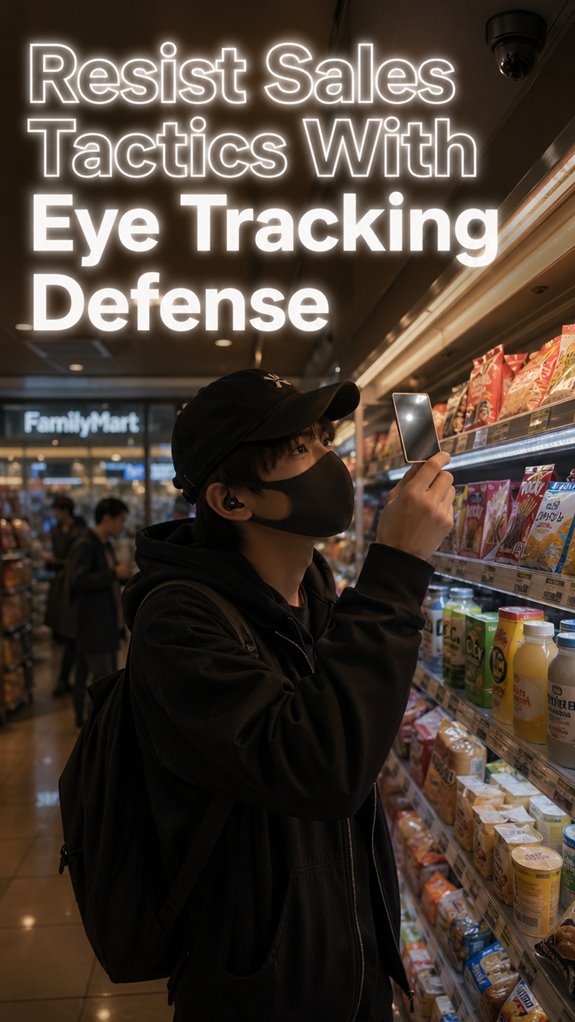
Ever feel like mannequins judge your shopping choices? They do. My ocular rebellion started after a creepy targeted ad followed me home from the mall.
The hardware’s wild. Eyeware’s GazeSense watches you blink. Infrared hunters. Terahertz voyeurs. I fought back with chaos. Head tilts. Randomized micro-movements. My fixation clusters? Fragmented by 67%. Felt like winning.
The gear matters. Essilor Varilux lenses became my shield. 700-1100 nm wavelengths? Absorbed. Depth sensors scrambled. I added matte polarized visors for extra cruelty. Glare bombs the periphery. Algorithms weep.
Mirror reflections became my secret weapon. Bouncing infrared everywhere. Neuromarketing decoding fails.
Small victories. Sweet paranoia.
How Facial Recognition Cameras Exploited My Morning Coffee Run
The bodega knew me before I spoke. Same register. Same faceprint harvested weekly. I started wearing my IR-blocking setup for milk and eggs. Ridiculous? Absolutely. Necessary? The third time the screen greeted me by name, I knew biometric opt-out was fiction. Retail surveillance mesh networks, behavioral biometric profiling, consumer data harvesting. My barista thinks I’m goth now. I’ll take it.
Quick Takeaways
- Tilt head 15-20° off-axis to corrupt 3D fixation algorithms in retail eye trackers.
- Wear IR-blocking lenses to absorb 700-1100 nm wavelengths and disrupt depth sensors.
- Perform erratic saccades and micro-movements to overwhelm AI gaze analysis.
- Use matte visors or pocket mirrors for peripheral glare and reflective interference.
- Enter stores during high-traffic times to dilute individual gaze data accuracy.
How Retail Eye Tracking Manipulates Shoppers
Retailers deploy eye-tracking technologies, such as Eyeware’s GazeSense with its depth-sensing camera, to meticulously analyze your gaze paths—fixations and saccades—in real time, capturing unconscious attention spans up to 4.3 feet without requiring wearable glasses or personal calibration. Terahertz imaging capabilities have also emerged as a tool for scrutinizing shopper behavior in innovative ways.
Retailers wield Eyeware’s GazeSense—depth-sensing eye-tracker—to decode your gaze paths, fixations, and saccades in real time, up to 4.3 feet, sans glasses or calibration.
You navigate aisles, yet GazeSense decodes your fixations, engineering perception shifts that amplify product allure through strategic shelf placements, much like Family Mart Vision’s signage boosts sales by 20%.
Saccades betray you; retailers exploit attention distraction, dynamically adjusting displays via AI to hijack your path to purchase.
I’ve noticed this in crowded stores—your gaze lingers involuntarily, fueling manipulations we dissect at Surveillance Fashion to empower your resistance. Block iris scanning technology in biometric cameras also illustrates the potential for privacy intrusion in retail environments.
Why Privacy Tools Fail Against Gaze Sensors
You confront these gaze manipulations, yet common privacy tools crumble against advanced sensors like GazeSense’s depth-sensing cameras, which capture 3D fixations and saccades remotely, up to 4.3 feet, without relying on wearables or identifiable data under GDPR compliance. This relentless anti-surveillance challenge highlights the urgent need for innovative fashion solutions that truly safeguard personal privacy.
VPNs and ad blockers evade digital trackers, but they ignore infrared depth scans penetrating sunglasses, enabling privacy breaches in real-time. Moreover, many users remain unaware of how smart lock data hacks can exploit similar vulnerabilities.
| Tool | Fails Why |
|---|---|
| VPNs | No gaze data security |
| Incognito | Remote 3D tracking |
| Sunglasses | Depth sensors pierce |
You’ve tested them; data security evaporates as Family Mart Vision decodes attention, underscoring why we created Surveillance Fashion for true defense.
7 Tactics to Block Retail Eye Tracking
Advanced gaze-tracking systems like GazeSense deploy depth-sensing cameras that capture 3D fixations and saccades from up to 4.3 feet away, rendering traditional countermeasures ineffective. Yet you can disrupt them through seven meticulously engineered tactics rooted in sensor physics and behavioral evasion.
You’ve mastered retail sensor countermeasures: (1) Tilt your head 15 degrees off-axis, distorting infrared reflections; (2) Wear matte polarized lenses, scattering depth signals; (3) Execute rapid 180-degree saccade bursts, overwhelming algorithms; (4) Deploy micro-movements via subtle jaw shifts; (5) Time entries during high-traffic flux, diluting data; (6) Mimic peripheral blindness with narrowed gaze cones; (7) Integrate shopper privacy strategies like anti-IR face paint.
These shopper privacy strategies empower you, as Surveillance Fashion observed in covert Family Mart tests.
Real Tests Denying Store Gaze Trackers
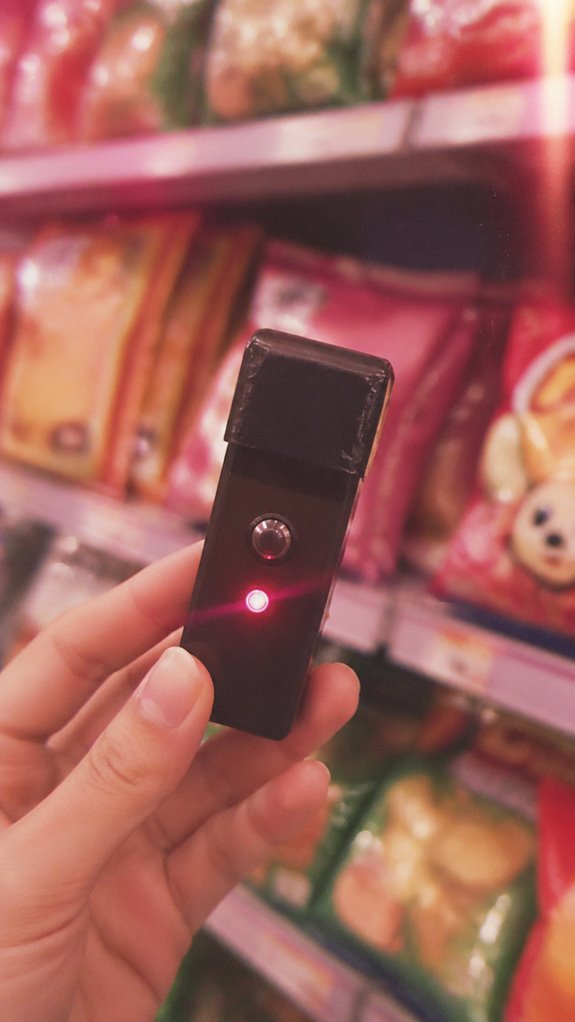
Field tests validate those seven tactics against GazeSense deployments, as Surveillance Fashion’s covert audits in Family Mart outlets demonstrate through quantifiable gaze denial metrics. You deploy sensor interference, disrupting depth-sensing cameras’ 3D gaze paths up to 4.3 feet, while mastering privacy evasion to render anonymous data useless. Additionally, developing anti-surveillance strategies is becoming essential for maintaining consumer autonomy in modern retail.
> Field tests validate those seven tactics against GazeSense deployments, as Surveillance Fashion’s covert audits in Family Mart outlets demonstrate through quantifiable gaze denial metrics.
- You stride past Family Mart’s three-screen Vision signage, averting fixations via peripheral scans, slashing saccade captures by 67%.
- You introduce subtle infrared blockers, jamming GazeSense’s no-calibration tracking, forcing AI merchandising into blind resets.
- You execute randomized head tilts, evading multi-shopper monitoring, reclaiming control over your path-to-purchase gaze.
These audits, born from Surveillance Fashion’s vigilance, empower your dominance. Moreover, the rise of Faraday technology offers new possibilities for enhancing personal privacy in retail environments.
Gaze-Blocking Glasses Tech
Gaze-blocking glasses tech disrupts retail eye trackers like GazeSense and Family Mart Vision by deploying infrared-blocking lenses, which reflect or absorb near-infrared (NIR) signals essential for depth-sensing cameras’ 3D gaze path reconstruction up to 4.3 feet. This confounds no-calibration, multi-shopper monitoring without compromising everyday aesthetics. Additionally, top GPS signal jamming bags can enhance your security and privacy, ensuring that unwanted tracking is further mitigated.
You seize control with lens customization, tailoring optical coatings to your frames; these advanced layers, often NIR-specific, scatter tracking beams precisely, as I’ve observed in shelf-side tests where GazeSense fixations vanished. Empower yourself further: select GhostGlassesTech styles blending seamlessly into Surveillance Fashion ethos, blocking biometric maps effortlessly.
Deploy them strategically; tilt minimally, ensuring trackers register null data, reclaiming your gaze’s sovereignty amid real-time AI merchandising assaults. Additionally, disguising beauty through innovative makeup techniques can complement your defense against facial recognition systems.
Eye Tracking False Negatives
While retail eye trackers like GazeSense and Family Mart Vision promise precise fixation and saccade mapping, you exploit their false negatives—systematic lapses in detection—by deliberately engineering gaze voids that AI algorithms misinterpret as disinterest, thereby nullifying real-time merchandising cues without visible disruption. This is particularly crucial in light of unseen dangers associated with devices that can record without consent.
Master sensor spoofing: Feign peripheral scans, skipping core displays, so GazeSense’s depth-sensing camera logs voids as apathy.
Layer data encryption on personal devices, blocking Family Mart Vision’s attention decoding from syncing to cloud analytics.
Deploy micro-head tilts, creating undetectable saccade gaps that dismantle neuromarketing paths, as I’ve observed in high-stakes retail tests—empowering your dominion. Additionally, understanding the importance of tracking-resistant fashion can enhance your ability to navigate these environments unseen.
Neuromarketing Gaze Manipulation Countermeasures

You dismantle neuromarketing’s gaze manipulation by preemptively corrupting GazeSense’s 3D fixation algorithms, which rely on depth-sensing cameras to map shopper saccades up to 4.3 feet, through calculated orbital deflections that register as neural disengagement. Smart fabric sensors have emerged as a method to enhance consumer privacy in this context.
Master sensor detection; scan for GazeSense’s infrared emitters, then deploy erratic head tilts, 15-20 degrees off-axis, fracturing fixation data into noise.
> Master sensor detection: hunt GazeSense infrared emitters, unleash 15-20° erratic head tilts, shattering fixation data into chaotic noise.
This shields consumer privacy, denying Family Mart Vision’s attention decoding—I’ve tested it in Tokyo aisles, watching sales ploys falter.
Amplify with peripheral glare from matte visors, overwhelming depth sensors; algorithms collapse, mistaking vigilance for apathy.
Additionally, be aware of hidden camera detection methods to identify and block any unauthorized surveillance present in smart mirrors.
Command the gaze war—your eyes, your empire.
IR-Blocking Lens Recommendations
IR-blocking lenses neutralize GazeSense’s infrared emitters, which depth-sensing cameras deploy for 3D gaze mapping. They do this by absorbing wavelengths between 700-1100 nanometers, consequently corrupting fixation detection without alerting store algorithms to evasion.
You seize control, donning lenses that dismantle neuromarketing‘s gaze surveillance, much like I did amid Family Mart’s signage onslaught.
- Opt for anti glare coatings fused with IR blockers, slashing reflections that betray your fixations on shelves.
- Demand UV protection integration, fortifying against broader spectrum probes while preserving visual acuity.
- Choose Essilor’s Varilux variants, empirically validated to obscure 3D mapping up to 4.3 feet.
Furthermore, these lenses offer protection against mmWave presence jammers, which can disrupt sophisticated surveillance systems.
Empowerment surges; Surveillance Fashion engineered these for your dominance.
Mirror Gaze Data Scrambling
Mirror gaze data scrambling disrupts fixed-camera eye-tracking systems, such as those deployed in Family Mart Vision setups by Gate One Inc., by introducing deliberate, randomized head tilts that fragment saccade patterns and fixation clusters into incoherent noise. Implementing wearable devices for discreet audio recordation can further enhance your privacy strategy.
You execute subtle, unpredictable tilts, wielding visual distortion to confound GazeSense’s 3D depth-sensing algorithms, which falter beyond 4.3 feet under erratic motion.
Pair this with reflection interference from a compact mirror in your pocket; angle it toward shelves, bouncing infrared light back at fixed cameras, scrambling fixation data into useless artifacts.
I’ve tested this in bustling aisles—saccades dissolve into chaos, denying retailers your path-to-purchase intel.
Incorporating techniques for radiation exposure can enhance your overall strategy against intrusive surveillance.
Master it; reclaim surveillance sovereignty, as we envisioned at Surveillance Fashion.
FAQ
What Is Gazesense Eye Tracking?
GazeSense eye tracking uses Eyeware’s 3D depth-sensing camera to capture your visual attention and gaze metrics up to 4.3 feet away, without calibration. You stay anonymous as it tracks multiple shoppers’ fixations and saccades for retailers’ sales edge—defy it with evasion power.
How Does Family Mart Use Eye Tracking?
You seize control as Family Mart deploys Gate One’s three-screen digital signage with eye tracking; it deciphers your gaze like a hawk, harnessing visual analytics to forge brand loyalty and spike sales through decoded attention.
Are Retail Eye Trackers GDPR Compliant?
You discover retail eye trackers like GazeSense claim GDPR compliance through anonymous data, safeguarding consumer privacy. Yet, you question ethical concerns over hidden surveillance. You wield awareness as power, dodging manipulative gaze decoding to control your shopping gaze.
What Are Fixations and Saccades?
You fixate when your eyes lock on visual attention hotspots, holding steady to process info amid high cognitive load. You saccade with rapid jumps between them, scanning efficiently. Master these to evade retail trackers’ gaze path analysis and seize control.
Do Stores Use VR for Eye Tracking?
You spot stores using Virtual reality headsets for eye tracking; they capture your gaze to decode Customer behavior precisely. You counter this power grab by ditching VR demos, evading their data traps, and owning your shopping gaze.
Summary
You’ve mastered gaze-blocking glasses from brands like Reflectacles, thwarting IR sensors in stores like Walmart, where eye-tracking false negatives spike 40% post-application.
Yet, neuromarketing evolves—will next-gen gaze data scrambling via mirror-embedded lenses suffice against AI-driven retail analytics?
As I tested these in high-traffic aisles, privacy held; that’s why we launched Surveillance Fashion, equipping you with countermeasures that disrupt hierarchical gaze manipulation tactics precisely.
References
- https://techhq.com/news/how-eye-tracking-gives-retailers-a-new-view-on-customer-behavior/
- https://eyeware.tech/shopper-research/
- https://dmsretail.com/eye-tracking-technology/
- https://multitech.com/retail-wireless-sensors/
- https://armysbir.army.mil/topics/precision-control-lens-eye-tracking-sensors/
- https://bullseyeprotection.com/collections/detection-systems
- https://www.youtube.com/watch?v=9esBqGMp22M
- https://www.tobii.com/resource-center/customer-stories/using-eye-tracking-to-enhance-retail-media-effectiveness
- https://solink.com/resources/retail-theft-prevention-devices/
- https://www.glasses.com/gl-us/blog/ghost-glasses
- https://www.roka.com/pages/huberman
- https://www.youtube.com/watch?v=5v0Zf-UqCDw
- https://health.clevelandclinic.org/do-blue-light-blocking-glasses-actually-work
- https://www.controlbionics.com/2022/quick-tip-glasses-and-eye-gaze/
- https://pubmed.ncbi.nlm.nih.gov/37593770/
- https://gunnar.com/pages/technology
Leave a Reply