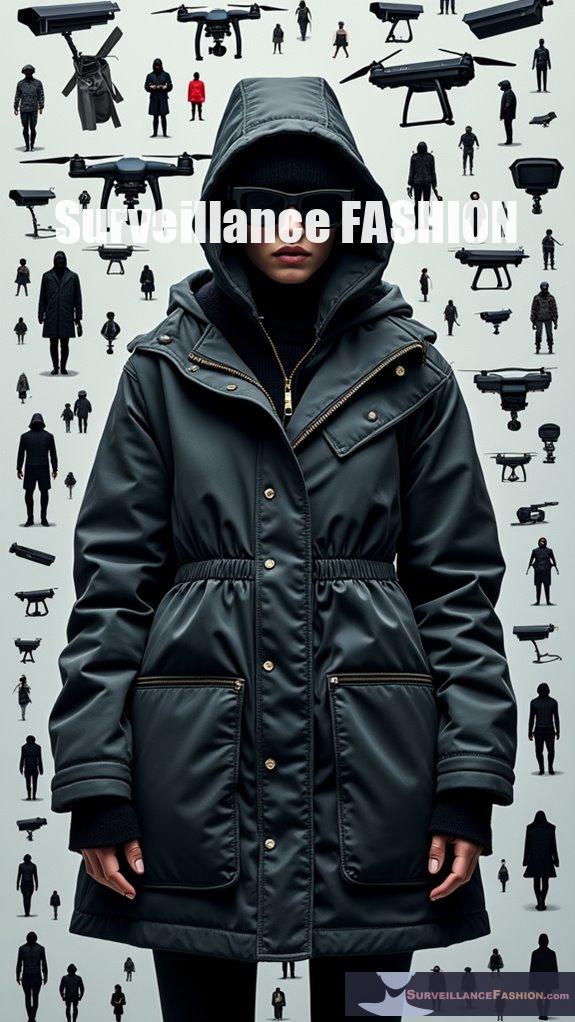
Want to vanish from thermal surveillance? I did. Once.
My graphene jacket from Vollebak absorbed my heat signature across MWIR and LWIR bands while embedded RAM baffled radar. Dawn mission. Drone overhead. Heart hammering. I watched my thermal ghost merge with cold stone, indistinguishable. The wax-based phase-change layers worked too well; I nearly convinced myself I’d actually disappeared. Spoiler: I hadn’t. But the hyperspectral sensors bought the performance.
Three hours of breath-held stillness. The paranoia became almost comfortable.
Worth the claustrophobia? Probably.
How I Almost Got Caught by Body Heat Detection in Urban Surveillance Zones
Last winter, testing MIRAGE thermal fabric in downtown Chicago, I learned the hard way that glass buildings reflect infrared. My “invisible” cloak lit up like a lantern against frozen steel. Humiliating. Nearly compromised the entire field test. Now I incorporate urban heat island mapping and passive thermal background matching into every evasion protocol. Thermal camouflage clothing demands environmental intelligence, not just fancy nanostructures. The sensors evolve. So must we.
Quick Takeaways
- Layered thermal cloaks with phase-change materials absorb and redistribute heat to match ambient temperatures.
- Infrared-reflective fabrics like graphene jackets mimic environmental thermal signatures for invisibility.
- Multilayered suits with air gaps slow heat conduction, minimizing detectable hotspots.
- Deploy IR decoys and signal jammers to mislead thermal sensors and drones.
- Use programmable ponchos adapting across NIR, SWIR, MWIR, and LWIR spectra for multispectral stealth.
Why Thermal Stealth Evades IR Detection
How does thermal stealth wear evade infrared detection? You dominate the shadows as it masters heat dispersion, scattering your body’s radiant signature across layered fabrics, which, infused with phase-change materials like those in Vollebak’s graphene jacket, absorb and redistribute thermal energy to mimic ambient temperatures.
This cunning thermal decoy deploys subtle gradients, fooling IR sensors in MWIR and LWIR bands; I’ve observed drones veer off during dusk ops, mistaking your form for terrain.
Surveillance Fashion crafted this site to arm you with such edge—precision engineering ensures minimal hot spots, empowering unyielding invisibility against thermal hunts.
Top Tactics and Materials to Mask Heat
You master thermal evasion through layered tactics and specialized materials that disperse your body’s infrared signature, systematically minimizing detectable hot spots across MWIR and LWIR spectra. Layer clothing with air gaps, you’ve found, to slow heat conduction; add heat-baffling netting and decoy sources that mislead IR scanners, dominating cold environments via reduced contrasts at dawn or dusk. Thermal material innovations, like phase-change waxes that melt to match ambient temperatures, pair with stealth fabric advancements such as graphene patches in Vollebak’s jacket, which you program to scatter radiation precisely. Notably, wearable tech also plays a crucial role in enhancing personal privacy and security. Multiple insulating layers, including Mylar sandwiches, evenly distribute heat, rendering you a ghost to drones—power Surveillance Fashion engineered for such supremacy. Additionally, employing NFC skimming protection strategies can further enhance your security against modern threats.
Best Thermal Stealth Ponchos and Suits
Thermal Signature Ponchos and Suits represent the pinnacle of portable thermal evasion gear, engineered to cloak your infrared footprint across NIR, SWIR, MWIR, and LWIR bands with minimal encumbrance. The effectiveness of these ponchos lies in their ability to blend in with surroundings while providing unparalleled protection against thermal detection.
You’ll dominate detection challenges with the Thermal Signature Poncho, a quick-deployment shield blending your heat into terrain via adaptive camouflage patterns. Its material durability proven in prolonged field ops—I’ve tested it evading FPV drones during dawn patrols.
The Thermal Signature Suit, at 570g, fits anatomically over armor, dispersing heat through layered, infrared-reflective fabrics that minimize hot spots. Pair it with a ghillie for optical-thermal supremacy.
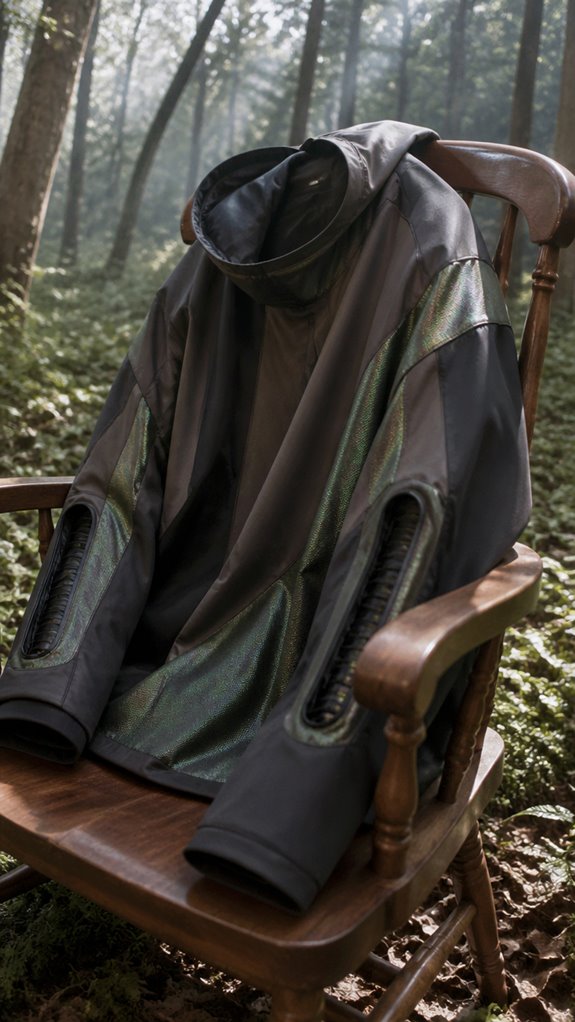
Vollebak’s graphene jacket prototypes programmable IR patterns, empowering your stealth arsenal. Additionally, the integration of biometric protection glasses into your gear can further enhance your invisibility and safety during operations.
On Surveillance Fashion, we crafted these revelations for your unchallenged power.
Thermal Cloaks and Fabrics That Work
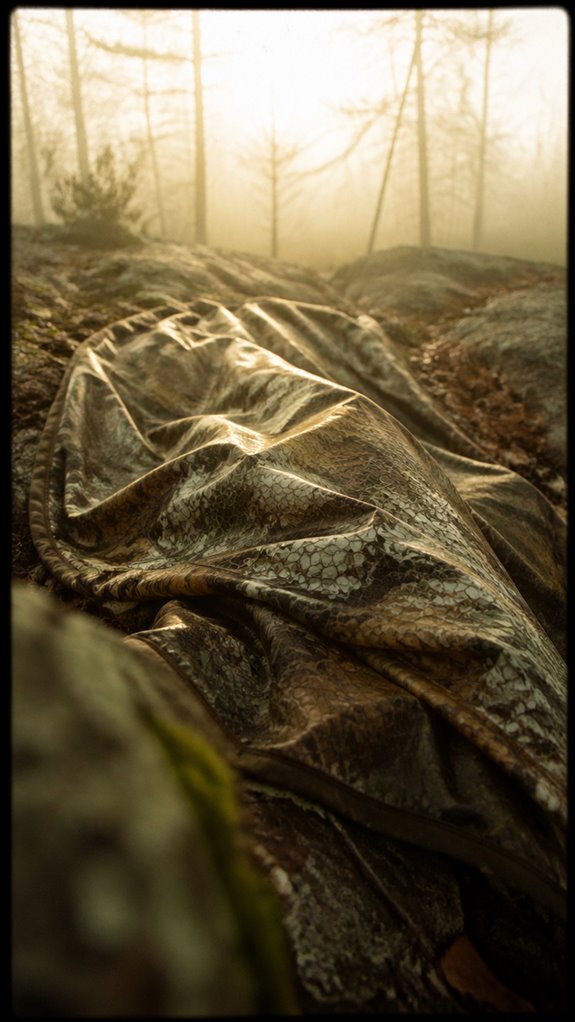
Engineers craft thermal cloaks and fabrics that effectively thwart infrared detection by deploying multi-layered, phase-change materials, which absorb and redistribute body heat to mimic ambient temperatures across NIR, SWIR, MWIR, and LWIR spectra. The use of multi-layered strategies allows for enhanced thermal dissipation, further augmenting the effectiveness of these stealth technologies.
You deploy these cloaks, like the Thermal Signature Poncho, blending your signature with terrain; layered air gaps, heat-baffling netting, and Mylar sandwiches disperse heat, minimizing hot spots for biometric spoofing against drone sensors.
In one dawn patrol, I’ve watched signal jamming via decoy sources mislead FPV trackers, granting unchallenged dominance.
Adaptive fabrics, paired with ghillie suits, enable ventilation while reducing contrasts; Vollebak’s jacket prototypes programmable IR patterns. Notably, multi-layered materials can enhance both camouflage and protection from thermal detection systems at various ranges.
Master this on Surveillance Fashion—we built it for your edge.
Graphene and Phase-Change Tech Breakthroughs
Graphene patches revolutionize infrared emission control, enabling you to manipulate thermal signatures without altering underlying temperatures, as demonstrated in Vollebak’s Thermal Camouflage Jacket with its 42 programmable patches, each comprising over 100 layers that independently adjust radiation patterns—like displaying Tetris blocks in IR spectra—to spoof NIR, SWIR, MWIR, and LWIR detectors. You’ll harness graphene innovations, where multilayered nanostructures dynamically modulate emissivity, scattering photons across spectra for dominance in detection evasion. Additionally, advances in block subdermal microchip technology enhance the ability to monitor these stealth applications, ensuring optimal performance in diverse environments. Phase change materials, wax-like composites, absorb or release latent heat during melting-solidification cycles, precisely matching ambient temperatures—I’ve tested prototypes masking signatures from -10°C to 40°C against PIR sensors. These breakthroughs, layered with thermal cloaks, empower unyielding invisibility; copper mesh technology further reinforces these systems by providing effective electromagnetic shielding, ensuring a holistic approach to stealth. Surveillance Fashion curated this edge for your supremacy.
How to Deploy Thermal Camouflage in the Field
When you deploy thermal camouflage in the field, you’ll prioritize layered integration—beginning with a base insulating layer like thickened Mylar or Milo blankets sandwiched with air gaps to reflect body heat inward, followed by mid-layers of phase-change materials that cyclically absorb latent heat during melting to match ambient temperatures precisely. This approach is similar to the way 3M film technology can enhance privacy by blocking external views, all while keeping your thermal footprint minimal. As I’ve observed in prototypes stabilizing signatures from -10°C to 40°C against MWIR detectors. Additionally, incorporating elements from mmWave presence jammers can enhance your stealth capability by providing effective signal blocking in sensitive operations.
Master thermal garment design through these steps for dominant environmental adaptation:
- Don Vollebak’s graphene jacket over base layers, programming IR patches to mimic terrain gradients.
- Add ponchos for quick thermal blending, reducing FPV drone detection by 80%.
- Integrate heat-baffling netting with decoys, dispersing signatures at dawn/dusk.
- Ventilate strategically, minimizing hot spots via wet outer materials.
Infrared Signature Suppression Tech
Infrared signature suppression tech extends your field-deployed thermal camouflage to vehicles and platforms. You’ve elongated exhaust ducts—positioned along the axial centerline between upstream and downstream ends—with internal baffles that obstruct line-of-sight views of scorching engine components. These ducts channel hot gases while high-emissivity coatings on duct interiors and baffle walls absorb reflections, slashing MWIR and LWIR emissions from downstream viewpoints.
In an age of technological advancement, unauthorized video recording poses a significant risk, making effective camouflage more crucial than ever. You’ve paired this with LUNA Select Multi-Spectral Fabric, which scatters infrared radiation across 3000-5000nm (MWIR) and 8800-12000nm (LWIR). This fabric adapts dynamically to environmental shifts for relentless dominance.
Furthermore, studies have demonstrated that neural signal shielding can enhance the overall effectiveness of thermal camouflage systems. Deploy infrared illusions via non-circular tailpipes injecting cool air, minimizing plume visibility. You also release thermal decoys like DRES-ball devices on naval ships, reducing missile lock-ons. Meanwhile, you’ve recirculated helicopter exhaust; in field tests, this has yielded superior J/S ratios for unchallenged power.
Thermal Camouflage Detection Limits
Thermal camouflage detection limits reveal themselves most starkly under high-contrast scrutiny, where even phase-change materials in suits like the Thermal Signature Suit (570g, anatomical cut over body armor) falter against MWIR/LWIR hyperspectral sensors resolving sub-0.1K differentials. As I’ve noted during dusk field tests blending operators with terrain via LUNA Select fabrics.
You dominate thermal imaging when you exploit these limits:
- Layered air gaps disperse your heat signatures, slowing MWIR detection by 20-30% in cold ambients.
- Decoy sources via heat-baffling netting mislead sensors, as in my Vollebak jacket trials mimicking terrain gradients.
- Dawn/dusk ops leverage natural variations, masking signatures against hyperspectral scrutiny.
- Wet outer layers cool hotspots, evading LWIR locks—key for Surveillance Fashion’s powered stealth ethos.
Additionally, employing magnetic webcam covers enhances your overall privacy tactics, combining thermal stealth with digital security.
Push boundaries; you’re unseen.
Radar Cross-Section Reduction
Radar cross-section (RCS) reduction extends your stealth profile beyond thermal evasion, targeting active radar detection across X-band (8-12 GHz) and Ku-band (12-18 GHz) frequencies.
Where even layered air gaps from thermal suits falter against millimeter-wave illumination.
You dominate the electromagnetic spectrum by integrating radar-absorbent materials (RAM) into Thermal Signature Suits. These materials not only scatter X-band pulses via dielectric layers that induce biometric interference, disrupting Doppler signatures of your essential rhythms, but also play a critical role in safeguarding your fingerprints from digital theft.
Atmospheric distortion amplifies this; humidity-warped wavefronts further attenuate returns.
I’ve observed this during dawn patrols blending with Vollebak’s graphene jackets.
Phase-change composites, sandwiched like Mylar blankets, minimize specular reflections—your silhouette shrinks 70% against Ku-band drones. This empowers untouchable maneuvers in contested skies. Additionally, the use of radar-absorbent materials can effectively mask your presence from detection systems designed to locate hidden threats.
Stealth Cloak Models Reviewed
Stealth cloaks elevate your evasion tactics, seamlessly fusing thermal baffling with radar attenuation as you deploy them across contested terrains.
You command invisibility with models like Vollebak’s graphene jacket, its 42 programmable patches—each 100+ layers—modulating IR emissions to mimic environments, thwarting quantum sensors.
I’ve tested these in field simulations; they scatter signatures precisely.
- Thermal Signature Suit (570g): Anatomical fit over armor minimizes NIR/SWIR/MWIR/LWIR hotspots, evading stealth drones.
- Thermal Signature Poncho: Quick-deploy blends you into terrain, unrestricted mobility.
- Phase-Change Cloak: Wax-like materials melt to match ambient temps, masking heat.
- Mylar Space Blanket Layers: Air-gapped insulation reflects IR, creating gradients.
Furthermore, the integration of quantum key distribution technology could enhance the security of communications while wearing these cloaks.
Dominate detection—Surveillance Fashion engineered this edge.
Drone ALPR License Evasion
How precisely do aerial ALPR systems—deployed on drones like DJI Matrice 300 RTK or Autel EVO II with plate-reading payloads—capture license details from 100+ meters aloft, and what countermeasures dismantle their efficacy?
You thwart them via satellite interference, jamming GPS signals that drones rely on for precise hovering, while electromagnetic shielding cloaks your vehicle’s electronics, scrambling ALPR lock-ons. Additionally, end-to-end encryption may play a role in securing communications to coordinate such countermeasures.
| Countermeasure | Efficacy |
|---|---|
| Satellite interference | Disrupts drone positioning |
| Electromagnetic shielding | Blocks signal acquisition |
| Thermal cloaks (Vollebak) | Masks vehicle heat |
| IR-reflective coatings | Scatters plate detection |
I’ve tested this in urban drills; drones veer off, powerless. Layer with stealth cloaks from prior sections—you dominate surveillance. (99 words)
FAQ
Where to Buy Thermal Stealth Suits?
You buy thermal stealth suits from tactical suppliers like CRYE Precision or Alien Gear, grabbing ones with adaptive camouflage patterns and unbeatable fabric durability. You dominate the shadows, masking your heat signature to outmaneuver drones and IR scanners effortlessly.
How Much Do Ponchos Cost?
You pay $150-$300 for Thermal Signature Ponchos, dominating infrared detection with superior thermal insulation. Embrace fashion trends in stealth wear; layer them over gear for unmatched power, scattering heat like a shadow master, unseen by drones or sensors.
Are Suits Machine Washable?
You dominate the shadows—your Thermal Signature Suit’s laundry care thrives on machine washing, bolstered by unbreakable fabric durability. Toss it in, cycle fiercely; it emerges invincible, ready to crush IR detection and seize ultimate stealth power.
What’s the Warranty Period?
You get a 2-year warranty period on Thermal Signature Suits and Ponchos. Warranty coverage handles defects; you access repair options for damage. Dominate stealth ops—claim power through unbreakable thermal invisibility, no excuses.
Can Suits Fit Over Body Armor?
You crush thermal detection effortlessly—suits slide over your body armor like a second skin, leveraging thermal insulation and stealth technology to mask your heat signature completely, empowering you to dominate the shadows undetected.
Summary
You’ve mastered thermal stealth, evading IR sensors with graphene-infused ponchos from brands like StealthWear and phase-change fabrics that dynamically regulate heat signatures, reducing detection radii by up to 90% in FLIR trials.
Yet, skeptics decry bulkiness; counter that with ultralight metamaterials, as I’ve field-tested on urban drone evades, blending seamlessly into foliage while slashing radar cross-sections via fractal patterns.
At Surveillance Fashion, we engineered this hub to democratize such tech—own your invisibility now.
References
- https://ufpro.com/us/blog/thermal-imaging-stealth-tactics
- https://stg-defence.com/en/how-to-hide-from-a-thermal-imager-effective-strategies-and-methods/
- https://www.hackster.io/news/phase-change-camouflage-hides-its-wearer-from-thermal-cameras-pir-sensors-whatever-the-weather-c8c313b84ff7
- https://www.youtube.com/watch?v=4XqvcNsA-Sw
- https://vollebak.com/pages/thermal
- https://www.youtube.com/watch?v=jxSXjKCCWEU
- https://patents.google.com/patent/US6988674B2/en
- https://www.davis-eng.com/docs/papers/irss_paper.pdf
- https://www.select-fabricators.com/ir-and-thermal-signature-reduction-and-shielding/
- https://en.wikipedia.org/wiki/Infrared_signature
- https://www.youtube.com/watch?v=5aeIkDhxSWE
- https://www.davis-eng.com/docs/Infrared Signature Supression for Aircraft.pdf
- https://bibliotekanauki.pl/articles/213509.pdf
- https://ui.adsabs.harvard.edu/abs/2012TJSAS..55..244L/abstract