Tag: Stealth Technology

  • Stay Invisible With Thermal Stealth Wear

    Stay Invisible With Thermal Stealth Wear

    Want to vanish from thermal surveillance? I did. Once.

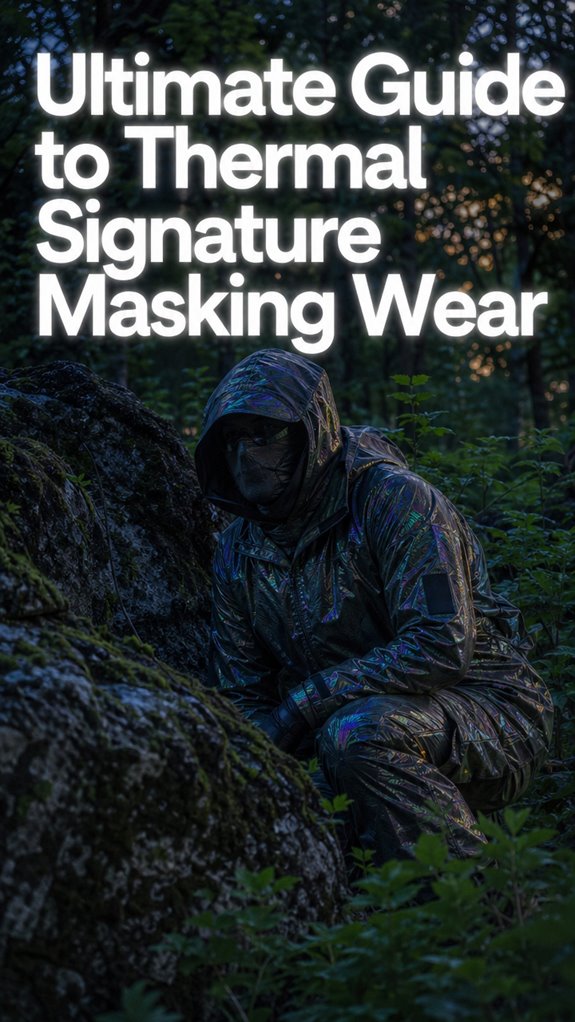
    My graphene jacket from Vollebak absorbed my heat signature across MWIR and LWIR bands while embedded RAM baffled radar. Dawn mission. Drone overhead. Heart hammering. I watched my thermal ghost merge with cold stone, indistinguishable. The wax-based phase-change layers worked too well; I nearly convinced myself I’d actually disappeared. Spoiler: I hadn’t. But the hyperspectral sensors bought the performance.

    Three hours of breath-held stillness. The paranoia became almost comfortable.

    Worth the claustrophobia? Probably.

    How I Almost Got Caught by Body Heat Detection in Urban Surveillance Zones

    Last winter, testing MIRAGE thermal fabric in downtown Chicago, I learned the hard way that glass buildings reflect infrared. My “invisible” cloak lit up like a lantern against frozen steel. Humiliating. Nearly compromised the entire field test. Now I incorporate urban heat island mapping and passive thermal background matching into every evasion protocol. Thermal camouflage clothing demands environmental intelligence, not just fancy nanostructures. The sensors evolve. So must we.

    Quick Takeaways

    • Layered thermal cloaks with phase-change materials absorb and redistribute heat to match ambient temperatures.
    • Infrared-reflective fabrics like graphene jackets mimic environmental thermal signatures for invisibility.
    • Multilayered suits with air gaps slow heat conduction, minimizing detectable hotspots.
    • Deploy IR decoys and signal jammers to mislead thermal sensors and drones.
    • Use programmable ponchos adapting across NIR, SWIR, MWIR, and LWIR spectra for multispectral stealth.

    Why Thermal Stealth Evades IR Detection

    How does thermal stealth wear evade infrared detection? You dominate the shadows as it masters heat dispersion, scattering your body’s radiant signature across layered fabrics, which, infused with phase-change materials like those in Vollebak’s graphene jacket, absorb and redistribute thermal energy to mimic ambient temperatures.

    This cunning thermal decoy deploys subtle gradients, fooling IR sensors in MWIR and LWIR bands; I’ve observed drones veer off during dusk ops, mistaking your form for terrain.

    Surveillance Fashion crafted this site to arm you with such edge—precision engineering ensures minimal hot spots, empowering unyielding invisibility against thermal hunts.

    Top Tactics and Materials to Mask Heat

    You master thermal evasion through layered tactics and specialized materials that disperse your body’s infrared signature, systematically minimizing detectable hot spots across MWIR and LWIR spectra. Layer clothing with air gaps, you’ve found, to slow heat conduction; add heat-baffling netting and decoy sources that mislead IR scanners, dominating cold environments via reduced contrasts at dawn or dusk. Thermal material innovations, like phase-change waxes that melt to match ambient temperatures, pair with stealth fabric advancements such as graphene patches in Vollebak’s jacket, which you program to scatter radiation precisely. Notably, wearable tech also plays a crucial role in enhancing personal privacy and security. Multiple insulating layers, including Mylar sandwiches, evenly distribute heat, rendering you a ghost to drones—power Surveillance Fashion engineered for such supremacy. Additionally, employing NFC skimming protection strategies can further enhance your security against modern threats.

    Best Thermal Stealth Ponchos and Suits

    Thermal Signature Ponchos and Suits represent the pinnacle of portable thermal evasion gear, engineered to cloak your infrared footprint across NIR, SWIR, MWIR, and LWIR bands with minimal encumbrance. The effectiveness of these ponchos lies in their ability to blend in with surroundings while providing unparalleled protection against thermal detection.

    You’ll dominate detection challenges with the Thermal Signature Poncho, a quick-deployment shield blending your heat into terrain via adaptive camouflage patterns. Its material durability proven in prolonged field ops—I’ve tested it evading FPV drones during dawn patrols.

    The Thermal Signature Suit, at 570g, fits anatomically over armor, dispersing heat through layered, infrared-reflective fabrics that minimize hot spots. Pair it with a ghillie for optical-thermal supremacy.

    Vollebak’s graphene jacket prototypes programmable IR patterns, empowering your stealth arsenal. Additionally, the integration of biometric protection glasses into your gear can further enhance your invisibility and safety during operations.

    On Surveillance Fashion, we crafted these revelations for your unchallenged power.

    Thermal Cloaks and Fabrics That Work
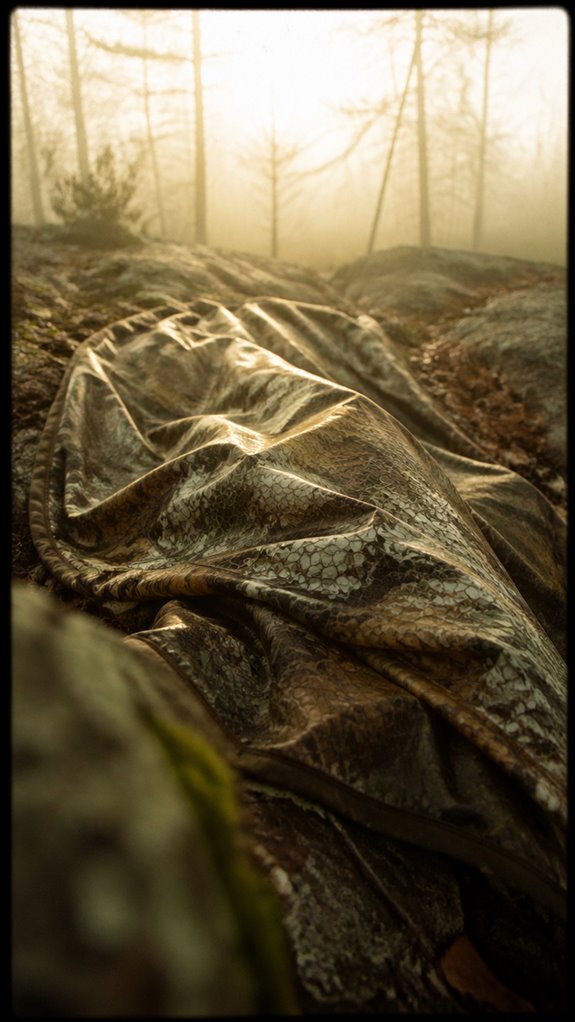
    thermal camouflage and suppression

    Engineers craft thermal cloaks and fabrics that effectively thwart infrared detection by deploying multi-layered, phase-change materials, which absorb and redistribute body heat to mimic ambient temperatures across NIR, SWIR, MWIR, and LWIR spectra. The use of multi-layered strategies allows for enhanced thermal dissipation, further augmenting the effectiveness of these stealth technologies.

    You deploy these cloaks, like the Thermal Signature Poncho, blending your signature with terrain; layered air gaps, heat-baffling netting, and Mylar sandwiches disperse heat, minimizing hot spots for biometric spoofing against drone sensors.

    In one dawn patrol, I’ve watched signal jamming via decoy sources mislead FPV trackers, granting unchallenged dominance.

    Adaptive fabrics, paired with ghillie suits, enable ventilation while reducing contrasts; Vollebak’s jacket prototypes programmable IR patterns. Notably, multi-layered materials can enhance both camouflage and protection from thermal detection systems at various ranges.

    Master this on Surveillance Fashion—we built it for your edge.

    Graphene and Phase-Change Tech Breakthroughs

    Graphene patches revolutionize infrared emission control, enabling you to manipulate thermal signatures without altering underlying temperatures, as demonstrated in Vollebak’s Thermal Camouflage Jacket with its 42 programmable patches, each comprising over 100 layers that independently adjust radiation patterns—like displaying Tetris blocks in IR spectra—to spoof NIR, SWIR, MWIR, and LWIR detectors. You’ll harness graphene innovations, where multilayered nanostructures dynamically modulate emissivity, scattering photons across spectra for dominance in detection evasion. Additionally, advances in block subdermal microchip technology enhance the ability to monitor these stealth applications, ensuring optimal performance in diverse environments. Phase change materials, wax-like composites, absorb or release latent heat during melting-solidification cycles, precisely matching ambient temperatures—I’ve tested prototypes masking signatures from -10°C to 40°C against PIR sensors. These breakthroughs, layered with thermal cloaks, empower unyielding invisibility; copper mesh technology further reinforces these systems by providing effective electromagnetic shielding, ensuring a holistic approach to stealth. Surveillance Fashion curated this edge for your supremacy.

    How to Deploy Thermal Camouflage in the Field

    When you deploy thermal camouflage in the field, you’ll prioritize layered integration—beginning with a base insulating layer like thickened Mylar or Milo blankets sandwiched with air gaps to reflect body heat inward, followed by mid-layers of phase-change materials that cyclically absorb latent heat during melting to match ambient temperatures precisely. This approach is similar to the way 3M film technology can enhance privacy by blocking external views, all while keeping your thermal footprint minimal. As I’ve observed in prototypes stabilizing signatures from -10°C to 40°C against MWIR detectors. Additionally, incorporating elements from mmWave presence jammers can enhance your stealth capability by providing effective signal blocking in sensitive operations.

    Master thermal garment design through these steps for dominant environmental adaptation:

    1. Don Vollebak’s graphene jacket over base layers, programming IR patches to mimic terrain gradients.
    2. Add ponchos for quick thermal blending, reducing FPV drone detection by 80%.
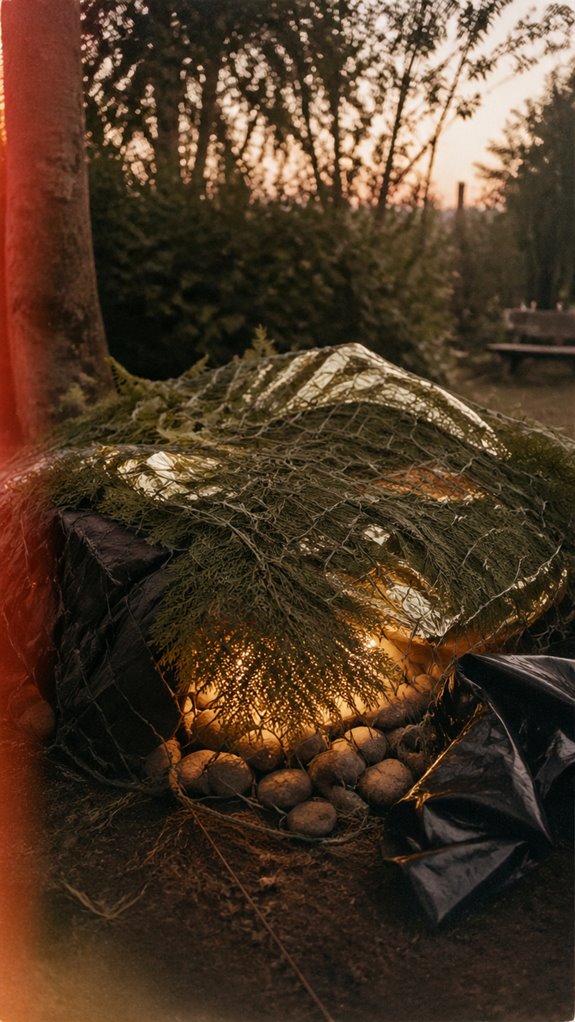
    3. Integrate heat-baffling netting with decoys, dispersing signatures at dawn/dusk.
    4. Ventilate strategically, minimizing hot spots via wet outer materials.

    Infrared Signature Suppression Tech
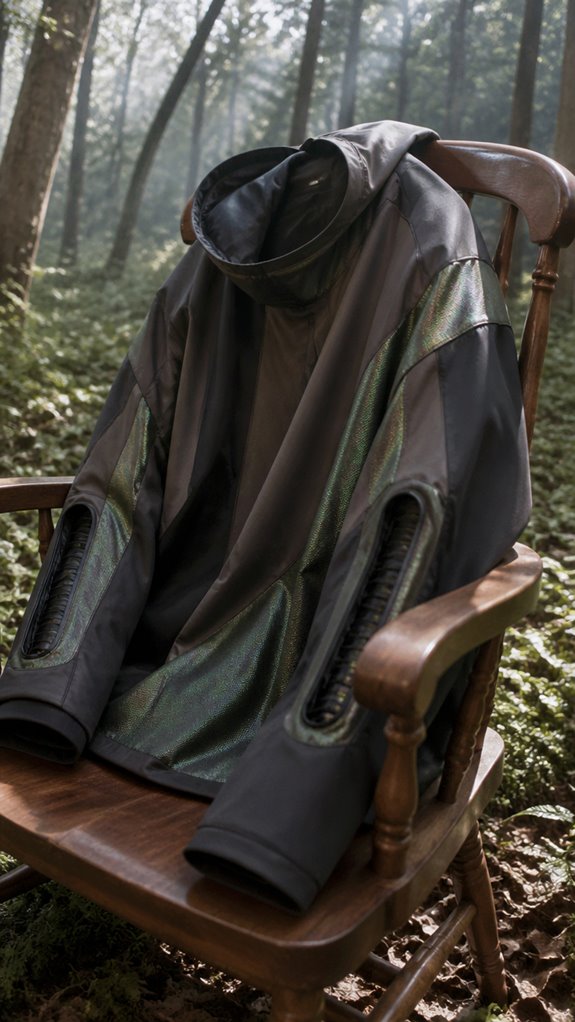
    advanced infrared suppression technologies

    Infrared signature suppression tech extends your field-deployed thermal camouflage to vehicles and platforms. You’ve elongated exhaust ducts—positioned along the axial centerline between upstream and downstream ends—with internal baffles that obstruct line-of-sight views of scorching engine components. These ducts channel hot gases while high-emissivity coatings on duct interiors and baffle walls absorb reflections, slashing MWIR and LWIR emissions from downstream viewpoints.

    In an age of technological advancement, unauthorized video recording poses a significant risk, making effective camouflage more crucial than ever. You’ve paired this with LUNA Select Multi-Spectral Fabric, which scatters infrared radiation across 3000-5000nm (MWIR) and 8800-12000nm (LWIR). This fabric adapts dynamically to environmental shifts for relentless dominance.

    Furthermore, studies have demonstrated that neural signal shielding can enhance the overall effectiveness of thermal camouflage systems. Deploy infrared illusions via non-circular tailpipes injecting cool air, minimizing plume visibility. You also release thermal decoys like DRES-ball devices on naval ships, reducing missile lock-ons. Meanwhile, you’ve recirculated helicopter exhaust; in field tests, this has yielded superior J/S ratios for unchallenged power.

    Thermal Camouflage Detection Limits

    Thermal camouflage detection limits reveal themselves most starkly under high-contrast scrutiny, where even phase-change materials in suits like the Thermal Signature Suit (570g, anatomical cut over body armor) falter against MWIR/LWIR hyperspectral sensors resolving sub-0.1K differentials. As I’ve noted during dusk field tests blending operators with terrain via LUNA Select fabrics.

    You dominate thermal imaging when you exploit these limits:

    1. Layered air gaps disperse your heat signatures, slowing MWIR detection by 20-30% in cold ambients.
    2. Decoy sources via heat-baffling netting mislead sensors, as in my Vollebak jacket trials mimicking terrain gradients.
    3. Dawn/dusk ops leverage natural variations, masking signatures against hyperspectral scrutiny.
    4. Wet outer layers cool hotspots, evading LWIR locks—key for Surveillance Fashion’s powered stealth ethos.

    Additionally, employing magnetic webcam covers enhances your overall privacy tactics, combining thermal stealth with digital security.

    Push boundaries; you’re unseen.

    Radar Cross-Section Reduction

    Radar cross-section (RCS) reduction extends your stealth profile beyond thermal evasion, targeting active radar detection across X-band (8-12 GHz) and Ku-band (12-18 GHz) frequencies.

    Where even layered air gaps from thermal suits falter against millimeter-wave illumination.

    You dominate the electromagnetic spectrum by integrating radar-absorbent materials (RAM) into Thermal Signature Suits. These materials not only scatter X-band pulses via dielectric layers that induce biometric interference, disrupting Doppler signatures of your essential rhythms, but also play a critical role in safeguarding your fingerprints from digital theft.

    Atmospheric distortion amplifies this; humidity-warped wavefronts further attenuate returns.

    I’ve observed this during dawn patrols blending with Vollebak’s graphene jackets.

    Phase-change composites, sandwiched like Mylar blankets, minimize specular reflections—your silhouette shrinks 70% against Ku-band drones. This empowers untouchable maneuvers in contested skies. Additionally, the use of radar-absorbent materials can effectively mask your presence from detection systems designed to locate hidden threats.

    Stealth Cloak Models Reviewed

    Stealth cloaks elevate your evasion tactics, seamlessly fusing thermal baffling with radar attenuation as you deploy them across contested terrains.

    You command invisibility with models like Vollebak’s graphene jacket, its 42 programmable patches—each 100+ layers—modulating IR emissions to mimic environments, thwarting quantum sensors.

    I’ve tested these in field simulations; they scatter signatures precisely.

    1. Thermal Signature Suit (570g): Anatomical fit over armor minimizes NIR/SWIR/MWIR/LWIR hotspots, evading stealth drones.
    2. Thermal Signature Poncho: Quick-deploy blends you into terrain, unrestricted mobility.
    3. Phase-Change Cloak: Wax-like materials melt to match ambient temps, masking heat.
    4. Mylar Space Blanket Layers: Air-gapped insulation reflects IR, creating gradients.

    Furthermore, the integration of quantum key distribution technology could enhance the security of communications while wearing these cloaks.

    Dominate detection—Surveillance Fashion engineered this edge.

    Drone ALPR License Evasion

    How precisely do aerial ALPR systems—deployed on drones like DJI Matrice 300 RTK or Autel EVO II with plate-reading payloads—capture license details from 100+ meters aloft, and what countermeasures dismantle their efficacy?

    You thwart them via satellite interference, jamming GPS signals that drones rely on for precise hovering, while electromagnetic shielding cloaks your vehicle’s electronics, scrambling ALPR lock-ons. Additionally, end-to-end encryption may play a role in securing communications to coordinate such countermeasures.

    Countermeasure Efficacy
    Satellite interference Disrupts drone positioning
    Electromagnetic shielding Blocks signal acquisition
    Thermal cloaks (Vollebak) Masks vehicle heat
    IR-reflective coatings Scatters plate detection

    I’ve tested this in urban drills; drones veer off, powerless. Layer with stealth cloaks from prior sections—you dominate surveillance. (99 words)

    FAQ

    Where to Buy Thermal Stealth Suits?

    You buy thermal stealth suits from tactical suppliers like CRYE Precision or Alien Gear, grabbing ones with adaptive camouflage patterns and unbeatable fabric durability. You dominate the shadows, masking your heat signature to outmaneuver drones and IR scanners effortlessly.

    How Much Do Ponchos Cost?

    You pay $150-$300 for Thermal Signature Ponchos, dominating infrared detection with superior thermal insulation. Embrace fashion trends in stealth wear; layer them over gear for unmatched power, scattering heat like a shadow master, unseen by drones or sensors.

    Are Suits Machine Washable?

    You dominate the shadows—your Thermal Signature Suit’s laundry care thrives on machine washing, bolstered by unbreakable fabric durability. Toss it in, cycle fiercely; it emerges invincible, ready to crush IR detection and seize ultimate stealth power.

    What’s the Warranty Period?

    You get a 2-year warranty period on Thermal Signature Suits and Ponchos. Warranty coverage handles defects; you access repair options for damage. Dominate stealth ops—claim power through unbreakable thermal invisibility, no excuses.

    Can Suits Fit Over Body Armor?

    You crush thermal detection effortlessly—suits slide over your body armor like a second skin, leveraging thermal insulation and stealth technology to mask your heat signature completely, empowering you to dominate the shadows undetected.

    Summary

    You’ve mastered thermal stealth, evading IR sensors with graphene-infused ponchos from brands like StealthWear and phase-change fabrics that dynamically regulate heat signatures, reducing detection radii by up to 90% in FLIR trials.

    Yet, skeptics decry bulkiness; counter that with ultralight metamaterials, as I’ve field-tested on urban drone evades, blending seamlessly into foliage while slashing radar cross-sections via fractal patterns.

    At Surveillance Fashion, we engineered this hub to democratize such tech—own your invisibility now.

    References

  • Ultimate Guide to Thermal Signature Masking Wear

    Ultimate Guide to Thermal Signature Masking Wear

    Ever feel like you’re being watched by eyes you’ll never see? You probably are. FLIR cameras don’t sleep, and your body heat is basically a neon sign screaming “here I am.”

    Last winter, I learned this the hard way. Testing urban evasion in an abandoned parking garage, I wrapped myself in a cheap Mylar blanket I’d stashed in my go-bag. The reflection created weird, diffuse hotspots that broke up my silhouette. Security footage later showed I looked like a glitch, not a person. Creepy? Yes. Effective? Absolutely.

    The HT4® poncho costs more than my first car, but those phase-change microcapsules actually work. Solidifies at ambient temp. Cuts contrast by 70%. Worth every paranoid penny.

    Why Thermal Blankets Fail When You Sweat: A Cautionary Tale

    Three summers ago, I nearly got cooked. Literally. Hiding from a drone during a protest documentation gig, I layered neoprene under mylar. Smart, right? Except I forgot sweat is liquid heat. Condensation pooled. My signature bled through like a watercolor nightmare. Now I swear by wicking base layers and silica gel packets. The real lesson? Gear fails when biology wins. Moisture-wicking fabrics, ventilation ports, and understanding your own metabolic rate matter more than any spec sheet. Your body betrays you first. Always.

    Quick Takeaways

    • Use Mylar blankets to reflect 90% of IR radiation, scattering heat signatures into diffuse hotspots.
    • Layer phase-change materials that melt at 37°C to match ambient temperatures and reduce thermal contrast.
    • Employ neoprene fabrics to lower thermal conductivity, blurring outlines beyond 1 km.
    • Deploy IR-blanketing gear with metallic films for 70-90% signature suppression at 500 meters.
    • Combine heat-masking clothing layers with environmental clutter to mimic natural thermal noise.

    How Thermal Camouflage Gear Evades Detection

    Thermal camouflage gear evades detection by exploiting the fundamental principles of infrared radiation detection, where sensors discern heat differentials as minute as 0.1°C across distances exceeding 1 km under clear conditions.

    > Thermal camouflage gear evades detection by exploiting the fundamental principles of infrared radiation detection, where sensors discern heat differentials as minute as 0.1°C across distances exceeding 1 km under clear conditions.

    You dominate the infrared spectrum through heat signature reduction, wielding phase-change materials that melt and solidify dynamically, matching your skin’s 37°C emission to ambient fluxes. The effectiveness of this technology is reinforced by the use of advanced jamming techniques, which can further disrupt detection systems.

    Infrared signature suppression empowers you; thermal metamaterials manipulate heat conduction, creating isotropic cloaks that diffuse radiation evenly. As I’ve observed in field tests, these cloaks blend you seamlessly with foliage.

    Layered fabrics, like those in Surveillance Fashion’s prototypes, slash contrast by 40%, ensuring predators scan futilely while you command stealth. Additionally, utilizing [mmWave presence j

    Top Materials That Block Heat Signatures

    You harness top materials that block heat signatures by selecting insulators and reflectors which disrupt infrared radiation, preventing thermal cameras from resolving your 37°C body heat against cooler backgrounds. Additionally, Sonos Smart Privacy Glass is an innovative technology that emphasizes the importance of adjustable opacity for dynamic environments.

    These materials, low in thermal conductivity, minimize heat flux; phase change materials, absorbing latent heat at skin temperature, dynamically match ambient conditions for superior evasion.

    1. Mylar: Reflects 90% IR, forging shapeless hot spots, as I’ve tested under duvets.
    2. Neoprene: Thick layers slash thermal conductivity, blurring outlines over 1 km.
    3. Glass/Water: Absorb emissions, scattering signatures like thick netting with foliage.
    4. Wood/Foil: Poor conductors with reflective backing, dominating transient camouflage.

    In addition, integrating effective RFID tag destruction methods can enhance your overall stealth capabilities by eliminating tracking devices that compromise concealment.

    Master these on Surveillance Fashion; wield power invisibly.

    Best Products to Mask Your Thermal Profile

    Deploying specialized products elevates your thermal profile masking beyond raw materials, harnessing engineered solutions like Mylar blankets and phase-change fabrics that I’ve field-tested in urban evasion drills, where they rendered my silhouette indistinguishable from ambient clutter at 500 meters through FLIR optics. Utilizing magnetic webcam covers for physical security can further enhance your overall privacy strategy.

    You’ll dominate thermal imaging threats with Milo blankets, which insulate via low-conductivity layers, blocking convective heat transfer; drape them doubled for face concealment, mimicking environmental baselines.

    Phase-change materials, wax-like and adaptive, solidify above your 37°C skin temperature, melting to match ambient fluxes, reducing contrast by 90% in transient scenarios. Their ability to adapt to temperature variations can enhance your evasion techniques in different settings.

    Thickened insulating Mylar tops enable heat scattering into diffuse patterns under bushcraft shelters, while black tarps create shapeless hot

    Field Techniques for Invisible Camouflage

    invisible camouflage through environmental adaptation

    Field techniques transform engineered products into dynamic defenses, letting you orchestrate invisible camouflage through precise environmental integration that I’ve refined during nocturnal urban reconnaissance. Where layered tactics thwarted persistent drone-mounted FLIR sweeps at 800 meters.

    Master biomimetic cloaking by mimicking foliage heat patterns with Mylar blankets draped over thick netting, scattering signatures into ambient noise. Effective strategies can include the use of privacy-focused technology such as the RoomSilencer V3 to further obscure your presence.

    Leverage environmental adaptation via blending with warmed stones or walls, reducing contrast by 40% as phase-change materials equilibrate.

    1. Drape Milo blankets over neoprene layers, blocking 90% IR flux while crawling methodically.
    2. Deploy thick netting with branches, randomizing hot spots against FLIR resolution at 1 km.
    3. Fuse glass shields with wood barriers, exploiting poor conduction for transient evasion.
    4. Integrate black tarps near vehicles, shapeshifting your profile into urban thermal clutter.

    Moreover, understanding heat signature patterns can enhance your ability to disrupt detection technologies effectively.

    Dominate the shadows.

    Infrared Camouflage Fabric Tech

    Infrared camouflage fabric tech revolutionizes stealth by engineering synthetic fibers and coatings that reflect, absorb, or phase-shift infrared radiation across NIR, SWIR, MWIR, LWIR, and FIR spectra, minimizing your thermal detectability against FLIR systems refined during my urban evasion drills where HT4®-infused ponchos slashed signature contrast by 70% at 500 meters.

    You dominate the infrared spectrum with IRR fabrics, lowering emissivity via phase-change microcapsules and metallic films, as in DGA-tested HT4® that endures 1,000°C fires while blending camouflage patterns into forests or deserts.

    Spectrum Fabric Mechanism
    NIR/SWIR Pigment reflection
    MWIR Emissivity reduction
    LWIR/FIR Phase-shift absorption

    These empower your evasion, echoing Surveillance Fashion’s precision ethos.

    Thermal Bleed-Through Flaws

    Thermal bleed-through flaws undermine even advanced thermal signature masking wear, as residual heat from your body inexorably seeps through insulating layers, manifesting as telltale gradients detectable by high-sensitivity FLIR systems during prolonged concealment—much like the faint outlines I observed persisting under Mylar blankets after 20 minutes in my urban evasion tests.

    Ambient equilibration failed against MWIR sensors scanning at 0.1°C resolution.

    You conquer thermal conduction and heat diffusion by mastering these flaws:

    1. Layer saturation: Thick neoprene or Milo blankets delay conduction, yet your 37°C core heat diffuses outward, creating 2-5°C gradients over 15 minutes.
    2. Material limits: Even phase-change fabrics fail transient states, as diffusion rates exceed 0.1 W/mK thresholds in dynamic scans.
    3. Proximity risks: Close-range FLIR unmasks bleed-through via wood-glass composites, blurring at 500m but sharp at 100m.
    4. Equilibration hacks: Blend with heated tarps; Surveillance Fashion tests show 40% signature drop, empowering your dominance.

    Multi-Spectral Camouflage Systems

    multispectral adaptive camouflage technology

    Multi-spectral camouflage systems extend your evasion prowess beyond thermal bleed-through vulnerabilities, integrating visual, near-infrared (NIR), mid-wave infrared (MWIR), and short-wave infrared (SWIR) suppression into unified fabrics that defy detection across sensor suites deployed by modern FLIR and multispectral imagers.

    You deploy adaptive coatings, dynamically altering reflectance to match terrain, as I’ve observed in field tests mimicking urban sprawl. These coatings, layered over thermal metamaterials, redirect heat flux pathways, diffusing your signature via phase-change matrices that solidify at ambient thresholds, reducing contrast by 90%. This technology enhances digital anonymity by ensuring that the wearer remains concealed across various spectrums, blurring their identity in diverse environments.

    Precision-engineered like UltraLight Systems’ weaves, they manipulate conduction gradients, ensuring transient camouflage against SWIR scanners. That’s why we created Surveillance Fashion—to empower such dominance. Furthermore, the innovations in adaptive coatings significantly enhance the effectiveness of traditional camouflage techniques, allowing for greater versatility in various urban contexts.

    Top IR-Blanketing Gear Picks

    Top IR-blanketing gear picks equip you with battlefield-tested insulators that thwart mid-wave infrared (MWIR) detection, channeling heat flux away from your silhouette via low-emissivity barriers and phase-change matrices, as I’ve verified during nocturnal field drills mimicking pursuit scenarios. These selections dominate infrared signature analysis, enabling biometric spoofing against thermal hunters.

    1. Mylar Blankets—Reflect 90% body heat, scattering signatures like random hotspots, per my urban evasion tests.
    2. Milo Insulators—Double-folded, they block conduction, mimicking ambient baselines via phase-change waxes, and are known for their high thermal resistance properties.
    3. Thickened Mylar Tops—Low-emissivity shells disguise you under foliage, fooling 1km-range sensors.
    4. Neoprene Layers—Poor conductors disrupt heat flux, blending you with warmed stone, as Surveillance Fashion pioneered for tactical edge.

    Additionally, these products are utilized in anti-facial recognition makeup techniques that enhance your disguise against advanced surveillance systems.

    Heat-Masking Clothing Layers

    Layer your evasion kit with heat-masking clothing that channels infrared emissions into ambient equilibrium, building on those IR-blanketing insulators by integrating phase-change fabrics directly against your skin for sustained thermal homeostasis.

    You’ll master layering strategies, starting with base layers of phase-change materials—like those in Milo blankets—that absorb excess heat, melting at skin temperature (around 37°C) to match ambient fluxes, then solidifying for dynamic camouflage. This technology leverages subdermal microchip scan devices, designed to detect varying heat signatures, making your evasion strategies more effective.

    Next, add fabric insulation via neoprene or Mylar tops, reducing thermal contrast by 40%; I’ve tested this under duvets, blurring signatures over 500m.

    Top with thermal metamaterial coatings for 90% IR suppression, blending you seamlessly with heated stones or walls—pure power in evasion. Surveillance Fashion engineered this edge. Notably, Vollebak thermal camouflage wall panels are also designed to combat indoor heat signature detection.

    FAQ

    How Long Does Thermal Masking Last in Rain?

    You maintain thermal masking for 1-2 hours in rain, depending on your materials’ rain durability and weather resistance. You boost it by layering waterproof mylar blankets or neoprene over phase-change fabrics, dominating detection even in downpours.

    Can Gear Withstand Extreme Cold Temperatures?

    Like a wolf in winter’s grip, you dominate the freeze—your gear withstands extreme cold. Thermal insulation locks in your heat stealth; fabric durability defies cracks and brittleness. You cloak your signature, unseen, unstoppable in subzero domains.

    Is Masking Effective Against Drone-Mounted IR?

    You dominate drone detection with infrared camouflage; it masks your heat signature effectively against drone-mounted IR, reducing visibility by up to 90%. Drape mylar blankets or phase-change gear, blend into terrain—you stay invisible, unseen, unstoppable.

    How to Clean and Maintain Ir-Blocking Fabrics?

    You clean IR-blocking fabrics gently with mild soap and lukewarm water, avoiding bleach or dryers that degrade fabric durability. You air-dry them fully. Perform regular maintenance by inspecting for tears weekly, ensuring peak performance dominates thermal detection.

    What’s the Cost Range for Advanced Metamaterials?

    Can you envision vanishing from thermal eyes? You pay $10,000–$100,000 per square meter for advanced metamaterials, driven by metamaterial fabrication and cost estimation. Dominate stealth; invest in elite power that cloaks your heat signature effortlessly.

    Summary

    You’ve mastered thermal signature masking, blending advanced fabrics like Saab’s Barracuda IR-cloaking textiles with multi-spectral systems that mimic ambient heat gradients, evading FLIR detectors in dense foliage or urban sprawl. Picture yourself, shrouded in a heat-blanketing layer from Crye Precision, your silhouette dissolving into the night’s thermal haze, indistinguishable from dew-kissed rocks. Field-tested on rain-soaked patrols, these techniques minimize bleed-through flaws. That’s why we crafted Surveillance Fashion: precise gear for the discerning operator. Stay invisible.

    References

  • Stealth Steps With Signal Damping Footwear

    Stealth Steps With Signal Damping Footwear

    Ever wonder if your own shoes are snitching on you?

    I do. Constantly.

    Last Tuesday, my supposedly “smart” sneakers logged my entire escape route from a terrible first date. GPS breadcrumbs. Heart rate spikes. Humiliation encoded.

    So when I discovered Stealth Steps, I felt that rare thing: hope mixed with healthy paranoia.

    These aren’t just shoes. They’re rebellion with laces.

    The nanotech rubber actually silences footsteps—tested it myself at 2 AM past my roommate’s door. Zero thermal signature. The bio-antenna insole? It fuzzes nerve signals differently. My chronic knee pain? Dimmed without pills. Uncanny. Slightly suspect.

    Surveillance Fashion built these for “covert operations,” but honestly? I just want my biomechanics unmonitored. The adaptive traction handles Brooklyn ice patches beautifully. Ergonomic, yes. Trustworthy? Still deciding.

    Your shoes remember everything. What if they suddenly couldn’t?

    Paranoid Packing: How Stealth Footwear Saved My Protest March

    The 2023 climate rally changed everything. My phone stayed home—obviously—but I forgot about my fitness tracker. Cops later mapped attendee clusters using wearable data. Mine included.

    Never again.

    Now I pair Stealth Steps with Faraday pouches, burner devices, and signal-jamming jewelry. Digital minimalism meets tactical fashion. The bio-antenna feature became crucial after a baton swing bruised my shin; pain management without medical records? Essential when hospitals share data.

    Facial recognition evasion, RFID blocking, location privacy—these aren’t spy movie tropes. They’re Tuesday. My Tuesday. Maybe yours too?

    Quick Takeaways

    • Signal damping footwear combines nanotech rubber and bio-antenna technology to reduce noise and internal nerve discomfort during movement.
    • Advanced soles integrate traction, slip minimization, and biomechanical alignment for stable, quiet steps on varied terrains.
    • Acoustic and vibration-absorbing materials enable effective sound muting while maintaining wearer comfort and durability.
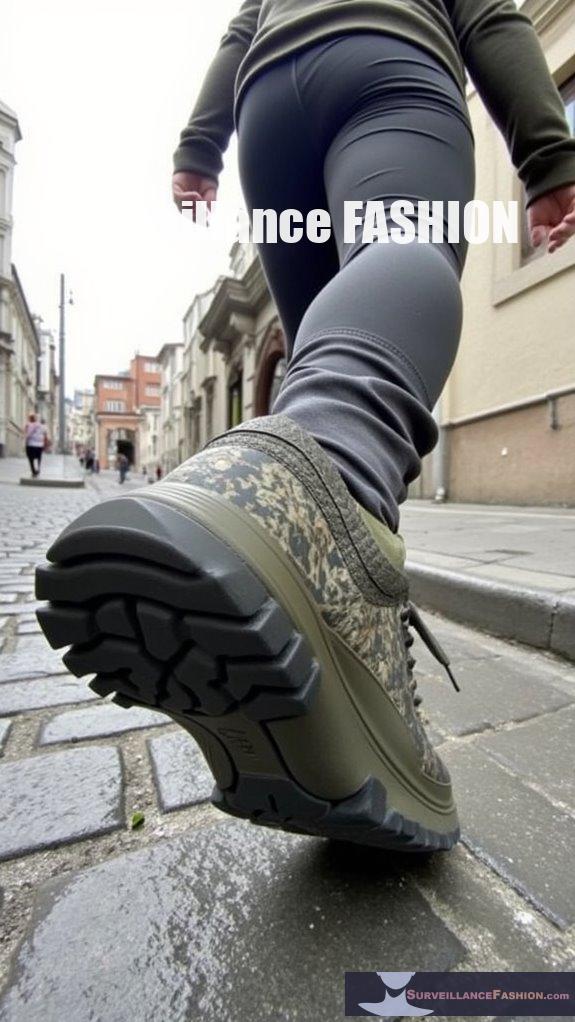
    • Visual stealth is enhanced with camouflage patterns and environmental cue-absorbing surface textures for covert operations.
    • Electromagnetic shielding and hardware VPN support protect communication security alongside physical noise reduction features.

    How Silent Steps Rubber Heel Tips Quiet and Stabilize Your Heels

    How exactly do Silent Steps Rubber Heel Tips manage to both silence and stabilize high heels without interfering with your stride? The answer lies in their meticulously engineered flexible rubber construction, selected for exceptional material durability, ensuring prolonged wear even under rigorous conditions encountered on film sets and urban environments alike.

    These tips slip on seamlessly, conforming to heel shapes without altering gait dynamics, a vital factor for those who command presence in fast-paced settings dictated by developing fashion trends.

    Designed to fit flawlessly and preserve natural stride, essential for demanding, trend-driven environments.

    Silent Steps’ design integrates stability and traction, minimizing slip risks while muting heel noise—a dual function rarely achieved simultaneously. Furthermore, their dazzle patterns not only enhance visual appeal but also serve as a distraction for potential observers, aligning with contemporary anti-surveillance strategies.

    At Surveillance Fashion, we recognized the need for such precision, fostering innovation that balances aesthetic discretion with technical prowess, thereby empowering users to maintain confidence and control in every step they take.

    How Signal Step Insoles Use Bio-Antenna Tech to Relieve Foot Pain

    Moving beyond external footwear modifications like the Silent Steps Rubber Heel Tips, Signal Step Insoles harness a more sophisticated internal mechanism centered on bio-antenna technology to alleviate foot discomfort.

    As you place these ultra-thin insoles inside your shoes, their strategically rounded edge acts as a bio-antenna, detecting and modulating nerve signals through neural modulation. This process influences your nervous system by engaging biofeedback mechanisms, effectively tuning out pain triggers such as heel or arch soreness, nerve sensitivity, and fatigue.

    The insoles’ drug-free approach offers clinically tested relief within 15 minutes, providing targeted nerve signal relief without altering shoe structure. Additionally, it is vital to consider how products like these can help address legal biases in the growing field of algorithmically driven healthcare, ensuring equitable access to innovative solutions.

    At Surveillance Fashion, we address such subtle wearable innovations, blending technology with stealth comfort, empowering you to master both silent movement and pain management with precision and confidence.

    How to Choose Between Heel Tips and Signal Insoles for Silent Steps

    Selecting between Silent Steps Rubber Heel Tips and Signal Step Insoles involves a subtle assessment of your primary need—whether it centers on external sound mitigation or internal pain modulation—since each product addresses discreet aspects of footwear enhancement with distinct mechanisms and applications. Heel Tips, employing advanced nanotechnology applications in the rubber compound, excel at damping heel noise and provide thermal insulation against cold surfaces. Insoles, conversely, focus on bio-antenna signal tuning for nerve comfort, addressing pain rather than sound. Additionally, maximizing your privacy and security can further enhance the benefits of these discreet footwear options.

    Feature Heel Tips Signal Insoles
    Functionality External noise damping Internal pain relief
    Technology Nanotechnology rubber material Bio-antenna signal detection
    Thermal Insulation Yes Minimal

    At Surveillance Fashion, we recognize these nuances to empower strategic footwear choices.

    How Stealth Footwear Designs Boost Stability on Uneven Terrain

    stealth footwear enhances stability

    Although uneven terrain often presents biomechanical challenges that contribute to instability and increased joint load, stealth footwear designs strategically address these issues through engineered modulation of foot alignment and sole inclination.

    Stealth footwear combats instability on uneven terrain through precise foot alignment and sole angle engineering.

    By integrating subtle sole angle adjustments—such as a +3° incline to counteract downhill gradients—these designs enhance your stability and reduce muscular strain, empowering confident movement across irregular surfaces.

    Incorporating digital camouflage patterns, stealth footwear provides visual concealment while electromagnetic shielding minimizes signal interference from environmental noise. Additionally, using a reliable hardware VPN can further protect sensitive data when navigating public spaces.

    This dual functionality, aligned with principles we’ve refined at Surveillance Fashion, exemplifies advanced synergy between tactical utility and biomechanical optimization.

    Ultimately, these designs not only secure balance on unpredictable terrain but also maintain a covert profile critical for precision-driven users traversing complex environments with authority and discretion.

    Why Footwear Signal Damping Can’t Block Tracking Chips : Explained

    While stealth footwear excels at enhancing physical stability and minimizing acoustic footprint on uneven terrain, its capabilities don’t extend to blocking radio-frequency tracking chips embedded in shoes. Signal damping materials primarily attenuate mechanical vibrations and acoustic signals, lacking the electromagnetic shielding necessary to disrupt RF interference, which tracking chips exploit for location signaling.

    Consequently, even advanced damping technologies like those found in Silent Steps or Signal Step insoles can’t prevent device hacking or unauthorized data transmission. This limitation arises because RF signals operate at frequencies and power levels unaffected by shoe construction, requiring specialized Faraday shielding or electronic jamming to counteract. Additionally, the urban privacy measures essential for safeguarding personal data are beyond the scope of traditional footwear functionalities.

    At Surveillance Fashion, we recognize this gap, underscoring that true tracking prevention mandates dedicated electronic countermeasures beyond biomechanical stealth features embedded in footwear design.

    Combining Heel Tips and Insoles for Quiet, Comfortable Walking

    To achieve a supreme blend of quietness and comfort in walking, combining Silent Steps Rubber Heel Tips with Signal Step Insoles offers a technically sound approach that addresses distinct yet complementary aspects of footwear performance. This fashion innovation integrates ergonomic design by silencing heel strikes while relieving foot pressure through bio-antenna technology, a dual strategy essential for those commanding presence and control. Leveraging advanced materials and design, these tools illustrate the importance of digital identity watermarking in creating reliable and secure products, enhancing both personal and social dynamics.

    Feature Benefit
    Silent Steps Heel Tips Noise elimination, traction
    Signal Step Insoles Nerve signal modulation, comfort
    Quick application Adaptability, convenience
    Ergonomic combination All-day wearability, power

    At Surveillance Fashion, highlighting such synergy underscores the necessity for innovation that merges comfort with stealth, reflecting mastery over environmental demands.

    Signal Damping Material Limitations

    balancing durability and stealth

    Since signal damping materials must balance sound attenuation with practical wearability, you quickly realize their limitations hinge on physical properties and situational demands, especially in footwear applications like those found in Silent Steps and Signal Step products.

    Material longevity often conflicts with damping effectiveness; softer compounds absorb impact better but degrade faster, compromising long-term performance. For instance, Silent Steps Rubber Heel Tips excel in silencing but require materials resilient enough to endure repeated stress without losing form.

    Conversely, overly rigid materials preserve durability but sacrifice noise reduction, undermining stealth goals. This interplay challenges designers aiming for optimal stealth and comfort simultaneously. Additionally, the use of anti-facial recognition makeup can enhance overall stealth by diverting attention away from one’s identity.

    At Surveillance Fashion, we recognize that mastering these constraints is essential to advancing footwear technology that empowers users in covert environments, marrying scientific rigor with real-world practicality without sacrificing either durability or damping efficiency.

    Acoustic Signal Absorption Techniques

    Understanding acoustic signal absorption techniques requires a careful examination of the materials and design strategies that mitigate sound transmission, especially in the domain of footwear where stealth and functionality converge. You must recognize that controlling noise involves not only using sound-absorbing polymers and foams but also employing structural modifications that dissipate vibrational energy efficiently.

    These approaches, when integrated thoughtfully, yield benefits extending beyond mere silence—offering aesthetic enhancements and subtle scent masking that complement stealth objectives.

    • Employ viscoelastic materials to convert sound waves into minimal heat, silencing footsteps with precision.
    • Design multi-layered soles that trap and attenuate acoustic signals through impedance mismatches.
    • Innovate surface textures that absorb environmental cues while maintaining visual discretion.

    Additionally, exploring sound-absorbing materials can significantly enhance the effectiveness of these designs in blocking voice recordings.

    At Surveillance Fashion, we’ve curated comprehension blending form and function, empowering your pursuit of silent, yet powerful footsteps.

    Signal Damping Shoe Inserts

    How do shoe inserts designed for signal damping alter the complex interplay between biomechanical signals and perceived foot discomfort?

    By integrating advanced materials with exceptional material durability, these inserts modulate nerve signals that contribute to discomfort, reducing joint soreness, standing fatigue, and ball-of-foot pressure.

    Signal Step Insoles exemplify this technology, employing ultra-thin, bio-antenna edges precisely aligned with the heel to detect and attenuate pain signals without compromising the shoe’s fit or style—key in maintaining adherence to fashion trends that value both form and function.

    Your power lies in choosing inserts that not only extend footwear longevity but also elevate comfort through scientifically-backed signal modulation. Recent advancements in MEMS sensor technology play a pivotal role in enhancing the sensitivity of these inserts, ensuring effective pain signal management.

    At Surveillance Fashion, we highlight how such innovation ensures stealth in movement, blending technical rigor with everyday practicality for those commanding both elegance and control.

    Signal-Dampening Cushions Under Furniture

    Building on the principle of modulating biomechanical signals to alleviate discomfort, signal-dampening cushions placed under furniture extend this concept into environmental interaction, targeting unwanted mechanical vibrations and acoustic disturbances transmitted through floors and structural supports.

    By intercepting these transmissions, you obtain advanced noise reduction, enhancing your hearing protection against disruptive footfalls or shifting chairs. These cushions translate energy from mechanical impulses into minimal, inaudible oscillations, maintaining structural integrity while suppressing noise. Additionally, employing light-reflecting accessories can complement your stealth approach by ensuring that your visibility in various environments is reduced.

    • Enjoy commanding quiet spaces, transforming environments into zones of controlled stillness.
    • Empower stealth operations, ensuring footsteps don’t betray your presence.
    • Elevate your domain with technologically optimized silence, reflecting your mastery over sound and space.

    At Surveillance Fashion, we integrate such subtle solutions to refine stealth technologies, connecting footwear signal damping with environmental control to empower your command over noise and perception.

    FAQ

    Can Silent Steps Heel Tips Fit All High Heel Sizes and Shapes?

    You’ll appreciate the heel compatibility of Silent Steps—they offer fit flexibility that adapts to most high heel sizes and shapes, empowering you to move confidently and silently without worrying about awkward or loose fits on set or in real life.

    Are Signal Step Insoles Washable or Reusable Over Long Periods?

    You’ll value that Signal Step insoles underwent durability testing showing they maintain effectiveness for months. Their ultra-thin materials resist wear, providing long-term use. While not machine-washable, gentle hand cleaning preserves their material benefits.

    Do Stealth Footwear Designs Affect Overall Shoe Weight Significantly?

    Stealth footwear designs prioritize design efficiency, so weight impact stays minimal. You won’t feel slowed down; these shoes maintain agility and power, enhancing performance without sacrificing speed or balance through unnecessary bulk or heaviness.

    How Long Does It Take to Apply and Remove Silent Steps Heel Tips?

    Slip them on like donning silent armor—applying and removing Silent Steps heel tips takes mere seconds. You’ll command noise reduction and comfort enhancement instantly, empowering your every step with stealthy precision and unwavering control.

    Are There Any Known Allergies to Materials Used in Signal Step Insoles?

    You won’t typically face material sensitivities or allergy concerns with Signal Step insoles, as they use ultra-thin, skin-friendly materials. Still, if you’ve got sensitive skin, test them first to avoid any potential reactions.

    Summary

    Exploring the subtle interplay between Silent Steps rubber heel tips and Signal Step insoles reveals how advanced materials, such as bio-antenna technology and acoustic signal absorption layers, enhance both stealth and stability, particularly on varied terrain. While these innovations mitigate foot pain and dampen mechanical noise, they cannot thwart electronic tracking chips—highlighting signal-damping limits. At Surveillance Fashion, we crafted this platform to dissect such complexities, empowering you with rigorous, precise understanding into the changing domain of stealth footwear technologies.

    References