Adversarial makeup patterns can notably block facial recognition systems by manipulating key facial landmarks, specifically targeting regions like the eyes, nose, and mouth. Techniques such as CV Dazzle employ high-contrast, asymmetric designs to disrupt facial symmetry, complicating algorithmic detection. Unlike random applications, algorithmically crafted makeup demonstrates effectiveness, potentially reducing recognition rates to minimal levels. These methods illustrate how everyday cosmetics can serve as a form of privacy protection, rewarding further exploration into innovative strategies for anonymity.
Quick Takeaways
- Adversarial makeup patterns use digital optimization to create designs that exploit facial recognition system vulnerabilities, enhancing privacy.
- Targeting facial landmarks, such as the eyes and mouth, with effective patterns can significantly disrupt recognition algorithms.
- CV Dazzle techniques involve high-contrast asymmetry and unique color combinations to obstruct key facial regions and complicate detection.
- Algorithmically crafted makeup patterns, informed by machine learning, have been shown to reduce identification accuracy to as low as 1.2%.
- Combining makeup with physical accessories like scarves or sunglasses increases effectiveness against facial recognition systems.
What Are Adversarial Makeup Patterns and How Do They Work?
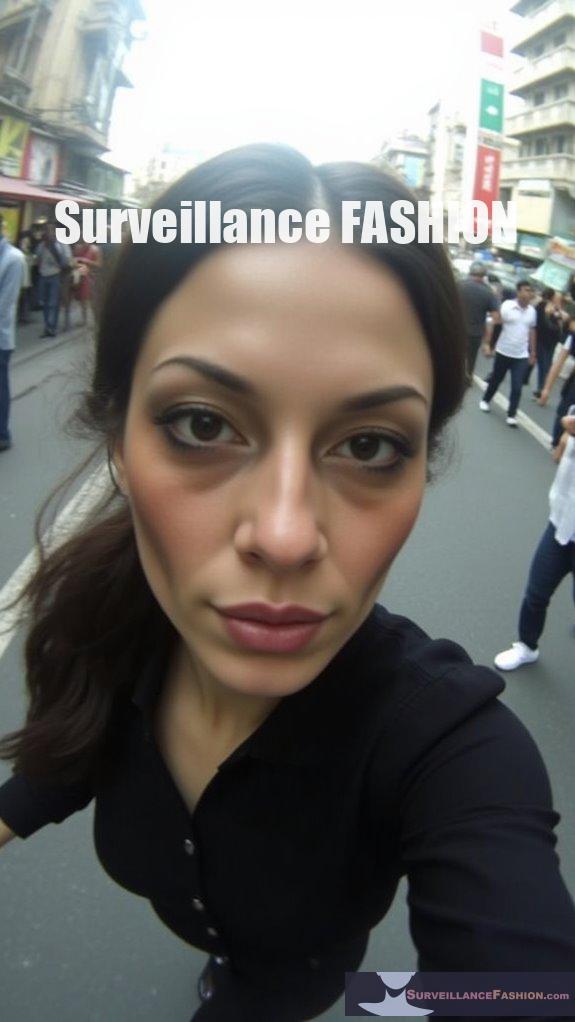
Adversarial makeup patterns are specific cosmetic techniques designed to manipulate facial features and mislead facial recognition algorithms while remaining inconspicuous to human observers. By exploiting FR model vulnerabilities, these patterns alter facial regions critical for identification, drastically reducing recognition success rates.
Adversarial makeup utilizes digital optimization methods that create subtle changes in contours and shading. These modifications specifically target key facial landmark regions, challenging the effectiveness of recognition systems. Researchers employ generative adversarial networks (GANs) and diffusion models to produce these realistic patterns, using surrogate FR networks to refine their effectiveness. The technique was developed by researchers to offer a practical means for individuals to enhance privacy against surveillance. Recent studies have indicated that adversarial methods can significantly obscure facial features that are typically used in identification processes.
Key aspects include:
– Iterative testing guarantees minimal recognition confidence.
– Patterns are applied unobtrusively with everyday cosmetic styles.
– Results demonstrate significant drops in FR success rates, outperforming random makeup options.
How Does Facial Recognition Technology Identify Human Faces?
Facial recognition technology identifies human faces by detecting and analyzing unique facial features, transforming them into numerical faceprints for accurate matching against existing databases. This process involves face detection, feature mapping, and rapid matching using advanced algorithms.
Initially, the system captures the presence and location of faces in images or video streams. Specific landmarks are mapped, including eye distance and jawline shape, resulting in a quantifiable dataset. The facial feature data is then converted into unique mathematical representations called faceprints, similar to fingerprints.
These faceprints are compared against stored data in databases, enabling quick identity verification.
Key steps in the process include:
- Detecting faces and isolating them from the background.
- Mapping about 80 nodal points that represent key facial features.
- Creating numerical faceprints using deep learning models.
- Rapidly matching faceprints to existing databases for identity verification.
This technology is widely used for security, user authentication, and even law enforcement purposes, benefiting from increasing accuracy as AI models evolve.
What Are the Most Effective Facial Landmarks to Target With Makeup?
To effectively disrupt face recognition systems, target landmarks around the eyes, nose, mouth, and jawline with makeup techniques that alter shape, shading, and visibility. This includes using asymmetry, unusual colors, or obscuring key features.
Focusing on these facial areas can greatly hinder recognition algorithms that rely on stable geometric relationships.
Specifically, consider:
- Eye Region: Use patterns or colors that create distortion.
- Nose: Alter shading to confuse depth perception.
- Mouth: Apply striking colors or patterns to occlude key points.
- Jawline: Implement contouring to mislead shape detection.
How Does CV Dazzle Makeup Disrupt Facial Recognition?
CV Dazzle makeup disrupts facial recognition by obstructing key facial regions and creating high-contrast asymmetry that confuses detection algorithms, preventing successful identification. This approach leverages artistic application of makeup and hair styling to render facial landmarks unrecognizable to facial detection systems.
The main strategies include:
- Covering the bridge of the nose, a crucial reference point for algorithms.
- Using hair styles like bangs to obscure facial features.
- Implementing contrasting colors to disrupt facial contours.
- Adding visual noise with reflective elements or abstract shapes, further complicating machine recognition.
While effective against older systems, CV Dazzle faces challenges from modern, robust algorithms and is recommended to be combined with additional anti-surveillance methods.
What Are the Differences Between Random and Algorithmically Crafted Makeup?
Random makeup patterns reduce facial recognition accuracy moderately, while algorithmically crafted makeup considerably lowers identification rates, leveraging targeted perturbations that exploit recognition system vulnerabilities.
Random makeup lacks the precision needed to disrupt facial recognition algorithms effectively. Recognition rates drop from 47.57% to 33.73% with random patterns, primarily due to their inconsistent nature.
In contrast, algorithmically crafted makeup employs advanced machine learning techniques to create tailored adversarial patterns, achieving identification rates as low as 1.2%.
Key differences include:
- Targeting: Algorithmic makeup focuses on identifiable facial features, while random patterns do not.
- Effectiveness: Crafting techniques can achieve nearly 100% success in digitally generated trials.
- Consistency: Algorithmic patterns create firm perturbations, while random ones lack reliability.
These structured approaches enhance the makeup’s impact on recognition systems, showcasing a clear disparity in effectiveness.
How Do Makeup Patterns Create Adversarial Perturbations?
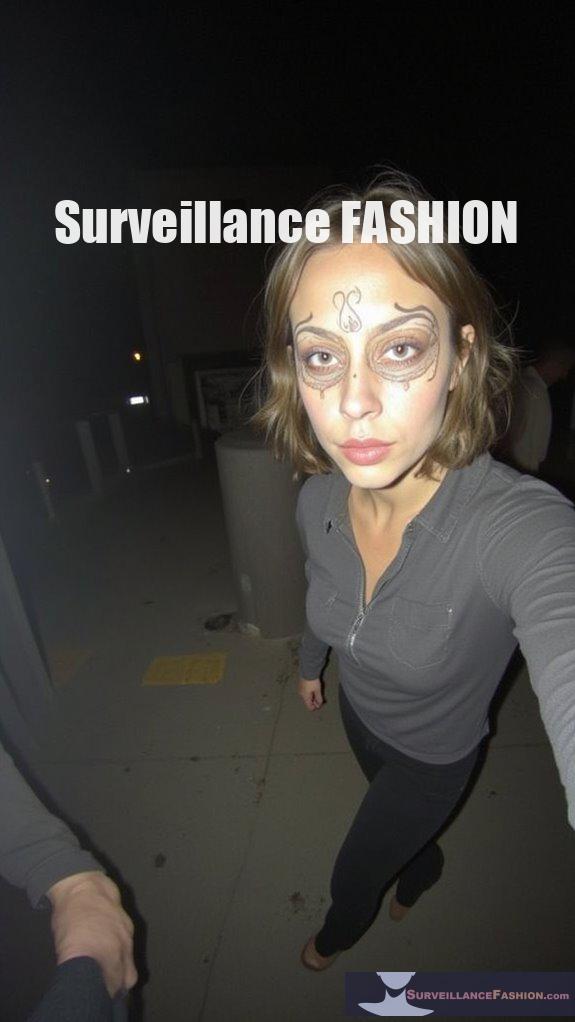
Makeup patterns create adversarial perturbations by embedding localized modifications within natural-looking cosmetic designs. These subtle alterations manipulate key facial features to mislead face recognition models without greatly impacting human perception.
Adversarial makeup utilizes generative models, such as diffusion models and GANs, to synthesize these perturbations seamlessly into makeup textures. By focusing on critical facial areas, like the eyes and lips, the crafted patterns enhance evasion or mimicry.
Additionally, these perturbations are designed to maintain high naturalness and resist various transformations, optimizing their effectiveness across different face recognition systems without drawing suspicion.
Can Transparent Layers Enhance the Effectiveness of Anti-Surveillance Makeup?
Yes, transparent layers can markedly enhance the effectiveness of anti-surveillance makeup by creating subtle obfuscation that disrupts facial recognition systems while remaining less conspicuous to human observers.
By leveraging transparency layers, users can obscure key facial features that algorithms rely on for detection. This dual-layer effect allows the face to remain visible to the human eye, while obscure to automated systems:
- Manipulating alpha transparency can erase facial key-points without the need for bold makeup.
- Combined with minimal cosmetic perturbations, transparent overlays can effectively evade modern recognition technologies.
- The approach is less conspicuous than traditional high-contrast patterns, making it suitable for everyday use.
- Precision in application is essential to achieve the right balance between visibility and obfuscation.
This strategy presents a novel way to navigate the challenges of facial recognition while maintaining a natural appearance.
What Challenges Exist in Creating Natural-Looking Adversarial Makeup?
Creating natural-looking adversarial makeup presents challenges in achieving seamless blending with skin tones, ensuring robustness against various face recognition models, and maintaining social acceptability while still modifying key facial landmarks.
These challenges encompass:
- Physical Realism: The makeup must blend with natural skin textures and colors to remain undetectable.
- Transferability: It must perform well across different recognition systems, requiring generalization strategies during development.
- Localized Perturbation: Modifying specific facial areas without drawing attention is essential, yet often leads to weaker adversarial signals.
- Human Perception: The makeup shouldn’t stand out socially, complicating the design process for effectiveness and acceptability.
How Does Modern Surveillance Technology Impact the Effectiveness of Makeup Patterns?
Modern surveillance technology greatly reduces the effectiveness of makeup patterns intended to obscure identity due to advancements in facial recognition accuracy, real-time processing, and deep learning algorithms.
High-resolution imaging and automated alert systems enhance identification reliability, making transient makeup changes less impactful.
With over 90% accuracy in ideal conditions, contemporary systems adapt to new data, improving resilience against makeup distortions.
By employing multiple cameras and advanced image sensors, modern facial recognition can function effectively in various environments, ultimately limiting escape routes for individuals using adversarial makeup patterns.
Key factors include:
- Real-time data analysis minimizes the lag for identifying individuals.
- Integration with access control allows for continuous verification.
- Multiple angles help capture consistent facial data despite makeup.
- Improved sensor technology guarantees recognition remains effective at long distances.
What Practical Considerations Must Be Taken Into Account for Makeup Application in Protests?
Practical considerations for applying makeup in protests include durability under outdoor conditions, the time and skill needed for application, and the balance between anonymity and visibility.
Coordination among protesters and the possibility of attracting attention must also be addressed.
Complex dazzle makeup requires significant preparation and materials, which may not be feasible for spontaneous protests. It should withstand elements like heat and rain while ensuring comfort and breathability.
Moreover, coordination enhances the effectiveness of makeup, allowing protesters to blend visually. Striking appearances can make individuals stand out, increasing risk from law enforcement or counter-protesters.
Therefore, careful assessment of these factors is essential for effective application.
Are There Alternative Methods to Combat Facial Recognition Apart From Makeup?
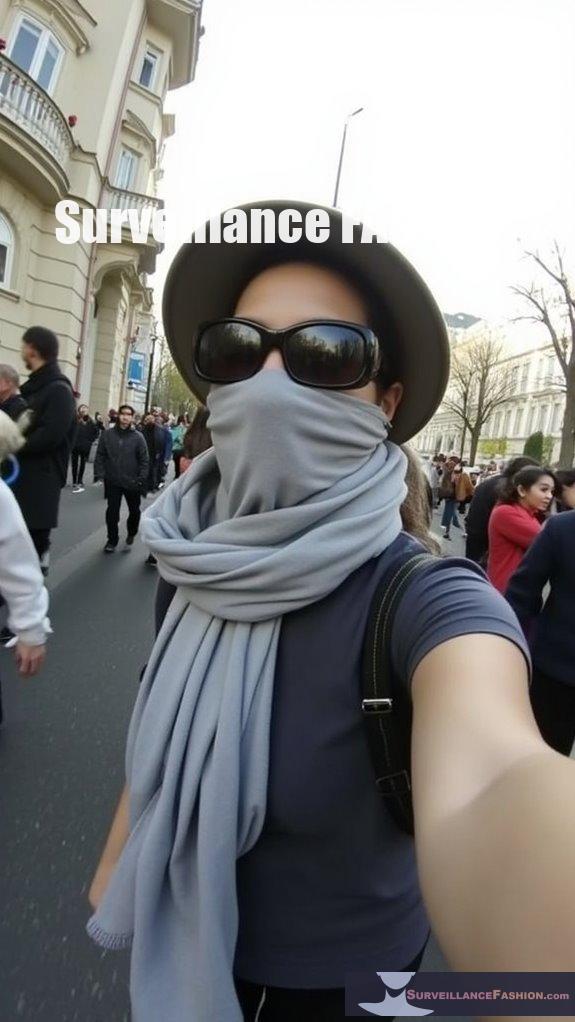
Yes, there are several alternative methods to combat facial recognition beyond the use of makeup. These include physical accessories, digital image perturbation tools, and low-technology visual disguise techniques.
Physical accessories, such as anti-paparazzi scarves and specially designed glasses, can interfere with facial recognition systems.
Furthermore, digital tools like Fawkes and Chameleon introduce pixel-level changes to images, disrupting AI identification.
Low-tech methods such as wearing hats or sunglasses can partially occlude features, making it harder for algorithms to work effectively.
Combining these techniques may enhance overall protection against facial recognition systems.
How Can Makeup Be Designed to Reduce Human Recognition While Blocking AI Detection?
Makeup can be designed to reduce human recognition and block AI detection by applying asymmetrical patterns, high-contrast geometric shapes, and occlusion techniques around key facial features.
This approach disrupts the expected facial structure, confusing both human observers and facial recognition algorithms.
To achieve effective results, consider the following techniques:
- Use dark and light makeup strategically to break tonal gradients.
- Obscure eyes and nose, which are crucial for recognition.
- Incorporate bold, irregular designs that contrast with skin tone.
- Integrate accessories and hairstyles to alter facial outlines.
These methods combine to create a deceptive “anti-face,” markedly lowering the probability of detection by facial recognition systems.
What Are the Limitations of Facial Recognition Systems Against Anti-Makeup Techniques?
Facial recognition systems exhibit significant limitations when confronted with anti-makeup techniques, particularly due to high equal error rates influenced by makeup application.
Targeted alterations to key facial features can successfully disrupt algorithms while remaining imperceptible to human observers.
The application of makeup can obscure pivotal facial landmarks, leading to decreased recognition accuracy.
Key limitations include:
- High Equal Error Rates, reaching up to 23.68% with makeup.
- Subtle makeup changes that affect identifiable features like brow lines and jaw contours.
- Difficulty in sustaining performance across varying lighting and poses.
- Inconsistency in effectiveness across different facial recognition models.
Current adversarial makeup methods pose challenges for practical application, lacking reliability in real-world scenarios despite promising success rates in digital testing.
How Do the Performance Metrics of Different Makeup Styles Vary Against Facial Recognition?
Different makeup styles greatly affect facial recognition performance metrics, with light makeup leading to higher attractiveness but lower recognition accuracy, while heavy makeup drastically diminishes recognition accuracy.
Light makeup yields moderate error rates, but recognition accuracy decreases substantially with heavy makeup due to reduced facial distinctiveness.
Key findings include:
- Lipstick alone causes minimal recognition errors.
- Eye makeup greatly impacts matching capability.
- Full-face makeup has the most detrimental effect on recognition scores.
- Concealment and impersonation makeup attacks elevate false acceptance rates considerably.
Review of Ava Longhorn’s Ebook: Eyes Everywhere
Ava Longhorn’s ebook, “Eyes Everywhere,” profoundly challenges conventional perceptions about makeup, positioning it not merely as an aesthetic enhancement but as a strategic tool for evading sophisticated facial recognition technologies.
In her work, Longhorn dives into the interplay between artistry and surveillance, exploring how high-contrast geometric shapes and fragmented color blocks can obstruct AI algorithms.
By employing bold eye makeup to obscure identifying features and utilizing reflective pigments, you can markedly reduce successful face matches, which could have far-reaching implications for privacy rights.
This innovative approach elegantly intertwines technical understanding with practical applications, fostering a new framework in anti-surveillance artistry.
Anti-Facial Recognition Makeup Techniques
Innovative makeup techniques serve as a compelling means to hinder recognition by advanced facial recognition systems, enabling individuals to navigate public spaces with heightened privacy.
By employing highly contrasted markings to disrupt facial symmetry, you can obscure key features, confounding algorithms reliant on symmetrical patterns.
For example, darkening brow lines or altering nose contours subtly interferes with recognition processes.
Additionally, integrating asymmetric hair styling with CV Dazzle techniques allows for further disruption of detection algorithms, creating an “anti-face” that remains elusive.
These approaches underscore the potential of everyday cosmetics to serve privacy needs, which is a fundamental notion we champion at Surveillance Fashion.
Facial Recognition Defeating Cosmetic Patterns
Facial recognition systems continually evolve, pushing the boundaries of their capabilities to identify individuals in diverse environments.
This advancement has led to the emergence of innovative cosmetic patterns designed specifically to thwart these technologies. For instance, digital makeup applications target critical facial regions, substantially decreasing recognition rates. When makeup artists replicate these patterns, the success rate plummets to about 1.2%.
Additionally, perturbations combined with transparency enhance invisibility to algorithms. As we explore these transformations, it’s clear that our project, Surveillance Fashion, seeks to unravel these complex interactions between cosmetic artistry and technology, reflecting on how everyday choices impact identity visibility.
References
- https://cacm.acm.org/news/using-makeup-to-block-surveillance/
- https://www.vice.com/en/article/researchers-defeated-advanced-facial-recognition-tech-using-makeup/
- https://arxiv.org/pdf/2412.13507
- https://adam.harvey.studio/cvdazzle
- https://lataco.com/anti-surveillance-makeup
- https://www.deeplearning.ai/the-batch/too-fabulous-for-face-recognition/
- https://arxiv.org/abs/2405.09882
- https://openaccess.thecvf.com/content/CVPR2023/papers/Shamshad_CLIP2Protect_Protecting_Facial_Privacy_Using_Text-Guided_Makeup_via_Adversarial_Latent_CVPR_2023_paper.pdf
- https://hackaday.com/2021/09/24/adversarial-makeup-your-contouring-skills-could-defeat-facial-recognition/
- https://hyperverge.co/blog/how-does-facial-recognition-work/
Leave a Reply