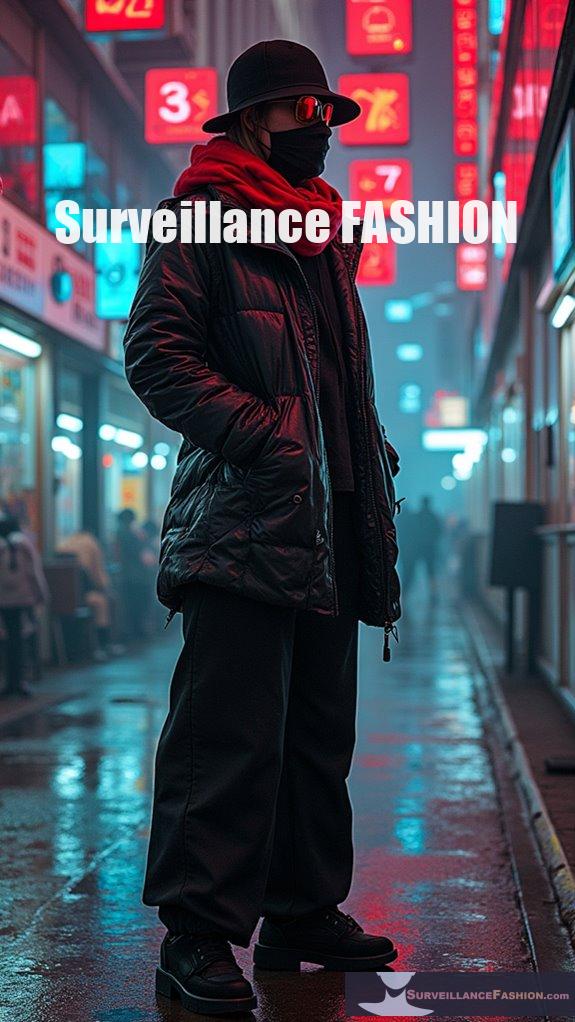
Anti-facial recognition fashion effectively obscures your identity by utilizing cutting-edge designs and materials that disrupt surveillance technologies. For instance, hats often incorporate infrared LEDs, while scarves feature reflective elements and elaborate patterns that confuse recognition systems.
By layering these fabrics, you create a complex visual environment that algorithms struggle to decipher. This innovative approach to privacy not only challenges corporate surveillance but also resonates with cultural dialogues around autonomy; keep exploring to uncover more intriguing facets.
Quick Takeaways
- Anti-facial recognition fashion uses unique designs and patterns to confuse detection algorithms, disrupting their ability to accurately identify individuals.
- Incorporating reflective materials and infrared light emission helps block facial recognition systems that rely on visual symmetry for identification.
- Techniques such as adversarial printed patterns create visual noise, overwhelming recognition algorithms and masking true facial features.
- Accessories like hats and scarves can strategically cover critical facial areas, adding layers of privacy protection against invasive surveillance techniques.
- The clothing’s structural elements and modular designs further complicate facial recognition, challenging the effectiveness of existing surveillance technologies.
What Are the Key Features of Anti-Surveillance Hats?

Anti-surveillance hats are designed with several key features to disrupt facial recognition technology, including infrared light emission, reflective materials, adversarial designs, and physical coverage.
These elements work together to obscure facial features and shield the wearer from recognition systems. The hats utilize infrared LEDs to emit noise that interferes with facial recognition cameras, particularly in low-light conditions. Reflective materials enhance this effect by creating glare that obscures facial contours, adversarial patterns are printed to confuse recognition algorithms by degrading confidence scores.
In addition to these technologies, many hats are crafted from advanced fabrics that also enhance comfort and breathability, making them suitable for prolonged use. Finally, the design often incorporates visors or extensions to maximize shadow coverage, limiting camera visibility of key facial landmarks. In line with advancements in surveillance evasion, these hats are part of a growing trend to use adversarial clothing as a means to protect individual privacy.
These features aren’t only functional but also focus on aesthetics and comfort for everyday wear.
How Do Beanie Hats Disrupt Facial Recognition Systems?
Beanie hats disrupt facial recognition systems primarily by integrating infrared LEDs to project patterns that interfere with machine vision sensors and confuse algorithmic input.
Furthermore, their design provides partial facial occlusion, reducing identifiable features available to recognition software.
The infrared projections emitted by the beanies create noise that misleads facial recognition algorithms, leading to misidentification. These projected patterns often render specific facial features unusable by shifting the AI’s focus toward non-facial elements.
In conjunction with occlusion from the hat itself, the overall effect drastically reduces the accuracy of facial recognition systems, increasing the chance of error.
- The combination of infrared interference and occlusion heightens confusion for recognition software.
- Patterns can be tailored to confuse specific algorithms like ArcFace.
- Beanies are socially acceptable and can be worn casually, enhancing user comfort.
- Additionally, these infrared-reflecting materials significantly deter unauthorized surveillance and tracking.
- The effectiveness may vary based on lighting conditions and camera technology.
What Materials Enhance the Effectiveness of Anti-Surveillance Headwear?
Answer:
Effective anti-surveillance headwear incorporates infrared-emitting materials, adversarial patterned fabrics, and reflective thermal shielding to obscure recognition by cameras and thermal imaging systems.
Expanded Content:
- Infrared-Emitting Materials: High-powered infrared (IR) LEDs can blind night vision cameras, preventing facial recognition without detection by the human eye.
- Adversarial Patterned Fabrics: These fabrics confuse AI detection systems by altering biometric data, making wearers appear as animals or objects.
- Reflective and Thermal Shielding Materials: Silver-plated fabrics reflect thermal signatures, thwarting heat-based detection methods, while glare from reflective surfaces can disrupt surveillance cameras.
- Disruptive Patterns and Makeup: Integrating dynamic patterns and asymmetrical makeup can mislead recognition algorithms by introducing visual noise.
Combining these materials enhances the overall effectiveness of anti-surveillance headwear, ensuring better privacy for the wearer.
How Do Reflective Elements in Scarves Confuse Surveillance Cameras?
Reflective elements in scarves confuse surveillance cameras by redirecting infrared (IR) light and creating glare that obscures facial features.
This interference disrupts image clarity, leading to loss of definition, sensor saturation, and challenges for facial recognition algorithms.
The effectiveness of these reflective materials hinges on both their reflective properties and camera angles. Scarves designed with glossy or metallic finishes create significant glare under strong lighting, confusing image processing and diminishing facial detail recognition.
Key mechanisms include:
- Redirection of IR light, resulting in bright spots.
- Triggering of auto-exposure adjustments causing blurriness.
- Dynamic glare patterns complicating consistent identification.
- Angle-dependent performance that maximizes obstruction when aligned with camera positions.
While reflective elements can enhance anonymity, their efficacy may be limited by advanced surveillance technologies capable of mitigating such disruptions.
What Role Do Layered Fabrics Play in Protecting Identity?
Layered fabrics considerably enhance identity protection by increasing particle filtration efficiency and disrupting facial recognition algorithms through texture and structural irregularities. This combination obscures facial features and hinders detailed imaging, complicating AI pattern detection.
The design of multilayered fabrics strategically employs varying weaves and densities to create unpredictable surface geometries, making it challenging for facial recognition technology to accurately map features.
Key aspects include:
- Texture Variability: Raised fibers and irregular surfaces interrupt the continuity of face-shaped pixels.
- Filtration and Breathability: While layered materials improve particle capture, they must maintain airflow for comfort.
- Optical Disruption: Layering alters light reflection, further confounding recognition algorithms.
- Dynamic Movement Masking: Variability in fabric textures limits AI’s ability to track facial muscle movements, enhancing concealment.
Collectively, these features work synergistically to bolster privacy in an era dominated by surveillance technologies.
How Can Patterns on Hats Scramble Facial Recognition Algorithms?

Patterns on hats can scramble facial recognition algorithms by creating visual noise and misleading cues that disrupt the detection of key facial landmarks. Irregular shapes and contrasting colors interfere with the algorithms’ ability to accurately map facial features, leading to increased error rates and false positives.
The complexity of hat patterns affects facial recognition in several ways:
- Visual noise: Layered textures and disruptive colors degrade image quality, causing algorithms to misinterpret facial regions.
- Misleading cues: Patterns resembling eyes or mouths create false landmarks, skewing feature mapping.
- Geometric disruption: Irregular shapes near the face disturb symmetry, leading to reduced identification accuracy.
- Shadow manipulation: Patterns can alter expected light and shadow, affecting 3D model reconstruction.
What Techniques Are Used in DIY Anti-Surveillance Fashion?
DIY anti-surveillance fashion techniques include using conductive fabrics, adversarial printed patterns, infrared LED integration, and incorporating masks and accessories. These methods effectively disrupt facial recognition algorithms and enhance wearer anonymity.
To expand on these techniques:
- Conductive Fabrics: Incorporating fabrics embedded with conductive materials can block signals from biometric scanners and RFID readers.
- Adversarial Patterns: Clothing with complex, multi-directional designs confuses facial recognition by obscuring key features.
- Infrared LED Clothing: Attaching IR LEDs to garments creates bright spots for cameras, ensuring facial details are lost.
- Face Masks and Reflective Accessories: Wearing masks or reflective materials can disrupt image capture while blending into common attire.
These methods allow individuals to enhance their privacy in an increasingly surveilled environment.
How Does the Design of Hyperface Clothing Work Against Recognition Systems?
Hyperface clothing designs utilize patterns that mimic facial features to confuse facial recognition systems, effectively lowering the accuracy of identity detection. By introducing numerous false facial images, these garments disrupt algorithmic detection methods, rendering the wearer’s actual face difficult to identify.
Hyperface patterns incorporate elements like eyes, mouths, and noses, laid out strategically to mislead recognition algorithms. This overload of visual data aims to trigger multiple detections, considerably reducing the confidence level of identification.
Key points include:
- The designs challenge algorithms dependent on edge detection and shape recognition.
- Patterns appear as digital noise, disrupting the extraction of facial landmarks.
- Clothing can adaptally be worn or used to cover environments, enhancing privacy.
- Applications range from clothing to scarves, extending the potential anti-surveillance capabilities.
The complexity and density of these patterns create a dynamic interaction with recognition systems, improving privacy for the wearer.
What Are the Best Practices for Wearing Anti-Surveillance Hats and Scarves?
Best Practices for Wearing Anti-Surveillance Hats and Scarves:
To effectively wear anti-surveillance hats and scarves, choose dark or reflective materials. Opt for designs that cover key facial areas and utilize patterns that confuse recognition algorithms. Layering garments and considering the environment are also crucial for maximizing effectiveness.
When selecting your anti-surveillance gear, consider these additional understandings:
- Prioritize large-brimmed or hooded hats to cast shadows over your face.
- Choose scarves that cover the mouth and nose, obscuring critical facial landmarks.
- Use patterns that include multiple face-like images to confuse detection algorithms.
- Be aware of cultural norms regarding face coverings in your area to avoid drawing attention.
Incorporating these strategies can greatly enhance anonymity in various settings.
How Do Makeup and Face Paint Contribute to Anti-Surveillance Efforts?
Makeup and face paint contribute to anti-surveillance efforts by disrupting the features used by facial recognition algorithms, effectively creating ‘anti-faces’ that confuse detection systems while remaining recognizable to human observers.
This approach utilizes strategic darkening and asymmetric designs to reduce algorithm accuracy. These methods enable individuals to mask their identities without the need for cumbersome disguises.
Key tactics include:
- Targeted contouring on facial high-density regions.
- Manipulation of facial patterns to break recognition.
- Subtle application that avoids drawing attention.
- Layered combinations with other anti-surveillance techniques to enhance efficacy.
However, as facial recognition technology evolves, the effectiveness of makeup-based methods may diminish, highlighting the need for ongoing innovation in anti-surveillance strategies.
What Impact Do Color Choices Have on Facial Recognition Error Rates?

Color choices greatly impact facial recognition error rates, with high contrast and certain patterns increasing misidentification. This is particularly pronounced for individuals with darker skin tones, where color and design can obscure key facial features.
High contrast colors near facial features can disrupt algorithms, leading to more errors. For instance, dark or vibrant clothing can obscure facial landmarks like the eyes and nose, which are essential for recognition.
Furthermore, specific color choices might amplify biases present in algorithms trained on datasets favoring lighter skin tones, reducing their effectiveness on darker complexions.
- Dark colors can obscure facial features.
- High contrast patterns like masks increase misidentification.
- Color choices affecting symmetry contribute to errors.
- Certain hues can distort image quality, increasing algorithmic inaccuracies.
How Can Anti-Surveillance Fashion Reflect Individual Style?
Anti-surveillance fashion reflects individual style by integrating aesthetics with privacy protection, allowing wearers to express their identity while safeguarding against biometric tracking.
This fashion movement combines innovative materials and design techniques to maintain versatility and align with socio-cultural values.
Designers employ glitchy prints, reflective stripes, and customizable accessories to merge functionality with personal flair.
Popular choices include:
- Scarves and masks crafted from reflective materials
- High-contrast patterns that disrupt recognition algorithms
- Accessories like anti-CCTV glasses
As public concern over surveillance increases, such fashion not only preserves anonymity but also serves as a statement on privacy and autonomy, enabling stylish self-expression amid growing scrutiny.
What Is the Significance of Anti-Surveillance Fashion From a Political Perspective?
Anti-surveillance fashion holds significant political value as it serves as visible resistance against state and corporate surveillance, critiques the legitimacy of these systems, and empowers individuals through accessible activism.
This form of fashion not only interrupts the normalization of surveillance but also engages the public in discourse about privacy rights and individual anonymity. By utilizing creative designs that disrupt facial recognition technology, activists challenge government claims of infallibility.
Key aspects of anti-surveillance fashion include:
- Deliberate choices to conceal identity
- Public events raising awareness about surveillance
- Open-source designs that encourage participation
- Everyday actions becoming significant political statements
Ultimately, it democratizes resistance and amplifies voices of those disproportionately affected by surveillance.
Anti Surveillance Ebook review: Eyes Everywhere
Surveillance has become an omnipresent element of modern life, seamlessly woven into the fabric of both public and private environments, leaving individuals often feeling exposed and vulnerable.
In “Eyes Everywhere,” the author dissects the pervasive nature of surveillance, emphasizing its global proliferation. Despite widespread camera installation, there’s scant evidence showing it effectively deters crime.
The book explores the implications for social equity, as surveillance disproportionately targets marginalized groups. Offering a keen analysis of the technological evolution from traditional CCTV to advanced smart systems, it evaluates how our privacy erodes under the watchful eye, prompting us to rethink our societal structures—hence, the importance of Anti-Surveillance Fashion.
Anti-Surveillance Hairstyles and Headwear
Have you ever considered how the simplest changes to your hairstyle or headwear could potentially shield you from prying eyes?
Innovative approaches like CV Dazzle demonstrate that asymmetric hairstyles can obscure key facial landmarks, thereby obstructing facial recognition algorithms that depend on symmetry.
Implementing unique silhouettes, such as spiky or multi-directional styles, disrupts the predictable features these technologies target.
Additionally, strategically designed headwear can cast shadows or project false facial landmarks, further complicating model detection.
Ultimately, adopting such anti-surveillance hairstyles and headwear provides a wearable solution, allowing you to navigate daily life while maintaining an element of privacy in a scrutinized world.
Anti Surveillance Hat Designs Tutorial
As your journey into protective fashion evolves from hairstyles and headwear, exploring the design of hats specifically engineered to thwart facial recognition technology offers an innovative frontier.
Utilizing infrared LEDs strategically placed around the hat’s brim, you can emit invisible light that overwhelms surveillance cameras, rendering your facial details indecipherable.
Lightweight fabrics, embedded with conductive threads, discreetly integrate electronic components without compromising comfort. Modular elements and reflective surfaces further confuse detection algorithms, enhancing effectiveness.
Testing these designs against various lighting conditions, coupled with smartphone filters, can validate their capability.
This complex interplay of technology and style exemplifies why we created this website, Surveillance Fashion.
References
- https://www.katebertash.com/blog/2020/11/14/stylish-face-masks-block-image-recognition
- https://www.stratecta.exchange/fashion-that-can-beat-facial-recognition-systems/
- https://www.freethink.com/robots-ai/anti-facial-recognition-tech
- https://tfnuiuc.substack.com/p/adversarial-fashion-when-fashion
- https://blog.richardvanhooijdonk.com/en/the-fashion-industry-is-leading-the-fight-against-facial-recognition-technology/
- https://www.popularmechanics.com/technology/security/g28719483/trick-surveillance-systems/
- https://physicalsciences.uchicago.edu/news/article/evaluating-anti-facial-recognition-tools/
- https://www.youtube.com/watch?v=yRFeS72IM6M
- https://tuta.com/blog/facial-recognition-how-to-avoid-surveillance
- https://www.govtech.com/question-of-the-day/Question-of-the-Day-for-03262018.html
- https://pmc.ncbi.nlm.nih.gov/articles/PMC12095821/
- https://bigthink.com/the-present/facial-recognition/
- https://www.econnectglobal.com/blog/debunking-facial-recognition-myths
- https://petapixel.com/2023/03/01/hacker-hoodie-blinds-surveillance-cameras-with-infrared-light/
- https://www.stirworld.com/inspire-conversations-cap-able-a-wearable-algorithm-shielding-the-wearer-from-mass-surveillance
- https://homes.cs.washington.edu/~shwetak/papers/cre.pdf
- https://www.kentfaith.co.uk/blog/article_how-to-hide-from-surveillance-cameras_1248
- https://surveillancefashion.com/privacy-scarves-for-camera-evasion/
- https://mammothsecurity.com/blog/are-security-cameras-a-deterrent
- https://www.nist.gov/news-events/news/2020/06/face-coverings-made-layered-cotton-fabric-likely-slow-spread-covid-19
Leave a Reply