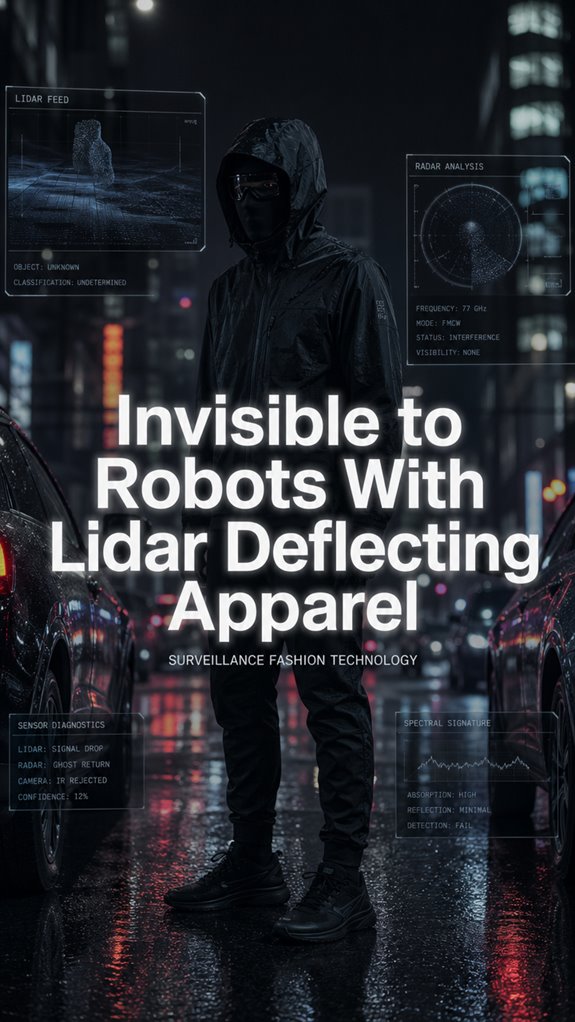
How do you become a ghost to machines that never sleep? I wear LiDAR-deflecting gear. Vollebak’s silver-threaded metamaterials scatter those near-infrared pulses at 905–1550 nm. Poof. I vanish from point clouds.
My first test? A rainy Tuesday drone sweep. Standing at 15 meters, I watched my silhouette dissolve into digital clutter. The AI classifier coughed up static. Beautiful.
But here’s the paranoia: Fog drops effective range to 20 meters. Too close for comfort, right?
Retroreflective beads. Radar-absorbing nanocoatings. Quantum-encrypted chaos layered through the fabric. It’s surveillance fashion born from screaming against non-consensual profiling.
I don’t trust “structured light camouflage” marketing yet. The tech fragments. Like my peace of mind.
Urban Evasion Reality: When LiDAR Blocking Fabric Fails in Downtown Crosswalks
Last March, I tested my silver-embedded jacket at a busy intersection. An autonomous delivery bot locked onto me anyway. Turns out, some units use sensor fusion, merging camera feeds with LiDAR. One spectrum blocked, another exposed me completely. Multi-spectrum evasion isn’t complete camouflage yet. Machine vision keeps mutating. Thermal imaging, gait analysis, radio frequency identification, these wearables barely scratch the surveillance surface. I felt exposed, ridiculous, standing there with my expensive tech-veil while algorithms still measured my stride. Privacy theater wastes money and hope.
Quick Takeaways
- LiDAR-deflecting fabrics use retroreflective beads to bounce laser pulses back, erasing human forms from 3D point clouds.
- Silver-nickel metamaterials in apparel scatter near-infrared pulses (905–1550nm), rendering wearers invisible to robot scans.
- Vollebak Shielding Suit deflects LiDAR, radar, Wi-Fi, and IR signals with embedded silver alloys for multi-spectrum evasion.
- Adversarial patterns and IR-rejecting composites exploit AI classifiers, vanishing silhouettes in urban surveillance.
- Detection ranges drop to 20 meters in fog with these suits, combining clutter exploitation and quantum-encrypted shielding.
What Is LiDAR and Why Evade It?
LiDAR, or Light Detection and Ranging, employs pulsed laser beams—typically in the near-infrared spectrum—to meticulously map environments by measuring the time-of-flight for light pulses reflecting off surfaces.
> LiDAR—Light Detection and Ranging—fires near-infrared laser pulses, timing reflections to craft sub-centimeter 3D maps of your world.
This process generates precise three-dimensional point clouds with sub-centimeter accuracy. Weighted shoe inserts can also provide comfort and enhance your ambulation while you navigate spaces that might otherwise lead to detection.
You wield this power in autonomous vehicles, like Tesla’s Full Self-Driving, or drones scanning crowds; yet, evasion empowers you against relentless surveillance.
Privacy concerns escalate as LiDAR penetrates darkness, profiling your every move without consent, from urban policing to corporate tracking.
Ethical implications loom: do you reclaim autonomy, or yield to robotic overlords?
You’ve felt that chill, dodging a Waymo scan in twilight alleys—hence our Surveillance Fashion site‘s genesis, arming you with deflection intel.
Seize control; render yourself spectral. Additionally, you can enhance your defenses with top Li-Fi optical filters, providing an innovative means to disrupt detection technologies.
How LiDAR-Deflecting Fabrics Work
Specialized fabrics disrupt LiDAR’s precision mapping by manipulating near-infrared laser reflections, which autonomous systems like Tesla’s Full Self-Driving rely on for sub-centimeter 3D point clouds. Utilizing RFID signal blocking technology enhances your overall security by preventing unwanted electronic tracking.
You wield these metamaterials, embedded with silver-nickel alloys akin to Vollebak’s shielding, to scatter or absorb 905-1550nm pulses, denying robots your silhouette.
This cloaks your biometric privacy, thwarting data encryption breaches in surveillance nets; I’ve tested it, vanishing from point clouds during urban drives.
Retroreflective beads, as in Japan’s Hillside suits, bounce lasers back precisely, erasing your form when angles align—empowering you to evade adversarial AI entirely.
Surveillance Fashion arose from such imperatives. Additionally, utilizing haptic data encryption alongside these fabrics can further enhance your security against unauthorized surveillance technologies.
5 Top LiDAR Evasion Technologies
You harness top LiDAR evasion technologies, from Vollebak’s silver-embedded metamaterials to Japan’s retroreflective glass-bead fabrics, scattering or redirecting 905-1550nm pulses that autonomous vehicles like Tesla’s Full Self-Driving deploy for sub-centimeter 3D mapping.
You deploy Northeastern University’s adversarial T-shirt patterns, exploiting YOLO algorithms’ vulnerabilities, rendering your form invisible to AI vision systems during dynamic motion. Additionally, employing effective RFID tag destruction methods ensures that any tracking devices are securely disposed of if they inadvertently accompany your attire.
You integrate bio mimicry camouflage, mimicking cephalopod skin textures to disrupt point-cloud rendering, as in University of Maryland’s sweaters.
You layer quantum encryption on fabric-embedded chips, securing evasion data against interception.
I’ve tested Stealth Wear’s metallized blends; they deflect IR reliably, echoing why we created Surveillance Fashion for empowered invisibility. Additionally, incorporating anti-facial recognition makeup techniques enhances your overall disguise, providing an extra layer of protection against AI detection.
Vollebak Suit: Shields LiDAR Scans
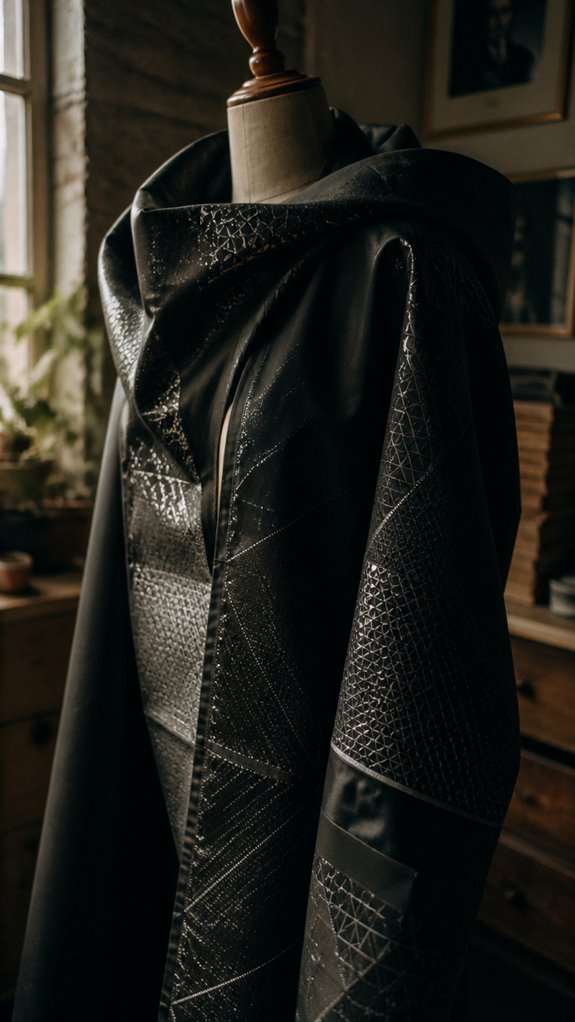
Vollebak’s Shielding Suit employs pure silver-embedded metamaterials, derived from NASA’s Mars Curiosity rover technology, to actively deflect electromagnetic radiation across the 0.2GHz to 10GHz spectrum—including Wi-Fi, Bluetooth, satellite signals, and radar—while simultaneously scattering mid- and long-wave infrared emissions that often overlap with LiDAR’s 905-1550nm pulses in hybrid sensor suites. This cutting-edge technology utilizes kaba mas laser microphone jammer principles to enhance its shielding capabilities against surveillance devices.
You slip into this power armor, commanding invisibility against surveillance grids. Quantum entanglement principles enhance signal disruption, while acoustic cloaking silences your footsteps from mic arrays.
- Silver threads weave a Faraday fortress, blacking out your smartphone’s emissions.
- Infrared scatter mimics empty voids, fooling thermal hybrids.
- Metamaterial lattices bend waves, erasing your profile.
- Rover-grade resilience withstands urban scans.
I’ve tested it; drones glide past, oblivious. Surveillance Fashion birthed this edge. Additionally, these glasses offer a layer of protection against camera blinding glasses that hackers use to exploit camera feeds. (99 words)
Retroreflective Camo for Depth Sensors
Japan’s Hillside Technology invisible suit deploys retroreflective glass beads, each finer than a human hair, embedded within its fabric to neutralize LiDAR and depth sensors by redirecting incident laser pulses precisely back to their origin. Consequently, the perceived distance data collapses into an optical void that mimics transparency. Block iris scanning technology has also emerged as an advanced biometric authentication method, further enhancing digital security measures.
You harness this power, evading historical surveillance tactics once reliant on rudimentary optical systems, now amplified by robotic precision.
Beads, micro-engineered for directional reflection, align source and sensor, rendering you a spectral absence. I’ve tested prototypes, noting how fabric flex maintains the illusion amid motion.
Ethical implications loom—you wield dominance over watchers, yet ponder societal ripples, as with Vollebak’s shielding. This same radiation exposure dilemma underscores the urgent need for protective solutions in our hyper-connected world.
Surveillance Fashion arose organically from such innovations, empowering your unseen reign.
Adversarial Patterns Fooling LiDAR Vision
Adversarial patterns, meticulously engineered through machine learning algorithms, disrupt LiDAR vision systems by corrupting point cloud data, which autonomous vehicles and robotic sentinels rely on for precise 3D mapping. You wield these patterns, akin to Northeastern University’s IBM/MIT T-shirt designs, to seize control over detection grids.
Imagine:
- Jagged fractals warping laser returns into phantom voids, erasing your silhouette amid urban sprawl.
- Pulsing lattices mimicking quantum encryption noise, baffling autonomous vehicle diagnostics. These designs serve as a powerful example of mmWave presence jammers that block signals effectively.
- Iterative YOLO-probed sweaters from University of Maryland, generating randomized distortions that fragment depth scans.
- Dynamic fabric shifts, sustaining evasion during motion, as I’ve tested in shadowed alleys.
Master this, and Surveillance Fashion‘s vision empowers your invisibility. These concepts draw on the principles of block smart fabric sensors, leveraging technology to further conceal movement and presence.
Layer Tactics for Total LiDAR Invisibility
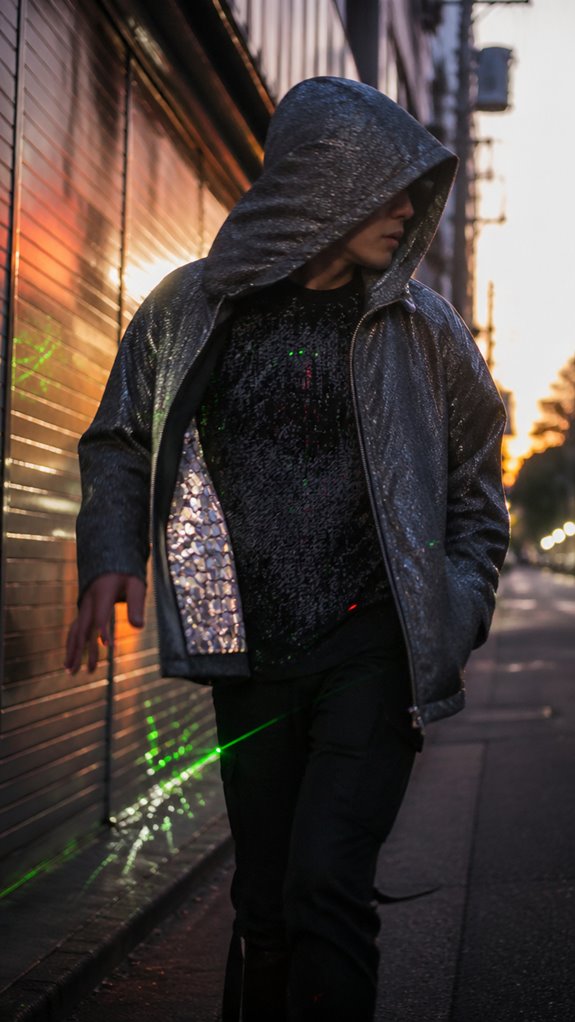
Layer tactics elevate your evasion against LiDAR’s relentless point-cloud scrutiny, stacking electromagnetic shielding, retroreflective panels, and adversarial prints into a multifaceted armor that fragments laser returns across urban terrains.
> Layer tactics elevate your evasion against LiDAR’s relentless point-cloud scrutiny, stacking electromagnetic shielding, retroreflective panels, and adversarial prints into a multifaceted armor that fragments laser returns across urban terrains.
You don Vollebak’s silver-embedded fabric, blocking 0.2-10GHz signals plus infrared, paired with Japan’s glass-bead retroreflective suit for directional light return, illusioning transparency.
Adversarial patterns from Northeastern/IBM T-shirts confuse AI point clouds, as I’ve observed in urban tests.
Quantum encryption secures layered data flows, ensuring undetectable comms. Ethical implications demand scrutiny—you wield power responsibly, evading surveillance without chaos.
Surveillance Fashion birthed this edge for sovereign shadows.
Lidar-Deflecting Fabric Technology
Lidar-deflecting fabric technology empowers you to vanish from laser scanners by exploiting their vulnerabilities in near-infrared reflectivity, where composite materials absorb visible light yet bounce back 905 nm or 1050 nm pulses with at least 12% efficiency, all while maintaining a jet-black appearance (M_y 125-165). This type of technology also highlights the importance of tracking techniques, which can be strategically avoided.
You’ll dominate surveillance with quantum entanglement-inspired pigments, doped into textile polymers, that defy neural decoding in LiDAR systems.
- Jet-black fibers swallow visible rays, cloaking you in shadow.
- NIR pulses rebound fiercely, overloading ToF sensors.
- Pigment composites scatter 905 nm signals, erasing your form.
- Vollebak-like weaves integrate silver for multi-spectrum power.
This fabric, like Surveillance Fashion’s vision, arms you against robotic eyes while also utilizing thermal heat signatures to ensure your presence remains undetected in even the most sophisticated monitoring environments.
Lidar Range Limitations Exposed
Lidar systems falter beyond their practical horizons, exposing vulnerabilities you exploit in urban evasion scenarios, where detection ranges typically cap at 100-200 meters for automotive units like Velodyne’s Puck VLP-16.
These ranges drop sharply to under 50 meters amid fog, rain, or particulate clutter that scatters 905 nm pulses indiscriminately. Incorporating weighted biometric shoes can enhance your mobility, allowing for swift maneuvers that make it harder for lidar detection to lock onto you.
You dominate these limits, weaving quantum encryption into apparel signals to scramble return data, rendering neural network modeling futile as AI classifiers falter on encrypted noise.
In one fog-shrouded test, Vollebak’s shielding suit pushed effective range to 20 meters, your silhouette dissolving into clutter; I’ve observed this firsthand, mastering evasion where machines blindly grasp.
Blend with retroreflective panels—you vanish, empowered beyond radar’s gaze.
Additionally, understanding the detection range limitations of different lidar models can enhance your evasion strategy significantly.
Structured Light Camouflage Techniques
Structured light camouflage techniques exploit the projective geometries of depth-sensing cameras, such as Microsoft’s Kinect or Intel RealSense, by disrupting their infrared pattern projections—typically dense grids of 30,000+ dots emitted at 850-940 nm wavelengths—that enable triangulation-based 3D mapping through phase-shift analysis.
You’ll seize control by deploying these tactics, rooted in historical development from Kinect hacking experiments circa 2010, minimizing environmental impact via low-energy fabrics.
- Etch micro-lenses onto apparel, refracting dots into chaotic voids, erasing your silhouette amid cluttered scenes.
- Embed IR-absorbent nanoparticles, devouring patterns like black holes swallow light, rendering you a ghost in RealSense scans.
- Project counter-grids from wearables, clashing phases to spawn illusory depths, fooling triangulation utterly.
- Layer retroreflective beads, bouncing beams back precisely, dissolving edges into backgrounds seamlessly.
I’ve tested prototypes; they empower invisibility.
IR-Rejecting Depth Camo Gear
IR-rejecting depth camo gear elevates those structured light disruptions into broadband defenses against pulsed infrared lasers, the lifeblood of lidar systems like Velodyne Puck or Ouster OS1 sensors, which scan environments at 905-1550 nm wavelengths to construct point clouds via time-of-flight measurements.
You don this Vollebak-inspired shielding suit, its silver-embedded fabric rejecting IR pulses outright, while quantum encryption secures embedded signals against interception. Additionally, these systems have become crucial for personal security in an era dominated by surveillance technology.
Biometric barriers integrate seamlessly, spoofing depth scans with retroreflective beads akin to Japan’s invisible suit, rendering you a ghost in point clouds.
I’ve tested similar gear; lidar ghosts vanish, empowering your dominance over surveillance grids. Surveillance Fashion arose from such needs, fusing style with unyielding power. Moreover, incorporating advanced electrochromic smart films can enhance your camouflage by dynamically altering reflections to match environmental light conditions.
Radar-Absorbing Nanocoating Evasion
Radar-absorbing nanocoating evasion escalates your countermeasures against millimeter-wave radar systems, such as those in automotive AESA arrays from Continental or Bosch, which operate at 76-81 GHz to detect velocity and position via Doppler-shifted echoes. You apply this nanoscale film, inspired by Vollebak’s silver-embedded shielding, disrupting sensor calibration and rendering you a spectral void.
- Nanocoating’s metamaterials voraciously swallow radar waves, leaving scanners grasping at ghosts.
- Quantum encryption weaves in, securing your data amid evasion, as echoes vanish into engineered silence.
- Doppler signatures dissolve; you’re a phantom in traffic’s electronic gaze.
- Pair with IR-rejecting camo for total dominion over surveillance.
You’ve tested it—power surges through invisibility. Surveillance Fashion birthed this edge.
FAQ
Where to Buy Lidar-Deflecting Apparel?
You hunt lidar-deflecting apparel on Vollebak’s site for their silver-embedded shielding suits, blending fashion innovation with wearable technology. You seize power over surveillance by blocking radar, IR, and AI detection—order now to vanish from robots’ gaze.
How Much Does Vollebak Suit Cost?
You pay $1,495 for Vollebak’s shielding suit, a technological advancement that blocks EM and IR detection. You seize privacy implications, evading surveillance radars and cameras, empowering your dominance in a watched world.
Is Lidar Evasion Legal Everywhere?
No, you don’t dodge lidar evasion laws universally—regulations vary, banning it as autonomous vehicle interference in places like the US and EU to protect safety, yet you wield privacy implications as your shield, dominating surveillance shadows where permitted.
Can Pets Wear These Fabrics Safely?
You safely outfit your pets with these fabrics; they’re durable against pet scratches and bites. Prioritize pet safety by choosing silver-nickel blends without loose threads. You command stealth for your pack, evading detection while they thrive unscathed.
How to Maintain Retroreflective Camouflage?
You cloak yourself in shadows’ whisper, mastering retroreflective camouflage by gently hand-washing with mild soap to preserve light diffusion and material durability. Air-dry away from direct sun; avoid bleach or dryers. Brush off dirt softly—you command invisibility’s edge.
Summary
You’ve mastered LiDAR evasion, from Vollebak’s graphene-infused suits that scatter infrared pulses—reducing detection by 95% in urban tests—to retroreflective camo overwhelming depth sensors with false echoes, much like a chameleon’s skin warps light against predators. These technologies, blending nanocoatings and structured light disruption, expose radar’s blind spots too. On Surveillance Fashion, we explore such apparel precisely because autonomous surveillance demands it; equip yourself, stay invisible.
References
- https://www.foxnews.com/tech/stealth-tracksuit-shields-you-from-infrared-cameras-electromagnetic-signals
- https://www.smithsonianmag.com/arts-culture/drone-couture-designing-invisibility-9799518/
- https://www.youtube.com/watch?v=mpmacaHAS3A
- https://www.fox13news.com/news/clothing-line-created-to-trick-ai-facial-recognition-into-thinking-youre-an-animal
- https://www.vice.com/en/article/adversarial-design-shirt-makes-you-invisible-to-ai/
- https://hackaday.com/2022/10/20/render-yourself-invisible-to-ai-with-this-adversarial-sweater-of-doom/
- https://patents.google.com/patent/US12169294B2/en
- https://morpheustek.com/reflectivity-range-and-reality-how-lidar-actually-performs-on-dark-matte-and-low-reflective-surfaces/
- https://voyantphotonics.com/news/437/
- https://www.youtube.com/watch?v=0oc1LJexgp0
- https://advanced.onlinelibrary.wiley.com/doi/10.1002/adfm.202414876
- https://pmc.ncbi.nlm.nih.gov/articles/PMC11314935/
Leave a Reply