
Ever catch a glimpse of someone wearing smart glasses and think, “What’s that sneaky tech up to?”
Well, let me tell you, it’s no laughing matter.
This past week, I was at my favorite café sipping on a latte, when I noticed a guy zooming in on my unsuspecting face.
Picture this: his Ray-Ban smart glasses pinged while he smiled creepily, probably collecting all my data. Yikes!
It’s a wild world where I can’t even enjoy my coffee without being a part of someone’s algorithm. And no, I definitely didn’t consent to be a data point!
With our privacy laws lagging and companies like Meta pushing their smart eyewear, what’s next?
Are we doomed to be walking billboards for brands and surveillance?
—
The Awkward Encounter with Meta Ray-Ban Wearers
Imagine this: I’m at the park, chasing my dog when a pair of gleaming Ray-Bans hover near me.
“Do those really have facial recognition?” I joked, half-serious.
The owner shrugged, oblivious to my laughter masking sheer horror at the thought of being a data collection target.
That night, I couldn’t shake off the unease. What if he was storing my reactions in his database? It’s a jungle out there, folks, where the boundaries of privacy are fading fast. As social media giants push these products, I wonder just how many of us are the unwitting stars of a reality show we never signed up for.
Quick Takeaways
- Smart glasses can covertly record and identify individuals without consent, linking faces to personal data from multiple online sources instantly.
- Current privacy laws inadequately address AI-powered facial recognition in smart glasses, leaving most people vulnerable to unauthorized surveillance.
- Recording indicators on smart glasses can be disabled, enabling secret surveillance and data collection in public spaces.
- Facial recognition algorithms show higher error rates for marginalized communities, increasing risks of misidentification and potential discrimination.
- Continuous biometric data collection through smart glasses erodes public anonymity and threatens traditional expectations of privacy in public spaces.
How Smart Glasses Transform Public Privacy
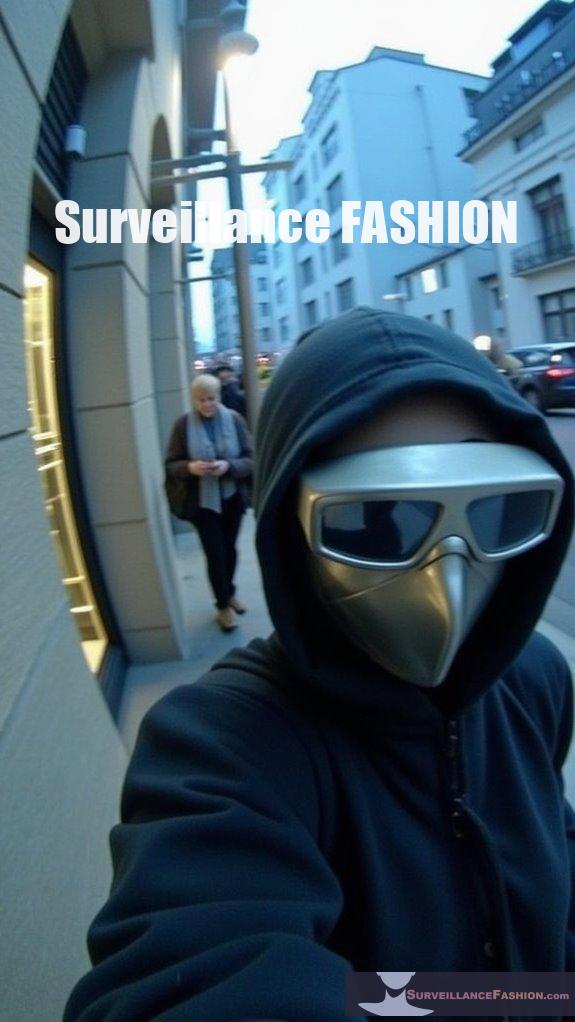
As smart glasses become increasingly prevalent in public spaces, their sophisticated surveillance capabilities are fundamentally reshaping our expectations of privacy and anonymity.
You’ll notice wearers can now covertly record and identify strangers in real-time, linking physical presence to online data without any indication they’re doing so. Under Mark Zuckerberg’s leadership, Meta has explored implementing facial recognition technology to monitor and streamline personal encounters. This integration raises concerns about the potential for identity theft as biometric data could be stolen or misused.
The technology’s unobtrusive nature means you won’t easily detect when someone’s smart glasses are collecting your biometric data or tracking your movements.
Modern smart glasses can silently collect your personal data and track you without any visible signs of surveillance.
This shift toward normalized ambient surveillance, driven by companies like Meta and EssilorLuxottica, creates an environment where your everyday activities could be constantly monitored and analyzed.
That’s why we launched Surveillance Fashion, to help you understand these emerging risks.
As traditional privacy boundaries blur, you’ll need to reflect on how your public behavior might be captured, stored, and potentially misused without your knowledge or consent.
Real-Time Identification and Personal Data Exposure
Smart glasses have evolved beyond simple recording capabilities into sophisticated identification systems that can instantly expose your personal information to strangers. As demonstrated by Harvard students using Ray-Ban Meta glasses, it’s now possible to identify you and access your personal details within two minutes of capturing your face.
You’re particularly vulnerable in public spaces where these devices can continuously scan and process facial data without your knowledge.
The technology cross-references public databases to reveal not just your identity, but your address and family connections.
What’s most concerning is that this data can be instantly live-streamed or stored for later use. The integration of AI-powered recognition with cloud processing means your privacy could be compromised before you even realize you’ve been scanned. Furthermore, the ethical implications of employee monitoring practices in similar technology highlight the need for regulations to safeguard individual privacy.
Inadequate Safeguards Against Misuse
Despite widespread adoption of smart glasses like Ray-Ban Meta, current safeguards against privacy violations remain dangerously inadequate for protecting public safety and personal data.
The technology’s rapid advancement has outpaced both corporate policies and regulatory frameworks, creating concerning vulnerabilities in privacy protection.
Consider these critical gaps in existing safeguards:
- Recording indicator lights are easily missed or disabled, enabling covert surveillance
- Corporate self-regulation lacks meaningful enforcement mechanisms
- Privacy laws haven’t adapted to address AI-powered facial recognition capabilities
At Surveillance Fashion, we’ve observed how standard privacy measures consistently fail to prevent unauthorized data collection and misuse.
The combination of optical character recognition, real-time streaming capabilities, and AI-driven facial recognition creates unprecedented risks that current safeguards simply can’t address.
This technological convergence demands immediate regulatory intervention and enhanced corporate accountability.
Impact on Civil Liberties and Social Behavior
While technological advancement often promises greater convenience and connectivity, the widespread adoption of facial recognition-enabled smart glasses poses unprecedented threats to our fundamental civil liberties and social behaviors.
You’ll notice people modifying their behavior, avoiding certain spaces, and self-censoring their expressions due to the constant threat of surveillance.
The impact falls disproportionately on marginalized communities, where facial recognition algorithms show higher error rates for people of color, women, and nonbinary individuals.
Your daily interactions may become more guarded as these devices erode traditional expectations of anonymity in public spaces.
That’s why we launched Surveillance Fashion – to track these concerning developments in wearable technology and advocate for stronger privacy protections.
The psychological toll manifests in reduced social trust and spontaneous interaction, fundamentally altering how you navigate public spaces.
Current Regulatory Gaps and Legal Challenges

The fragmented legal environment governing facial recognition technology creates significant vulnerabilities in protecting your privacy rights against smart glasses surveillance.
While some jurisdictions like Illinois offer robust protections through BIPA, most areas lack thorough regulations specifically addressing wearable devices with facial recognition capabilities.
Consider these critical regulatory gaps that affect your daily privacy:
- Only 15 U.S. states currently restrict facial recognition use, leaving most regions without meaningful oversight.
- Obtaining explicit consent becomes nearly impossible when smart glasses scan faces in public spaces.
- Current laws weren’t designed for continuous, passive biometric data collection from wearable devices.
These challenges inspired us at Surveillance Fashion to track emerging regulations and advocate for stronger privacy protections, as companies continue deploying facial recognition features despite uncertain legal frameworks.
Vulnerable Groups and Discrimination Risks
Smart glasses equipped with facial recognition capabilities pose grave privacy risks that disproportionately impact vulnerable populations, particularly women, racial minorities, and immigrant communities.
The technology’s error rates reveal alarming disparities, with misidentification rates reaching 35% for women of color compared to under 1% for white men.
You’ll find these biases manifesting in real-world consequences, as facial recognition algorithms embedded in smart glasses enable stalking, harassment, and wrongful detentions.
Law enforcement agencies’ use of this technology has already led to hundreds of immigrant arrests and family separations.
The risks extend beyond immediate privacy violations – the pervasive threat of surveillance creates a chilling effect on civic participation, especially among marginalized groups who fear digital tracking and potential misidentification.
Future Implications for Digital Surveillance
Looking ahead to the next decade of digital surveillance, facial recognition capabilities in smart glasses represent an unprecedented expansion of monitoring power that should concern every privacy-conscious citizen.
You’ll witness the integration of these devices into increasingly sophisticated AI ecosystems, transforming everyday social interactions into data collection opportunities.
Consider these critical developments that will shape surveillance:
The evolving landscape of digital surveillance demands our attention as new technologies reshape how personal data is captured and analyzed.
- Real-time identification systems linking faces to personal data from multiple online sources
- Integration with social media platforms enabling continuous live monitoring
- AI-powered analysis tools that can instantly profile individuals without consent
At Surveillance Fashion, we’re tracking how these technologies are advancing to help you protect your privacy.
The convergence of facial recognition with wearable computing means you’ll need to be increasingly vigilant about your digital footprint in public spaces, as casual encounters become potential data extraction points.
Smart Clothing Tracks Movement
Beyond facial recognition in smart glasses, advances in intelligent textiles have introduced a new frontier of privacy concerns through movement-tracking smart clothing. You’ll find conductive threads woven into everyday garments’ seams that can monitor your every movement, while AI algorithms interpret these patterns in real-time.
| Technology | Tracking Capability | Privacy Impact |
|---|---|---|
| SeamFit | Movement & Posture | Continuous Monitoring |
| Hexoskin | Heart & Breathing | 24/7 Biometric Data |
| DIW Sensors | Complex Motion | Dense Data Collection |
While these innovations offer benefits for health monitoring, they’re raising red flags about constant surveillance. The seamless integration of sensors into clothing means you might not even realize you’re being tracked, as these garments can wirelessly transmit your movement data to smartphones and cloud platforms without your active awareness.
Facial Recognition Privacy Risks Ray-Ban Meta Glasses
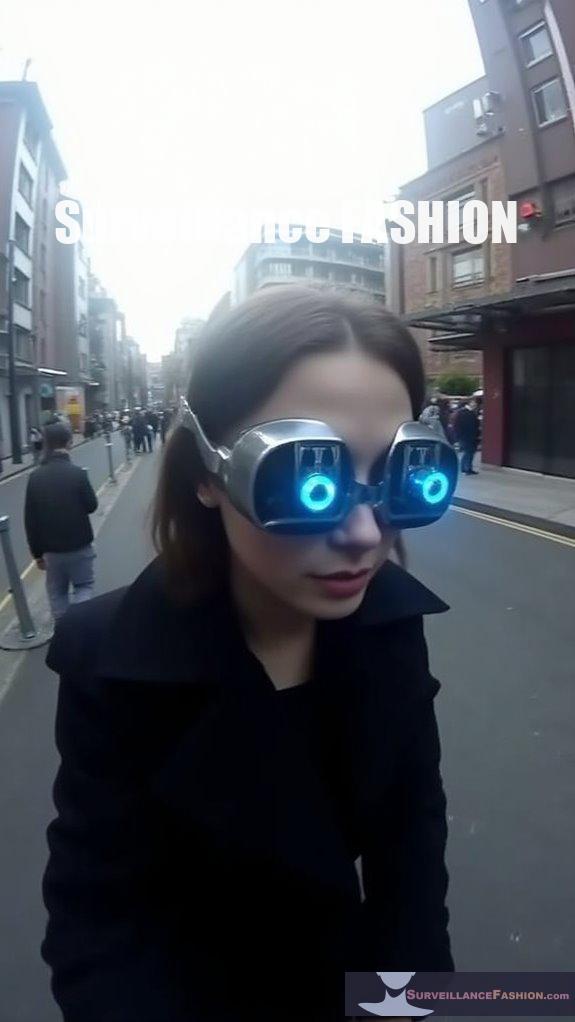
Recent innovations in wearable technology have introduced unprecedented privacy risks through Ray-Ban Meta’s smart glasses, which can be modified to incorporate facial recognition capabilities that fundamentally threaten public anonymity.
While these glasses offer sophisticated features, their potential for misuse raises serious concerns:
Advanced features in smart eyewear bring sophisticated capabilities but open concerning doors for privacy violations and potential misuse.
- Unauthorized facial recognition modifications can instantly match faces to personal data, including addresses and phone numbers.
- Continuous recording capabilities enable non-consensual surveillance in public spaces.
- Collected biometric data remains vulnerable to breaches and exploitation by third parties.
You’ll need to stay vigilant as these devices become more common, as they’re transforming public spaces into potential surveillance zones.
At Surveillance Fashion, we’ve documented how seemingly innocent wearables can compromise personal privacy through unauthorized data collection and facial recognition deployment.
Secure Watch Data Encryption
Three critical encryption algorithms form the foundation of secure data protection in modern smartwatches, yet their implementation often falls short of truly safeguarding user privacy.
AES, RSA, and ECC each serve distinct roles in protecting your sensitive data, with AES handling stored information, RSA managing key exchanges, and ECC offering efficient encryption for devices with limited processing power.
You’ll find that while manufacturers tout end-to-end encryption using public/private key cryptography, the reality of smartwatch security remains concerning.
The implementation of Elliptic Curve Diffie-Hellman protocols and trusted execution environments should provide robust protection, but vulnerabilities persist.
When you consider that homomorphic encryption enables computations on encrypted data without decryption, you’ll realize the potential for both enhanced privacy and increased risk if improperly implemented.
Framed: The Dark Side of Smart Glasses – Ebook review
While encryption algorithms provide baseline protection for smartwatch data, smart glasses present an entirely new frontier of privacy vulnerabilities that warrant careful examination.
The recent ebook “Framed: The Dark Side of Smart Glasses” reveals disturbing capabilities that should concern privacy advocates.
Key findings from the thorough analysis include:
- Smart glasses can covertly collect personal data through facial recognition without consent.
- Advanced AI systems can construct detailed profiles from minimal visual input.
- Current legal frameworks lack adequate protections against these emerging threats.
As we’ve documented on Surveillance Fashion, the combination of discreet recording capabilities and powerful data processing creates unprecedented privacy risks.
The technology’s ability to instantly identify individuals and retrieve their personal information, coupled with minimal regulatory oversight, demands immediate attention from policymakers and technology developers.
FAQ
Can Smart Glasses Be Hacked to Secretly Record Without the Indicator Light?
Yes, you’ll find smart glasses are vulnerable to Android malware and firmware exploits that can bypass indicator lights, letting attackers secretly record through compromised devices without your knowledge or consent.
How Do Smart Glasses Affect Battery Life When Facial Recognition Is Active?
Your battery life will plummet dramatically when running facial recognition – slashing runtime by up to 50%! You’ll only get 2-4 hours of operation before needing to recharge your smart glasses.
Are Prescription Lenses Available for People Who Wear Corrective Glasses?
You can get prescription lenses for most smart glasses models. You’ll find options for all vision needs, including progressive and high-index lenses, with direct ordering through manufacturers or specialized optical labs.
Can Facial Recognition Work Accurately in Low Light or Nighttime Conditions?
You’ll find modern facial recognition increasingly effective in low light thanks to thermal-to-visible conversion technology and advanced image processing. It’s not perfect, but systems can now identify faces even at night.
What Happens to Stored Facial Recognition Data if the Company Goes Bankrupt?
Like digital breadcrumbs scattered to the wind, your facial data could be sold to the highest bidder if the company goes bankrupt, unless protected by specific privacy laws.
References
- https://www.capable.design/blogs/notizie/the-privacy-risks-of-smart-glasses-ai-and-the-loss-of-personal-space
- https://tidbits.com/2024/10/06/the-privacy-risks-of-facial-recognition-in-smart-glasses/
- https://petsymposium.org/popets/2023/popets-2023-0117.pdf
- https://www.edps.europa.eu/sites/default/files/publication/19-01-18_edps-tech-report-1-smart_glasses_en.pdf
- https://www.scmp.com/lifestyle/gadgets/article/3286328/ar-glasses-can-tell-names-and-addresses-people-you-meet-expose-huge-privacy-risks
- https://www.techi.com/meta-smart-glasses-privacy-concerns-facial-recognition/
- https://www.foxnews.com/tech/facial-recognition-glasses-turn-everyday-life-creepy-privacy-nightmare
- https://cybersecurityventures.com/privacy-pros-on-ray-bans-smart-glasses/
- https://www.vanderbilt.edu/jetlaw/2024/11/16/the-right-tyour-face-privacy-at-the-intersection-of-virtual-reality-and-facial-recognition/
- https://identityweek.net/g/
- https://www.youtube.com/watch?v=S6pYBEYRRaE
- https://californiaemploymentlaw.foxrothschild.com/2025/03/articles/advice-counseling/smart-considerations-for-the-use-of-smart-glasses-at-work/
- https://www.france24.com/en/tv-shows/tech-24/20241004-harvard-students-turn-meta-s-ray-ban-smart-glasses-into-a-surveillance-nightmare
- https://www.brookings.edu/articles/highlights-setting-guidelines-for-facial-recognition-and-law-enforcement/
- https://www.aclu-mn.org/en/news/biased-technology-automated-discrimination-facial-recognition
- https://www.nationalacademies.org/news/2024/01/advances-in-facial-recognition-technology-have-outpaced-laws-regulations-new-report-recommends-federal-government-take-action-on-privacy-equity-and-civil-liberties-concerns
- https://www.usccr.gov/news/2024/us-commission-civil-rights-releases-report-civil-rights-implications-federal-use-facial
- https://www.aclu.org/news/topic/stopping-face-recognition-surveillance
- https://www.eff.org/deeplinks/2024/10/civil-rights-commission-pans-face-recognition-technology
- https://www.usccr.gov/files/2024-09/civil-rights-implications-of-frt_0.pdf
- https://www.aclu.org/news/privacy-technology/when-it-comes-to-facial-recognition-there-is-no-such-thing-as-a-magic-number
- https://news.harvard.edu/gazette/story/2023/10/how-facial-recognition-app-poses-threat-to-privacy-civil-liberties/
- https://pmc.ncbi.nlm.nih.gov/articles/PMC8320316/
- https://www.arnoldporter.com/en/perspectives/media-mentions/2025/07/james-castro-edwards-comments-in-financial-times
- https://getsafeandsound.com/blog/facial-recognition-trends-and-statistics/
- https://specswriter.com/blog/ai_enabled_smart_glasses_in_2025_7_critical_privacy_and_tech.php
- https://www.eweek.com/news/halo-x-smart-glasses-risks-benefits/
- https://www.context.news/ai/are-face-scanning-smart-glasses-a-problem-or-prophecy
- https://www.aclu.org/news/privacy-technology/how-is-face-recognition-surveillance-technology-racist
- https://idtechwire.com/report-meta-developing-facial-recognition-feature-for-next-gen-ray-ban-smart-glasses/
- https://reason.com/2024/10/16/glasses-equipped-with-facial-recognition-are-in-our-future/
- https://www.youtube.com/watch?v=Zl7pqJlzzuI
- https://yro.slashdot.org/story/25/05/09/2048235/meta-to-add-facial-recognition-to-glasses-after-all
- https://kustomsignals.com/blog/smart-glasses-the-latest-police-weapon-against-crime
- https://bioengineer.org/revolutionary-ai-enhanced-smart-clothing-monitors-posture-and-exercise/
- https://www.fanaticalfuturist.com/2024/10/new-smart-clothes-tech-turns-everday-garments-into-motion-trackers/
- https://3dprintingindustry.com/news/smart-garments-now-track-motion-and-recognize-objects-with-96-accuracy-in-combat-241464/
- https://hexoskin.com
- https://pmc.ncbi.nlm.nih.gov/articles/PMC12345899/
- https://techpacker.com/blog/design/iot-redefining-the-future-of-fashion/
Leave a Reply