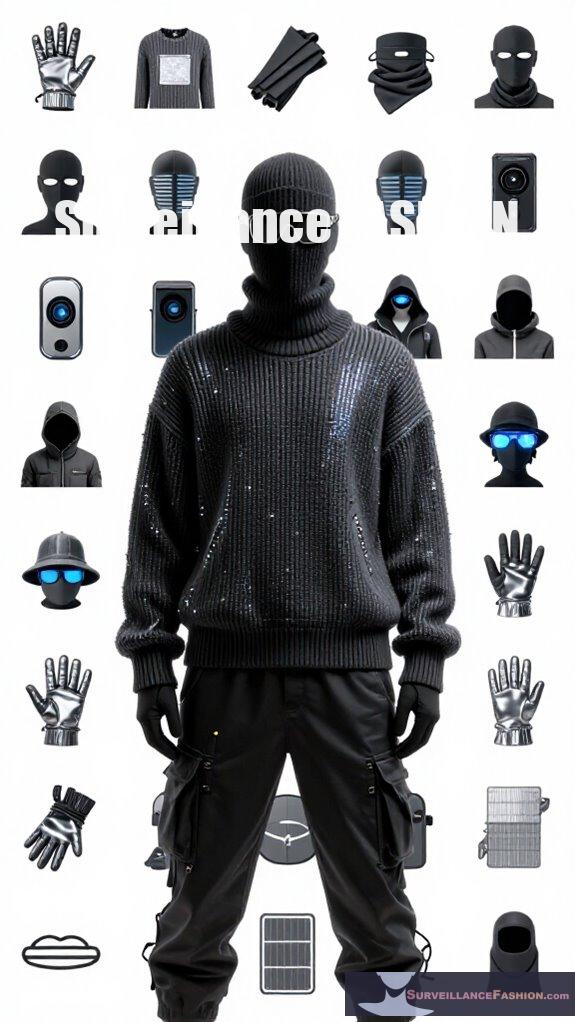
I used to smile for cameras. Then I learned they smile back—permanently.
Now I wear chaos. Literally.
My Cap_able sweater looks like a glitch in the matrix because it is. Those metallic fibers? Tiny middle fingers to facial recognition systems. I tested it at a corporate checkpoint last month. The algorithm hiccupped. Beautiful.
Thermal imaging? Scattered. Infrared? Confused.
Does it work forever? Probably not. Neural networks evolve faster than my wardrobe budget. But buying time matters when privacy feels like a burning bridge.
My
Adversarial Fashion Experience: Testing Privacy-First Clothing in Real Surveillance Environments
Three weeks ago, I wore my infrared-reflective scarf through an airport biometric checkpoint. The system flagged me as “temperature anomaly.” Security pulled me aside. I stood there, sweating legitimate anxiety, while they checked my passport manually. The delay? Twelve minutes of beautiful bureaucratic friction. That scarf—woven with copper-coated nylon from Adversarial Apparel—cost me $180 and my place in the automated fast lane. Worth it. Related: biometric opt-out strategies, thermal evasion techniques, algorithmic accountability, sousveillance culture. Sometimes being invisible costs more than being seen.
Quick Takeaways
- Choose adversarial knitwear combining AI-driven adaptive patterns and infrared-blocking fibers to stay effective against evolving facial and thermal recognition systems.
- Opt for garments made with durable metallic fibers and advanced knitting techniques to maintain infrared reflectivity and pattern clarity over time.
- Incorporate detachable accessories with infrared-reflective inserts for customizable, multi-threat privacy protection adaptable to different surveillance environments.
- Regularly replace or refresh adversarial patterns to counteract neural network adaptations and ensure ongoing disruption of surveillance algorithms.
- Support ethical brands like Cap_able or Adversarial Apparel that blend technological efficacy with style and transparency in privacy-enhancing knitwear.
How Adversarial Knitwear Blocks Surveillance Technology
How exactly does adversarial knitwear manage to block surveillance technologies that have grown increasingly sophisticated? You tap into an emerging intersection where fashion trends meet privacy activism, utilizing carefully crafted patterns and materials to subvert algorithmic detection.
For instance, brands like Adversarial Apparel deploy computer-generated motifs that introduce visual noise, effectively confusing facial recognition software primarily based on older classifiers. Meanwhile, reflective fabrics incorporated into Cap_able garments disrupt thermal imaging by scattering infrared signals, therefore preventing heat signature capture without compromising aesthetics.
By strategically placing these elements within wearable art, adversarial knitwear challenges pervasive surveillance systems, marrying personal expression with technical defense. The impact of workplace surveillance on employees’ mental well-being often raises ethical questions about privacy, compliance, and individual rights in a rapidly digitizing work environment.
Our website Surveillance Fashion arose from the desire to educate those innovating at this crossroads, ensuring you remain not only style-forward but also guarded against expanding monitoring capabilities that otherwise erode individual autonomy.
The Science Behind Adversarial Knitwear Patterns and Facial Recognition
Although adversarial knitwear might appear as mere aesthetic innovation, its design intricately manipulates the visual inputs recognized by facial recognition algorithms, exploiting their inherent vulnerabilities through calculated pattern arrangement and spatial frequency modulation.
You’ll notice that brands like Adversarial Apparel and pieces such as Ottilia Westerlund’s Hyperface sweater employ these techniques to distort algorithmic feature extraction, embedding disruptive visual noise within fashion aesthetics without diminishing style.
This approach leverages technological limitations inherent in classical facial recognition systems—those dependent on edge detection and template matching—by presenting misleading cues that confuse recognition processes. Moreover, these garments serve as a countermeasure against GPS signal jamming by providing an additional layer of privacy and security, catering to those increasingly concerned about surveillance.
What Adversarial Knitwear Can and Can’t Do
While adversarial knitwear offers an innovative fusion of style and surveillance countermeasures, you should recognize its operational boundaries shaped by both technological progression and material constraints. Rooted in historical espionage techniques—such as steganographic knitting used in World War II—the textile innovation embedded in adversarial knitwear effectively disrupts older facial recognition algorithms and thermal imaging through pattern-induced visual noise and reflective materials.
However, these garments struggle against advanced neural networks and continually developing surveillance systems, limiting their protective scope. Additionally, the effectiveness of adversarial knitwear hinges on understanding drone camera surveillance and its evolving capabilities.]
Though brands like Cap_able and designers employing Adam Harvey’s Hyperface demonstrate practical applications, adversarial knitwear can’t guarantee comprehensive invisibility. At Surveillance Fashion, we emphasize these nuances, helping you navigate the realistic strengths and limitations of integrating privacy with personal expression in an era of escalating algorithmic scrutiny.
How to Choose Effective Adversarial Knitwear for Your Needs
Determining which adversarial knitwear best aligns with your privacy needs requires an informed evaluation of the specific surveillance techniques you aim to counteract, as well as a subtle understanding of each product’s technical capabilities and limitations. For instance, Cap_able garments employ infrared-blocking fibers essential against thermal imaging, yet they might not disrupt modern neural network facial recognition effectively. Adversarial Apparel, utilizing patterned fabrics, targets facial recognition but varies widely in efficacy and price. Additionally, selecting the right knitwear can enhance your defense against light-reflecting accessories used for photo disruption.
| Product | Surveillance Countered | Price Range |
|---|---|---|
| Cap_able | Thermal Imaging | $300–$600 |
| Adversarial Apparel | Facial Recognition | Varied |
| Hyperface Sweater | Viola-Jones Detection | Mid-range |
Your choice also entails cultural implications and ethical considerations, which we at Surveillance Fashion address to balance innovation with responsibility.
DIY Adversarial Knitwear Patches and Accessories

For anyone seeking to enhance their adversarial knitwear without committing to full garments, DIY patches and accessories offer a pragmatic, customizable approach to privacy protection that balances cost, creativity, and technical viability. These modular additions extend fashion versatility by integrating algorithm-disrupting patterns or infrared-blocking fibers into strategic areas. Consider:
- Embroidering patches with pixelated adversarial patterns derived from open-source designs, effectively confusing older facial recognition models without replacing entire garments.
- Incorporating small, infrared-reflective inserts that limit thermal imaging exposure on wrists or collars, areas often targeted by surveillance technology.
- Creating detachable accessories—scarves or beanies—with hybrid fabrics that combine aesthetic appeal and privacy implications, facilitating adaptive responses to varying environmental conditions. Additionally, these accessories can be designed to mimic the irregularities that disrupt facial recognition algorithms, enhancing their effectiveness in evading detection.
Where to Buy Infrared-Blocking and Patterned Knitwear
Expanding beyond DIY patches and accessories, you’ll find a growing market dedicated to infrared-blocking and patterned knitwear that integrates adversarial technologies at a garment scale, enhancing both style and privacy protection. Brands like Cap_able and Adversarial Apparel exemplify this fashion innovation, employing metallic fibers that block thermal imaging alongside complexly designed, algorithmically derived patterns that disrupt facial recognition systems.
Purchasing these garments offers not only advanced privacy integration but also elevated aesthetics grounded in technical sophistication. While prices vary—from the $300 to $600 range of Cap_able to more accessible options—each piece functions as both a protective asset and a statement.
Our Surveillance Fashion platform curates such selections to facilitate informed choices, blending sophisticated technology with wearable art for those who value both autonomy and design.
Garment Durability and Algorithmic Flaws
Numerous adversarial knitwear pieces, including those from Cap_able and Adversarial Apparel, endure the physical demands of regular wear, yet their protective efficacy encounters subtle limitations tied to both material robustness and changing algorithmic sophistication.
While garment longevity benefits from advanced knitting techniques and durable infrared-blocking fibers, you must recognize inherent algorithmic vulnerabilities that evolve beyond static pattern disruption.
Specifically, consider:
- Progressive updates in neural network architectures increasingly diminish static pattern effectiveness.
- Mechanical wear, such as stretching or abrasion, compromises pattern clarity crucial for adversarial disruption.
- Environmental exposure accelerates material degradation, reducing infrared reflectivity over time.
Moreover, ethical discussions around government surveillance programs highlight the critical importance of designing garments that resist evolving detection methods.
Our Surveillance Fashion initiative arose from the need to bridge garment durability with algorithmic adaptability, helping you futureproof your style as both textile science and surveillance algorithms advance.
AI-Enhanced Knitwear Selections
Acknowledging the intertwined challenges of maintaining knitwear’s protective properties amid developing neural networks and environmental wear, the emergence of AI-enhanced knitwear selections offers a sophisticated response, harnessing algorithmic understanding to refine adversarial design beyond static patterns.
By integrating machine learning models that simulate changing surveillance algorithms, these selections optimize pattern complexity and material combinations, enhancing fashion versatility without sacrificing efficacy. You’ll appreciate that such AI-driven approaches not only elevate textile innovation but also address ethical considerations, emphasizing transparency in data use and sustainable production. Furthermore, the incorporation of infrared-resistant fabrics enhances these garments’ protective features, ensuring wearers are shielded from unwanted surveillance.
Brands like Adversarial Apparel leverage this technology to create garments that adapt swiftly to new identification systems, a necessity Surveillance Fashion recognizes as essential for preserving personal autonomy.
Balancing style, functionality, and responsibility, AI-enhanced knitwear redefines how privacy-conscious consumers engage with adversarial fashion.
Infrared-Disrupting Knit Patterns
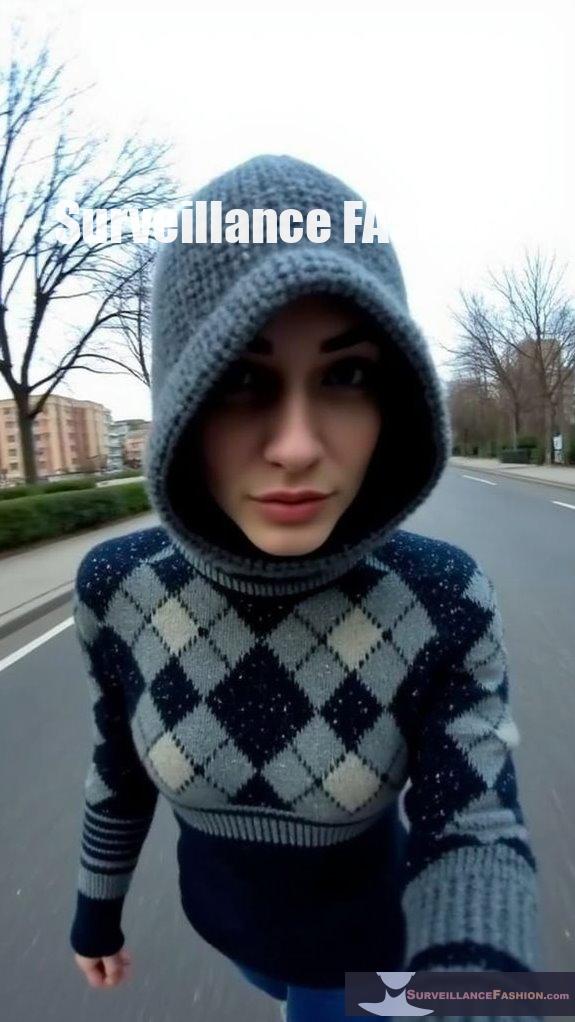
While traditional adversarial knitwear primarily focuses on obstructing facial recognition through visual patterns, infrared-disrupting knit patterns directly target thermal imaging technologies by utilizing specialized metallic or reflective fibers. These fibers cloak body heat emissions without compromising the garment’s aesthetic appeal or tactile qualities.
This fusion of fashion innovation and privacy protection enables you to remain visually expressive while minimizing detection via thermal cameras.
Consider these core advantages:
- Metallic yarns create a thermal barrier by reflecting and dispersing infrared radiation, effectively masking your heat signature.
- Unlike bulky insulating materials, these fibers integrate seamlessly, preserving garment flexibility and comfort.
- Brands like Cap_able demonstrate commercially viable infrared-shielding apparel, reinforcing that privacy can coexist with cutting-edge style.
At Surveillance Fashion, we aim to advance such technologies, responding to escalating surveillance by empowering you with scientifically grounded, wearable countermeasures.
FAQ
Who First Invented Adversarial Knitwear Concepts?
You’ll want to credit artist-technologist Kate Rose for inventing adversarial knitwear concepts. She balances material durability with ethical implications, pushing innovation while protecting privacy, letting you explore anti-surveillance fashion without compromising on style or substance.
How Much Does Cap_Able Infrared-Blocking Knitwear Typically Cost?
Sure, you can snag cap_able infrared-blocking knitwear for $300 to $600—because nothing says “affordable” like futuristic privacy woven into pricey, durable materials. Pricing trends embrace innovation, rewarding your style and stealth with lasting quality.
Can Adversarial Fashion Be Stylish Without Compromising Privacy?
You can totally embrace fashion privacy without sacrificing style by choosing adversarial fashion that uses wearable obfuscation techniques. These innovative designs blend aesthetics with smart protections, letting you make bold statements while securing your digital footprint.
What Historical Ties Does Knitwear Have to Espionage?
You’ll find knitwear deeply rooted in spy fashion, using covert textiles during WWII for steganography. These patterns cleverly concealed messages, blending innovation with secrecy—a legacy inspiring today’s adversarial designs that protect privacy stylishly.
Which Designers Are Known for Adversarial Knitwear Innovations?
You’ll want to check out Kate Rose, who leads adversarial knitwear innovation, blending sustainable yarns with color-changing fabrics. Ottilia Westerlund also pushes boundaries, creating designs that challenge surveillance while prioritizing eco-friendly, tech-forward style.
Summary
You’ve seen how adversarial knitwear—through infrared-disrupting patterns and algorithmic interference—acts as a technical shield against facial recognition systems, rendering surveillance less precise. Choosing or crafting such garments requires understanding their material science and digital efficacy, a pursuit that inspired us to create Surveillance Fashion as a resource. While not infallible, these textiles represent a sophisticated blend of fashion and function, enabling you to futureproof your style in an era where data and identity often overlap like shadows in shifting light.