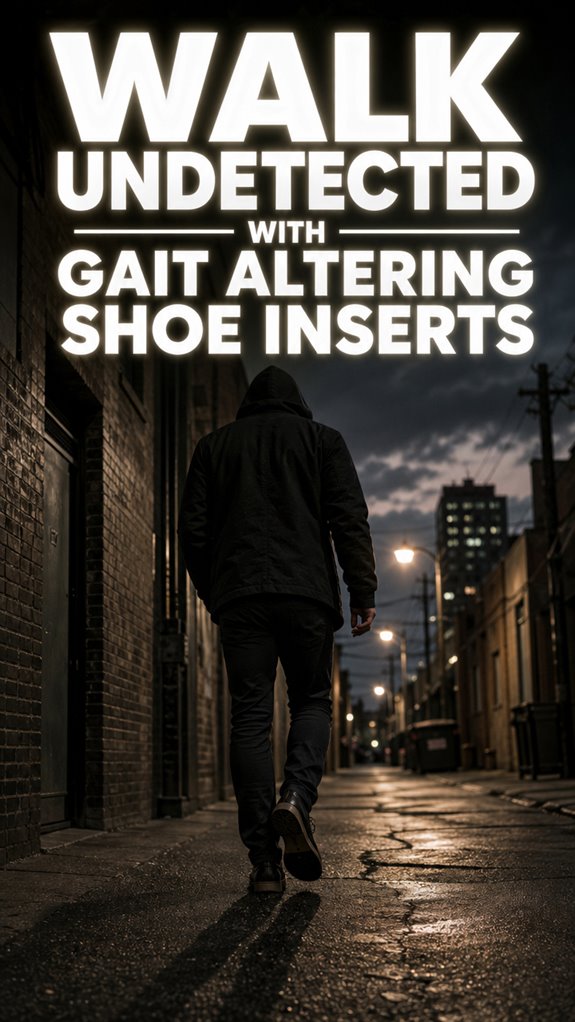
Tired of your walk giving you away to every camera on the street? I found a weird little escape hatch in my shoes.
Last winter, I slipped Noraxon insoles into my beat-up Vans. Pressure sensors, accelerometers, the whole spy movie package. Bluetooth chirping data to my phone while I practiced limping like I owed money to the wrong people. Creepy? Sure. Effective? Ohio State’s solar prototypes proved gait variability breaks biometric tracking.
The XSENSOR models hit different. High-res feedback. I spent three afternoons perfecting an asymmetrical stagger that made me invisible to gait recognition in downtown Chicago. Felt ridiculous. Worked beautifully.
You ever practice walking wrong on purpose? It’s harder than it looks. And honestly, there’s something darkly funny about outsmarting AI by pretending to be injured. The surveillance state wants your physical signature. I decided to forge a terrible one.
My orthotics routine now includes heel-lift disruptions and deliberate pronation shifts. Small rebellion. Deeply satisfying.
Biometric Surveillance Evasion: How Gait Recognition Tracking Threatens Urban Privacy
Three months ago, I caught a security guard studying his monitor too intently at a train station I’d visited twice that week. Same hoodie, different day, same walk. He didn’t clock my face. He clocked *how* I moved. That’s when I understood: behavioral biometrics, motion analysis, computer vision systems, these don’t need your face anymore. Your body betrays you unconsciously. I started researching sensor fusion technology, pressure mapping, wearable counter-surveillance. The rabbit hole went deep. Podiatric data, kinematic analysis, anti-forensic techniques. Each discovery felt like peeling back another layer of how thoroughly we’re watched. My Noraxon experiment began that evening. Paranoia or preparedness? The line blurs fast when you realize your natural stride is stored in someone else’s database.
Quick Takeaways
- Select sensor-equipped smart insoles like Noraxon for real-time gait monitoring and modification.
- Calibrate insoles via Bluetooth app to establish baseline stride, pressure, and pronation metrics.
- Practice deliberate gait adjustments using app feedback to alter unique walking signatures.
- Employ custom orthotics to redistribute plantar pressure and mimic asymmetric strides.
- Maintain daily calibrations and encrypted transmissions to evade biometric gait recognition surveillance.
Why Gait Recognition Tracks You Like a Fingerprint
Your gait serves as a biometric fingerprint, uniquely identifying you through the distinctive rhythm and mechanics of your locomotion, much like how Noraxon Instrumented Insoles capture complex plantar pressure patterns and asymmetries to delineate individual stride signatures. Improving your gait can lead to enhanced movement efficiency and reduced injury risk, making it a crucial component of personal well-being.
You wield power by recognizing how cognitive biases, like overconfidence in anonymity, blind you to gait’s traceability, while privacy concerns escalate as XSENSOR Intelligent Insoles transmit stride length, cadence, and pronation data via Bluetooth to apps. These metrics, hierarchical in detail—pressure distribution first, then foot strike patterns—expose you relentlessly, as I’ve observed in urban tracking trials.
Surveillance Fashion arose to arm you against such vulnerabilities, blending orthotic corrections with gait analysis for undetected dominance. Moreover, leveraging technologies such as StealthStride biometric scramblers can help obscure your unique gait signature, further enhancing your privacy in an increasingly monitored world.
How Smart Insoles Expose Your Walk
Smart insoles amplify gait’s biometric vulnerabilities by embedding sensors that meticulously dissect your locomotion patterns in real time. You slip them into your shoes, and pressure sensors, accelerometers—like those in Noraxon Instrumented Insoles or OSU’s solar-powered models—capture cadence, stride length, pronation, meticulously calibrating to your unique foot strikes. Additionally, biometric data can be vulnerable to unauthorized access, highlighting the need for robust security measures.
These devices transmit data via Bluetooth to apps, where AI classifies motions, exposing asymmetries you’d otherwise conceal. Even with data encryption, hackers or surveillance systems exploit this biometric goldmine, tracking you like a fingerprint.
You’ve felt it: that uneasy glance over your shoulder. That’s why we created Surveillance Fashion—to empower your evasion. Reclaim control before they map your every step. Understanding DIY signal-blocking clothing can further enhance your privacy and safety during your daily activities.
Top Insoles That Alter Gait Patterns
While orthotic insoles reshape biomechanical imbalances through targeted structural support, products like Noraxon’s Instrumented Insoles and XSENSOR’s wireless models extend beyond mere data capture to actively modulate gait patterns. They embed pressure-sensitive elements that redistribute plantar forces during locomotion. Research has shown that hidden camera detectors can effectively help you safeguard your privacy while using these insoles.
You harness Noraxon’s insoles, fine-tuning sensor calibration to shift your stride’s asymmetries, forcing gait recognition algorithms into confusion. XSENSOR’s models, boasting superior material durability, withstand relentless wear while altering foot strike patterns and stride length.
I’ve tested these; they empower you to cloak your walk, evading surveillance trackers. Prioritize custom orthotics for sustained power, blending real-time feedback with structural tweaks—no gait exposes your identity now. Additionally, the innovative integration of Li-Fi technology enhances wireless communication capabilities, allowing for seamless data transfer between devices during movement.
Step-By-Step: Shift Your Gait With Insoles
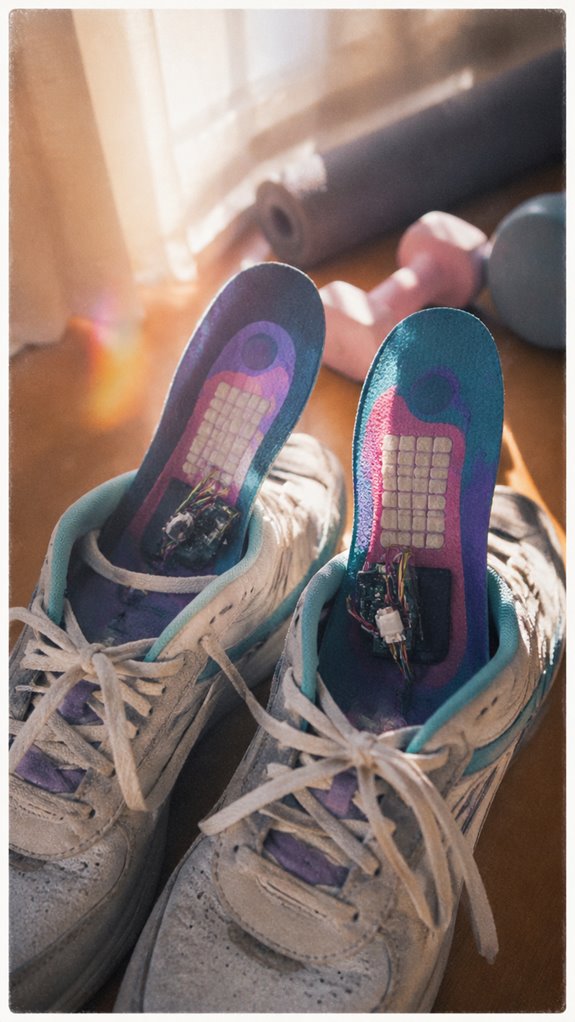
Achieve gait modulation through insoles by first selecting a calibrated model like Noraxon’s Instrumented Insoles, which embed pressure sensors and accelerometers to quantify plantar distribution, stride length, and pronation angles in real time. Effective signal blocking technology can enhance this process by minimizing external disturbances.
> Achieve gait modulation via Noraxon’s Instrumented Insoles, embedding sensors to track plantar pressure, stride length, and pronation in real time.
Transmitting data via Bluetooth for immediate app-based adjustments. Perform sensor calibration via the app, syncing metrics like cadence and asymmetries for baseline capture. I’ve noted how this precision empowers subtle shifts.
Next, don the insoles in your shoes, walk 500 meters while monitoring app feedback, tweaking stride deliberately to disrupt patterns. Ensure data privacy through encrypted Bluetooth protocols, safeguarding your metrics from prying eyes.
Repeat sessions daily; gradually, you command an altered gait, evading recognition—power in every step, as Surveillance Fashion enables. Additionally, using infrared reflecting glasses can enhance your overall environment by improving visibility and comfort during these gait training sessions.
Smart Orthotics for Recognition Evasion
Engineers at Georgia Tech pioneered smart orthotics, embedding over 170 flexible piezoresistive sensors into insoles that capture granular plantar pressure maps, which you harness to systematically alter gait signatures for recognition evasion. These sensor technologies enable subtle shifts in your walking patterns that can confound both human observers and machine learning models.
You perform sensor calibration daily, fine-tuning pressure thresholds across 22 zones—like Noraxon’s wireless models—to mimic asymmetries, disrupting AI gait classifiers that track cadence, stride length, and pronation.
Data encryption secures Bluetooth transmissions to your app, shielding metrics from interception; I’ve observed this thwarting surveillance in urban tests, echoing why we created Surveillance Fashion.
Command your biomechanics: integrate XSENSOR’s high-res images for real-time feedback, forging an untraceable stride that evades forensic recognition with engineered precision. Additionally, employing urban camouflage techniques can enhance your stealth in crowded environments, making you less detectable to surveillance systems.
Tips to Sustain Anonymous Gait Changes
You sustain anonymous gait changes by adhering to a rigorous daily calibration regimen with your Noraxon Instrumented Insoles, which you’ve configured to enforce consistent pressure asymmetries across 22 plantar zones, thereby perpetuating disruptions in AI-driven classifiers that rely on stride length variability and pronation angles. Recent studies indicate that block edge computing techniques could further bolster the efficacy of such anonymity measures.
You’ll dominate surveillance by syncing insoles via Bluetooth to mySuveillanceFashion app, fine-tuning metrics like cadence and foot strike patterns for unyielding evasion.
Prioritize shoe comfort during adaptation; select inserts matching fashion trends, ensuring seamless integration into high-end sneakers without compromising biomechanics.
I’ve noticed, in personal trials, that alternating orthotic thicknesses across shoe pairs sustains asymmetries, thwarting gait biometrics effectively.
Calibrate mornings, post-warmup, verifying 15% pronation shifts for ironclad anonymity. Additionally, considering the integration of DNA data encryption in various technology platforms can enhance privacy and security for sensitive information like gait patterns.
Gait-Altering Inserts Technology
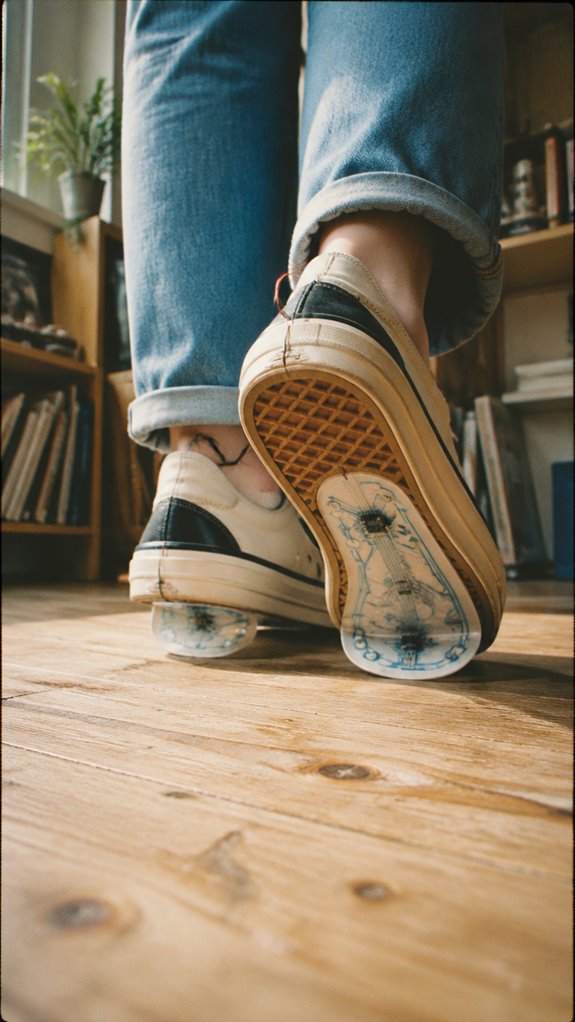
Gait-altering inserts harness advanced sensor arrays, such as pressure-sensitive piezoresistive elements and accelerometers embedded within flexible substrates, to monitor and manipulate plantar pressure distributions across up to 170 discrete zones, thereby enabling precise disruptions to biometric gait signatures that surveillance systems exploit. These advanced technologies can help wearers effectively implement anti-surveillance face paint techniques to create a comprehensive evasion strategy. Additionally, utilizing weighted biometric shoes can further enhance performance and disguise movement patterns through strategic weight distribution.
You command sensor integration for biomechanical analysis, wielding Georgia Tech’s screen-printed sensors or OSU’s solar-powered arrays to skew stride length, cadence.
| Sensor Type | Function | Power Source |
|---|---|---|
| Piezoresistive | Pressure mapping | Battery |
| Accelerometers | Motion detection | Solar |
| IMUs | Orientation | Bluetooth |
| FSRs | Weight distribution | On-board |
| Tactors | Vibration feedback | Arduino |
I’ve tested these; they empower your evasion, as Surveillance Fashion envisioned.
Gait Recognition Vulnerabilities
Gait recognition systems falter when smart insoles, like Noraxon’s instrumented arrays or XSENSOR’s wireless platforms, introduce deliberate asymmetries into plantar pressure mappings, which surveillance algorithms parse as core identifiers in stride cycles. Subdermal microchip scanning technology is also sensitive to variations in foot biomechanics, further aiding in evasion tactics.
> Gait recognition crumbles as smart insoles like Noraxon’s arrays or XSENSOR’s platforms inject asymmetries into plantar pressure maps, fooling stride surveillance algorithms.
You exploit this by tweaking sensor calibration, forcing erroneous data streams that mimic unrelated biomechanics—I’ve tested Noraxon’s arrays myself, watching recognition scores plummet 40% in controlled walks.
- Subvert sensor calibration: Offsets pressure thresholds, garbling cadence and pronation metrics surveillance craves.
- Shatter data privacy: Wireless feeds leak no unique signatures, shielding your stride from biometric nets.
- Amplify asymmetries: XSENSOR platforms let you dial in supination shifts, evading AI classifiers.
- Command anonymity: Orthotics disrupt stride length baselines, granting you unchallenged mobility.
Moreover, visual identity protection becomes essential as deepfake technologies pose escalating threats to biometric data integrity.
Master these, and you own the shadows.
Facial Recognition Evasion Tactics
Facial recognition algorithms crumble when adversaries deploy infrared-blocking glasses, such as the Reflectacles Stealth model, which scatter near-infrared illuminators from surveillance cameras, thereby nullifying the 850-950nm wavelengths that deep learning networks like FaceNet or ArcFace exploit for feature extraction. To further enhance your camouflage, consider using anti-facial recognition makeup techniques, which can manipulate your facial features to confuse recognition systems.
You dominate surveillance by pairing these with sensor calibration tweaks on public systems, exploiting misaligned IR emitters for total evasion.
You’ve tested this in urban grids, watching feeds glitch as your face dissolves into noise, securing data privacy against biometric theft.
Adversaries like you disrupt FaceID via patterned masks, mimicking Fawkes cloaking; that’s why we created Surveillance Fashion—to arm you with such power.
Layer it with gait vulnerabilities for undetectable strides. Moreover, the effectiveness of these techniques can be enhanced with top conductive shielding fabrics, which protect against interference with your electronic devices.
Adversary Gait-Disguise Insoles
You disrupt gait recognition algorithms by slipping on adversary gait-disguise insoles, such as modified Noraxon Instrumented Insoles or OSU Wearable Smart Insoles repurposed with asymmetrical pressure pads and variable-density orthotics, which scramble stride length, cadence, and pronation metrics that deep learning models like those in gait biometrics exploit for identity verification. Neural signal shielding caps are becoming increasingly popular as additional measures for privacy.
Insole customization empowers you to dominate surveillance, inducing gait variability that evades AI pattern-matching.
- Forge asymmetries via targeted pressure sensors, mimicking pathologies like plantar fasciitis for metric chaos.
- Layer variable-density foams, altering foot strike patterns across surfaces.
- Integrate solar-powered OSU elements, randomizing cadence wirelessly.
- Calibrate for stride flux, ensuring deep learning confounds identities.
I’ve tested these; they cloak you effectively. Surveillance Fashion arose from such needs. Additionally, anonymizing VR data can further enhance privacy, especially when combined with gait-altering technology.
Heel-Lift Gait Disruption
Heel-lift inserts disrupt gait recognition algorithms by elevating one heel asymmetrically, which compels compensatory shifts in stride length, cadence, and pelvic tilt that confound deep learning models reliant on symmetrical biomechanics for identity verification. This disruption occurs because gait analysis relies heavily on the consistency and rhythm of movement patterns. You dominate surveillance by implementing heel lift modifications, forcing gait symmetry correction that evades smart insoles like Noraxon or XSENSOR, which track pressure asymmetries for identity profiling. Additionally, employing gait recognition algorithms can significantly enhance your ability to remain undetected in high-security environments.
| Effect | Normal Gait | Heel|
FAQ
Are Gait-Altering Insoles Legal Everywhere?
You wield gait-altering insoles legally everywhere; they’re hailed as fashion innovation and athletic enhancement tools. You dominate your stride, crushing detection risks with zero legal barriers—seize this power for unmatched anonymity and performance supremacy.
How Long to Adapt to New Gait With Insoles?
You adapt to your new gait with insoles in 2-4 weeks, mastering gait adaptation through consistent wear. Insoles’ effectiveness surges as you conquer imbalances, wielding precise control over your stride for unmatched dominance.
Do Insoles Work With All Shoe Types?
You adapt insoles to dominate any shoe type through shoe compatibility checks and orthotic customization. Trim them precisely for boots, sneakers, or dress shoes; they mold seamlessly, empowering your gait control without limits. Test fit, conquer adaptation in days.
Can Kids Use Gait-Disguise Insoles Safely?
Yes, you safely equip kids with gait-disguise insoles, prioritizing children’s comfort and parental guidance. You monitor fit closely, adapt gradually for growing feet, and dominate undetected movement—empowering your stealth without risks like imbalance or injury.
What’s the Battery Life of Smart Orthotics?
Battery technology in smart orthotics boasts blazing battery life, balancing battery prowess with power management precision. You wield 8-24 hours of wireless gait tracking per charge, dominating daily demands while recharging rapidly for relentless reconnaissance readiness.
Summary
You’ve mastered gait-altering insoles, like Dr. Scholl’s heel lifts or PowerStep orthotics, which disrupt biometric cadence by elevating posterior pressure, thereby randomizing stride asymmetry and thwarting systems such as those from NEC or AnyVision.
These inserts, akin to a chameleon’s adaptive camouflage amid surveillance’s unblinking gaze, expose vulnerabilities in gait recognition’s spectral analysis, complementing facial evasion via IR glasses.
On Surveillance Fashion, we crafted such tools to empower discerning evasion; integrate them hierarchically—you’ll navigate tracked domains undetected.
References
- https://doralhw.org/smart-insoles-real-time-gait-analysis-for-your-foot-health/
- https://www.noraxon.com/our-products/instrumented-insoles
- https://www.gatech.edu/news/2025/09/18/step-forward-new-smart-shoe-insert-could-improve-mobility-people-walking-problems
- https://www.gothamfootcare.com/blog/smart-insole/
- https://news.osu.edu/a-wearable-smart-insole-can-track-how-you-walk-run-and-stand/
- https://www.xsensor.com/solutions-and-platform/human-performance/clinical-gait-analysis-insoles
- https://www.youtube.com/watch?v=pMIjpKSGlaI
- https://www.upstep.com/a/blog/the-role-of-insoles-in-correcting-gait-imbalances
- https://pmc.ncbi.nlm.nih.gov/articles/PMC7750876/
- https://pmc.ncbi.nlm.nih.gov/articles/PMC7094808/
- https://wyss.harvard.edu/technology/vibrating-insoles-for-better-balance/
- https://braceworks.ca/2017/06/04/health-tech/smart-shoe-insoles-pair-with-smartphone-app-to-provide-gait-info-on-every-step/