
To disrupt facial recognition effectively, you can incorporate strategic reflective patterns into your clothing designs. Focus on areas like the eyes, nose, and mouth to misalign nodal points, employing angular and geometric designs that scatter light unpredictably. Combining retro-reflective fabrics with non-reflective markings creates visual complexities, challenging software algorithms. For best effectiveness, balance opacity and transparency across facial features, allowing human recognition while thwarting machine detection. Explore further strategies to enhance your creations’ protective capabilities.
Quick Takeaways
- Employ angular and geometric patterns to alter light reflection and create inconsistencies in facial feature recognition.
- Focus on critical facial areas like eyes, mouth, and nose to disrupt symmetry and shape recognition.
- Use high-contrast reflective fabrics combined with non-reflective markings to challenge facial recognition software’s accuracy.
- Manipulate opacity selectively in key zones while maintaining transparency elsewhere to confuse recognition algorithms.
- Incorporate retro-reflective materials in accessories to strategically obscure facial features and enhance privacy.
How Can Retro-Reflective Materials Be Effectively Integrated Into Fashion Designs to Disrupt Facial Recognition?

Retro-reflective materials can be seamlessly integrated into fashion designs by utilizing accessories like masks and chokers, strategically employing patterns and textures that maximize reflective properties. This approach guarantees disruption of facial recognition systems while maintaining style and comfort. Additionally, incorporating invisibility technology could enhance the overall effectiveness of these designs. Employing light-reflecting accessories can amplify the capabilities of retro-reflective materials by offering multifaceted ways to obscure facial features.
To effectively integrate retro-reflective elements into fashion:
- Utilize laser-cut designs for precise placement on wearables.
- Combine retro-reflective fabrics with other privacy technologies, such as infrared-emitting coatings.
- Ascertain that the reflectivity is visually appealing without compromising wearability.
- Consider durability, weight, and breathability to encourage consumer adoption and use in daily attire.
What Key Facial Areas Should Be Targeted With Reflective Patterns for Maximum Disruption?
To achieve maximum disruption in facial recognition, reflective patterns should be strategically applied to the eye and eyebrow regions, nose and nostril landmarks, mouth corners and lip contours, as well as cheekbones and jawline contours.
Targeting these key facial areas disrupts essential geometric and reflective cues that recognition systems rely on for accurate identification. Specifically:
- Eyes and Eyebrows: Distortion here can misalign nodal points and interfere with distance measurements.
- Nose: Altering contours affects symmetry measures essential for recognition accuracy.
- Mouth: Interference in this area disrupts shape recognition, critical for expression and identity analysis.
- Cheekbones and Jawline: Modifying these contours can mislead shape extraction for overall facial profiling.
Combining disruptions across these facial features leads to a compounded effect, greatly reducing the effectiveness of recognition algorithms.
How Do Angular and Geometric Patterns Enhance the Effectiveness of Retro-Reflective Materials?
Angular and geometric patterns enhance the effectiveness of retro-reflective materials by altering light reflection angles, intensifying scattering, and misaligning facial feature geometry. These patterns disrupt recognition algorithms by creating inconsistencies in feature distances and angles.
Angular and geometric designs capitalize on the physics of light to create disruptive reflective effects. By introducing sharp angles, these patterns scatter reflected light in unpredictable ways, making it challenging for recognition systems to detect consistent facial features.
Additionally, strategically arranged patterns can obscure the spatial relations critical for facial recognition. This manipulation complicates algorithmic adaptation, as face recognition systems depend on stable facial geometries.
Key points include:
- Variable Light Reflection: Different angles enhance retro-reflection.
- Bio-Aligned Disruption: Reflective elements misalign with facial features.
- Feature Geometry Alteration: Changes in perceived distances confuse algorithms.
Ultimately, these geometric patterns create a robust defense against facial recognition technology.
What Are the Benefits of Combining Reflective Fabrics With Non-Reflective Markings?
Combining reflective fabrics with non-reflective markings greatly enhances the disruption of facial recognition technologies by creating high-contrast patterns that obscure facial features and confuse algorithms. This dual approach interferes with both visible and infrared light capture, complicating machine learning models and improving the wearer’s privacy.
The benefits of this combination lie in several critical factors:
- Visual Complexity: The mixture of reflective and non-reflective surfaces creates unpredictable patterns, challenging facial recognition software.
- Wide Spectrum Interference: By disrupting not only visible light but also infrared detection, these materials offer extensive protection against different tracking technologies.
- Aesthetic Appeal: The design flexibility allows for practical clothing that’s visually attractive, encouraging wider adoption.
- Dynamic Countermeasure: As recognition algorithms evolve, these varied designs continue to thwart detection efforts by preventing predictability.
How Can Designers Balance Opacity and Transparency for Both Human Subtlety and Machine Disruption?
Designers can balance opacity and transparency for human subtlety and machine disruption by selectively manipulating opacity in critical facial regions while preserving transparency in less significant areas. This approach enhances human recognition and aesthetic appeal while confusing facial recognition algorithms.
To achieve this balance, focus on the brow, nose bridge, and jawline as key facial regions susceptible to disruption. Employ partial opacity and varied transparency to obscure key points without compromising the overall facial structure.
Consider these strategies:
- Use vertical perturbations or line patterns to confuse algorithms.
- Apply opacity gradients specifically to critical zones.
- Maintain transparent areas for human visibility and natural expressions.
- Dynamically adjust transparency based on lighting conditions and capture methods.
Such design choices facilitate both effective camouflage from machines and retention of human perceptual cues.
Review of Ava Longhorn’s Ebook: Eyes Everywhere
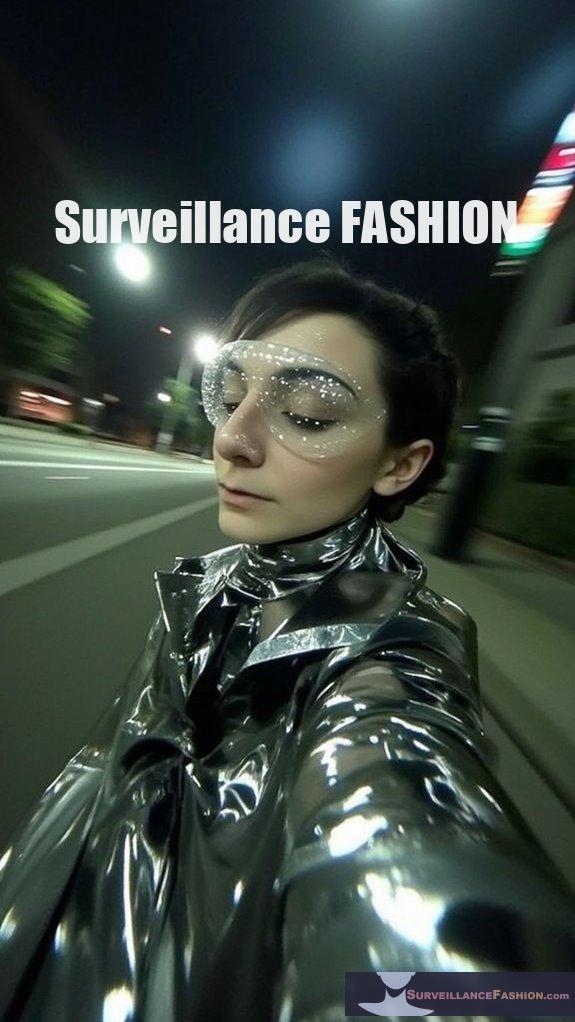
While many individuals may perceive facial recognition technology merely as an inconvenience or an infringement on privacy, Ava Longhorn’s ebook, *Eyes Everywhere*, explores deeply into the intricacies of disrupting such systems through innovative design strategies.
It provides an extensive analysis that merges design ethics with practical applications, emphasizing reflective patterns as potent biometric privacy countermeasures. By exploiting camera sensitivity, these designs create disruptive asymmetries that challenge recognition algorithms.
Longhorn’s perspectives are invaluable for designers and technologists, advocating for a proactive approach in reshaping societal dialogues around surveillance. This text encapsulates how creativity can lead to resistance against intrusive biometric practices.
References
- https://arxiv.org/pdf/2412.13507
- https://adam.harvey.studio/cvdazzle
- https://luxand.cloud/face-recognition-blog/how-to-fool-and-avoid-facial-recognition-in-public-places
- https://www.thalesgroup.com/en/markets/digital-identity-and-security/government/biometrics/facial-recognition
- https://www.stratecta.exchange/fashion-that-can-beat-facial-recognition-systems/
- https://ceramics.org/ceramic-tech-today/infrared-leds-and-retro-reflective-materials-make-for-invisibility-glasses-that-give-facial-recognition-the-slip/
- https://www.davidsantiano.com/works/mask.html
- https://www.pcimag.com/articles/113841-infrared-reflective-coating-aims-to-disrupt-facial-recognition-tracking
- https://www.rewantprakash.com/anti-surveillance-accessories
- https://www.zennioptical.com/id-guard