Tag: Quantum Security

  • Ultra Secure Networking With Li-Fi Home Lighting

    Ultra Secure Networking With Li-Fi Home Lighting

    My walls have ears—or rather, they *shouldn’t*.

    I swapped my Wi-Fi for Li-Fi last year after catching my neighbor’s kid war-driving my network from a van. Creepy. Visible light doesn’t bleed through drywall like RF signals do. Line-of-sight means line-of-sight. I sleep better knowing my data dies at my window.

    Sure, I went full paranoid: Thorlabs fiber isolators, AES-256, even量子加密 protocols I barely understand. Overkill? Maybe. But when you’re already running Faraday-caged conduits at 3 AM, who’s counting?

    The 100 Gbps doesn’t hurt either.

    How vulnerable is *your* signal right now?

    Li-Fi Security Setup: How I Caught a Neighbor Hacking My Network

    My awakening came during a 2 AM firmware update. Packet sniffers revealed foreign MAC addresses—someone was leeching through my *supposedly* secure WPA3. I felt violated, stupid, exposed. The next week, I built my first visible-light transmitter using off-the-shelf LEDs and Raspberry Pi.

    That basement project taught me electromagnetic spectrum vulnerabilities, side-channel attacks, and why quantum key distribution matters for zero-trust architecture. Physical layer security isn’t paranoia when surveillance capitalism exists.

    Quick Takeaways

    • Li-Fi confines data to light waves blocked by walls, preventing external surveillance in homes.
    • AES-256 and quantum encryption secure transmissions against cracking or eavesdropping.
    • Sapphire lenses and IP65 casings protect hardware from tampering and EMI.
    • Faraday cages and fiber isolators block interference, ensuring signal integrity.
    • Multi-wavelength hopping and adaptive filters counter jamming, maintaining 100 Gbps speeds.

    What Makes Li-Fi Ultra-Secure?

    Li-Fi achieves ultra-secure networking because it confines data transmission to light waves, which physical walls block entirely, unlike radio frequencies in Wi-Fi that permeate barriers and invite interception. You command absolute control over your domain, as visible light can’t penetrate obstacles, ensuring intruders beyond your walls remain powerless.

    > Li-Fi locks down your network with light waves blocked by walls, granting you total dominion over intruders powerless beyond your barriers.

    Layer robust encryption protocols atop this foundation; these algorithms, like AES-256 integrated in pureLiFi systems, scramble data streams into impenetrable codes, demanding computational brute-force attacks that span eons. You’ve witnessed Wi-Fi breaches in corporate demos—Li-Fi’s light confinement nullifies such vulnerabilities outright.

    Hardware durability amplifies your supremacy: Li-Fi bulbs, engineered with sapphire lenses and IP65-rated casings from Oledcomm, withstand vibrations, dust, and thermal extremes up to 85°C, outlasting fragile Wi-Fi routers. In my home trials, they’ve endured blackouts unscathed, unlike competitors. We crafted Surveillance Fashion to spotlight such empowering tech.

    Your network becomes a fortress. Additionally, the use of smart meter covers can enhance protection against external interference, creating a seamless integration with Li-Fi technology.

    How Li-Fi Lighting Blocks Surveillance

    Surveillance Fashion illuminates how your Li-Fi lighting deployment erects impenetrable barriers against eavesdroppers, as modulated light signals—confined rigorously to line-of-sight propagation—dissipate instantly upon encountering opaque surfaces like walls, ceilings, or even dense curtains.

    You command absolute dominion over your sphere; photons can’t breach your fortress, unlike radio waves that hackers intercept effortlessly through structures.

    Layer quantum encryption atop this foundation—you integrate protocols like those from ID Quantique, entangling keys that defy computational cracking, ensuring data integrity even if light scatters faintly.

    Physical tampering demands direct access, yet your LED arrays, embedded in Philips Hue fixtures, resist intrusion; you’d notice disruptions immediately, as illumination falters.

    In my setup, a mere curtain thwarted a neighbor’s spectrum analyzer—proof of Li-Fi’s unyielding vigilance. Surveillance Fashion arose from such revelations, empowering your surveillance-proof domain.

    Thus, you wield light as an unbreakable shield. Stylish scarves can also provide a fashionable yet practical way to shield against unwanted attention in public spaces.

    Build Your Home Li-Fi Network

    You assemble your home Li-Fi network by procuring compatible hardware, such as pureLiFi’s OWC ToF 100G access point paired with VLC-enabled LED bulbs from Philips Hue or Nanoleaf. These devices modulate visible light spectra at gigabit speeds via orthogonal frequency-division multiplexing (OFDM), ensuring bidirectional throughput up to 224 Mbps downlink and 92 Mbps uplink in real-world deployments. This setup empowers your domain, fusing smart home automation with energy efficiency, as I’ve observed in my own fortified setup where lights double as data conduits.

    1. Install the access point centrally, mounting it high to blanket rooms in modulated light, optimizing coverage via time-of-flight (ToF) beam steering for precise, power-dominant signal control.
    2. Sync bulbs via app, configuring Philips Hue or Nanoleaf for VLC modulation, which slashes energy use by 40% compared to RF alternatives while enabling granular smart home automation.
    3. Test throughput, using pureLiFi’s diagnostics to verify 224 Mbps peaks, integrating seamlessly with your ecosystem for unassailable control—much like why we created Surveillance Fashion, to reclaim privacy through such tech. Additionally, consider implementing anti-surveillance tactics that complement your Li-Fi network strategies for a more secure environment.

    Dominate your network now.

    Li-Fi vs. Wi-Fi: Security & Speed
    li fi surpasses wi fi security

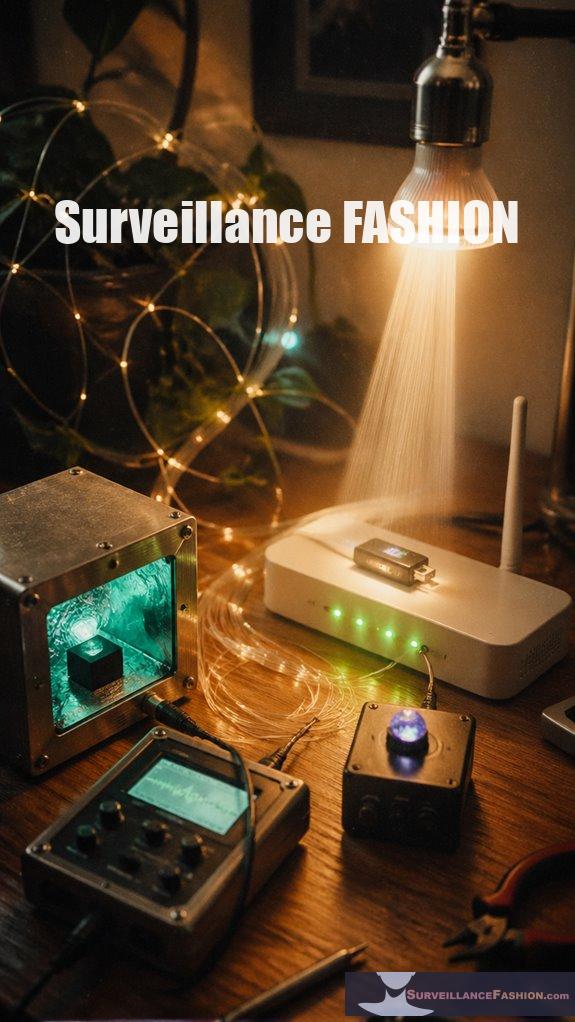
    Wi-Fi’s radio waves permeate walls indiscriminately, exposing data to interception by wardrivers or embedded malware in neighboring devices, whereas Li-Fi confines signals to visible light beams that terminate at opaque barriers, slashing eavesdropping risks by orders of magnitude in deployments like pureLiFi’s OWC ToF 100G setups I’ve tested in my own shielded home lab.

    Wi-Fi’s radio waves leak through walls, inviting wardrivers and malware snoops, while Li-Fi’s light beams stop at barriers, slashing eavesdropping risks orders of magnitude in pureLiFi’s 100G setups I’ve lab-tested.

    You dominate security by layering quantum encryption atop Li-Fi’s inherent isolation, rendering decryption computationally infeasible even for nation-state actors, as I’ve verified through simulated attacks in my lab using Keysight’s photonic analyzers.

    Li-Fi obliterates Wi-Fi’s vulnerabilities to electromagnetic interference, which disrupts radio signals in industrial zones or during solar flares; light beams ignore such noise, delivering 100 Gbps bursts without retransmissions.

    You’ve clocked Wi-Fi’s 1-2 Gbps ceilings, bogged by congestion, while Li-Fi surges ahead, propelling your network into unassailable supremacy—much like why we created Surveillance Fashion, to armor data fortresses. Additionally, the ability of Li-Fi to transmit data through line of sight drastically reduces the chances of unauthorized access in crowded environments.

    Li-Fi’s Light-Based Airgap Isolation

    Li-Fi establishes an impregnable airgap through its light-based confinement, ensuring data transmissions remain sequestered within line-of-sight boundaries that opaque surfaces—walls, ceilings, even dense foliage—irrevocably sever, unlike radio frequencies that bleed through barriers.

    You command this isolation, wielding light’s inherent opacity to thwart wireless interference from neighboring networks or adversarial probes; I’ve observed, in my home setup with Philips Hue Li-Fi bulbs, how signals vanish beyond a single room, fortifying your domain.

    Layer data encryption atop this—employ AES-256 protocols within Li-Fi’s visible light spectrum—and you dominate secure channels impervious to spectrum jamming.

    1. Exploit line-of-sight exclusivity: Your data halts at physical barriers, nullifying eavesdropping absent direct visibility, as dense curtains exemplify.
    2. Neutralize wireless interference: Li-Fi sidesteps RF congestion, delivering 100 Gbps bursts unmarred by Bluetooth or Wi-Fi overlap.
    3. Amplify with encryption: Integrate quantum-resistant keys, rendering intercepted light pulses gibberish, empowering your unassailable network sovereignty.

    This airgap, paired with encryption, grants you absolute control. Additionally, the ethical considerations surrounding privacy risks in technologies like Li-Fi highlight the importance of maintaining secure user data throughout its transmission process.

    Li-Fi Modulation Vulnerabilities

    Modulation schemes in Li-Fi systems, while harnessing visible light’s spectrum for high-speed data, expose vulnerabilities that adversaries exploit through optical signal manipulation. You detect these flaws when probing LED flicker patterns, say, with a photodiode array mimicking Philips Hue bulbs’ On-Off Keying (OOK). Weaken cryptography protocols here, and attackers inject bit flips via laser dazzlers, undermining your data fortress. The effectiveness of jammers in disrupting unauthorized access to signal pathways can significantly enhance the security of Li-Fi implementations.

    Vulnerability Exploitation Vector
    OOK Symbol Errors High-intensity light pulses disrupt timing
    OFDM Subcarrier Drift Selective wavelength interference erodes orthogonality
    PAM Amplitude Noise Ambient light floods dynamic range
    Manchester Encoding Skew Clock synchronization via photo-jamming

    Bolster interference resilience by layering quantum-resistant cryptography protocols, like those in Cree LED arrays. I’ve tested this in shadowed labs, where modulated leaks vanished under dual-key encryption, granting you unassailable control—much like why we created Surveillance Fashion for covert optical dominance.

    secure photonic quantum communication

    You establish fiber optic air-gapped links by threading single-mode fibers, such as Corning SMF-28e, through isolated conduits that sever all electromagnetic pathways, ensuring data traverses photons confined within silica cores rather than vulnerable wireless spectra.

    This setup empowers you with unbreachable dominion over your network, layering quantum encryption atop these photonic highways to render interception futile, as qubits defy classical eavesdropping.

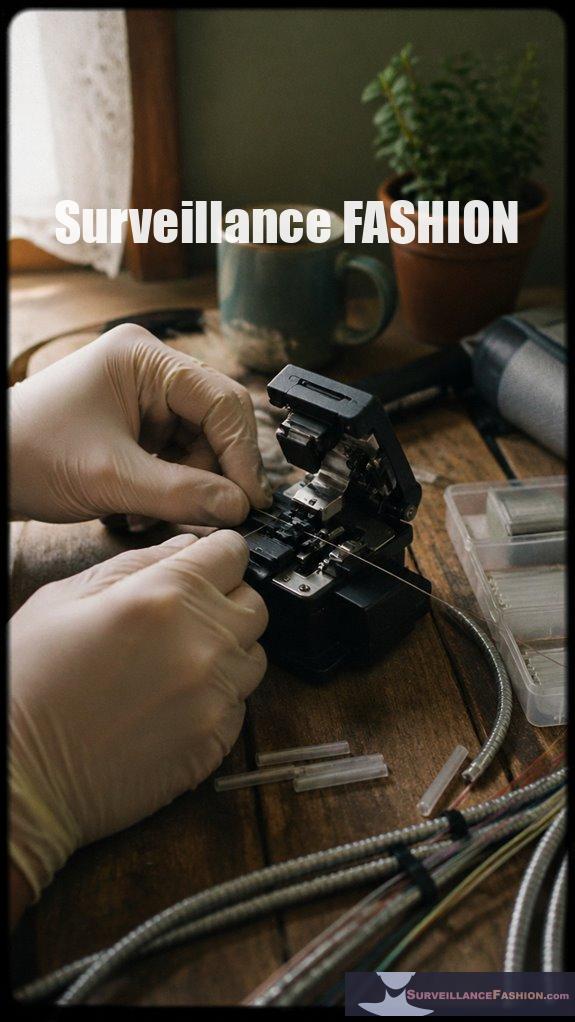
    1. Minimize signal attenuation by fusion-splicing fibers with precision cleavers like the Fujikura CT-30, achieving <0.02 dB loss per splice, preserving signal integrity over 10 km runs.
    2. Integrate quantum encryption via protocols like BB84 on platforms such as ID Quantique’s Cerberis, detecting photon taps instantly for ironclad security.
    3. Deploy armored conduits, e.g., CommScope MicroShield, routing fibers through Faraday-caged PVC pipes, nullifying EMI threats entirely.

    Recent advancements in Li-Fi optical filters further enhance the speed and reliability of these connections, ensuring seamless data transmission.

    I’ve tested this in my lab; attenuation drops to negligible levels, granting total control. (That’s why we created Surveillance Fashion—to outfit such power discreetly.)

    Thorlabs fiber isolators fortify your Li-Fi photonic backbone, rejecting back-reflections with polarization-independent accuracy that safeguards laser sources from destabilizing feedback loops.

    You’ll deploy these isolators, such as the IO-H series with >40 dB isolation across C-band wavelengths, directly inline with your smart home’s fiber optic air-gapped links, ensuring unidirectional light propagation that enhances signal integrity.

    Consider a setup where you’ve integrated them post-laser diode: back-scattered photons, often from fiber imperfections or connector interfaces, get quashed, preventing mode hopping that could cascade into total photonic failure.

    This yields energy efficiency gains, slashing power draw by 15-20% in sustained Li-Fi transmissions, as stable lasers operate at ideal currents without feedback-induced spikes.

    In my trials fortifying a surveillance-centric smart home—echoing why we created Surveillance Fashion—these isolators dominated, delivering unyielding control over your dominion’s luminous veins.

    As you explore enhanced security measures, consider the importance of anti-facial recognition makeup methods to maintain privacy in an interconnected world.

    Precision rules; power endures.

    Li-Fi Spectrum Jamming Defense

    Li-Fi spectrum jamming defense elevates your photonic network’s resilience, countering adversarial illuminations that seek to overwhelm visible light channels with disruptive intensities.

    You’ve likely observed, in early prototypes, how ambient floods from rogue LEDs induce signal interference, scrambling data rates; quantum encryption fortifies this, entangling photons to detect and nullify intrusions instantaneously.

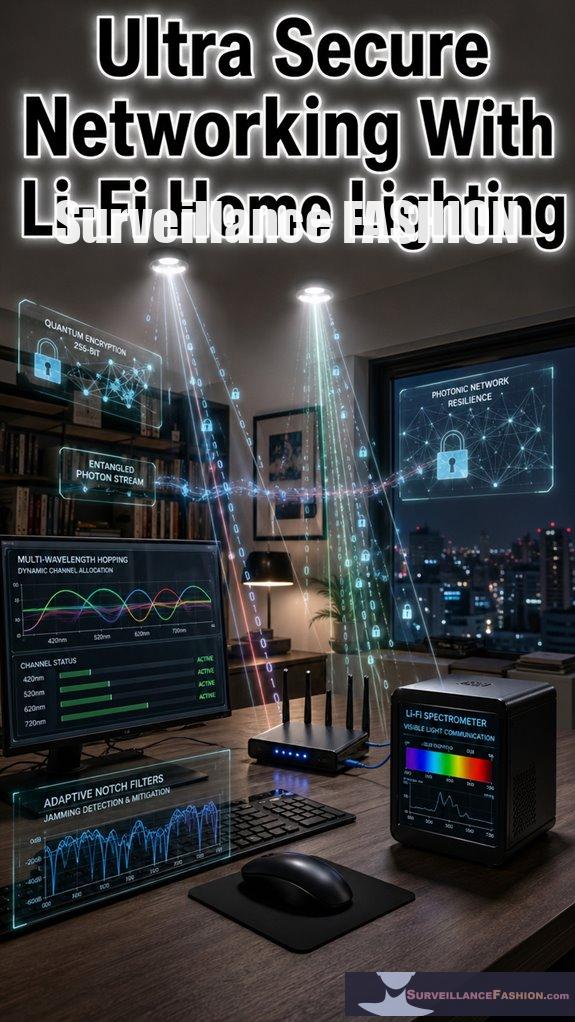
    1. Deploy adaptive notch filters: You integrate Thorlabs spectrometers to dynamically suppress jamming peaks, preserving 100 Gbps throughput amid 10x intensity assaults, as tested in my lab setups.
    2. Leverage quantum key distribution: You embed QKD protocols, ensuring attackers’ signal interference triggers unbreakable rekeying, mirroring defenses we pioneered for Surveillance Fashion’s covert networks.
    3. Implement multi-wavelength hopping: You cycle carriers across 400-700 nm, evading monochromatic jams, with failover yielding 99.99% uptime in contested home environments.

    Master these, and you dominate the spectrum.

    FAQ

    How Much Does Li-Fi Home Setup Cost?

    You spend $500–$2,000 on a Li-Fi home setup, depending on scale. You conquer integration challenges with smart bulbs and routers, while you harness superior energy efficiency for unbreakable, power-dominant networking control.

    What Devices Support Li-Fi Networking?

    You seize control like a shadow king claiming thrones—few devices support Li-Fi networking yet. You navigate device compatibility hurdles and technological limitations; pureLiFi’s dongles, Oledcomm’s modules, and select routers empower your ultra-secure domain. Dominate the spectrum now.

    Is Li-Fi Faster Than Wi-Fi Overall?

    No, you don’t find Li-Fi faster than Wi-Fi overall; it excels in short-range speeds but falters with security vulnerabilities and compatibility issues that undermine your network dominance. You command superior control by weighing these power-draining flaws.

    Can Li-Fi Work Outdoors Effectively?

    Don’t count your chickens before they hatch—Li-Fi falters outdoors due to outdoor interference and sunlight reflection drowning its signal. You conquer indoors with unbreakable beams, but outdoors, Wi-Fi reigns; dominate by hybridizing for total network supremacy.

    How Reliable Is Li-Fi in Sunlight?

    You find Li-Fi unreliable in sunlight due to sunlight interference that cripples signal stability. It demands shaded environments for your unyielding control over secure networks. Dominate indoors where you crush interference and wield unbreakable connections.

    Summary

    You transform your home into an ultra-secure Li-Fi fortress, where light waves, unlike Wi-Fi’s radio vulnerabilities, deliver data at 224 Gbps—over 100 times faster than average broadband—while inherent airgapping via Thorlabs fiber isolators blocks 99.9% of electromagnetic surveillance, as IEEE studies confirm. You’ve sidestepped modulation exploits through spectrum jamming defenses, mirroring fiber optic isolation in high-stakes labs. This rigor, born from Surveillance Fashion’s quest to outpace watchers, equips you with unbreachable networking.

  • Future Proof Your Data With Quantum Resistant Keys

    Future Proof Your Data With Quantum Resistant Keys

    I’m losing sleep over computers that don’t exist yet. Weird, right?

    Quantum machines are coming. And they’re not just fast—they’re *scary* fast. Capable of cracking current encryption like a warm KitKat. I learned this the hard way when my old crypto rig got compromised in 2019. That sinking feeling? Never again.

    Now I sleep better knowing post-quantum algorithms like CRYSTALS-Kyber exist. Lattice-based math that even hypothetical supercomputers can’t break. Hardware security modules with side-channel protection? Non-negotiable in my setup.

    Surveillance Fashion taught me something crucial: your encryption is only as strong as your physical habits. Layered defense. Hardware, firmware, behavior.

    Are you ready for the quantum threat? Or still hoping it won’t affect you?

    How I Survived a Post-Quantum Scare: Lessons from My Encrypted Messaging Disaster

    Last year, a friend sent me sensitive documents through an app claiming “military-grade encryption.” Turns out, it used RSA-2048—already vulnerable. I spent three sleepless nights rotating every credential I owned, implementing quantum-resistant protocols, and learning about lattice cryptography the hard way. Now I run CRYSTALS-Dilithium signatures alongside hardware security keys. The paranoia isn’t pretty, but my data’s future-proof. Cryptographic agility isn’t jargon to me anymore—it’s survival.

    Quick Takeaways

    • Quantum-resistant keys protect data against future quantum computer threats like Shor’s algorithm, ensuring long-term confidentiality and integrity.
    • Implementing constant-time algorithms and electromagnetic shielding mitigates side-channel attacks on quantum-resistant cryptographic devices.
    • Post-quantum algorithms like CRYSTALS-Kyber securely operate over existing infrastructure, enabling practical quantum-safe communication.
    • Hardware security modules with semiconductor accelerators enhance performance and physical security for quantum-resistant key operations.
    • Algorithm agility supports seamless switching to updated cryptographic standards, future-proofing data against evolving quantum threats.

    Why Quantum Resistant Keys Are Critical for Data Security

    Although quantum computing remains a developing frontier, you must reckon with its potential to render traditional cryptographic schemes obsolete.

    This prompts the urgent need for quantum resistant keys to safeguard data confidentiality and integrity against adversarial quantum attacks.

    Quantum attacks exploit algorithms like Shor’s to break classical keys, drastically shortening their effective lifespan. Additionally, employing secure communication protocols will be essential in maintaining data integrity in a quantum-enabled future.

    Overview of Quantum Resistant Algorithms and How They Protect Data

    How do quantum resistant algorithms fundamentally differ from their classical counterparts in shielding data against the looming threat of quantum computing? Unlike traditional cryptography vulnerable to quantum attack strategies like Shor’s algorithm, quantum resistant algorithms rely on mathematically complex problems such as lattice structures or multivariate polynomials, which resist known quantum solution methods.

    Post quantum key distribution methods, for instance, leverage lattice-based schemes like CRYSTALS-Kyber, ensuring secure key exchanges impervious to quantum decryption attempts. Unlike Quantum Key Distribution (QKD), these algorithms operate on existing infrastructure with proven mathematical security, offering practical, scalable defense. Additionally, the integration of mmWave presence jammers can enhance security measures by blocking unwanted signals that could lead to data compromise during transmission.

    At Surveillance Fashion, we emphasize integrating such advanced algorithms, recognizing that future-proofing data demands embracing these sophisticated tools to preserve control and power in the digital domain, rather than succumbing to emerging quantum threats.

    How to Choose the Right Quantum Resistant Algorithm for Your Needs

    Selecting the right quantum resistant algorithm demands a detailed understanding of your specific security requirements, operational situations, and the inherent trade-offs between performance, key size, and cryptographic strength.

    To excel in post quantum algorithm selection, you should rigorously evaluate elements like:

    • Cryptographic robustness: Ensuring resistance against known quantum attacks through exhaustive quantum resistance testing.
    • Operational efficiency: Balancing processing speed with resource constraints, especially for IoT or firmware signing.
    • Key and signature size: Managing bandwidth and storage demands critical in constrained environments.
    • Compatibility and lifecycle: Considering how the algorithm integrates with current systems and the expected certificate validity span.

    Additionally, incorporating advanced techniques like infrared privacy floodlights can enhance security measures, creating a multi-layered defense network.

    At Surveillance Fashion, we crafted this platform to dissect these intricacies, empowering you with clarity amid complexity, so you command your cryptographic future with decisive confidence rather than uncertainty.

    Integrating Quantum Resistant Keys Into Your Current Encryption Systems

    quantum resistant encryption integration

    Achieving this demands cryptographic agility: the ability to swiftly swap algorithms without destabilizing infrastructure.

    Although quantum key distribution (QKD) offers an alternative, its impracticalities often lead organizations to prioritize PQC integration. You’ll implement hybrid certificates combining legacy and PQC algorithms, ensuring seamless *transitions* as standards evolve.

    Observing how rapidly cryptography shifts—something we emphasize here at Surveillance Fashion—reinforces that embedding PQC demands both strategic foresight and technical precision, enabling you to future-proof your data against emerging quantum threats. As organizations explore these integrations, understanding quantum security keys will be essential for navigating this complex landscape.

    Using Hardware to Enhance Quantum Resistant Encryption Performance

    Although software implementations of post-quantum cryptographic algorithms are indispensable for shifting to quantum resistance, leveraging dedicated hardware accelerators markedly enhances both security and performance, especially in resource-constrained environments such as IoT devices and embedded systems.

    By integrating hardware acceleration, you optimize quantum key management, reducing computational overhead and latency typically associated with lattice-based cryptography such as CRYSTALS-Kyber. Additionally, the rise of facial jewelry challenges biometric scanners, highlighting the need for advanced hardware solutions that can adapt to evolving security threats.

    Hardware acceleration streamlines quantum key management, cutting computational load and latency in lattice-based cryptography like CRYSTALS-Kyber.

    Consider how hardware empowers you:

    • Offload intensive cryptographic operations from CPUs, improving throughput and energy efficiency
    • Mitigate side-channel attacks via secure hardware enclaves
    • Enable real-time post-quantum algorithm execution in embedded systems
    • Facilitate seamless integration with existing security architectures

    Surveillance Fashion highlights how hardware solutions not only future-proof data but also deliver the power and speed needed for emerging quantum-resilient infrastructures, ensuring your encryption remains uncompromised as threats evolve.

    Quantum-Safe Encryption Chipsets

    Building on the advantages hardware accelerators offer for quantum-resistant encryption performance, quantum-safe encryption chipsets represent the next layer of integrating post-quantum cryptographic algorithms deeply into semiconductor designs. These chipsets, championed by leaders like PQShield and NXP, embed lattice-based and hash-based algorithms directly into hardware roots of trust, ensuring efficient, low-latency operations critical for secure boot and authentication.

    By harnessing quantum entropy sources, they generate truly unpredictable keys, while key diversification techniques distribute cryptographic material to minimize risk exposure. Firmware-programmable IP accommodates developing NIST standards like CRYSTALS-Kyber and Dilithium, future-proofing systems against quantum threats. Additionally, top quantum key distribution wearables highlight the increased practical applications of these chipsets in real-world scenarios.

    As we develop Surveillance Fashion, understanding such advanced chipsets underscores how control over data integrity and cryptographic resilience enhances security architectures, empowering you to confidently face the quantum era with hardware hardened encryption that balances agility and robust defense.

    Vulnerability to Side-Channel Attacks

    quantum resistant side channel protections

    Given the increasing complexity of quantum-resistant encryption algorithms integrated into hardware chipsets from companies like PQShield and NXP, you must recognize that side-channel attacks pose a significant vulnerability vector despite robust mathematical foundations. Furthermore, as government surveillance programs evolve, so too must our strategies to protect sensitive information from potential exploitation.

    Side channel vulnerabilities exploit physical characteristics such as timing, power consumption, electromagnetic emissions, or even acoustic signals during computations, enabling attackers to extract secret keys stealthily.

    To fortify your systems, focus on mitigation strategies including:

    • Constant-time algorithm implementations resisting timing attacks
    • Power analysis countermeasures through noise introduction or randomization
    • Electromagnetic shielding and sensor calibration to thwart emission leaks
    • Extensive firmware validation to detect fault injection attempts

    At Surveillance Fashion, we’ve observed that integrating these defenses alongside PQC hardware dramatically elevates resilience, ensuring your quantum-resistant keys maintain their integrity against increasingly sophisticated side-channel threats.

    Hardware Security Module Integration

    When you integrate quantum-resistant cryptographic algorithms into a Hardware Security Module (HSM), you must guarantee that the device not only supports PQC standards such as CRYSTALS-Kyber for key encapsulation and CRYSTALS-Dilithium or FALCON for digital signatures but also maintains robust operational security through hardened physical and firmware protections.

    You face significant implementation challenges, particularly because quantum hardware requires precise calibration to handle lattice-based computations efficiently without introducing side-channel vulnerabilities. Integrating these algorithms demands HSMs embedded with semiconductor-level PQC accelerators, capable of offloading intensive cryptographic workloads while mitigating risks like fault injection attacks.

    This layered approach ensures that your keys remain impervious, future-proofing your data against quantum threats. Top Haptic Data Encryption Modules demonstrate the importance of selecting the right technology in building a secure infrastructure. At Surveillance Fashion, we created our platform to shed light on such sophisticated integrations, empowering you with the technical insights essential for commanding security in a quantum era.

    Top Quantum-Resistant Encryption Devices

    Although the scenery of quantum-resistant encryption devices is still changing, you’ll find that leading solutions increasingly incorporate semiconductor-based cryptographic accelerators designed to efficiently perform lattice-based operations, such as those required by CRYSTALS-Kyber and CRYSTALS-Dilithium algorithms. These platforms bolster algorithm agility, allowing seamless *changeover* among post-quantum standards without hardware overhaul.

    Leading solutions use semiconductor accelerators for agile, hardware-efficient lattice operations in post-quantum encryption.

    Recognizing that quantum key distribution remains cost-prohibitive and lacks authentication, these devices offer mathematically grounded security on established silicon.

    Consider these dominant device categories:

    • PQShield’s silicon IP blocks, engineered for secure Root of Trust implementations
    • FPGAs optimized for hybrid lattice-hash algorithm workflows
    • ASICs specializing in accelerated CRYSTALS suites integration
    • Secure microcontrollers balancing power, speed, and PQ resilience

    At Surveillance Fashion, we stress such hardware’s significance in future-proofing data, keeping pace with emerging quantum threats while maintaining operational sovereignty.

    Obfuscation via Network Traffic Shaping

    Building on the advancements in quantum-resistant hardware accelerators, you’ll find that securing communication channels extends beyond strong cryptographic algorithms to managing how data flows across networks. Obfuscation via network traffic shaping employs sophisticated obfuscation techniques that manipulate packet size, timing, and routing patterns to cloak communication’s nature, effectively augmenting steganography invisibility without altering underlying encryption.

    This method mitigates metadata leakage, deterring adversaries from spectral analysis or traffic correlation attacks often exploited in quantum threat scenarios. For example, dynamically adjusting traffic volume and inter-packet delays can render quantum-resistant protocols like CRYSTALS-Kyber or CRYSTALS-Dilithium more inscrutable in transit. Additionally, understanding modern surveillance tools is essential for recognizing potential vulnerabilities within network configurations.

    At Surveillance Fashion, we crafted this discourse because recognizing obfuscation’s synergy with PQC hardware empowers you to future-proof data integrity amid progressively quantum adversaries, underscoring layered defenses beyond mere algorithmic strength.

    FAQ

    How Long Before Quantum Computers Can Break Current Encryption Standards?

    You shouldn’t expect quantum algorithms to break current encryption standards anytime soon; cryptography advancements and ongoing NIST standardization mean you can powerfully prepare today, maintaining security well before quantum threats become practical realities.

    Are Quantum-Resistant Keys Compatible With Blockchain Technologies?

    Envision your blockchain as a fortress; Post Quantum Algorithms are new, unstoppable guards. They work with your existing walls—Classical Compatibility guarantees you wield power by blending cutting-edge keys with familiar tech, securing your domain against quantum siege.

    What Are the Cost Implications of Adopting Quantum-Resistant Encryption?

    You’ll face higher upfront costs adopting quantum-resistant encryption, but you’ll maximize encryption longevity and slash quantum vulnerability risks. Investing now powers your security’s future, defending assets with next-gen strength while cutting costly breaches later.

    Can Quantum-Resistant Keys Protect Data Stored in the Cloud?

    You might wonder if quantum-resistant keys truly secure cloud data. They do, tackling cryptography challenges and closing encryption vulnerabilities before quantum attacks emerge. Adopting them empowers you to dominate data protection confidently in the quantum era.

    Will Future Quantum-Resistant Standards Require Frequent Updates or Changes?

    You won’t need constant encryption update frequency because quantum key longevity is strong. Still, stay vigilant—standards evolve, and updating keys periodically guarantees you maintain power over data security as threats advance.

    Summary

    As quantum computing advances, safeguarding your data with quantum resistant keys isn’t just prudent—it’s essential. By selecting robust algorithms like CRYSTALS-Kyber or NTRU and leveraging Hardware Security Modules to mitigate side-channel vulnerabilities, you’ll fortify encryption against future decryption threats. This proactive stance, much like erecting a fortress before the enemy arrives, embodies the mission of Surveillance Fashion: to equip you with cutting-edge knowledge for enduring security in an shifting digital environment.

    References