
To safeguard your privacy during protests, leverage encrypted messaging apps like Signal, which provide end-to-end encryption and features such as disappearing messages that give you control over your data. Engage decentralized communication platforms like Bridgefy and Session for anonymous interactions, enhancing your safety. Furthermore, consider disguised clothing to obscure your identity and reduce tracking, utilizing layers and face coverings while maneuvering through the complexities of public presence. Explore advanced tools and strategies for maintaining your anonymity and safety during demonstrations.
Quick Takeaways
- Use encrypted messaging apps like Signal for secure, private communication that protects your conversations from surveillance.
- Disable location services and utilize offline maps to prevent tracking during protests.
- Employ disguised clothing and face coverings to obscure your identity and enhance anonymity.
- Back up sensitive data before protests and delete it afterward to mitigate risks of unauthorized access.
- Explore decentralized communication platforms like Bridgefy and Session for resilient, private messaging options.
Protecting Privacy During Protests

How can you effectively protect your privacy while participating in protests, where the convergence of political expression and digital surveillance creates a precarious environment? The answer lies in utilizing a combination of encrypted messaging and robust data protection strategies. In an era where your digital footprint can be scrutinized at any moment, the tools you choose to communicate can make all the difference.
First and foremost, opting for encrypted messaging apps like Signal can greatly enhance your privacy. Signal’s end-to-end encryption guarantees that your conversations remain confidential, shielding them from unwarranted access. Additionally, the disappearing messages feature adds an extra layer of security, allowing you to control what’s stored, or not stored, on your device. This is particularly critical as many communities are empowering themselves against surveillance with various countermeasures, including collective anti-surveillance organizing strategies.
While other platforms like WhatsApp and iMessage offer some encryption, they come with caveats such as corporate ownership and potential data backups in cloud services, which can compromise your privacy. On the contrary, Signal prioritizes user anonymity, making it a reliable choice for sensitive discussions.
When participating in protests, the risk of surveillance is ever-present, particularly from tools like IMSI catchers that can intercept unencrypted communications. To mitigate this risk, using encrypted messaging is imperative. Tools like Safety Numbers in Signal or Security Codes in WhatsApp provide a way to verify that your messages are securely exchanged, confirming that you’re communicating with trusted individuals. This level of data protection is essential, especially in crowded environments where anonymity becomes increasingly challenging.
Additionally, it’s important to adopt further data protection strategies that can safeguard your personal information. For instance, consider disabling location services or using offline maps to navigate the area without leaving a digital trail. Engaging airplane mode not only limits network connections but also prevents unintended data collection by your phone’s service provider. Furthermore, being aware of local laws regarding photography can ensure you do not accidentally violate regulations while documenting events.
If you find yourself in a situation where your device might be confiscated, disabling biometric authentication can prevent forced access, a tactic that many overlook.
Before you head out, keep in mind to back up sensitive data. This prudent step guarantees that you retain important information, even if your device is compromised. After the protest, promptly delete any sensitive data related to the event. This practice can greatly reduce risks associated with potential surveillance or unauthorized access.
With the advent of advanced surveillance technologies, including facial recognition, the need for privacy tools has never been more essential. As we created this website, Surveillance Fashion, to empower individuals with knowledge about protecting their identities, we recognize the importance of informed choices in the digital age.
The blend of encrypted messaging with strategic data protection not only fortifies your privacy during protests but also cultivates a culture of awareness and vigilance.
Disguised Clothing for Anonymity
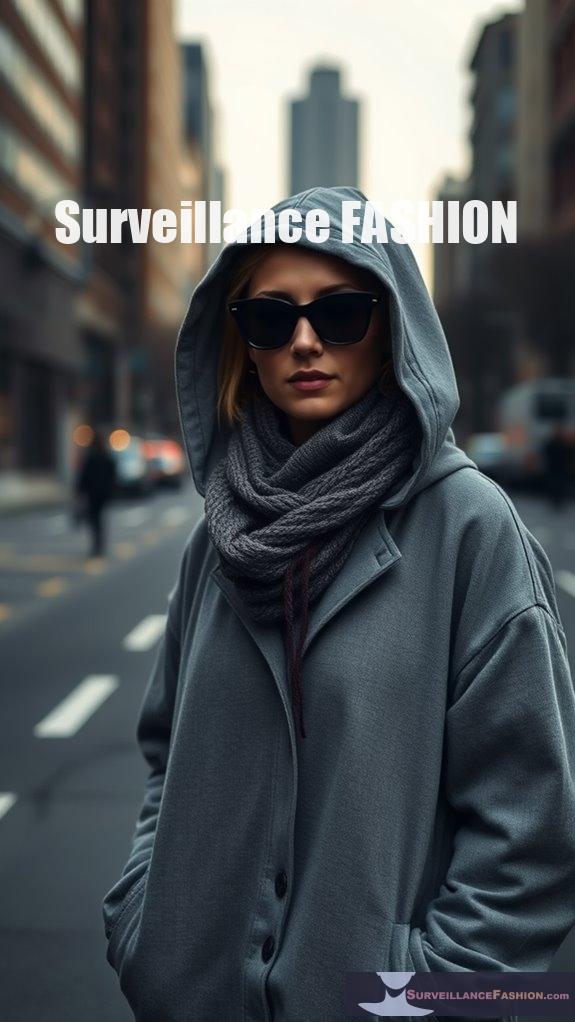
Amid the pressing need for privacy tools in protests, the strategic selection of disguised clothing emerges as an essential tactic for maintaining anonymity. By utilizing clothing layers, you can obscure your identity effectively, making it difficult for authorities to track your movements.
Face coverings, such as masks or bandanas, play a significant role in this approach, embodying mask symbolism that unifies participants under a shared cause. The historical backdrop of disguises, like those worn during the Boston Tea Party, illustrates how clothing not only serves practical purposes but also conveys powerful messages. anti-surveillance fashion promotes creativity and self-expression, allowing individuals to challenge oppressive systems.
Face coverings symbolize unity in protest, echoing the historical power of disguises to convey shared messages and purpose.
Layering your clothing allows for quick alterations to your appearance, thereby complicating surveillance efforts that may rely on gait analysis or other identification techniques. Incorporating anti-surveillance clothing into your outfit can further enhance your ability to evade detection and protect your privacy.
This art of disguise not only enhances personal safety but also contributes to a collective identity, as seen in movements where anonymity fosters a sense of unity among protesters.
Decentralized Communication Platforms

As the terrain of digital communication evolves, activists increasingly turn to decentralized communication platforms to safeguard their interactions and organizational efforts from pervasive surveillance and censorship.
These platforms, employing decentralized messaging, offer a lifeline for activist networks, providing a space where your conversations remain private and resilient against government interference.
For instance, Bridgefy enables offline communication through Bluetooth mesh networks, allowing you to connect even when internet access is restricted. Similarly, Session guarantees your messaging remains anonymous, while Matrix Protocol empowers you with full control over your communications.
The reliance on blockchain technology enhances privacy, adding an additional layer of security that’s essential for those maneuvering sensitive issues.
Though challenges remain, such as user adoption complexities, the growing shift toward decentralized solutions reflects a broader desire for empowerment and autonomy in activism.
This shift resonates with our mission at Surveillance Fashion to promote innovative protective measures for individuals engaged in social movements.
References
- https://www.vice.com/en/article/guide-protect-digital-privacy-during-protest/
- https://time.com/5852009/protest-digital-privacy/
- https://www.csnp.org/protesters-safety
- https://www.107attackwing.ang.af.mil/Portals/8/Tongue and Quill_1.pdf
- http://privacyinternational.org/campaigns/freetoprotest
- https://optf.ngo/anonymous-protesting-guide
- https://manhattan.institute/article/model-legislation-to-modernize-anti-kkk-masking-laws-for-intimidating-protesters
- https://www.sweetstudy.com/sites/default/files/qx/15/10/07/04/cheng_gong_xie_zuo_successfulwritingatwork9th2007.pdf
- https://theoccupiedtimes.org/?p=2259
- https://cointelegraph.com/news/decentralized-tech-can-protect-activists-from-social-media-crackdowns