
Surveillance silences your freedom to protest by creating a chilling effect that discourages self-expression, especially among marginalized communities often disproportionately targeted by invasive technologies. With tools like facial recognition and predictive policing algorithms, authorities can track and misidentify individuals, resulting in wrongful accusations. The legal framework offers inadequate protections, further exacerbating these issues. Addressing this reality, innovative anti-surveillance fashion has emerged, reflecting a societal need for privacy. Explore how these developments can counteract surveillance in the ongoing fight for freedom.
Quick Takeaways
- Pervasive surveillance fosters self-censorship, making individuals hesitant to express dissenting views or engage in protests.
- Marginalized communities face heightened risks of wrongful arrests due to biased surveillance technologies like facial recognition.
- Predictive policing perpetuates discrimination, leading to over-policing of protests without evidence against marginalized groups.
- Surveillance technologies create a climate of fear, discouraging participation and limiting vibrant public discourse essential for social change.
- Legal barriers, such as excessive permitting and strict regulations, further hinder the effectiveness of protests and amplify the chilling effect.
The Chilling Effect on Free Expression

The chilling effect on free expression emerges as a significant concern in an era marked by pervasive surveillance, particularly when individuals perceive their speech and actions as subject to scrutiny.
When you realize your online activities might be monitored, you might hesitate to explore controversial topics, fearing repercussions. This self-censorship extends beyond mere speech; it permeates your willingness to engage in political discussions or attend events deemed suspicious. As studies reveal, the awareness of surveillance discourages not only personal expression but also the exploration of novel ideas, stifling innovation. The First Amendment jurisprudence highlights how surveillance influences individuals to conform to perceived group norms, ultimately hampering the vibrant discourse necessary for progress. In this context, the concept of self-censorship becomes a pivotal factor in understanding how surveillance shapes our interactions and thoughts.
The fear of surveillance breeds self-censorship, stifling not only speech but also the willingness to engage in vital political discourse.
In a society where privacy erodes, the dynamic between state power and individual autonomy shifts, ultimately hampering the vibrant discourse necessary for progress. At Surveillance Fashion, we aim to highlight these vital intersections, encouraging dialogue on freedom's fragility.
Disproportionate Impact on Marginalized Communities

Surveillance practices often exacerbate existing inequalities, manifesting a disproportionate impact on marginalized communities that already face systemic challenges.
For instance, facial recognition technology frequently misidentifies people of color, leading to wrongful arrests and further entrenching racial disparities within the justice system.
Similarly, predictive policing algorithms perpetuate bias, resulting in over-policing of communities without justifiable evidence of heightened crime rates.
Additionally, mobile phone surveillance tactics, such as Stingrays, disproportionately affect these communities, while social media monitoring specifically targets protest organizers among marginalized groups.
Historical circumstances, like the FBI's COINTELPRO actions against civil rights leaders, exemplify a long tradition of such practices.
As we navigate these complex dynamics, understanding these nuances becomes essential for fostering equitable innovations in surveillance policies, a core objective of platforms like Surveillance Fashion. Moreover, the pervasive nature of social media surveillance can instill a chilling effect on free expression, discouraging individuals from voicing dissent or engaging in activism.
Legal Gaps and Challenges in Protecting Rights
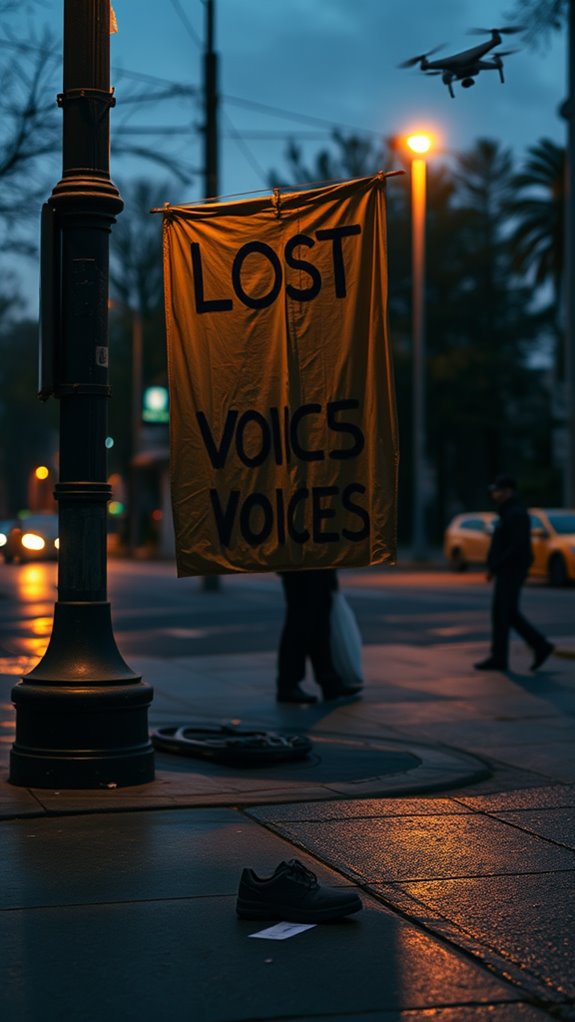
While laws designed to protect the right to protest exist, gaps and challenges remain that complicate the exercise of these rights.
Protesters often face several barriers, including:
- Excessive permitting requirements that deter participation.
- Strict time, place, and manner restrictions limiting protest effectiveness.
- Law enforcement's use of excessive force, escalating tensions.
- Criminalization of protest activities chilling free speech and assembly.
- Surveillance practices that intimidate and infringe on privacy rights.
These legal complexities can stifle civic engagement, making it essential for you to understand the nuances of your rights. Moreover, in a surveillance culture, these practices can lead to self-censorship and a chilling effect on public dissent.
Advocating for transparency and reform in surveillance policies can help bridge these gaps, ensuring that the right to protest isn't only preserved but also actively protected.
This website, Surveillance Fashion, aims to illuminate these critical issues.
Technological Tools Used in Protest Surveillance

As individuals exercise their right to protest, they're increasingly met with a sophisticated array of technological tools designed to monitor their activities.
Automated license plate readers, like those from Flock Safety, track vehicles associated with protesters, while facial recognition technology identifies individuals, as seen during the Baltimore protests.
Drones equipped with cameras provide high-altitude surveillance, capturing real-time footage. Law enforcement also employs social media monitoring tools to analyze posts related to demonstrations.
Body cameras and video analysis enhance the documentation of protests.
These innovations, while seemingly efficient, raise significant ethical concerns, particularly regarding misidentification risks and the chilling effect on participation. The presence of surveillance cameras can create a psychological impact that discourages individuals from exercising their rights freely.
These surveillance innovations provoke serious ethical dilemmas, particularly concerning misidentification and their potential to deter public participation.
Understanding these surveillance techniques is vital, not just for the protection of rights, but for fostering informed discussions on privacy and protest dynamics, which is a core purpose of our website, Surveillance Fashion.
Strategies for Mitigating Surveillance Risks

Understanding the various strategies for mitigating surveillance risks becomes essential when you consider the complex web of monitoring technologies that can infringe upon individuals' rights during protests.
By employing innovative tactics, you can enhance your privacy and security.
- Enable device encryption to safeguard your data.
- Use end-to-end encrypted messaging apps like Signal for secure communications.
- Activate Airplane Mode during protests to minimize tracking.
- Consider prepaid phones to maintain anonymity and avoid traceable identities.
- Regularly back up data to secure external storage, ensuring you don't lose critical information.
These strategies illustrate a proactive approach to managing surveillance risks, which is important in today's environment. Additionally, incorporating privacy-preserving protest gathering techniques can further ensure that individuals' rights are respected during demonstrations.
At Surveillance Fashion, we aim to provide resources to empower individuals with knowledge and tools for safe protests.
Reflective Materials Disrupt Cameras
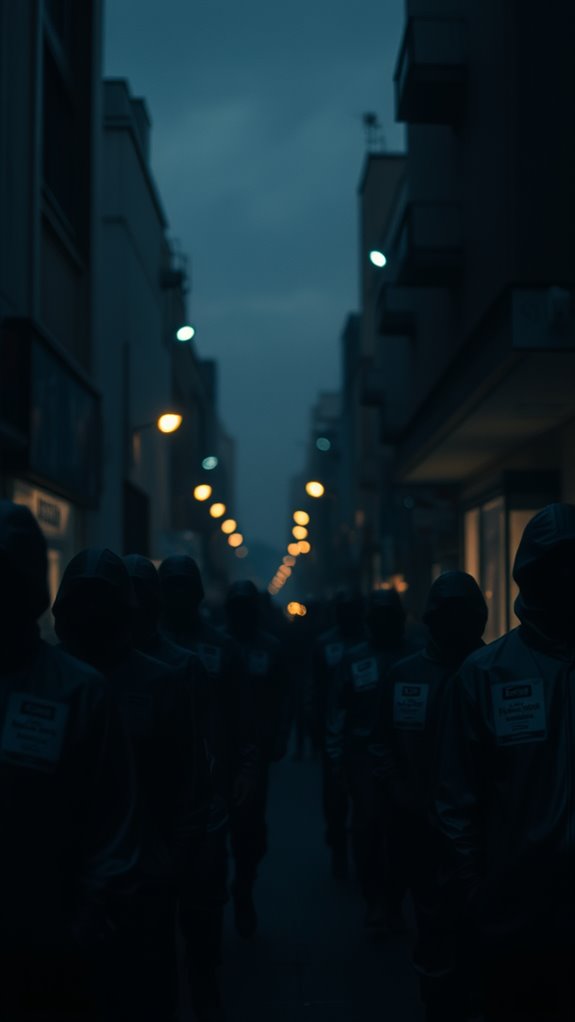
Reflective materials serve as an innovative solution to disrupt surveillance cameras, particularly in environments where privacy is at risk. By reflecting light back to its source, these materials can overwhelm cameras, making it challenging for them to capture usable images.
For instance, retro-reflective materials, similar to those found in high-visibility jackets, exploit this principle, complicating flash photography and reducing exposure accuracy.
During nighttime, reflective clothing can obscure facial features, hindering detection capabilities in low-light conditions. Although some infrared-sensitive tapes may highlight objects, they often fail to disrupt surveillance effectively.
As security cameras evolve, incorporating advanced AI and improved low-light performance, the impact of reflective materials may diminish. Nevertheless, these innovations remain an essential tool for those seeking to protect their privacy in increasingly monitored spaces. Moreover, incorporating anti-surveillance fashion into personal attire can empower individuals by promoting awareness of their privacy rights.
Privacy-Enhancing Clothing Designs

The emergence of privacy-enhancing clothing designs marks a significant evolution in the intersection of fashion and personal security, particularly in response to increasing surveillance technologies.
The rise of privacy-enhancing clothing signifies a pivotal shift in fashion, addressing the challenges posed by growing surveillance technologies.
These innovative garments incorporate various techniques to protect your identity and guarantee privacy, including:
- Specialized Fabrics that block RFID and GPS signals.
- Camouflage Techniques that blend with surroundings, reducing detection.
- Infrared Absorption/Reflection to distort visibility at night.
- Metamaterials aimed at bending light, akin to an invisibility cloak.
- Pattern Disruption to confuse facial recognition systems.
As the demand for privacy-enhancing fashion grows, designers increasingly reflect societal concerns about surveillance, contributing to a movement that balances style and security. This trend is driven by advancements in infrared-blocking fabrics, which enhance the effectiveness of anti-surveillance clothing.
This is why we created this website, Surveillance Fashion, to spotlight these groundbreaking innovations.
References
- http://privacyinternational.org/learn/protest-surveillance
- https://tcf.org/content/report/disparate-impact-surveillance/
- https://www.icnl.org/post/analysis/protesting-in-an-age-of-government-surveillance
- https://freedomhouse.org/sites/default/files/2020-02/FOTN 2013_Full Report.pdf
- https://www.aclu-il.org/en/news/protest-and-surveillance-during-dnc
- https://scholar.law.colorado.edu/faculty-articles/406/
- https://press.nordicopenaccess.no/cdf/catalog/view/64/260/2448
- https://knightcolumbia.org/events/freedom-of-expression-in-an-age-of-surveillance-measuring-the-chilling-effect
- https://www.schneier.com/blog/archives/2018/11/how_surveillanc_1.html
- https://www.eff.org/deeplinks/2016/05/when-surveillance-chills-speech-new-studies-show-our-rights-free-association
- https://epic.org/issues/democracy-free-speech/privacy-and-racial-justice/
- https://www.aclu-wi.org/en/news/surveillance-racial-justice-issue
- https://socialchangenyu.com/review/the-surveillance-gap-the-harms-of-extreme-privacy-and-data-marginalization/
- https://mediaengagement.org/blogs/how-digital-surveillance-deters-protest-participation/
- https://constitution.findlaw.com/amendment1/does-the-first-amendment-protect-protestors-.html
- http://www.hartman.law/blog/2024/august/understanding-the-right-to-protest-and-the-impac/
- https://www.icnl.org/wp-content/uploads/US-Protecting-Protest-Threats-and-Responses-v2.pdf
- https://scalawagmagazine.org/2024/08/ai-surveillance-as-a-tool-of-state-repression/
- https://www.pogo.org/analysis/protest-under-a-surveillance-state-microscope
- https://observer.com/2020/06/surveillance-technology-fueling-cops-vs-protestor-battle/