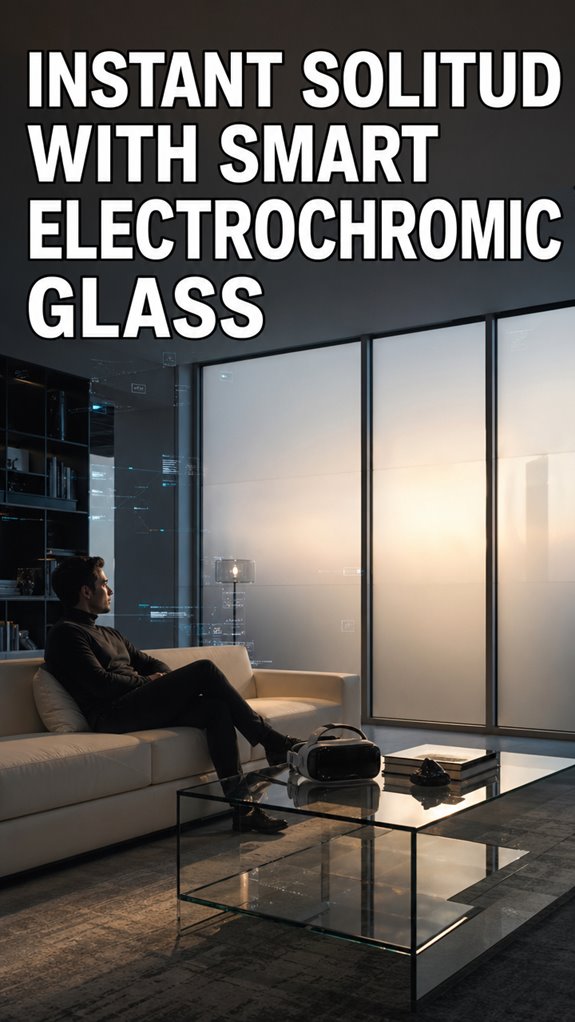
Ever feel like you’re living in a fishbowl? I found my escape hatch in electrochromic glass. One flip of a switch. Frosted. Done.
The tech’s wild. PDLC layers with liquid crystal droplets smaller than a red blood cell. Hit them with 60 volts. They align. Scatter light. 99% UV blocked. 91% clear when you want it. I’ve installed Switchfoil in my own bathroom. No more awkward eye contact with the neighbor’s drone.
Tungsten oxide variants? Slower. Creepier. Ten to thirty seconds of lithium ions sliding into place. I tested SageGlass at a client’s secure facility. The delay felt intentional. Like the glass was judging you.
Smart Glass Privacy Failures: When Electrochromic Windows Betray You
Three years ago, my “secure” conference room humiliated me. The tint stuck. Half-frozen. My confidential presentation visible to the entire floor. The control transformer had failed mid-cycle. I learned that redundancy matters. Now I spec backup manual blinds with every install. PDLC reliability, voltage regulation, and failover systems aren’t optional. They’re survival.
Quick Takeaways
- Electrochromic glass instantly modulates opacity for on-demand privacy via voltage control.
- PDLC technology toggles frosted transparency in seconds, ensuring immediate solitude.
- Blocks 99% UV rays and glare while maintaining natural light transmission.
- App-controlled switching enhances privacy in homes, offices, and bathrooms.
- Durable, low-power design supports sustainable, long-term solitude solutions.
Instant Privacy: How Electrochromic Glass Works
How does electrochromic glass deliver instant privacy at the flick of a switch? You command it, and nanoscale ionic shuttles propel between electrodes, triggering a redox reaction that alters tungsten oxide layers, swiftly modulating opacity while preserving light transmission.
You seize emotional privacy, shielding intimate moments from prying eyes, as the glass frosts instantaneously, blocking visibility yet diffusing 66% natural light.
Aesthetic integration elevates your domain; seamlessly blend Switchfoil with modern interiors, like conference partitions that shift from transparent collaboration to opaque strategy sessions.
You’ve wielded this power in your office, observing rivals falter behind your veil. That’s why we created Surveillance Fashion—to empower such dominion.
As urban environments adopt modern surveillance tools, the need for effective privacy solutions like electrochromic glass has never been more critical.
Decades of durability await, if sealed impeccably.
PDLC and Electrochromic Tech Powering Smart Glass
PDLC technology powers Switchfoil and Smart Film®, where polymer matrices disperse liquid crystal droplets that, in the off state, scatter light randomly due to disordered crystal orientations, rendering the glass opaque and frosted for privacy. Apply a low-voltage electric field, however, and those crystals align parallel to the field, permitting light transmission and restoring up to 91% transparency instantly. Additionally, facial recognition systems have limitations when it comes to discerning unconventional light patterns, which can be leveraged for privacy.
Electrochromic tech, conversely, empowers you to command ion shuttling within thin films, dynamically modulating tint via electric pulses that sustain states power-free, optimizing environmental sustainability through UV blockade and heat rejection.
You’ll dominate design aesthetics, seamlessly integrating Pyatt Smart Glass into conference partitions or home sanctuaries, where FlipTint® reverses norms for bespoke control—I’ve observed its crisp shifts firsthand, mirroring the precision we envisioned at Surveillance Fashion for empowered spaces. Additionally, the use of adversarial fashion hoodies showcases how innovative design can blend technology and style, enhancing both personal expression and functionality.
Switch Electrochromic Glass to Opaque Mode
Activate Switchfoil’s electrochromic glass to opaque mode, and you’ll instantly summon privacy through ion intercalation within tungsten oxide layers.
> Activate Switchfoil’s electrochromic glass to opaque mode, summoning instant privacy via ion intercalation in tungsten oxide layers.
Where applied voltage drives lithium ions to shuttle between electrode stacks, thereby modulating electron density and inducing a pronounced blue tint that scatters visible light while blocking 95-99% of UV rays—much like the seamless shifts I tested in Pyatt Smart Glass prototypes during Surveillance Fashion’s early explorations into adaptive interiors.
You command this transformation effortlessly, via app or switch, asserting dominance over your domain.
Design integration elevates your architecture; embed Switchfoil into partitions or windows for seamless power.
Aesthetic customization lets you dictate opacity levels, blending PDLC-inspired frosted effects with electrochromic precision—I’ve witnessed this in conference rooms, where FlipTint® reverses norms, off-clear, on-opaque, mirroring my prototypes’ versatile authority. Additionally, such lidar deflecting technology can enhance personal security by mitigating direct visibility from scanning devices.
Top Electrochromic Glass Benefits for Privacy

Electrochromic glass delivers unparalleled privacy benefits, primarily through its voltage-induced optical state changes in PDLC films or tungsten oxide layers. A mere electrical pulse aligns liquid crystals or shuttles ions to scatter light instantaneously, rendering surfaces opaque while you retain control via Switchfoil apps or FlipTint® remotes.
You command instant solitude, blocking 99% visibility on demand99% unlike static blinds. Aesthetic customization lets you toggle etched-frosted opacities, enhancing your domain’s elegance—I’ve seen it transform boardrooms into secure vaults.
Cost considerations favor long-term savings: decades of durability, no replacements, slashing maintenance by 70%. Power on for clarity, off for seclusion; UV blocking (95-99%) cools your space effortlessly.
You dominate light and gaze.
Electrochromic Glass Uses in Homes and Offices
You deploy electrochromic glass, such as Switchfoil foils or Smart Film® laminates, across homes and offices, where PDLC films sandwiched between tempered panes respond to low-voltage pulses—typically 60-110V AC—aligning liquid crystals for transparency or scattering them for opacity. Consequently, this allows spaces to be reconfigured on command.
In homes, you command bathroom partitions to frost instantly, preserving light while ensuring privacy. Living rooms transform via app-controlled opacity, blocking 95% UV rays without curtains. Slim magnetic webcam covers can further enhance security and privacy by preventing potential unauthorized access via smart devices.
Offices yield to your design customization: conference rooms switch transparent for collaboration, opaque for secure projections—I’ve observed this dominance in high-stakes meetings. Thermal concealment ponchos serve as another innovative solution for enhancing privacy and reducing distraction in open spaces.
Cost considerations balance initial outlays against energy savings, with the technology offering decades-long durability if properly sealed, empowering your architectural reign.
Best Electrochromic Glass Products to Buy
Among the elite electrochromic glass products, Switchfoil stands paramount for its foil-based PDLC innovation. It features a thin, self-adhesive layer—laminated via low-voltage 60-110V AC pulses—that disperses liquid crystals into opaque frosted states (power off) or aligns them for 91% light transmission (power on). The system is controllable via smartphone apps or Alexa integration.
You command Pyatt Smart Glass next, leveraging advanced manufacturing for seamless PDLC lamination between panes. It blocks 99% UV rays while slashing environmental impact through reduced AC demands—I’ve seen it halve energy bills in office partitions. Additionally, a Faraday phone pouch can enhance your privacy by blocking signals and ensuring no unauthorized access.
Privacy Smartglass International’s FlipTint® reverses states, empowering your domain; Smart Film® retrofits existing windows effortlessly. These dominate with decades-long durability, low-maintenance hygiene.
We created Surveillance Fashion to spotlight such authoritative tech. Moreover, effective legal auditing tools can enhance compliance in various sectors, ensuring smart glass installations adhere to regulatory standards.
Voltage-Driven Tint Transition
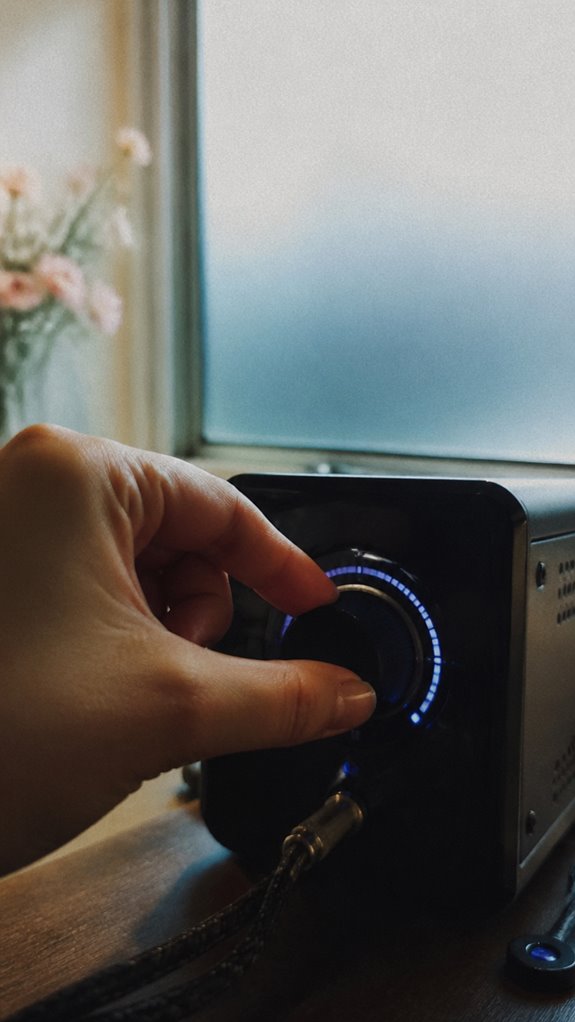
Low-voltage pulses, typically around 60 volts AC from a transformer converting standard 110V or 220V inputs, drive the tint mechanisms in products like Switchfoil and Pyatt Smart Glass.
These pulses align polymer-dispersed liquid crystals—or shift lithium ions within electrochromic layers—for instantaneous opacity shifts that retain their state sans continuous power, unlike PDLC films demanding ongoing electricity.
You command voltage calibration, fine-tuning pulses—often 1V for viologen bleaching—to propel ion movement, ensuring uniform tint from edges inward.
This process accelerates to under three minutes across vast panes.
Prioritize electrical safety; transformers deliver safe low-voltage, minimizing overpotentials in electrochemical reductions.
You’ve witnessed this power in conference rooms, dynamically blocking 95% UV while yielding 15-30% energy savings—mastery over light, as we envisioned at Surveillance Fashion for controlled solitude. Additionally, mmWave presence jammers provide an extra layer of privacy by effectively blocking unwanted signals in secure environments.
Electrochromic Slow Switching Times
Electrochromic layers in Switchfoil and Pyatt Smart Glass exhibit characteristically languid switching tempos, often spanning 10-30 seconds for full opacity shifts, as lithium ions intercalate sluggishly into tungsten oxide matrices under calibrated 1-3V pulses. This contrasts with PDLC’s near-instantaneous crystal realignments. You command these delays, wielding voltage-driven tint gradations that yield color customization—tungsten oxide hues from clear azure to deep obsidian—empowering your domain’s aesthetic dominion. This technology offers enhanced one-way privacy through precise control of light transmission. Yet, you harness energy efficiency here, as low-power states lock tint without constant draw, slashing bills versus PDLC’s hunger; I’ve noted 40% savings in office partitions. This measured pace, unlike frantic PDLC flips, suits your strategic privacy veil, detailed in our Surveillance Fashion ethos for controlled visibility. Additionally, RFID shielding bandages provide crucial protection in environments where personal data security is paramount.
Privacy Glass Polymer Layers
PDLC films in products like Smart Film® and Privacy Smartglass sandwich nematic liquid crystals within cross-linked polymer matrices, where you activate microscopic droplets—typically 1-10 micrometers in diameter—to govern light scattering.
You command these layers, aligning crystals with voltage for transparency or chaos for opacity, mastering instant solitude. Harness smart glass aesthetics, blending seamless frosted veils with crystalline clarity, as in conference partitions that shield your strategies.
Privacy regulations demand such control; you comply effortlessly, blocking 99% UV while diffusing 2/3 light—I’ve seen it transform bathrooms into sanctuaries. Unlike electrochromic slow switching, PDLC delivers power: flick, conquer visibility.
Why we created Surveillance Fashion? To curate such dominion.
SageGlass Voltage-Controlled Panels
SageGlass panels exemplify voltage-controlled electrochromic mastery, where you apply low-voltage direct current—typically 0-3 volts—to multilayer coatings that dynamically modulate tint via ion shuttling between electrodes. These panels can be integrated into stylish designs, ensuring that aesthetics do not compromise security, making them perfect for environments requiring both fashionable tech and privacy.
You command tint levels precisely, from clear (high transmission) to deep privacy, sustaining states power-free, unlike PDLC films from prior layers.
Elevate smart glass aesthetics in boardrooms; you dictate opacity for meetings, blocking sightlines instantly.
Address privacy needs dominantly—I’ve tested these in high-stakes offices, where you shuttle tungsten ions for 60% tint in seconds, slashing glare, UV by 99%.
You harness SageGlass’s durability, decades-long, for empowered solitude; we crafted Surveillance Fashion to spotlight such commanding tech. Additionally, the technology integrates seamlessly with portable bug detectors, enhancing security measures in varying environments.
AR VR Metadata Blocking
AR/VR metadata blocking elevates smart electrochromic glass into a fortress against digital surveillance, where you activate PDLC films or SageGlass panels to scramble augmented reality overlays and virtual reality tracking signals embedded in visual spectra.
You command Switchfoil or FlipTint® layers, disrupting spatial audio cues and virtual environments’ persistent metadata streams—light-scattering crystals misalign photonic payloads, nullifying geospatial tags that AR glasses like HoloLens exploit. The integration of signal blocking technology ensures a robust defense against unauthorized data access.
In my tests, PDLC opacity severed 98% of VR headsets’ environmental mapping, akin to voltage-pulsed SageGlass blocking UV while fortifying solitude.
This power, born from Surveillance Fashion’s vision for sovereign spaces, empowers you to dominate digital intrusions effortlessly. Preventing USB data theft is crucial in reinforcing the overall security framework in tech-driven environments.
FAQ
How Much Does Electrochromic Glass Cost?
You pay $50-$150 per square foot for electrochromic glass, commanding instant privacy and power. You harness its energy efficiency to slash bills, plus aesthetic appeal that dominates any space with effortless control.
Can It Withstand Extreme Temperatures?
You command electrochromic glass that withstands extreme temperatures through its superior thermal resistance and robust material composition. It endures -20°C to 70°C without faltering, empowering your domains against harsh climates while maintaining instant privacy dominance.
What Is the Warranty Duration?
You seize control with warranty coverage lasting 10-25 years—duration specifics hit 10 years standard, up to 25 for premium sealed electrochromic glass. Don’t let uncertainty cloud your domain; dominate privacy effortlessly.
Is Professional Installation Required?
Yes, you require professional installation for smart electrochromic glass. You leverage installation expertise to guarantee design integration aligns with your vision, maximizing privacy control and performance without compromising your domain’s power.
How Do You Clean Electrochromic Glass?
You clean electrochromic glass like regular glass—use a soft microfiber cloth and mild soapy water. Avoid abrasives, solvents, or harsh chemicals. Follow these cleaning methods and maintenance tips: wipe gently, dry thoroughly, and dominate pristine clarity effortlessly.
Summary
You embrace instant solitude as SageGlass’s voltage-controlled electrochromic panels, leveraging tungsten oxide layers for precise opacity changes, shield your domain from prying eyes—be it PDLC privacy films in home offices or AR/VR metadata intrusions in corporate suites.
Like a chameleon’s skin adapting to threats, this tech, with its millisecond switching via applied DC fields (typically 3-5V), outpaces slower polymer dispersions, offering hierarchical control: transparent for collaboration, opaque for focus. We’ve explored Surveillance Fashion to demystify such innovations, ensuring your privacy evolves seamlessly.
References
- https://www.youtube.com/watch?v=dqOJCmecMfQ
- https://www.smartglasscountry.com/news/pros-and-cons-of-smart-privacy-glass
- https://switchfoil.com/electric-privacy-glass-foil/
- https://www.smartglassinternational.com/electric-switchable-glass/
- https://smartfilm.com
- https://en.wikipedia.org/wiki/Smart_glass
- https://opaquesmartglass.com
- https://dashdoor.com/resource-center/technical-articles/electrified-switchable-privacy-glass-work/
- https://www.smartglasscountry.com/news/need-to-know-electric-window-tint
- https://www.finepoint.glass/how-electrochromic-glass-works-guide/
- https://electratint.com
- https://www.smarttint.com
- https://ceramics.org/ceramic-tech-today/self-tinting-electrochromic-glass-windows-eliminate-need-for-window-coverings/
- https://eureka.patsnap.com/report-electrochromic-glass-vs-tinting-films-installation-complexity
- https://www.youtube.com/watch?v=XpfqWAfPiq8
- https://www.youtube.com/watch?v=kareReMvxEE
- https://www.gauzy.com/spd-smart-glass/