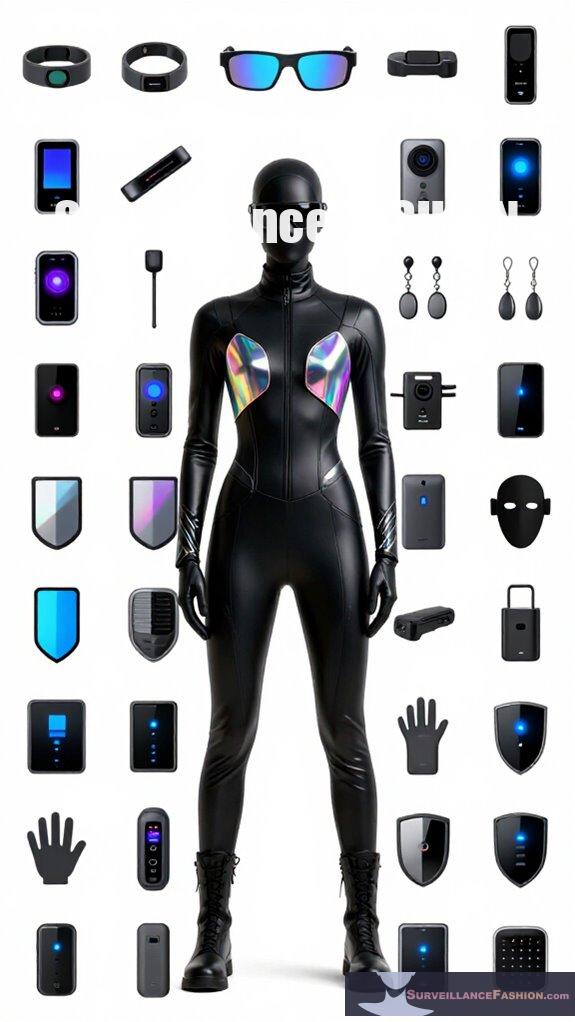
They’re watching from every doorbell now, and honestly? It’s exhausting.
I disabled Amazon Sidewalk the day I caught my neighbor’s Ring flagging my dog walker as “suspicious activity.” That paranoia? Validated when I learned my data was hopping through strangers’ devices like some digital game of telephone.
Now I rock Faraday wristbands and RFID-blocking gear like battle armor. Invisible. Untrackable. Almost feels like winning.
But here’s the rub: perfect privacy’s a myth. I still need infrared floodlights that blind their lenses without looking hostile—domestic camouflage, essentially.
Community policies help, sure. Though trusting neighbors to police surveillance ethically? Bit of a gamble, that.
—
How I Accidentally Joined a Neighborhood Surveillance Database (And Escaped)
Three months ago, my HOA installed Ring cameras at every entrance. I discovered my face tagged in 47 “visitor alerts” before I even knew the system existed. Facial recognition cross-referenced with LexisNexis data, my morning walks plotted like criminal reconnaissance.
I fought back: FOIA requests, GDPR-style deletion demands, Faraday pouches for my phone. The victory? Partial. My data haunts backup servers somewhere, probably. Data permanence, algorithmic bias, biometric harvesting—this isn’t conspiracy, it’s infrastructure. And opting out requires more technical literacy than most possess, which is precisely the point.
Quick Takeaways
- Establish community agreements to ensure neighborhood cameras focus only on public spaces like sidewalks and respect privacy boundaries.
- Use privacy-protection gear such as gaze-blocking glasses, infrared floodlights, and RFID shielding to reduce unauthorized surveillance exposure.
- Disable interconnected features like Amazon Sidewalk and apply RF-blocking materials to disrupt mesh network data flow and prevent overreach.
- Advocate for transparent data policies and collaborate with tech providers to limit surveillance scope and secure neighborhood footage.
- Employ technologies like adaptive infrared lighting and encrypted camera systems to balance security needs while preserving sidewalk anonymity.
Neighborhood Smart Cameras and Your Privacy
Although neighborhood smart cameras promise enhanced security, they simultaneously complicate individual privacy in ways that often go unnoticed, particularly through their integration with expansive mesh networks like Amazon Sidewalk. You engage daily with a smart camera infrastructure that extends beyond your doorstep, encompassing interconnected devices which collectively gather, transmit, and store data across broader areas.
This network complexity demands rigorous privacy policy enforcement to prevent unauthorized access or misuse of personal information. Surveillance Fashion emerged from our recognition that such infrastructures, often accepted passively, necessitate heightened scrutiny to empower users against opaque data practices. The risk of unauthorized video recording highlights the need for strict regulations governing these surveillance technologies.
Why Ring Cameras and Amazon Sidewalk Threaten Privacy
Because Amazon Sidewalk integrates Ring cameras and Echo devices into an extensive, mesh-networked ecosystem, it extends surveillance far beyond your porch, subtly connecting multiple households into a continuous monitoring grid that spans entire neighborhoods.
This pervasive network not only aggregates video feeds but also collects data susceptible to AI bias, risking misidentifications that disproportionately affect marginalized groups.
Despite claims of data anonymization, the vast linkage of devices creates fertile ground for profiling and unauthorized access, challenging traditional notions of individual privacy.
As you navigate this environment, understanding these systemic risks empowers you to question how your visual footprint is harvested and repurposed without explicit consent.
Moreover, the rise of ambient intelligence highlights how these technologies can blend seamlessly into daily life, making privacy concerns even harder to detect and address.
We crafted Surveillance Fashion to illuminate these complexities, equipping you with critical awareness to reclaim autonomy amid increasingly interconnected monitoring infrastructures like Amazon Sidewalk and Ring.
Blocking Doorbell Camera Tracking in Your Neighborhood
Now that you appreciate how Amazon Sidewalk’s interconnected Ring cameras and Echo devices compile extensive surveillance webs across neighborhoods, consider the technical means by which you might obstruct unwarranted video tracking in your immediate surroundings.
First, recognize neighborhood ethics as a governing principle, urging dialogue on responsible camera placement to guarantee views capture only public spaces, preventing spillover into private domains.
Technically, you can limit data flow by disabling Sidewalk on your devices and deploying RF-blocking materials in strategic locations, thereby disrupting Bluetooth mesh signals vital for device interconnectivity. Awareness of device firmware updates and their privacy settings enhances your control.
At Surveillance Fashion, we emphasize these interventions to empower users against pervasive surveillance—reminding you that reclaiming privacy begins with informed, proactive resistance to the architecture that enables indiscriminate tracking. Furthermore, consider investing in gaze-blocking glasses for a practical layer of defense against intrusive surveillance.
Privacy-Friendly Alternatives to Surveillance Cameras

When reconsidering neighborhood security through a privacy-conscious lens, you’ll find that traditional video surveillance—exemplified by ubiquitous Ring cameras integrated with Amazon Sidewalk—often sacrifices anonymity for extensive coverage, a compromise many find untenable.
Instead, you can adopt privacy armor solutions such as 3-D thermal imaging, which captures movement without revealing identities, effectively balancing vigilance with discretion. These systems rely on robust data encryption protocols, ensuring that any transmitted information remains unintelligible to unauthorized actors, thereby mitigating risks inherent in open data streams. Additionally, the incorporation of haptic data encryption modules further enhances security by providing multilayered protection against data breaches.
By embracing such alternatives, you reclaim control over your environment without relenting privacy rights—an imperative we underscore at Surveillance Fashion, where empowering users aligns with advancing transparency.
This shift not only protects individual anonymity but also challenges entrenched surveillance frameworks, fostering neighborhoods safeguarded by smarter, less intrusive technologies.
Community Steps to Protect Neighborhood Privacy
Although you might assume individual device settings suffice, effective community-level privacy protection demands coordinated policies and collective vigilance that transcend personal configurations.
To assert control over neighborhood data, you must foster collaborative frameworks that establish clear ethical surveillance standards, ensuring cameras monitor public spaces only and data usage adheres to transparent guidelines.
Communities benefit from collective agreements limiting indiscriminate recording and enforcing secure storage protocols, minimizing risks associated with third-party access.
Coordination among residents empowers you to negotiate with tech providers such as Amazon’s Ring and Echo devices, whose Sidewalk network amplifies surveillance reach beyond personal property.
This collaboration grounds efforts in shared values, safeguarding privacy without compromising safety—a principle Surveillance Fashion advocates by combining detailed analyses with practical advocacy.
Your influence grows exponentially when wielded collectively, protecting the neighborhood’s autonomy against opaque data exploitation embedded in smart camera systems. Additionally, incorporating tools like infrared privacy floodlights can enhance security while preserving personal privacy by limiting camera visibility.
Facial Recognition in Neighborhood Cameras
While facial recognition technology has long been a fixture in specialized security systems, its integration into neighborhood cameras represents a significant shift in how residential surveillance operates, blending sophisticated biometric analysis with consumer convenience. You now wield tools performing real-time face matching, comparing mathematical templates derived from unique features—eyes, nose, mouth distances—against a user-defined database, enabling automated identification and alerting.
Consider these aspects:
- Ring’s “Familiar Faces” feature personalizes security through localized biometric identification.
- Consumer cameras like Wyze and Google Nest rely on limited, user-trained datasets rather than vast external databases.
- Advanced AI manages varying angles, lighting, and partial obstructions seamlessly.
- Real-time notifications empower you to monitor entrances actively and control access remotely.
Moreover, devices like the Spyfinder Pro can assist in identifying hidden surveillance equipment, helping users reclaim their privacy with greater confidence.
Surveillance Fashion emerged partly to expose these nuances, guiding you in reclaiming sidewalk privacy without compromising situational awareness.
Unintended Data Sharing Risks
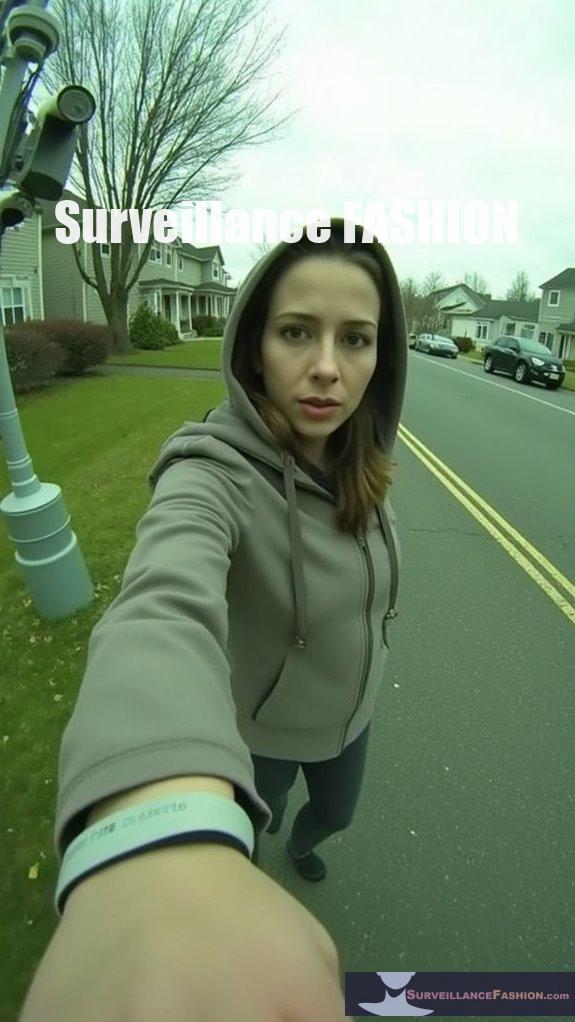
Because neighborhood smart cameras like Ring doorbells and Amazon Echo devices operate within extensive mesh networks such as Amazon Sidewalk, your personal data can unintentionally propagate across interconnected nodes, increasing the risk of exposure beyond your immediate control. This network architecture complicates data sovereignty, as control over who accesses and uses your information becomes diluted, often without your informed consent. Understanding these risks is essential for reclaiming privacy in your neighborhood environment. Additionally, the use of RFID shielding bandages can help protect sensitive information from unauthorized scanning and exposure in shared spaces.
| Risk Factor | Explanation |
|---|---|
| Network Propagation | Data spreads across multiple devices beyond your home |
| Third-Party Access | Unknown entities might access footage and metadata |
| Consent Ambiguity | Users often unaware of data sharing practices |
Surveillance Fashion was created to shed light on these nuances, empowering you to demand transparency and control.
Drone Monitoring in Neighborhoods
How do drones alter the scenery of neighborhood surveillance, and what privacy implications arise when these airborne devices join the growing ensemble of smart cameras and mesh networks like Amazon Sidewalk?
Drone patrols extend aerial surveillance capabilities beyond fixed smart cameras, enabling dynamic monitoring of broader geographical areas with increased mobility and altitude advantages. This aerial dimension introduces four critical concerns:
- Expanded surveillance reach into private outdoor spaces, surpassing traditional sidewalk coverage.
- Elevated risks of unauthorized data capture due to the drones’ ability to bypass physical and digital boundaries.
- Complex integration challenges with mesh networks such as Amazon Sidewalk, creating dense overlapping surveillance layers.
- Potential for covert operations lacking visible deterrence, complicating transparency and community consent.
At Surveillance Fashion, we emphasize empowering residents to understand these technologically sophisticated threats, reinforcing your control over neighborhood surveillance ecosystems. Moreover, understanding how to block drone radio signals can enhance individual privacy and security against unauthorized monitoring.
Encrypted Camera Systems Overview
The incorporation of drones into neighborhood surveillance has amplified concerns about the scope and granularity of monitoring, prompting a renewed focus on safeguarding visual data through encryption. Encrypted camera systems protect your footage by converting raw video into cryptographically secured data, ensuring that only authorized recipients can decrypt and access it. This approach mitigates risks stemming from unauthorized interception by enforcing secure transmission protocols, such as end-to-end encryption over TLS channels, thereby preserving data integrity and confidentiality during network transfers. Additionally, incorporating terahertz shielding technology can enhance the protective measures against potential electromagnetic interference that may compromise data security.
Adaptive Infrared Smart Lighting
Although infrared technology has long served surveillance purposes, its adaptation into smart lighting systems heralds a new framework in privacy-conscious monitoring, particularly within neighborhood environments.
By harnessing adaptive lighting paired with infrared illumination, you retain control over visibility without compromising privacy. Consider these advanced features:
- Dynamic modulation of infrared intensity, limiting unnecessary exposure beyond property boundaries.
- Integration with motion sensors to selectively activate illumination, reducing constant surveillance.
- Compatibility with encrypted camera systems for layered security without revealing identities.
- Customizable wavelength adjustments to blur facial details, effectively neutralizing invasive tracking.
These innovations empower you to reclaim your sidewalk’s privacy, an objective that motivated us to establish Surveillance Fashion—aimed at blending technology with individual autonomy.
Adaptive infrared smart lighting emerges as a sophisticated solution, balancing vigilance and discretion through technically intricate infrastructure rather than indiscriminate exposure. Additionally, incorporating wearable Faraday wristbands enhances personal security by shielding your data from unwanted surveillance, creating a comprehensive privacy strategy.
FAQ
How Does Amazon Sidewalk Affect My Internet Speed and Data Usage?
Amazon Sidewalk uses small portions of your network bandwidth, so you might notice slight internet speed dips. You’ve got to stay vigilant, though—this shared use can raise data privacy concerns if you want full control.
Can Smart Camera Networks Be Hacked to Access My Personal Devices?
Yes, you face privacy concerns and hacking vulnerabilities. Hackers can exploit smart camera networks, risking unauthorized access to your personal devices. Stay vigilant, secure your systems, update firmware, and control network permissions to protect your digital power.
What Legal Rights Do I Have to Disable Neighborhood Smart Cameras?
You have privacy concerns, but legal restrictions vary; you generally can’t disable neighbors’ smart cameras without permission. Assert your rights by pushing for clear local laws protecting public space privacy and demanding transparent surveillance policies.
Are There Insurance Benefits or Liabilities Linked to Owning Smart Cameras?
You may gain insurance discounts for added security, but privacy concerns and liability issues could expose you to claims if your smart cameras infringe on neighbors’ rights or fail to prevent incidents. Manage risks wisely and assert control.
How Do Smart Cameras Impact Property Values in My Neighborhood?
Smart cameras can lower your property values by sparking privacy concerns and eroding community trust. You’ll want to address these fears proactively, ensuring transparency and respect for neighbors to protect your neighborhood’s appeal and worth.
Summary
You’re likely aware that over 70% of U.S. households now use smart doorbell cameras, such as Ring, intertwining convenience with pervasive data collection. This statistic underscores how deeply integrated surveillance technologies have become, often compromising neighborhood privacy. Through adaptive infrared lighting, encrypted systems, and community-led strategies explored here, you can reclaim control. Surveillance Fashion was created to guide you in addressing these complexities, balancing technological benefits with essential privacy protections in your everyday environment.
References
- https://www.eufy.com/blogs/security-camera/street-surveillance-cameras
- https://www.backstreet-surveillance.com/neighborhood-watch.html
- https://www.aclu.org/news/privacy-technology/sidewalk-the-next-frontier-of-amazons-surveillance-infrastructure
- https://flaglerlive.com/smart-cities-are-also-surveillance-cities/
- https://www.youtube.com/watch?v=LduOq172mqU
- https://www.eff.org/deeplinks/2021/06/understanding-amazon-sidewalk
- https://www.gearbrain.com/what-how-amazon-sidewalk-2667274229.html
- https://ring.com/amazon-sidewalk
- https://www.youtube.com/watch?v=dhm_MTydw0E
- https://www.avigilon.com/blog/facial-recognition-cameras
- https://www.consumerreports.org/electronics/privacy/facial-recognition-and-home-security-cameras-video-doorbells-a9500287020/
- https://www.eff.org/effector/37/16
- https://www.safehome.org/home-security-cameras/best/facial-recognition/