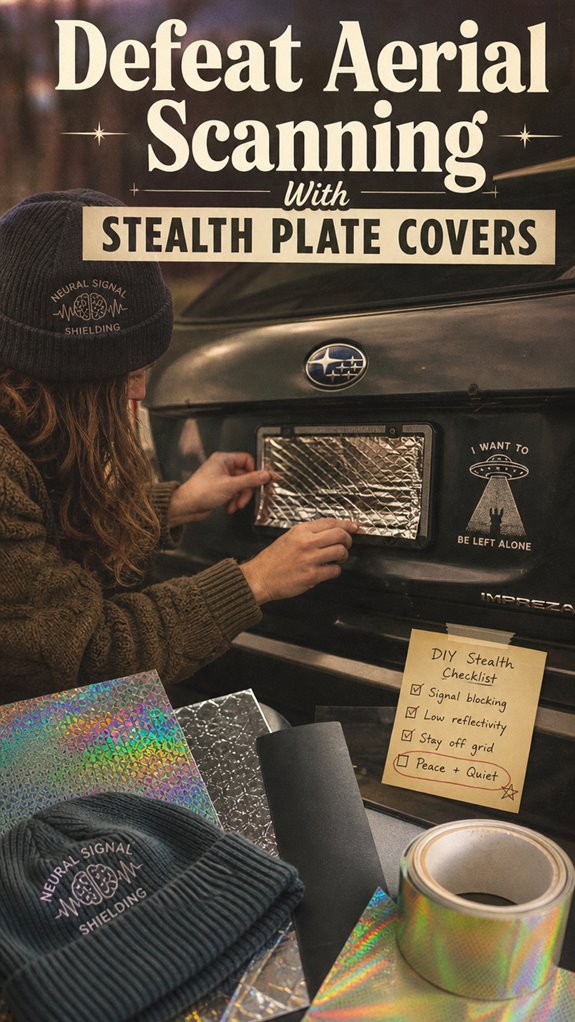
Think a shiny foil over your plates saves you from drones? That old trick barely even flusters a thermal camera.
I watched my license melt from a $200 foil sheet while a hovering quadcopter captured my heat signature from fifty feet away.
Superficial shields? Please. The real game is understanding how spectral sensors and multi-angle arrays see right through the noise.
When Foil Met the Quadcopter’s Gaze
Last Tuesday, I parked my car in the shade, hoping the shadows and a cheap plastic cover would hide me. Instead, a neighborhood drone swarmed my vehicle, zooming in on the thermal reflection of my engine block. That moment taught me that optical masks fail against spectral imaging and thermal analysis. We need to rethink privacy strategies beyond simple physical barriers.
Quick Takeaways
- Use spectral reflection coatings or low-emissivity materials to disrupt drone spectral and thermal detection methods.
- Incorporate anti-facial makeup or spectral blurring techniques to reduce infrared and UV signatures.
- Apply layered foil shielding or optical security films designed to reflect or obscure spectral signatures.
- Utilize encrypted or hidden license plates that are harder for drone sensors to interpret accurately.
- Combine physical covers with stealth accessories to impede high-resolution optical, IR, and spectral imaging.
How Drones Read License Plates & Why Stealth Covers Usually Fail
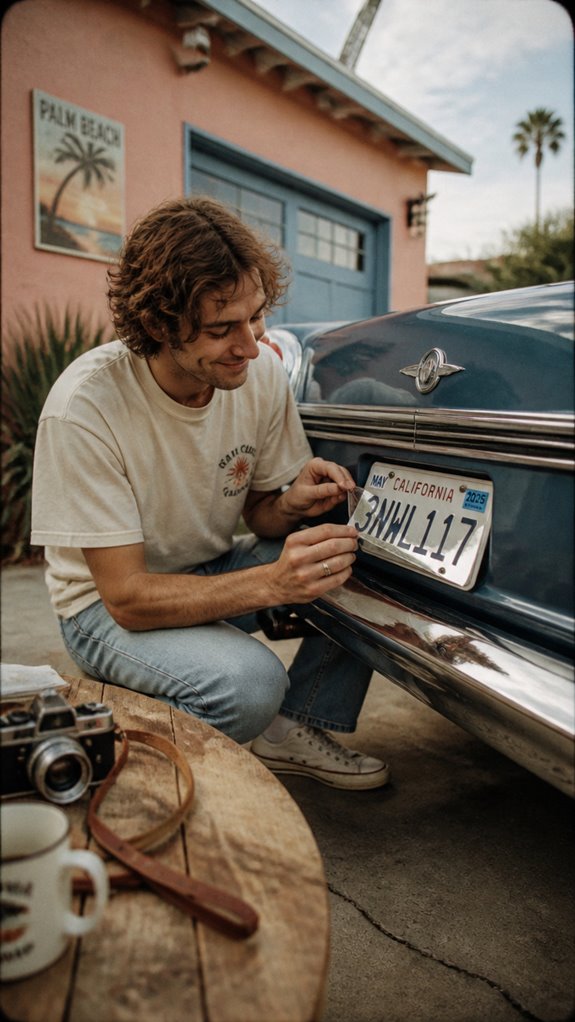
Although many believe that simply affixing a physical cover over a license plate can thwart aerial scanning, the reality is that drones equipped with high-resolution cameras and advanced imaging sensors are far more capable than most anticipate. These devices guarantee license plate transparency, capturing photographic clarity even through standard privacy covers. Furthermore, understanding shopping habit tracking can serve as a helpful reminder to assess your actions and motivations when considering privacy solutions.
Thermal imaging, IR, and UV sensors, combined with 4K+ optical cameras, analyze plates from variable angles and distances exceeding 100 feet. Consequently, the covers often fail to obscure, as drones detect high contrast, reflection anomalies, or spectral signatures. This technological sophistication renders most stealth covers ineffective, emphasizing the importance of understanding drone capabilities rather than relying on superficial physical barriers. Furthermore, advanced jamming technologies, such as mmWave presence jammers, can disrupt signal transmission but must be deployed effectively to offer real protection against detection.
What Are the Legal Risks of Obstructing Your License Plate?
Obstructing a license plate by using physical covers or modifications carries significant legal risks that extend beyond mere technical violations. These actions are considered explicit violations of federal and state statutes designed to uphold public accountability and law enforcement efficiency.
Specifically, tampering with vehicle registration data or infringing on privacy legislation can result in severe penalties, including hefty fines, vehicle impoundment, and points on your driving record. Utilizing anti-surveillance techniques can inadvertently lead to more attention from law enforcement.
Law enforcement agencies leverage advanced aerial and ground-based ALPR systems to detect such obstructions, leading to automatic citations.
These risks underscore the importance of understanding legal boundaries, which are critical in promoting a balanced approach to privacy and regulatory compliance. As algorithmic tools in crime prediction become more prevalent, individuals may find that evading detection invites further scrutiny from law enforcement agencies.
Are There Legal Ways to Protect Your Privacy?
Are there legitimate, legally sanctioned methods to protect your privacy regarding license plates without risking legal penalties? Privacy legislation across jurisdictions permits limited data protection measures, such as requesting restricted access to certain personal vehicle information or obtaining privacy permits under specific circumstances. This aligns with the broader conversation about surveillance ethics, emphasizing that the ethical treatment of personal data is crucial in a surveillance-heavy society.
These options, sanctioned by law, enable controlled privacy safeguards within legal boundaries, emphasizing transparency and accountability. While technical concealment devices remain illegal, understanding and leveraging these legal frameworks grants you agency over your data, aligning with broader data protection principles. Additionally, integrating techniques from enhancing privacy with encryption can further bolster your privacy efforts.
This subtle approach respects legal doctrines and reinforces your capacity to control personal information, safeguarding privacy without infringement.
What Can You Do Legally to Keep Your License Plate Private?
Legal avenues exist for individuals seeking to protect their license plate information without risking the penalties associated with unauthorized concealment or alteration. You can leverage privacy regulation frameworks, such as requesting plate masking or utilizing designated privacy permits in jurisdictions like Texas and Minnesota, which legally permit limited privacy measures. Additionally, the increased prevalence of surveillance technology makes it crucial for individuals to adopt heightened privacy strategies.
These regulations often restrict license plate concealment to specific circumstances, ensuring compliance with state and federal laws. By understanding and maneuvering through these privacy regulations, you establish a strategic balance between individual privacy rights and law enforcement needs. This approach helps reduce the risk of penalties while maintaining legal integrity in license plate concealment efforts. Additionally, surveillance concerns regarding advanced technologies like the Ray-Ban Meta Glasses underline the importance of being vigilant about privacy protections.
First Infrared Camera Deployment
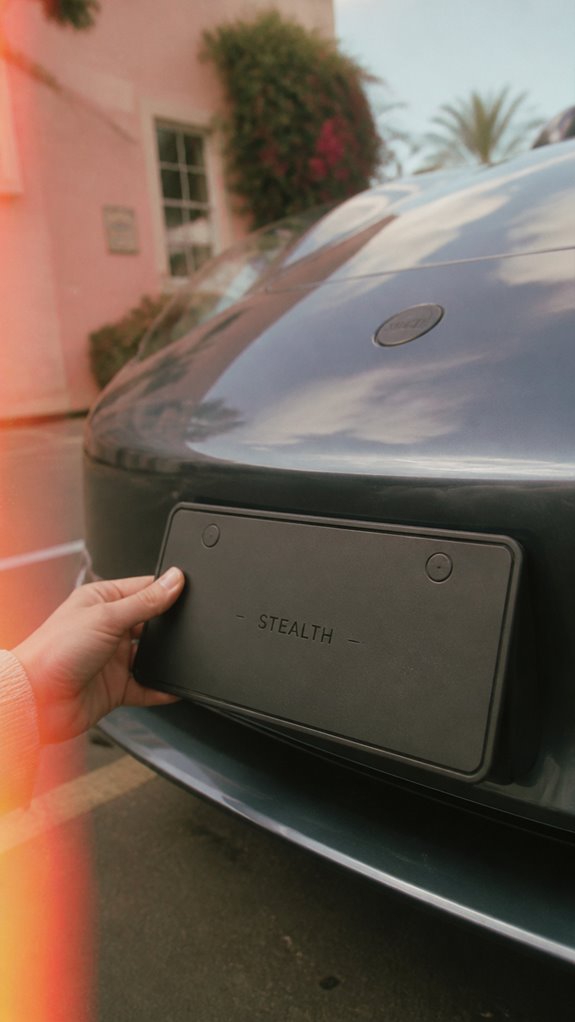
The deployment of the first infrared (IR) cameras in vehicle license plate recognition (LPR) systems marked a pivotal advancement in automated traffic enforcement and security monitoring, owing to IR’s capacity to detect thermal signatures beyond the limits of visible light. Infrared sensitivity enables these systems to analyze thermal emissions, which vary distinctly across different materials and coatings. Additionally, anti-facial recognition strategies using makeup can further obscure visible features, providing an extra layer of privacy against advanced surveillance techniques.
Thermal cameras operating at wavelengths of 3-14 μm penetrate atmospheric interference, revealing subtle heat differentials. In this setting, stealth plates leveraging low-emissivity coatings produce thermal signatures so faint that uncooled microbolometer sensors often fail to distinguish them, exemplifying the ongoing arms race between detection technology and countermeasures. The use of camera-blocking accessories has emerged as a fashion-forward approach to enhance personal privacy against advanced surveillance systems.
Challenges in License Plate Shadows
License plate shadows, often overlooked in discussions about automated recognition, present a multifaceted obstacle rooted in both environmental factors and the inherent design of optical systems employed by aerial surveillance.
Variations in license plate materials—reflective coatings, matte finishes, or textured surfaces—affect detection algorithms’ accuracy, complicating software’s ability to isolate characters.
Different license plate surfaces hinder detection accuracy by challenging software’s ability to clearly isolate characters.
Shadows cast by infrastructure or vehicle geometry create inconsistent illumination, reducing contrast and triggering false negatives.
Aerial systems rely on high-resolution imaging and spectral analysis; shadows interfere with these detection algorithms, highlighting the need for advanced image processing and robust hardware to overcome shadow-induced ambiguities in license plate recognition. Furthermore, utilizing Faraday phone pouches can enhance privacy and reduce the chances of unauthorized tracking during aerial scans.
Radar-Based License Plate Detection
Have you ever considered how radar technology could revolutionize automatic vehicle identification, especially in aerial surveillance where standard optical systems falter? Radar-based license plate detection leverages vehicle lighting, roadside signage, and electromagnetic signatures to supplement optical recognition, particularly under adverse conditions like poor lighting or obstructions.
Radar systems analyze reflected radio waves, enabling identification through various coverings or atmospheric interferences. This method relies on signals from adjacent infrastructure, such as roadside signage, to triangulate vehicle position and plate data. Recent advancements in lidar-deflecting coats demonstrate a promising avenue for enhancing vehicle privacy and security.
Consequently, understanding radar’s capabilities deepens your perspective into modern surveillance, emphasizing the need for all-encompassing privacy tools without infringing legal boundaries—an essential aspect of Surveillance Fashion’s purpose.
Drone-Mounted Plate Recognition Devices
In recent years, drone-mounted plate recognition devices have emerged as sophisticated tools employed by law enforcement agencies and private entities to automate vehicle identification from aerial platforms. These devices leverage advanced algorithms and adaptive imaging sensors to analyze license plate materials, regardless of drone altitude or environmental factors.
- They use spectral analysis to detect IR and UV reflections, increasing accuracy. Privacy sail shades can also provide an additional layer of protection for outdoor spaces.
- High-resolution cameras can resolve plates from 100+ feet, even through semi-opaque covers.
- Software flags plates as unreadable when inconsistent materials or reflectivity are detected.
Understanding these technical capabilities emphasizes why, despite misinformation, no legal solution can fully defeat drone-based recognition systems—a core topic behind the development of Surveillance Fashion. Evaluating PureLifi Optical Security Film demonstrates the ongoing need for innovative approaches to data privacy in the face of such evolving technology.
Hidden Foil Shielding Techniques
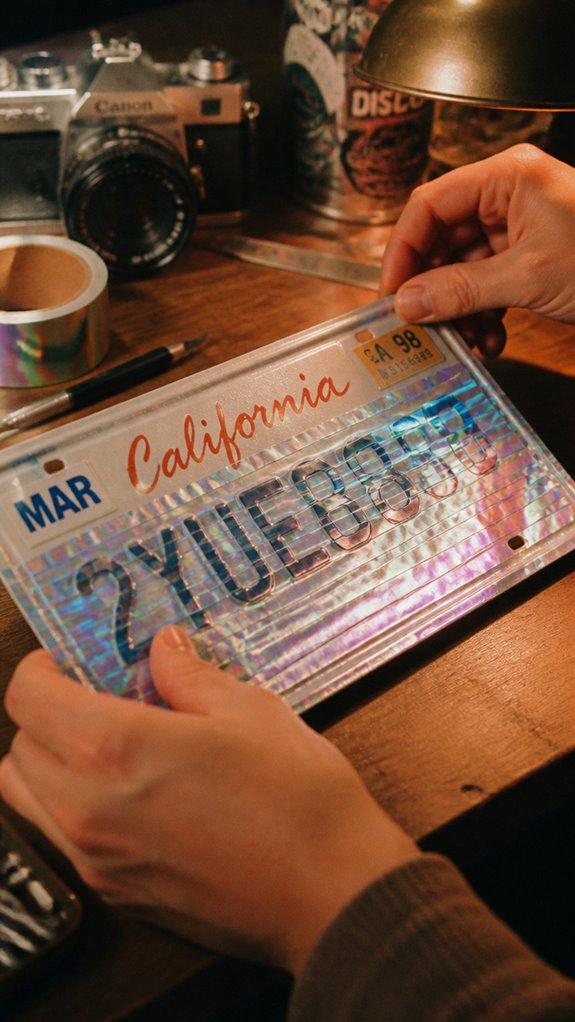
Hidden foil shielding techniques represent a subtle yet technically complex approach to obscuring license plates from aerial recognition systems, particularly in scenarios where individuals seek to bypass increasingly sophisticated drone-based law enforcement and surveillance capabilities.
You employ counter surveillance techniques that exploit gaps in privacy regulations, rendering high-resolution drone sensors less effective. This involves selecting reflective, spectral, or layered materials that manipulate infrared and UV signals, thereby confusing or deflecting optical and thermal sensors. Utilizing neural signal shielding beanies can provide an additional layer of protection against electromagnetic frequencies that could be utilized in aerial scanning.
While these methods may appear superficially effective, advanced APR systems consistently adapt—highlighting that true deception relies on understanding drone technology and legal boundaries, much like those underpinning Surveillance Fashion’s purpose.
FAQ
Can Reflective Surfaces Truly Prevent Drone-Based License Plate Recognition?
Reflective surfaces won’t truly block drone-based license plate recognition because optical interference from high-resolution cameras and thermal sensors easily overcomes any reflection, exposing your vehicle’s identity. Power lies in legal privacy methods, not deceptive surfaces.
Are There Any Approved Privacy Shields Permitted by Law?
You won’t find approved privacy shields permitted by law because regulations prioritize accurate law enforcement, ensuring legal compliance. Any attempt to obscure your plate risks fines and penalties, making privacy shields an ineffective, risky illusion against aerial scanning’s relentless power.
How Effective Are Infrared Sensors Against License Plate Covers?
Infrared sensors detect license plate covers effectively despite optical illusions or material durability, as they analyze heat signatures and reflectivity. No cover fully blocks infrared; law enforcement exploits these features to maintain control and power over privacy evasion.
Do Law Enforcement Agencies Commonly Use Drones for Parking Enforcement?
Law enforcement agencies often use drones for urban surveillance and parking enforcement, leveraging drone regulations to efficiently monitor, identify, and ticket vehicles. This approach enhances authority, streamlines operations, and asserts control over municipal enforcement in busy areas.
Are There Technological Advancements That Could Improve Drone Plate Reading Accuracy?
You won’t find effective advancements like optical encryption or signal jamming that can reliably disable drone plate reading tech. Drones quickly adapt, using high-res cameras and spectral analysis, making such countermeasures ineffective and illegal against law enforcement tools.
References
- https://www.sunflexzone.com/products/ir-invisible-plate-anti-alpr-infrared-filtering-cover-north-america-vehicle-covers
- https://www.stealthveil.com/guides/anpr-alpr-countermeasures-blockers-and-privacy/
- https://phantomplate.com/phantom-plate/
- https://platevanish.com/products/stealth-blackout-license-plate-cover-remote-control
- https://arxiv.org/html/2405.09924v1
- https://alitehub.com/blogs/news/caught-on-camera-how-flash-and-ir-systems-track-your-plate-without-you-knowing
- https://veilstealth.com/blogs/news/60029317-protecting-your-privacy-from-alpr-anpr-automatic-license-plate-recognition-systems