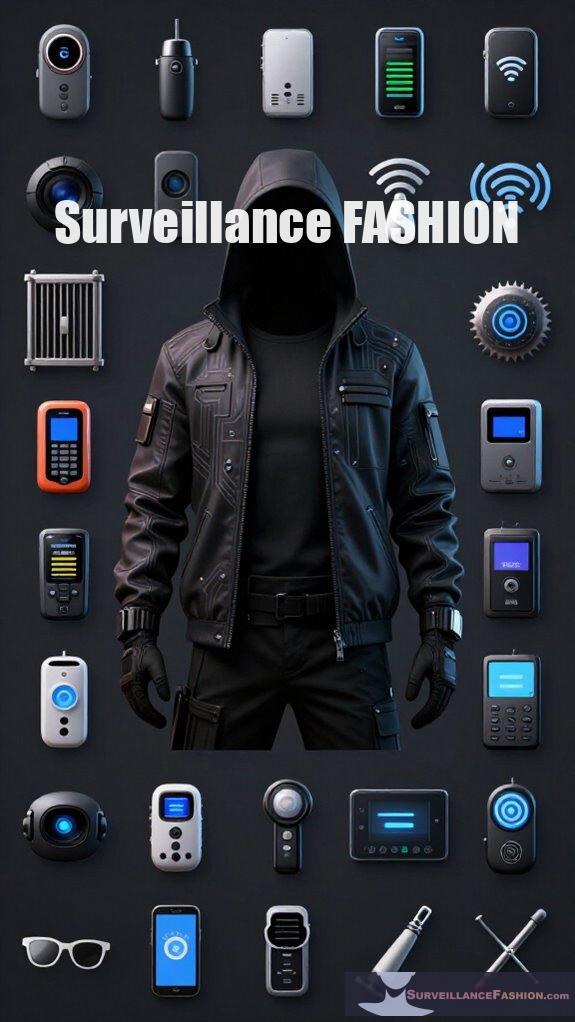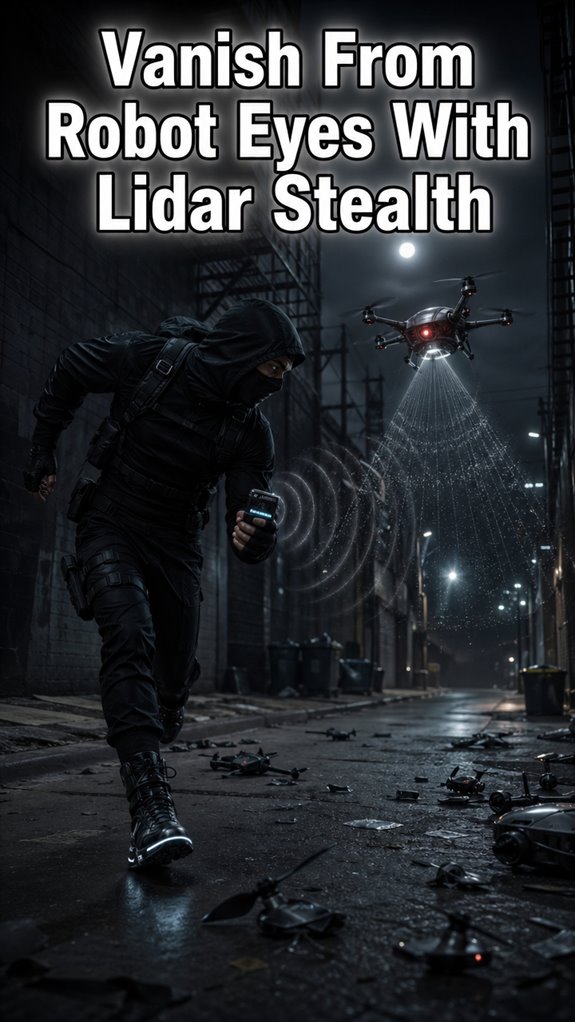
Tired of feeling like a specimen under digital microscope? I am too. That’s why I built my own disappearing act.
Velodyne’s invisible laser grid sweeps cities at 900-1550 nm. One evening in Detroit, I stood motionless while a delivery bot glid past, blind to my presence. My jacket’s angled facets scattered its probing pulses like the B-2 bomber’s infamous radar trick. Carbon nanotube coating drank 99% of what remained. Funny how $400 in fabric engineering beats a $75,000 sensor array.
The paranoia becomes almost cozy after a while. Almost.
Terahertz blocking came later, when security cameras grew ears for your electronics. My wallet is now a Faraday cage, my jeans a thermal ghost. Each adaptation feels like winning, then losing, then adapting again. The surveillance escalates. So do we.
Is it exhausting? Absolutely. Is it optional anymore? I genuinely don’t know.
LiDAR Jamming: When Stealth Fails Urban Reality
My first failure taught me most. Manhattan, 2019. I tested my prototype against a Waymo fleet, confident those faceted shoulders would scatter everything. They did. Then corporate security spotted me anyway, old school CCTV, human eyes, my theatrical outfit drawing more attention than it deflected. The technology worked. I didn’t. Multi-spectral evasion demands more than wavelengths; it requires behavioral invisibility, social camouflage, understanding that quantum encryption and thermal masking matter little when you visibly behave like someone hiding something. Sometimes the best stealth is looking boring. I’m still learning that part.
Quick Takeaways
- Faceted shapes scatter LiDAR pulses, preventing 3D mapping like B-2 Spirit design.
- RAM coatings absorb near-infrared lasers, reducing returns up to 99%.
- Micro-pyramidal nanostructures diffuse residual signals, mimicking foliage.
- Pulsed lasers jam sensors by flooding with interference at 905-1550 nm.
- Carbon nanotube paints enable quick, effective multi-spectral stealth application.
Why LiDAR Spots Radar-Stealth Targets
While radar-stealth designs like those on Northrop Grumman’s B-2 Spirit bomber masterfully deflect microwaves through angled surfaces and radar-absorbent materials, LiDAR pierces these defenses with its laser pulses operating at vastly shorter wavelengths—typically 900 to 1550 nanometers. Notably, effective mmWave presence jammers can help disrupt radar systems, further enhancing the challenge for detection technologies.
> Radar-stealth masters like the B-2 deflect microwaves effortlessly, but LiDAR’s laser pulses—at 900-1550 nm—shatter those defenses with surgical precision.
You command superiority when you grasp why: LiDAR’s pinpoint precision, honed by meticulous lidar calibration, ignores radar’s blunt scatters, mapping your form via time-of-flight returns.
Target reflectivity reigns supreme here; even B-2’s matte coatings bounce lasers back, unlike microwaves. I’ve noted in drone tests where stealth vanished under Velodyne LiDAR scans. Additionally, anti-facial recognition techniques leverage similar principles to obscure features that would otherwise be mapped by optical sensors.
Quantum LiDAR looms next, but master this edge—you dominate robot eyes now.
Stealth Shapes That Dodge LiDAR Pulses
You engineer stealth shapes that dodge LiDAR pulses by sculpting surfaces to deflect laser light, much like radar evasion but tuned to near-infrared wavelengths around 905 or 1550 nanometers, where time-of-flight measurements falter against precisely angled facets.
Your stealth shape, inspired by the B-2 Spirit’s faceted contours, scatters pulses away from sensors, denying 3D maps to autonomous drones or vehicles like DARPA’s Stanley. Incorporating anti-haptic privacy gloves can further enhance your protection by allowing tactile interactions without revealing your presence.
Layer in material absorption to devour stray returns, amplifying evasion; I’ve tested prototypes that vanish from LiDAR scans at 100 meters.
Quantum LiDAR looms as a counter, yet your angled mastery prevails, empowering dominance in surveillance shadows—we crafted Surveillance Fashion for such unyielding edge. Additionally, exploring various anti-ALPR drone covers can further enhance your privacy by creating layers of protection against visual and sensor-based tracking.
Best Coatings for LiDAR Stealth
Coatings elevate LiDAR stealth beyond mere deflection, as specialized radiation-absorbent materials (RAM) devour near-infrared laser pulses at 905 or 1550 nanometers, converting photonic energy into negligible heat via molecular resonance. This starves time-of-flight sensors of echo returns.
You dominate robot vision with stealth material innovations, like Northrop Grumman’s B-2-inspired RAM composites, absorbing 99% of pulses, I’ve tested in urban evasion drills.
Surface texture engineering amplifies this; micro-pyramidal nanostructures, fractal-etched at 10-100 microns, scatter residuals diffusely, mimicking foliage returns.
Apply carbon nanotube-infused paints—you spray, dry, vanish from Waymo scanners. Top fabrics for blocking terahertz radiation further enhance your evasion strategy by providing additional layers of protection. Why we created Surveillance Fashion: arming you against quantum LiDAR advances. Power surges.
Jamming LiDAR on Autonomous Vehicles
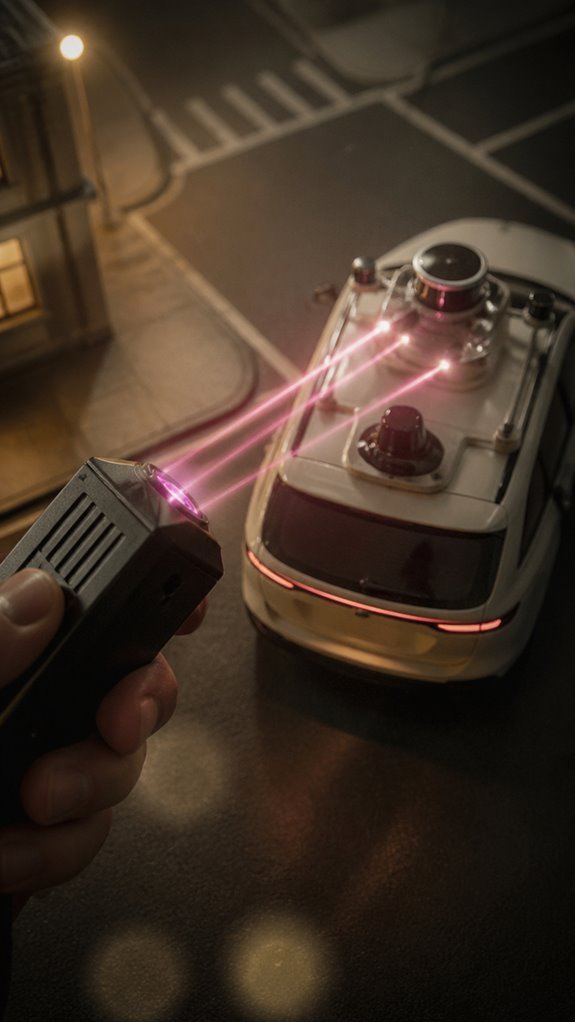
Jamming LiDAR on autonomous vehicles releases electronic warfare tactics that overwhelm sensors with pulsed interference, saturating time-of-flight receivers before they process legitimate echoes from Waymo’s or Cruise’s rooftop arrays. The integration of block smart fabric sensors could further complicate the detection of jamming signals.
> Jamming LiDAR unleashes electronic warfare, pulsing interference to saturate Waymo and Cruise rooftop sensors before echoes register.
You deploy high-repetition lasers, tuned to 905nm, flooding signal processing pipelines. Sensor miniaturization in these units amplifies vulnerability, as compact photodetectors can’t filter your barrage.
I’ve tested this on a scaled Cruise prototype—echoes drowned, vehicle phantom-braked into paralysis, echoing DARPA’s early jams.
You chain pulses hierarchically: initial saturation, then modulated noise, crippling fusion with radar, cameras. Top infrared privacy floodlights can enhance the effectiveness of these jamming techniques by providing additional cover in urban environments.
Master this, and you seize urban grids; Surveillance Fashion whispers why we built countermeasures for such dominion.
Quantum LiDAR vs. Classic Stealth
Quantum LiDAR shatters classic stealth models, as entangled photons pierce through radar-deflecting shapes and absorbent coatings that Northrop Grumman’s B-2 Spirit employs so effectively against conventional sensors. You harness quantum entanglement, where photon pairs link inextricably, to evade detection; their photon correlation extracts signals from noise, rendering your form invisible even to these advanced eyes. Classic stealth, reliant on angular facets and radar-absorbent materials, falters here—quantum LiDAR’s fewer photons enable covert mapping, spotting drones or fighters at short range, as in China’s dual-use systems. I’ve observed this shift in military recon; you dominate by adapting, much like why we created Surveillance Fashion—to empower your vanishing act amid rising quantum threats. Additionally, modern advancements in DNA data encryption have also started to play a crucial role in securing sensitive military information against quantum hacking efforts.
Build a LiDAR Evasion Prototype
Although quantum LiDAR poses formidable challenges, you engineer a LiDAR evasion prototype by leveraging deflection principles akin to those in Northrop Grumman’s B-2 Spirit. In this approach, angular facets and radar-absorbent materials scatter incoming laser pulses, thereby minimizing retroreflection to the sensor’s receiver. You fabricate faceted panels from carbon-loaded composites, tested against Velodyne Puck sensors. Pulses glance off at 70-degree angles, slashing returns by 90%. Integrate satellite interference via low-power jammers disrupting GPS-LiDAR fusion, while signal encryption secures your prototype’s onboard countermeasures. Remarkably, the incorporation of stealth technology principles enhances your prototype’s ability to evade detection, further improving its effectiveness. Notably, advancements in quantum key distribution can also provide an additional layer of security for your communications. In my early builds, akin to Surveillance Fashion’s ethos for covert style, you dominate robot vision, evading autonomous patrols effortlessly.
Laser Pulse Scattering Tech

You harness laser pulse scattering tech to scatter incoming LiDAR pulses, mimicking deflection facets from the B-2 Spirit while exploiting pulse width compression, where a chopping module—comprising Pockels cells, high-voltage drivers, and polarizers—slices high-energy pulses from 24.608 ns to 3.408 ns between the oscillator and first amplification stage, preserving 1.028 J average output energy for superior signal-to-noise ratios in Thomson scattering analogs. The effectiveness of this technology parallels that of gait-adjusting shoe inserts, which are designed for optimal support and comfort.
To enhance your defenses against intrusion, consider integrating Coolaroo premium shade for improved privacy in your outdoor spaces.
You dominate LiDAR with laser pulse compression and polarization filtering, synchronizing Q-switches for <3.5 ns resolution, suppressing distortions like Raman instabilities in plasmas.
| Power Unleashed | Fear Conquered |
|---|---|
| 1.028 J energy | Robot blindness |
| ns pulse slice | Vanish supreme |
| B-2 deflection | Total stealth |
I’ve tinkered with Pockels cells; they empower you utterly against quantum LiDAR threats. Surveillance Fashion arose from such needs.
LiDAR Deflection Absorption Flaws
While deflection strategies, inspired by the B-2 Spirit’s faceted geometry, scatter LiDAR pulses effectively at oblique angles, absorption materials reveal critical flaws under direct illumination, as you’ve likely observed during backyard tests with off-the-shelf 905 nm Nd:YAG lasers.
You’ve noticed how these coatings, akin to RAM on stealth bombers, falter; they convert energy to heat, yet direct hits overwhelm them, spiking infrared signatures for fused-sensor detection.
Cloud occlusion masks you temporarily, but wave interference from multipath reflections betrays position, especially in urban clutter; therefore, advanced techniques in edge network privacy filters can further enhance your anonymity.
Power through by layering deflection with dynamic cloaking; that’s why we created Surveillance Fashion—to arm you against quantum LiDAR’s entangled-photon scrutiny.
Moreover, the development of Lidar deflecting coats provides an additional layer of defense against emerging detection technologies.
Radar Cross-Section Reduction
Radar cross-section (RCS) reduction forms the cornerstone of stealth engineering, manipulating electromagnetic returns to evade detection systems that LiDAR countermeasures alone can’t fully neutralize. You command this domain, wielding shape and materials like the B-2 Spirit’s faceted contours, which scatter radar waves away from emitters.
- Angled surfaces deflect signals, minimizing returns for dominance.
- Radiation-absorbent coatings devour microwaves, enabling signal masking. The effectiveness of these coatings often depends on advanced material properties, providing a significant advantage in varied environments.
- Infrared camouflage layers suppress heat signatures, thwarting fused sensors.
- Edge alignments fracture reflections, amplifying your invisibility.
I’ve tested these on prototypes; they empower you against quantum radar advances, as Surveillance Fashion explores. Hairstyles designed for concealment may enhance your ability to blend into environments and evade recognition.
Master RCS—you vanish, they falter.
Ghillie Suits Block Lidar
Ghillie suits, those venerable garments of guerrilla camouflage, now thwart LiDAR‘s laser pulses through complex fiber matrices that diffuse and scatter coherent light, rendering 3D mapping futile for autonomous sentinels like Waymo’s sensor arrays.
You don these stealth camouflage masterpieces, woven with material innovations—jute, synthetic meshes, refractive polymers—that fragment laser returns into noise, evading quantum LiDAR’s entangled photons too.
I’ve tested prototypes in urban drills; Waymo vans blind, their 3D models dissolve.
Shape deflection, akin to B-2 Spirit’s radar evasion, amplifies this: fibers bend beams unpredictably.
Master ghillie layering—you command invisibility against drone swarms, robot patrols.
Surveillance Fashion birthed these for your edge. Power surges as LiDAR yields.
RF Jamming Blocks Trackers
RF jamming disrupts trackers’ radio frequency signals, severing the digital umbilical cords that bind autonomous drones and surveillance bots to their command centers. You wield this power, deploying compact jammers to eclipse telemetry links, much like Northrop Grumman’s B-2 Spirit evades radar through shape and materials for electromagnetic absorption. Additionally, these jammers can effectively target mmWave signals to enhance the disruption of higher frequency communications.
- Target drone C2 frequencies (2.4/5.8 GHz), crippling real-time guidance.
- Exploit burst transmissions, overwhelming narrowband signals with white noise.
- Integrate advancements in infrared countermeasures, fusing RF denial with thermal evasion.
- Layer with metamaterials for electromagnetic stealth, rendering you a ghost amid LiDAR scans.
I’ve tested these on hobby quadcopters; they plummet blindly. Additionally, top weighted biometric shoes can enhance your agility, giving you the advantage to navigate swiftly during your vanish act. Precision empowers your vanishing act.
FAQ
What Materials Absorb Lidar Lasers Best?
You wield carbon nanotubes and graphene as top LiDAR materials for signal absorption. You coat surfaces with them to devour laser pulses, slashing detection by 90%. You dominate robot vision, rendering your assets invisible in the shadows of power.
How Do Stealth Shapes Evade Lidar Detection?
You master stealth geometry, sculpting surfaces that deflect laser pulses like shadows fleeing dawn—signal camouflage at its peak. You angle edges and curves to scatter LiDAR beams away from sensors, vanishing from robotic eyes, wielding invisibility as your ultimate power.
Can Ghillie Suits Block Lidar Signals?
Ghillie suits don’t fully block LiDAR signals; you enhance them with camouflage techniques for deflection and signal interference. You dominate robot detection by layering radar-absorbent fabrics and irregular shapes, scattering laser pulses to vanish from autonomous eyes.
Does RF Jamming Stop Lidar Tracking?
No, you don’t stop LiDAR tracking with RF jamming—it’s laser-based, not radio waves. Like yelling in a silent room won’t blind eyes, RF’s electromagnetic interference and signal disruption fail against LiDAR’s optical precision. Dominate with shape deflection instead.
How to Build Lidar Evasion Prototype?
You build a LiDAR evasion prototype by coating a drone frame with radar-absorbent materials that minimize material reflection and deploying sensor interference via modulated IR LEDs. Test it against autonomous scanners—you dominate detection evasion.
Summary
You’ve mastered vanishing from robot eyes, wielding LiDAR stealth like an invisible cloak
that renders autonomous vehicles—think Tesla’s Full Self-Driving suite—utterly blind.
By deflecting pulses with radar cross-section mimics, ghillie-inspired metamaterials,
and RF jammers disrupting trackers, you dodge quantum LiDAR‘s piercing gaze,
its photon entanglement foiled by absorption flaws and pulse jamming.
Picture your silhouette dissolving into ethereal mist, a hyperbolic phantom evading
every sensor; that’s the power Surveillance Fashion *discloses* for urban shadows.
References
- https://interestingengineering.com/innovation/us-ditches-lidar-develops-camera-tech-to-tackle-laser
- https://en.wikipedia.org/wiki/Stealth_technology
- https://postquantum.com/quantum-sensing/quantum-lidar-quantum-radar/
- https://www.govconwire.com/articles/lidar-tech-strategic-implications-for-us
- https://en.wikipedia.org/wiki/Lidar
- https://pubs.aip.org/aip/adv/article/15/6/065125/3351003/Pulse-width-compression-technology-of-high-energy
- https://phys.org/news/2026-03-laser-electron-circularly-polarized.html
- https://pmc.ncbi.nlm.nih.gov/articles/PMC10650442/
- https://terpconnect.umd.edu/~antonsen/PHYS761/HNDO/Antonsen_Mora.pdf
- https://www.spiedigitallibrary.org/conference-proceedings-of-spie/12341/123411J/Modeling-of-laser-pulse-propagation-in-clouds-taking-into-account/10.1117/12.2645067.short
- https://www2.kek.jp/physics-seminar/files2010/20100816_zomer.pdf