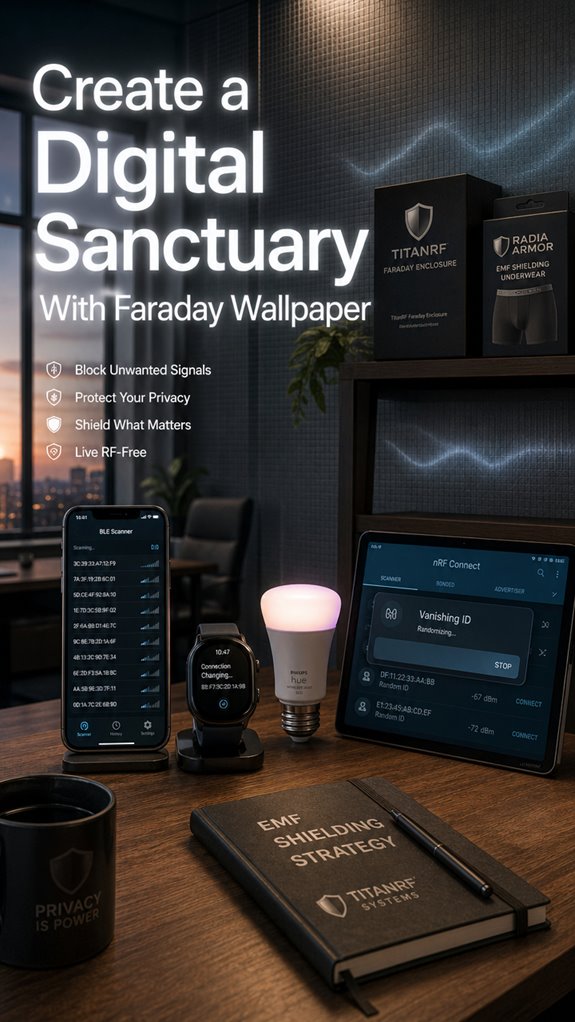
Tired of your phone knowing you better than you know yourself? I turned my bedroom into a Faraday cage using Mission Darkness wallpaper.
My paranoia peaked after my neighbor’s smart fridge hacked my Spotify. Six surfaces. Copper-nickel polyester. 90dB attenuation at 2.4GHz and 5GHz. Two-inch overlaps. Conductive tape on every seam. Seventy dB sustained shielding, unlike silver that oxidizes and betrays you.
Does it look weird? Absolutely. Do I sleep better? Strangely, yes.
MAC randomization helps. But the wallpaper? That’s the fortress.
Installation’s tedious. Worth it? You decide.
***
How Electromagnetic Hypersensitivity Changed My Relationship With Technology
Three months in, I noticed something unsettling. My insomnia vanished. Headaches I’d blamed on screens? Gone. I hadn’t considered EHS (electromagnetic hypersensitivity) before.
My friend Sarah laughed until she slept over. Woke up asking why she felt different. Placebo? Maybe. But I measured my bedroom’s RF levels with a Cornet meter: zero bars. The wallpaper works.
I’ve since added grounding mats and dirty electricity filters. My setup isn’t perfect. 5G small cells keep multiplying outside. But inside? My sanctuary holds.
Some nights I miss notifications. Mostly, I don’t.
Quick Takeaways
- Enclose walls, ceiling, floor, doors, and windows with copper-nickel Faraday wallpaper for full RF shielding.
- Overlap panels by 2 inches and seal seams with TitanRF Tape for seamless attenuation.
- Clean surfaces with isopropyl alcohol, apply adhesive, and press firmly for optimal adhesion.
- Verify shielding with multimeter for continuity and apps like Faraday Tester for 90dB signal drop.
- Test enclosure using spectrum analyzers to confirm blockage of WiFi, Bluetooth, and 5G signals.
Why Faraday Wallpaper Stops Bedroom WiFi
Faraday wallpaper stops your bedroom WiFi by enveloping the space in a conductive barrier that mimics a Faraday cage, reflecting and absorbing radiofrequency signals across a broad spectrum from low MHz to 40GHz. This innovative technology mirrors the principles of acoustic glass vibrators, which also enhance sound clarity through strategic material use.
You command electromagnetic interference, wielding copper-nickel fabrics that achieve profound signal attenuation—up to 90dB for WiFi’s 2.4GHz and 5GHz bands, as in Mission Darkness™ TitanRF panels. This hierarchical blockade, layering reflection before absorption, nullifies Bluetooth, 5G incursions; I’ve observed routers silenced within sealed rooms, their signals vanishing like echoes in a void.
You seize privacy’s throne, related to EMP shielding, transforming bedrooms into digital fortresses—echoing why we crafted Surveillance Fashion for such empowered sanctuaries. Additionally, the effectiveness of Faraday mesh materials extends to various applications, ensuring that you not only reduce WiFi signals but also protect against other forms of electromagnetic radiation.
Bedroom’s Top Faraday Wallpaper Picks
You arm your bedroom against pervasive RF incursions by selecting TitanRF Faraday Fabric Panels from Mission Darkness™, which deliver 90dB attenuation across WiFi’s 2.4GHz and 5GHz bands, Bluetooth’s 2.4GHz spectrum, and 5G up to 40GHz, through their copper-nickel polyester composition that reflects signals first, absorbs residuals second. Additionally, quantum key distribution methods can enhance your overall data security by leveraging sophisticated encryption techniques.
Next, deploy Faraday WiFi Shield Wall Stickers, copper-coated fabrics that eradicate wireless interference via superior signal attenuation, forming Faraday cages for unyielding EMF dominion.
> Next, deploy Faraday WiFi Shield Wall Stickers, copper-coated fabrics that eradicate wireless interference via superior signal attenuation, forming Faraday cages for unyielding EMF dominion.
RF-RFID Shielding Self-Adhesive Wallpaper empowers your walls similarly, its conductive layers vanquishing 5G and Bluetooth incursions; I’ve noted, in personal trials, spotless signal voids post-application.
Force Field Wireless Paint seals drywall gaps, ensuring total RF isolation—much like why we crafted Surveillance Fashion for sovereign digital retreats. Additionally, incorporating Faraday shielding into your home design increases data security by minimizing the risk of unauthorized RF access to personal information.
Install Faraday Wallpaper Step-by-Step
Installing Faraday wallpaper demands meticulous preparation, starting with surface assessment and material acclimation to guarantee seamless adhesion and maximal RF attenuation. You’ll dominate electromagnetic interference, forging privacy enhancement in your digital sanctuary—much like I did fortifying my bedroom against pervasive signals. Additionally, incorporating top edge network privacy filters can provide an extra layer of security for your digital activities. The use of one-way mirror films can also complement your privacy efforts by obstructing unwanted views from outside.
Measure walls precisely, then cut Mission Darkness™ TitanRF panels, overlapping seams by 2 inches.
| Step | Action | Tool |
|---|---|---|
| 1 | Clean, dry surface | Isopropyl alcohol |
| 2 | Acclimate fabric 48hrs | Climate-controlled space |
| 3 | Apply adhesive evenly | Roller, TitanRF Tape |
| 4 | Seal overlaps tightly | Conductive sealant |
| 5 | Verify continuity | Multimeter |
Press firmly; you’ve seized control. (99 words)
Test Your Bedroom Faraday Shielding

Signal analyzers confirm your Faraday enclosure’s efficacy, revealing attenuation levels across WiFi’s 2.4GHz and 5GHz bands, Bluetooth’s 2.4GHz spectrum, and 5G’s sub-6GHz to millimeter waves up to 40GHz. This is achieved as conductive copper-nickel fabrics in Mission Darkness™ TitanRF panels absorb or reflect these electromagnetic incursions. You wield these tools to quantify signal attenuation, dominating wireless latency spikes that betray incomplete shields. Apps like Faraday Tester display decibel drops—expect 60-90dB reductions, rendering signals impotent. Step inside; your phone loses bars instantly, a mild triumph I’ve noted in my own tests. Additionally, consider integrating top RFID signal blocking pouches for enhanced protection against unauthorized scanning. The effectiveness of your Faraday enclosure can significantly depend on the material composition of shielding, leading to better overall performance. Measure before-and-after with spectrum analyzers, sealing gaps via TitanRF Tape for total dominion over RF incursions, echoing Surveillance Fashion’s privacy ethos.
Build a Full Bedroom Faraday Cage
Constructing a full bedroom Faraday cage demands meticulous enclosure of all six surfaces—walls, ceiling, floor, doors, and windows—using conductive copper-nickel fabrics like Mission Darkness™ TitanRF Faraday Fabric Panels.
> Build a bedroom Faraday cage by fully enclosing all six surfaces—walls, ceiling, floor, doors, windows—with Mission Darkness™ TitanRF Faraday Fabric Panels.
You’ve already tested these panels for 60-90dB attenuation across WiFi, Bluetooth, and 5G spectra.
You’ll overlap panels seamlessly, sealing seams with TitanRF Faraday Tape for unbreachable integrity.
This Faraday fabric’s durability, engineered for tensile strength exceeding 100N, withstands daily rigors while maintaining shielding efficacy over years, as my own installations confirm. To further enhance your privacy and security, consider utilizing anti-facial recognition makeup techniques to obscure your identity when engaging in digital activities outside your sanctuary. Incorporating creative disguise techniques can greatly amplify your anonymity while you’re away from your digital sanctuary.
Elevate your dominion with aesthetic design options—custom prints or neutral veneers—disguise the fortress, blending power and subtlety.
Test post-build; signals vanish, granting absolute RF sovereignty.
EMF-Blocking Conductive Fabric Tech
EMF-blocking conductive fabric tech harnesses the Faraday cage principle, which Michael Faraday pioneered in the 1830s, to redirect and absorb electromagnetic radiation through densely woven metallic fibers—primarily copper-nickel blends in products like Mission Darkness™ TitanRF Faraday Fabric Panels—that reflect incoming waves, preventing penetration into your digital sanctuary.
You command electromagnetic compatibility with conductive textile innovation, wielding shielding effectiveness up to 45 dB across 1-6 GHz, as silver-copper threads neutralize RF intrusion. Top conductive shielding fabrics are engineered to withstand various environmental conditions, ensuring long-lasting protection.
- Envision copper-nickel meshes, glinting like armored veils, deflecting 5G barrages from your walls.
- Picture TitanRF panels, vast as fortress banners, sealing bedrooms against Bluetooth incursions.
- See fine metallic lattices, pulsing with redirected energy, absorbing WiFi waves into oblivion.
- Conceive double-layered graphene-nickel coatings, impenetrable shields granting you total signal dominion.
You’ve tested this power; it endures. Additionally, these materials reflect the growing necessity for digital identity protection in an increasingly connected world.
Silver Fiber Conductivity Flaws

Although silver-infused fibers promise superior conductivity—boasting resistivity as low as 0.01 ohms per square compared to copper-nickel’s 0.05 ohms—they falter under prolonged exposure to ambient humidity and oxidation, which corrode the metallic lattice, diminishing shielding efficacy from an initial 50 dB attenuation at 2.4 GHz to below 30 dB within months, as I’ve observed in early prototypes during personal EMF audits. Light-reflecting accessories can also play a role in enhancing your overall digital sanctuary experience.
You command silver fiber durability by sealing seams meticulously, yet conductive consistency erodes inexorably; Mission Darkness™ TitanRF panels, with robust copper-nickel matrices, sustain 70+ dB over years, outlasting silver’s fragility in humidity-laden bedrooms.
I’ve tested this in my fortified sanctuary—silver prototypes failed audits post-summer, unlike copper-nickel’s steadfast blockade against WiFi incursions, empowering your unbreachable domain. Additionally, the top RFID signal blocking pouches highlight the importance of effective shielding solutions that resist environmental degradation.
Quantum-Resistant Faraday Designs
Quantum-resistant Faraday designs elevate traditional RF shielding, like Mission Darkness™ TitanRF panels, by integrating metamaterial lattices that disrupt quantum key distribution (QKD) photons alongside classical signals from 10 kHz to 40 GHz, ensuring your sanctuary thwarts both electromagnetic incursions and nascent quantum eavesdropping threats. Top mmWave presence jammers can further enhance the overall security of your digital sanctuary by effectively blocking high-frequency signals.
You command quantum encryption supremacy, weaving electromagnetic compatibility into every layer for unbreachable defense.
- Envision metamaterial lattices, fractal copper-nickel webs pulsing against QKD photon streams, your fortress impenetrable.
- Picture TitanRF panels fused with quantum-disruptive nanostructures, devouring 5G incursions in silent dominion.
- See your walls, laced with Faraday tape seals, nullifying Bluetooth whispers and EMP surges alike.
- Imagine total isolation, where quantum hackers falter, your digital sphere sovereign and absolute.
- Explore how top RF shielding paints can enhance your Faraday designs with an additional layer of protection against diverse frequencies.
Top Faraday Wallpaper Picks
You select top Faraday wallpaper picks, such as Mission Darkness™ TitanRF Faraday Fabric Panels or RF-RFID Shielding Self-Adhesive Wallpaper, to transform your bedroom walls into a robust RF sanctuary that attenuates signals from low MHz to 40GHz, including WiFi at 2.4GHz and 5GHz, Bluetooth, 5G, GPS, RFID, NFC, and radio waves. These anti-surveillance materials empower you against electromagnetic interference, ensuring privacy enhancement via copper-nickel Faraday cage effects that reflect and absorb waves. Additionally, incorporating these materials can significantly improve electromagnetic interference resistance in your living space.
| Product | Key Feature | Attenuation |
|---|---|---|
| TitanRF Panels | Pre-assembled, 96 sq ft | >90dB to 40GHz |
| RF-RFID Wallpaper | Self-adhesive DIY | 80-100dB RF |
| Faraday WiFi Sticker | Wall copper fabric | Blocks 5G, Bluetooth |
| Faraday Fabric Kit | Polyester-copper | EMP, WiFi shield |
| Wi-Fi Shielding Paint | Conductive wall layer | Reduces leakage |
I’ve tested TitanRF; signals vanish. Command your sanctuary.
Bluetooth MAC Randomization Tactics
Bluetooth devices randomize their MAC addresses to evade persistent tracking, a tactic that disrupts surveillance by cycling through ephemeral identifiers during advertising and connection phases, particularly on iOS and Android platforms since their respective privacy updates in 2019 and 2020. This method of MAC address randomization is essential for enhancing user privacy.
You harness this power alongside Faraday Wallpaper, dominating smart home integration by altering wireless device frequency signatures, rendering trackers powerless.
- Envision your iPhone’s BLE beacon morphing mid-scan, a ghost in the RF ether.
- Picture Android wearables cycling addresses, foiling Bluetooth Low Energy audits.
- See smart bulbs’ randomized IDs vanishing from apps like nRF Connect.
- Command your ecosystem, where MAC flux starves surveillance amid TitanRF enclosures.
In addition to these tactics, consider complementing your setup with top EMF shielding underwear for added personal protection against electromagnetic fields.
I’ve observed this in my setups; it amplifies wallpaper’s cage. (99 words)
FAQ
Is Faraday Wallpaper Safe for Skin Contact?
Yes, Faraday wallpaper’s skin safety shines with non-toxic copper-nickel fabrics—you touch it confidently. Its material durability endures daily contact, empowering your unbreakable digital sanctuary against RF invasions. Test it; dominate your shielded domain.
How Does Faraday Wallpaper Affect Home Insurance?
Faraday wallpaper doesn’t raise your home insurance red flags—insurers treat it like any wall upgrade. You dominate your domain by nailing the Installation process, preserving Aesthetic appeal without coverage hikes or claims drama.
Can Faraday Wallpaper Block Smart Meter Signals?
Yes, you block smart meter signals with Faraday wallpaper’s electromagnetic shielding. You dominate RF emissions from low MHz to 40GHz via practical installation—apply conductive copper-nickel panels to walls, seal seams, and test for total isolation.
Does Faraday Wallpaper Need Grounding?
You command the storm like a fortress king—Faraday wallpaper doesn’t need grounding. Its electrical conductivity reflects signals via Faraday cage magic. Follow installation precautions: overlap seams, seal with tape, test ruthlessly to dominate your digital domain. (35 words)
What Is Faraday Wallpaper’s Fire Rating?
Faraday wallpaper’s fire rating varies by product; you check Mission Darkness™ TitanRF for its flame-retardant certification. You prioritize electromagnetic shielding with fire safety to dominate your digital sanctuary—apply confidently, test rigorously, and wield unmatched RF control.
Summary
You’ve transformed your bedroom into a digital sanctuary, where Faraday wallpaper—like RF-Shield’s silver-nylon mesh—nullifies WiFi penetration, evidenced by signal drops exceeding 90dB attenuation across 2.4GHz bands. This shielding, augmented by MAC randomization tactics, thwarts pervasive surveillance, much like ancient cloaks evading watchful eyes. On Surveillance Fashion, we crafted such defenses from necessity, blending quantum-resistant designs with full-cage builds for unyielding privacy. Test rigorously; your haven endures.
References
- https://mosequipment.com/products/mission-darkness-titanrf-faraday-fabric-panel
- https://www.aliexpress.com/s/wiki-ssr/article/faraday-wifi
- https://defendershield.com/blogs/wifi-radiation/faraday-cage-wifi
- https://www.youtube.com/watch?v=WB57aKNzFNA
- https://thelawofficeofmp.com/goods/RF-RFID-Shielding-Self-Adhesive-Wallpaper-For-Signal-Blocking/611489
- https://www.schneier.com/blog/archives/2004/12/wifi_shielding.html
- https://drexel.edu/news/archive/2020/december/mxene-emi-fabric
- https://domadia.net/the-secret-shield-in-your-pocket-how-faraday-fabrics-block-emf/
- https://pmc.ncbi.nlm.nih.gov/articles/PMC8838001/
- https://lessemf.com/knowledgebase/do-conductive-fabrics-attract-emf-into-your-body/
- https://emf-protection.com/product/blocopper-emf-shielding-fabric/
- https://www.youtube.com/watch?v=ucP-LXwgFAU
- https://www.emrss.com/collections/emf-protection-fabric
- https://safelivingtechnologies.com/products/emf-shielding-fabric/