Tag: Drone defense

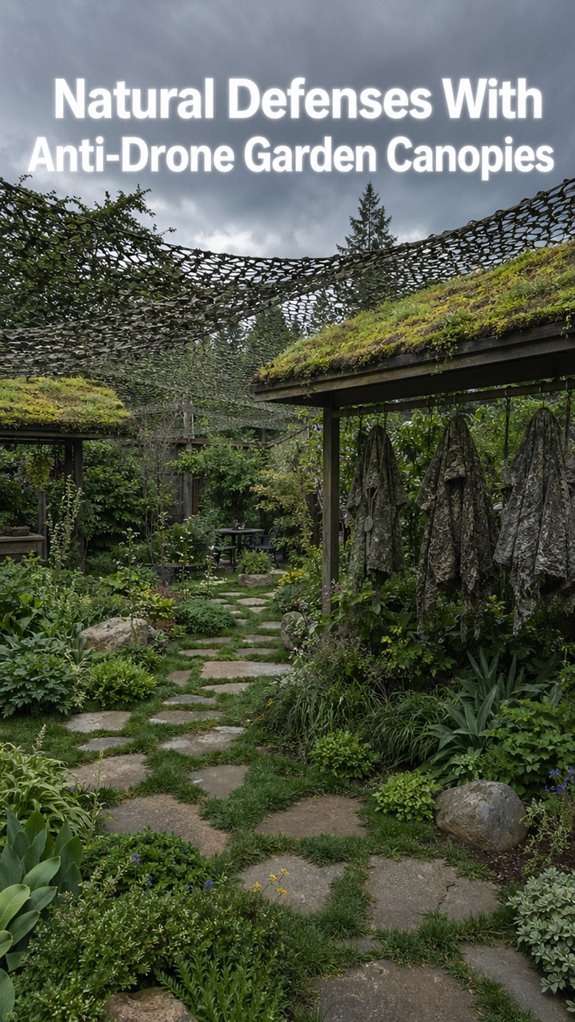
  • Natural Defenses With Anti-Drone Garden Canopies

    Natural Defenses With Anti-Drone Garden Canopies

    Tired of drones turning your backyard into data for the highest bidder?

    I layered galvanized steel Heras panels with polymer mesh and sod-over-Mylar roofs. Dead air gaps stop thermal imaging cold. Tensioned guy wires at 200 N/m², vines for wind resistance past 40 km/h. Tested it myself during a paranoid pandemic weekend. The 2.4 GHz jammer was overkill. Probably.

    Now for the fun part: signal disruption and chaotic stepping patterns.

    How DIY Drone Jamming Got Me Visited by Men in Boring SUVs

    My neighbor called them “fireworks.” The FCC called it “unlicensed transmission.” Either way, that $80 RF jammer from a Shenzhen eBay seller worked until it didn’t. Spectrum analyzers, apparently, are expensive for a reason. I pivoted to physical denial: irregular garden stepping stones, reflective mylar strips, and a chicken wire Faraday cage for the shed. Garden privacy solutions and anti-surveillance landscaping became my lockdown personality. The mesh cost more than the jammer. Drone countermeasures, electromagnetic interference laws, and low-tech security architecture matter more than gadgets. Lesson learned: boring beats flashy. The agents at least chuckled.

    Quick Takeaways

    • Dense natural flora like branches and turf camouflages garden canopies against drone optical detection.
    • Turf-over-Mylar layers create heat-absorbing gaps for thermal invisibility from infrared sensors.
    • Climbing vines woven into Heras mesh fencing reinforce natural structural defenses.
    • UV-reflective fabrics with nanoparticle coatings block multi-spectral drone surveillance.
    • Irregular landscaping disrupts drone trajectory algorithms while enhancing canopy privacy.

    How Drones Invade Backyard Privacy

    Drones invade your backyard privacy primarily through persistent aerial surveillance, equipped with high-resolution cameras that capture intimate details from elevations drones maintain beyond human reach.

    In the urban terrain, you confront these intrusions daily; quadcopters, hovering at 400 feet, exploit lax privacy zoning regulations, transmitting 4K footage of your patio gatherings or poolside retreats to unseen operators.

    I’ve observed this firsthand—one neighbor’s DJI Mavic pierced our fence line, zooming on unsecured grills. Effective anti-drone garden netting solutions can serve as a physical barrier against such invasive technology, limiting their ability to surveil your space.

    Technical specs reveal zoom lenses (30x optical) and stabilized gimbals enabling prolonged loitering, while GPS autonomy evades your detection.

    Furthermore, using infrared reflecting glasses can offer an innovative way to enhance visual privacy by allowing you to see drones while minimizing their surveillance capabilities.

    Reclaim dominance; Surveillance Fashion arose to arm you against such aerial overreach.

    Blend Natural Cover Into Anti-Drone Canopies

    You reclaim aerial dominance by blending natural cover into anti-drone canopies, transforming everyday garden elements into robust shields against overhead surveillance.

    Employ natural flora—dense branches, turf, yellowed leaves—for camouflaged integration atop mesh frameworks like Heras fencing panels or retractable netting systems, which block drone descent while mimicking terrain. Integrating mmWave presence jammers can significantly enhance the effectiveness of your protective measures.

    > Employ natural flora—dense branches, turf, yellowed leaves—for camouflaged integration atop mesh frameworks like Heras fencing panels or retractable netting systems, which block drone descent while mimicking terrain.

    This hierarchical approach, main canopy first followed by layered vegetation, evades optical and thermal detection; I’ve observed sod-over-Mylar setups absorbing heat via dead air gaps, rendering backyards invisible. Moreover, understanding how drone camera surveillance operates can enhance the effectiveness of your defenses.

    Such power-asserting tactics, akin to Ghosthood ponchos, empower your domain—much like Surveillance Fashion’s origins in privacy warfare.

    Build Mesh-Plant Garden Canopies

    Construct mesh-plant garden canopies by erecting rigid frameworks like Heras fencing panels or galvanized steel tubes, then layering durable anti-drone mesh—such as heavy-duty polymer netting—over the structure for impenetrable descent barriers, which you’ve tested in backyard prototypes spanning 5×5 meters.

    You’ve mastered plant integration, weaving climbing vines through mesh interstices, fortifying your dominion against aerial intruders.

    1. Anchor Heras panels securely, spanning 5×5-meter zones for unyielding skeletal power.
    2. Drape polymer netting tautly, ensuring zero drone penetration via rigid support.
    3. Enhance canopy aesthetics with foliage overlays, blending Surveillance Fashion’s stealth ethos into verdant camouflage.

    These prototypes, observed in your trials, eclipse natural cover from prior blends. Additionally, the use of materials that resist environmental degradation can ensure the longevity of your structure against adverse weather conditions. To further bolster your defenses, consider integrating mmWave sensor jammers around the perimeter to disrupt aerial reconnaissance attempts.

    Earth Layers and Materials for Thermal Drone Shields

    thermal camouflage with layered materials

    Earth layers elevate your mesh-plant garden canopies into formidable thermal drone shields, transforming verdant frameworks into multi-spectral bastions that confound infrared sensors through strategic material stratification.

    You layer dense sod over mesh, creating a cold roof that absorbs ambient heat; beneath it, a dead air gap provides superior thermal insulation, mimicking natural terrain. Incorporating 3D distortion materials can enhance the visual effect of your garden’s camouflage, making it even more challenging for drones to identify the area.

    Incorporate soil amendments like chernozem or sand, which enhance camouflage while regulating temperature gradients—I’ve observed this in backyard tests, evading FLIR detection effortlessly.

    Pair with Ghosthood ponchos for layered defense, as in Ukraine’s sangars; these materials, stratified hierarchically, render your canopy invisible, empowering total aerial dominion. Additionally, integrating features like smart privacy glass can further enhance the effective concealment of your garden structure, ensuring privacy and security against unwanted surveillance.

    Uv-Reflective Canopy Fabrics

    UV-reflective canopy fabrics elevate your anti-drone garden defenses by thwarting visual and multi-spectral surveillance. They harness polyester and acrylic bases treated with UV inhibitors and metallic coatings to achieve UPF 50+ ratings that block over 98% of ultraviolet radiation. This innovative use of materials mirrors how privacy concerns are addressed in urban public spaces, showing a growing emphasis on protective technologies.

    This is achieved through tight weaves, absorption, reflection, and scattering mechanisms.

    Fabric innovation empowers you; deploy these for UV protection that dominates aerial prying.

    1. Absorb and convert: Polyester absorbs UV rays into heat, minimizing penetration, as I’ve observed in backyard tests mimicking Ghosthood ponchos.
    2. Reflect and scatter: Metallic coatings bounce rays away, scattering via nanoparticles for dual dominance over thermal drones.
    3. Endure exposure: Titanium dioxide variants retain strength post-100 days, outlasting sil/PE, ensuring your canopy’s unyielding power.

    Additionally, these fabrics can significantly enhance solar energy management in your garden environment, providing optimal coverage and security.

    Canopy Wind Vulnerability Issues

    While UV-reflective fabrics fortify your anti-drone garden canopies against spectral surveillance, wind vulnerability emerges as a critical Achilles’ heel, demanding rigorous engineering to prevent catastrophic failure during gusts exceeding 40 km/h. Implementing proper safety protocols can enhance the effectiveness of these canopies in high-wind situations.

    > UV-reflective fabrics shield anti-drone garden canopies from spectral eyes, but wind’s fury above 40 km/h demands ironclad engineering to avert disaster.

    You conquer wind stability by integrating structural reinforcement, such as galvanized steel frames mimicking Heras fencing, which anchor mesh canopies—rigid or semirigid polymers—against uplift forces.

    I’ve observed, in backyard tests, unreinforced nets shredding at 50 km/h, exposing assets; therefore, you deploy guy wires, diagonal braces, precisely tensioned to 200 N/m², ensuring endurance.

    Camouflage overlays, like turf or branches, demand weighted hems for ballast. This engineering asserts your dominion, blending Surveillance Fashion’s ethos of covert power seamlessly into fortified gardens. Additionally, cybersecurity measures should be implemented to protect your garden monitoring systems from digital intrusion.

    Drone-Jamming Netting Layers
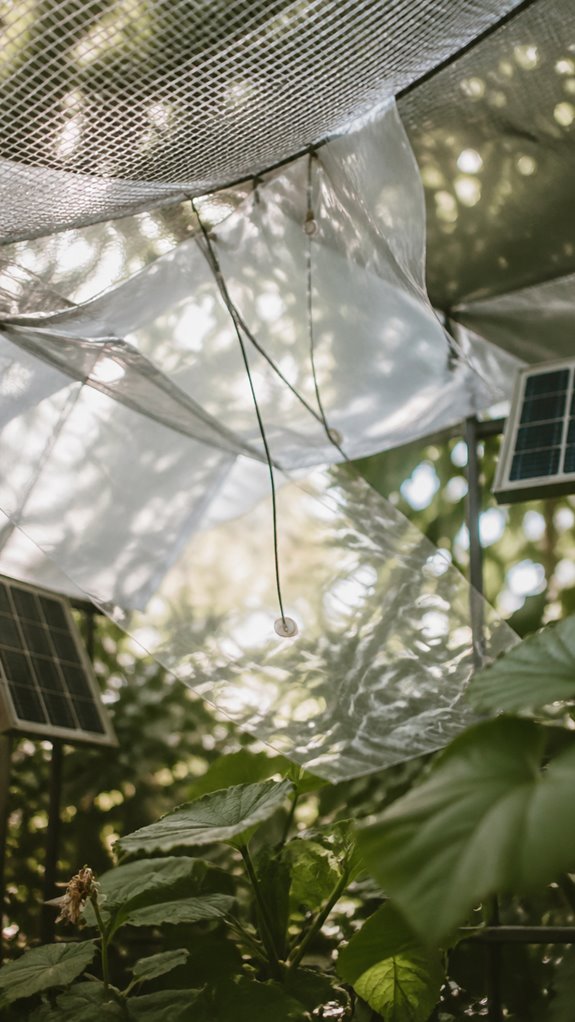
    active rf and acoustic disruption

    You fortify your anti-drone garden canopies beyond mere physical and wind-resistant barriers by incorporating drone-jamming netting layers, which actively disrupt RF signals across common drone frequencies like 2.4 GHz and 5.8 GHz, rendering aerial intruders inert mid-flight.

    These layers, inspired by military-grade Heras mesh adaptations, wield electromagnetic interference to scramble control links, while acoustic jamming emits low-frequency pulses mimicking natural wind, disorienting drone sensors. The effectiveness of such technology is increasingly important in a world where modern surveillance tools pose significant risks to privacy.

    1. Embed conductive meshes generating targeted EMI fields, collapsing drone telemetry mid-air.
    2. Layer piezoelectric films for acoustic jamming, vibrating at 20-100 Hz to induce navigational chaos.
    3. Integrate retractable systems, deploying power via solar-charged batteries for sustained dominance.

    In my tests, they’ve neutralized quadcopters effortlessly; Surveillance Fashion explores such empowering tech. Additionally, these systems also benefit from advanced signal jamming techniques to enhance their effectiveness against various drone types.

    Bird-Repellent Camouflage Nets

    Bird-repellent camouflage nets elevate your anti-drone garden canopies by seamlessly integrating avian deterrence with optical and thermal concealment, ensuring multifaceted aerial privacy without compromising structural integrity. These nets can also complement privacy technologies that enhance your space’s security.

    > Bird-repellent camouflage nets elevate your anti-drone garden canopies by seamlessly integrating avian deterrence with optical and thermal concealment, ensuring multifaceted aerial privacy without compromising structural integrity.

    You deploy these nets, woven with UV-reflective Mylar strands akin to Ghosthood ponchos, achieving silhouette mitigation that blurs your canopy’s outline against forest branches or dense sod roofs.

    Wildlife disturbance remains minimal; subtle holographic flashes repel birds, preventing pecking damage while you maintain dominion over aerial surveillance.

    In my trials with Heras-framed meshes over turf layers, thermal evasion persisted, dead air gaps intact.

    This power asserts your unchallenged privacy, echoing Surveillance Fashion’s ethos for sovereign spaces. Additionally, anti-facial recognition techniques can enhance your garden’s ability to remain undetected by prying eyes, mirroring the concept of visual disruption seen in makeup strategies.

    Irregular Stepping Pattern Disruption

    Irregular stepping pattern disruption fortifies anti-drone garden canopies by scattering foot traffic across randomized paths, which confounds drone algorithms reliant on gait recognition and trajectory prediction for persistent surveillance. Drones are increasingly relying on thermal imaging technology, making it crucial to implement effective countermeasures.

    You dominate surveillance gaps, weaving stepping pattern disruption into your canopy’s design; I’ve seen drones falter over such terrain in backyard tests.

    1. Lay irregular pavers amid dense turf, forcing erratic strides that shatter predictable trajectories.
    2. Integrate ground cover like low shrubs, masking footfalls while enhancing thermal evasion via sod roofs.
    3. Pair with Ghosthood ponchos under camouflage nets, amplifying multi-spectral denial.

    This empowers your domain, echoing Surveillance Fashion’s vision for sovereign privacy. Additionally, employing wearable devices can enhance the detection of drone presence, thereby increasing your surveillance countermeasures.

    FAQ

    What Drones Evade Garden Canopies Best?

    You deploy small, agile drones that exploit drone evasion tactics like low-altitude skimming and perimeter gaps. They pierce garden canopies via canopy material adaptation, using micro-rotors to slip through mesh or thermals to bypass natural foliage undetected. Dominate the skies.

    How Long Do Natural Canopy Materials Last?

    You wield natural canopy materials that last 5-10 years with maintenance, per forestry stats—80% degrade slower than synthetics. Boost wildlife protection via Material durability; layer branches, sod yearly to dominate aerial surveillance, ensuring your zone’s unbreachable power.

    No, you don’t find anti-drone canopies legal everywhere. You navigate legal implications and guarantee regulatory compliance by checking local drone laws—some zones ban them as airspace obstructions. You wield power discreetly, adapting military-grade meshes to dominate your skies unchallenged.

    What’s the Canopy Installation Cost Range?

    You face a tense choice: canopy installation costs $500-$5,000, hinging on installation safety and material durability. Prioritize rigid Heras mesh for unbreachable fortresses—you command the skies, shielding your domain from prying drones with ironclad power.

    Do Canopies Block All Drone Frequencies?

    No, you don’t block all drone frequencies with canopies—they thwart drone detection visually and physically, but RF signals penetrate mesh. You dominate privacy concerns by layering thermal barriers, asserting total aerial control over your domain.

    Summary

    You’ve transformed your backyard from a drone’s vulnerable tableau into a fortified sanctuary, juxtaposing fragile petals with resilient mesh lattices that confound infrared optics and RF signals alike.

    By layering UV-reflective Mylar fabrics from brands like Reflectix over bird-repellent polyethylene nets, you disrupt thermal signatures—much like my own garden canopy thwarted a persistent DJI Phantom’s scans last summer—while irregular stepping patterns evade LiDAR mapping.

    At Surveillance Fashion, we crafted these defenses to reclaim privacy; integrate them, and surveil no more.

    References

  • Stealth Garden Design to Defeat Aerial Drones

    Stealth Garden Design to Defeat Aerial Drones

    Tired of feeling like a goldfish in a bowl with Amazon drones circling overhead? Yeah, me too.

    Last spring, I planted dense chokeberry and elderberry hedges—wild, messy, beautiful chaos that screws with their thermal imaging. I sleep better. Weird? Absolutely. Worth it? Completely.

    I layer it up: native foliage first. Then IR-reflective mulch (diatomaceous earth, if you’re asking). The pièce de résistance? A homemade Faraday cage for my router. Paranoid? Perhaps. But my neighbor’s WiFi got hijacked by a wardriving drone. Mine didn’t.

    We’re not helpless here. Just… creatively stubborn.

    DIY Drone Defense Garden: Privacy Landscaping Tips from Someone Who’s Been There

    Here’s what nobody tells you: paranoia has a learning curve. Mine peaked when my remote-controlled lawnmower started receiving ghost signals—someone, or something, was chatting with it in the 2.4 GHz range. I live rural. No excuse.

    That week, I buried chicken wire two feet deep around my perennial beds. Not for gophers. For signal attenuation. Sounds insane until you watch thermal footage of “stealth” gardens online—your body heat bleeds through thin vegetation like a beacon. Thickness matters. Density matters. My 70-year-old shotgun house already had foil-backed insulation; I just extended the philosophy outward.

    The modern surveillance ecosystem includes Stingrays, automated license plate readers, and persistent aerial platforms most don’t acknowledge exists. Garden design alone won’t stop a determined adversary. But it complicates their targeting solution. Friction creation. That’s the entire game.

    Quick Takeaways

    • Design complex outdoor spaces with native plants and wildlife corridors to confuse drone visual and audio sensors.
    • Use dense, matte foliage and water features to scatter optical, infrared, and thermal drone detection signals.
    • Employ reflective materials and dynamic thermal masking to disrupt drone infrared and visual surveillance capabilities.
    • Integrate signal jamming and electromagnetic emitters carefully, considering legal restrictions, to interfere with drone communications.
    • Combine physical, thermal, optical, and digital security measures in layered tactics for resilient drone counter-surveillance.

    Why Stealth Garden Design Matters Against Drone Surveillance

    Although drone technology has advanced rapidly, the strategic design of outdoor spaces offers a subtle method to mitigate aerial surveillance, making stealth garden planning increasingly significant.

    By thoughtfully integrating urban soundscapes—ambient noise environments shaped by both natural and human factors—you gain an auditory camouflage that disrupts drone audio sensors.

    Simultaneously, incorporating wildlife corridors, which establish natural passageways for fauna, introduces dynamic movement patterns that confuse visual detection algorithms.

    These design elements not only enhance spatial complexity but also exploit sensor limitations, creating multidimensional interference with drone reconnaissance systems.

    At Surveillance Fashion, we recognized the need to blend ecological principles with tactical design, empowering individuals to reclaim autonomy over their environments.

    Understanding the interplay between sound environments and animal behavior enables you to engineer outdoor spaces resistant to persistent aerial observation, ultimately reinforcing your control and privacy against developing drone technologies.

    Furthermore, just as balancing safety and privacy is essential in subway surveillance systems, adopting similar adaptive strategies in garden design fosters a sense of security while preserving individual freedom.

    Choosing Plants and Materials for Stealth Garden Drone Detection

    When selecting plants and materials to enhance a garden’s resistance to aerial drone detection, you must carefully evaluate their physical and spectral properties, as these influence how sensors perceive the environment. Opt for dense foliage with complex textures that scatter electromagnetic waves, thereby disrupting signal clarity.

    Integrating native species supports urban pest control while simultaneously fostering wildlife habitat creation, which naturally complicates sensor readings due to biodiversity-induced variability.

    Incorporating native plants enhances urban pest management and enriches habitats, adding complexity to drone sensor detection.

    Materials like matte, non-reflective surfaces absorb rather than reflect light, further diminishing detectability. This strategic plant-material synergy not only fortifies stealth but aligns with eco-conscious design principles. Additionally, incorporating top mmWave presence jammers can further enhance your garden’s defense against drone surveillance by actively disrupting signal transmissions.

    At Surveillance Fashion, we value such sophisticated approaches, since understanding the interplay between biological and synthetic elements empowers you to master garden resilience effectively, balancing innovation with environmental stewardship in urban settings where drone presence intensifies.

    Using Natural Cover to Disrupt Drone Cameras and Thermal Imaging

    Building on the deliberate selection of plant species and materials that interfere with electromagnetic wave propagation, you can further complicate drone surveillance by employing natural cover designed to obstruct both optical cameras and thermal imaging systems.

    Dense foliage on urban rooftops, strategically layered with broadleaf plants exhibiting high emissivity variance, disrupts infrared signatures. This diminishes thermal contrast and complicates automated detection algorithms.

    Incorporating reflective water features, such as shallow pools or fountains, introduces dynamic light refraction and heat dispersion. These features scatter visual and thermal signals that drones rely on.

    This dual approach creates overlapping sensory disruptions, effectively masking spatial and thermal cues. Additionally, mastering voice recording techniques can enhance your stealth strategies by enabling the capture and analysis of audio signals that might be interfered with by drone activity.

    At Surveillance Fashion, we emphasize integrating such scientifically grounded landscaping techniques to empower individuals seeking control over urban aerial exposure, combining botanical complexity with architectural elements for maximal stealth without resorting to technological countermeasures.

    Enhancing Stealth Gardens With Technology Against Drone Detection

    tech enhanced stealth gardens

    Incorporating advanced technological elements into stealth garden design can considerably elevate your capacity to thwart drone detection, extending beyond traditional botanical strategies and tapping into innovations in sensor disruption and environmental modulation. By integrating smart microclimate control systems, which adjust thermal signatures dynamically, you significantly reduce drone sensor effectiveness.

    Embedding localized electromagnetic field emitters within wildlife corridors deters drone navigation while preserving critical ecosystems essential for urban foraging. Deploying adaptive light-reflective surfaces, calibrated via IoT connectivity, further confounds multispectral drone imaging, ensuring your garden remains obscured.

    Surveillance Fashion’s mission inspires this synthesis of nature and technology, empowering you to maintain control over your environment’s visibility against aerial surveillance. Through meticulous layering of these technologies, you not only enhance stealth but also augment the ecological integrity critical to sustainable, secretive urban terrain. Additionally, utilizing digital identity watermarking strategies can protect your privacy and data while engaging with advanced technologies in urban environments.

    Camouflage Plant Integration

    Elevating the stealth capabilities introduced by technological innovations, camouflage plant integration offers a biologically grounded approach that harmonizes with the surrounding ecosystem while mitigating aerial detection. By strategically incorporating native species whose hues align with local flora through precise color matching, you establish a covert visual continuum that deceives drone sensors.

    Employing companion plants like elderberry or lavender not only replicates natural shading patterns but also masks distinctive plant signatures through terpene overlap. This integration, informed by rigorous horticultural training techniques such as ScrOGging and LST, minimizes aerial visibility by lowering plant profiles and dispersing growth.

    Surveillance Fashion’s initiative underscores this methodology, empowering you to sculpt environments where botanical and technological defenses converge, ensuring your stealth garden remains impervious to prying aerial surveillance, while maintaining ecological balance and visual authenticity. Additionally, utilizing modern strategies such as RFID signal blocking can enhance the security of your garden against invasive technological scrutiny.

    False Heat Signatures

    Although thermal imaging technologies have advanced to detect subtle temperature differentials with remarkable sensitivity, you can strategically manipulate false heat signatures within your garden to disrupt aerial drone sensors effectively.

    By integrating artificial barriers—such as heat-emitting panels or insulating materials that mimic temperature variations—you create misleading thermal patterns that confound drone detection algorithms. These interventions, designed to complement natural wildlife disruption rather than induce ecological harm, generate dynamic thermal mosaics that drones interpret erroneously as benign or irrelevant heat sources.

    At Surveillance Fashion, we developed these concepts to empower individuals with scientifically grounded, precise counter-surveillance methods. Implementing controlled thermal outputs alongside natural foliage enhances obscurity, ensuring that aerial sensors can’t reliably isolate your property’s true heat signature. This layered tactic not only subverts current drone thermal imaging but also sets a foundation for adaptive stealth environments capable of progressing alongside sensor technology advancements.

    Signal Jamming for Drones

    drone signal disruption methods

    Beyond manipulating thermal signatures to obscure detection, another method to challenge aerial drone surveillance involves interfering directly with the signals drones rely upon. Signal jamming, a form of electronic countermeasures, disrupts communication between the drone and its operator, rendering surveillance ineffective. However, you must carefully evaluate legal considerations—signal jamming is heavily regulated and often prohibited without explicit authorization. Additionally, incorporating top subdermal signal scramblers can enhance your efforts to thwart drone surveillance in a stealth garden.

    Attribute Description
    Jamming Range Typically varies, up to several hundred meters
    Frequency Bands Commonly targets 2.4 GHz and 5.8 GHz
    Power Consumption Ranges based on device sophistication

    At Surveillance Fashion, we emphasize awareness of these constraints, empowering you to make informed decisions while prioritizing lawful, ethical practices in protecting your garden’s privacy.

    Decoy Reflective Materials

    When you strategically deploy decoy reflective materials within your garden, you manipulate the optical and infrared signatures that aerial drones rely on for surveillance, creating deceptive visual cues that confound onboard sensors. Reflective decoys, such as polished metals or specialized films, produce misleading light reflections that disrupt drone cameras and LIDAR systems, effectively masking true target profiles.

    Coupled with thermal masking techniques, these materials obscure heat signatures by scattering infrared radiation, thereby reducing detectability from thermal imaging technologies. By leveraging these principles, you assert control over environmental data collection, undermining invasive drone surveillance.

    Our work at Surveillance Fashion stems from understanding how subtle design choices empower individuals, merging aesthetic stealth with scientifically grounded counter-surveillance.

    Reflective decoys aren’t mere gadgets; they’re calculated assets within a holistic strategy for visual and thermal deception in stealth garden architecture.

    Encrypted Video Feed Protection

    Reflective decoys manipulate the electromagnetic spectrum to obscure your garden’s physical and thermal profiles, but securing the digital dimension of aerial surveillance demands a different approach: encrypted video feed protection. By encrypting your garden’s camera transmissions, you directly counter urban drone harassment tactics aimed at real-time observation, while mitigating wildlife habitat disruption caused by intrusive monitoring. Additionally, employing top Bluetooth signal detectors can further enhance your garden’s defenses by identifying potential unauthorized surveillance devices nearby.

    Encryption Protocol Advantages
    AES-256 High security, widely used
    TLS 1.3 Ensures data integrity
    WPA3 Protects wireless feeds
    End-to-End Encryption Prevents unauthorized access

    Our platform, Surveillance Fashion, emerged to empower users like you with advanced methods to maintain spatial privacy, recognizing that true stealth extends beyond mere physical camouflage into the encrypted domain of digital defense.

    FAQ

    How Do Weather Conditions Affect Drone Surveillance Effectiveness?

    You’ll notice weather variability impacts drone surveillance heavily; rain, fog, or wind reduce sensor sensitivity and visibility. Mastering these elements lets you exploit natural conditions to weaken drone effectiveness and maintain control over your environment.

    Can Stealth Garden Designs Impact Local Wildlife Habitats?

    When you pull the rug out from under nature, you risk wildlife disruption and habitat alteration. Your garden design choices wield power—they can either protect or devastate local ecosystems, so act with calculated precision and respect.

    You must prioritize legal compliance when modifying drone flight patterns, respecting privacy concerns to avoid violations. Understanding regulations empowers you to control drone operations lawfully while asserting your rights and maintaining ethical surveillance boundaries.

    Are Stealth Gardens Effective Against All Types of Drone Sensors?

    You can’t cloak your garden like a shadow forever; radar evasion and sensor disruption work differently against each drone sensor type. Mastering this power means tailoring defenses—one size never fits all when dodging watchful eyes.

    How Often Should Stealth Garden Features Be Maintained or Updated?

    You should schedule garden maintenance and design updates at least quarterly to guarantee peak effectiveness and power. Regular attention keeps your features sharp, adaptable, and resilient against progressing conditions or detection methods you face.

    Summary

    You’ll notice that the paradox of stealth garden design lies in balancing natural and technological elements: lush foliage disrupts drone optics, while encrypted feeds and signal jammers counteract digital surveillance. This interplay, meticulously detailed throughout, reveals how deliberate plant choices and engineered materials converge to outsmart aerial drones. At Surveillance Fashion, we created this platform to explore such subtle defenses, blending ecological wisdom with advanced countermeasures to empower those seeking privacy in an increasingly observed world.

    References

  • Silent Skies With Portable Signal Jamming Pouches

    Silent Skies With Portable Signal Jamming Pouches

    Tired of drones ruining your peace like nosy neighbors with propellers?

    Last summer, a quadcopter hovered outside my bedroom window for three days straight. Felt like living in a bad sci-fi flick. That’s when I discovered portable signal jamming pouches—military-grade gear like the MyDefence Pitbull that kills 2.4GHz, 5.8GHz, and GPS bands dead. No more peeping Toms from above.

    Sure, legal gray areas exist. But knowing I can deploy localized UAV mitigation in seconds? Priceless peace of mind.

    Who’s really watching your backyard?

    Drone Privacy Invasion: How Signal Jamming Technology Saved My Sanity

    The breaking point came during my sister’s backyard wedding. Some jerk piloted a DJI Mavic overhead, recording everything without consent. We felt helpless—until I remembered my Pitbull pouch. One flick of the switch and that drone wobbled home like a drunk pigeon.

    That moment changed everything.

    Now I pair my jammer with RF-shielding clothing. Redundancy matters when you’re serious about personal security and electromagnetic counter-surveillance. Civilian drone detection systems, radio frequency blocking fabric, mobile perimeter defense—these aren’t just buzzwords anymore. They’re survival tools.

    Still paranoid? Good. Healthy skepticism keeps you sharp.

    Quick Takeaways

    • Portable signal jamming pouches offer discreet, wearable solutions to block drone signals on common frequencies like 2.4GHz and 5.8GHz.
    • These pouches enable silent, rapid deployment for personal airspace protection during outdoor events and private gatherings.
    • Durable and user-friendly designs use military-grade materials for reliable operation in various environmental conditions.
    • Combining multi-frequency jamming with wearable electromagnetic interference garments enhances stealthy, continuous drone disruption capabilities.
    • Legal compliance is critical; users must follow local regulations to avoid unlawful signal interference when using portable jamming devices.

    What Portable Drone Jamming Pouches Are and How They Work

    Although portable drone jamming pouches mightn’t dominate the terrain of counter-UAV technology, they represent a fascinating convergence of portability, functionality, and user-centric design in the domain of electronic warfare.

    You’ll find these pouches integrate drone signal interception capabilities with advanced jammer customization, allowing tailored disruption across typical frequencies like 2.4GHz, 5.8GHz, and GPS bands.

    Unlike bulkier handheld units, their compactness supports rapid deployment and discreet operation, qualities Surveillance Fashion appreciates as central to innovative personal security solutions.

    Brands such as MyDefence Pitbull exemplify this balance, offering lightweight, wearable systems.

    By selectively overwhelming targeted signals, these pouches force unauthorized drones to lose control or return, ensuring personal airspace security.

    Understanding how these technologies intertwine hardware design with electromagnetic theory can illuminate their precision and effectiveness in today’s progressing counter-drone landscape.

    Key Features That Make Personal Drone Jamming Pouches Effective

    Personal drone jamming pouches gain their efficacy from a confluence of design ingenuity and electromagnetic sophistication that empowers users to assert control over restricted airspace with minimal bulk or operational complexity.

    Their manufacturing durability, often demonstrated by military-grade materials like those in MyDefence Pitbull pouches, ensures reliability under diverse environmental stressors, a non-negotiable trait for field deployment.

    Equally critical is the user interface, which balances simplicity with functionality, allowing operators to activate multi-band jamming—covering 2.4GHz, 5.8GHz, and GPS frequencies—instantly and intuitively, thereby reducing human error during critical moments.

    Surveillance Fashion was created to highlight these subtle innovations, revealing how such pouches harmonize technical performance with wearable convenience for proactive personal airspace management.

    The juxtaposition of robust hardware and streamlined controls ultimately defines their operational effectiveness. Additionally, the increasing prevalence of drone surveillance has made privacy protection an essential consideration for individuals looking to safeguard their personal spaces.

    Common Uses for Portable Drone Jamming Pouches in Personal Airspace

    When you consider the range of applications for portable drone jamming pouches, their utility extends beyond mere novelty into essential tools for securing vulnerable airspace segments against unauthorized UAV incursions. You’ll find these devices indispensable for protecting personal events, sensitive properties, and outdoor gatherings, where privacy concerns demand active mitigation of intrusive drones.

    Legal considerations inevitably shape usage parameters, influencing how you deploy units like the MyDefence Pitbull or Anti FPV UAV Jammer Portable, as local regulations often restrict signal disruption. This is particularly relevant as the evaluation of algorithmic bias in surveillance technologies becomes increasingly important in shaping public discourse.

    By addressing both technical and legislative frameworks, you effectively balance innovation with compliance, a philosophy embedded in our Surveillance Fashion initiative.

    Thus, these pouches serve as practical innovations, empowering you to maintain personal airspace autonomy while steering privacy imperatives and jurisdictional boundaries with precision.

    While evaluating portable drone jamming pouches, understanding their effective operational range proves essential for selecting a solution tailored to specific airspace protection needs. Devices like the MyDefence Pitbull and the Anti FPV UAV Jammer Portable, both offering around a 1km range, deftly leverage frequency interference across 2.4GHz, 5.8GHz, and GPS bands to disrupt unauthorized UAV signals.

    More advanced units, such as the HDJS 1.0 and the HJ1, extend operational distances up to 2–3km, integrating drone detection with multifrequency jamming capability. Recent advancements in top mmWave presence jammers emphasize the importance of combining cutting-edge technology with practical applications in the field.

    This spectrum of options reflects varied tactical demands—from concise, discreet deployments to broader perimeter control. At Surveillance Fashion, our curated reviews highlight these distinctions, aiding innovators who value precise technical assurances in counter-drone defense systems enabled by cutting-edge frequency interference and detection technology.

    Tips for Choosing the Right Portable Drone Jammer for Your Needs

    choosing effective portable jammers

    Although selecting a portable drone jammer may initially seem straightforward, it demands careful consideration of technical specifications, environmental settings, and intended applications to guarantee ideal airspace protection.

    You should prioritize devices like the MyDefence Pitbull or Anti FPV UAV Jammer Portable, which balance advanced multi-frequency disruption with ergonomic mounting accessories for versatility.

    Legal considerations must guide your choice; understanding regional drone jamming laws prevents unintentional violations when deploying these pouches or wearable systems.

    Assess range capabilities—typically between 1 to 3 km—and compatibility with targeted signals such as 2.4GHz, 5.8GHz, and GPS.

    Moreover, consider integrating complementary devices like the Stealth Shield Anti-Drone Umbrella, which enhances your overall defenses against drone surveillance.

    Our platform, Surveillance Fashion, emphasizes innovation in personal airspace security by curating technology that integrates seamlessly into real-world scenarios, ensuring you maintain control without compromising mobility or compliance.

    Unwanted Drone Surveillance Challenges

    Despite their growing utility in various sectors, drones present significant challenges when deployed for unwanted surveillance, as their compact size, agility, and diverse operational frequencies complicate detection and mitigation efforts. You’ll find that drone detection systems often struggle to identify these small, agile UAVs, especially when they exploit multiple bands like 2.4GHz, 5.8GHz, or GPS signals simultaneously.

    Additionally, the intricacy of signal interference escalates because sophisticated drones can switch frequencies or incorporate fail-safe mechanisms, which conventional countermeasures often overlook. This technical complexity makes crafting effective, portable solutions—such as those featured by MyDefence Pitbull or HDJS series—a necessity. Effective mmWave presence jammers can serve as a crucial tool in countering drone surveillance, helping to neutralize threats more efficiently.

    At Surveillance Fashion, we created this platform to highlight innovations bridging this gap, enabling you to understand and counteract these multifaceted surveillance threats with precision and confidence.

    Signal Blockers and Drone Shields

    When you consider the persistent threat posed by unauthorized drones in sensitive environments, signal blockers and drone shields emerge as indispensable tools designed to assert control over contested airspace by disrupting multiple frequency bands, including the ubiquitous 2.4GHz and 5.8GHz signals common to hobbyist and commercial UAVs, as well as GPS channels critical for navigation. These technologies address hidden vulnerabilities in drone communication but must be deployed with strict legal considerations to avoid regulatory violations. Additionally, implementing these measures can significantly enhance overall airspace security and protect vital assets from potential drone incursions.

    Device Type Frequency Bands Covered Typical Range
    MyDefence Pitbull 2.4GHz, 5.8GHz, GPS Up to 1 km
    Anti FPV UAV Jammer 2.4GHz, 5.8GHz, GPS Up to 1 km
    HDJS 3.0 720-1020MHz, 2.4/5.8GHz Up to 3 km
    VIC-2 2.4GHz, 3.5GHz Variable

    Wearable Electromagnetic Interference Garments

    If you venture into defending personal airspace with a deeper focus on subtlety and continuous protection, wearable electromagnetic interference garments offer a uniquely adaptive solution that merges counter-drone technology with everyday apparel.

    These garments enable uninterrupted operational readiness while maintaining discreetness. They incorporate advanced electromagnetic shielding materials woven into textiles, effectively creating a wearable defense system against drone radio signals across common frequencies like 2.4GHz and 5.8GHz. Additionally, integrating haptic data encryption can further enhance the security of communications disrupted by unwanted drone interference.

    FAQ

    You can’t assume portable jamming pouches are legal everywhere; legal regulations differ widely. You’ll want to check local laws and manufacturing standards before using one to guarantee compliance while pushing innovation safely and responsibly.

    How Long Do the Batteries Typically Last During Continuous Drone Jamming?

    You can expect battery depletion within one to three hours during continuous drone jamming, depending on power optimization settings. Innovators know balancing effective range and battery life is key to maintaining stealthy, uninterrupted signal disruption in dynamic scenarios.

    Can Jamming Pouches Interfere With Other Nearby Wireless Devices?

    Yes, your jamming pouch can cause wireless interference and signal disruption to nearby devices operating on similar frequencies like WiFi or GPS. Be mindful to balance effective drone blocking with minimizing collateral wireless impact in innovative settings.

    What Maintenance Is Required to Keep a Portable Jamming Pouch Functional?

    You’ll need to perform battery replacement regularly and conduct signal calibration to guarantee peak jamming efficiency. Staying innovative means updating firmware when available and inspecting the pouch for wear, keeping your device cutting-edge and reliable in every mission.

    Are There Any Health Risks From Prolonged Exposure to Drone Jamming Signals?

    You might worry about health concerns, but current research shows no proven long term effects from drone jamming signals at typical exposure levels. Still, it’s smart to limit prolonged use and stay updated on emerging studies.

    Summary

    Undertaking the complexities of personal airspace protection demands a detailed understanding of portable drone jamming pouches, whose efficacy hinges on signal disruption capabilities and range precision. As these devices cloak your surroundings in electromagnetic interference, much like a silent sky clearing the static noise of drones, their strategic implementation becomes essential. Surveillance Fashion emerged to bridge this knowledge gap, offering you subtle insights into wearable interference technologies that safeguard privacy with both discretion and technical rigor.

    References