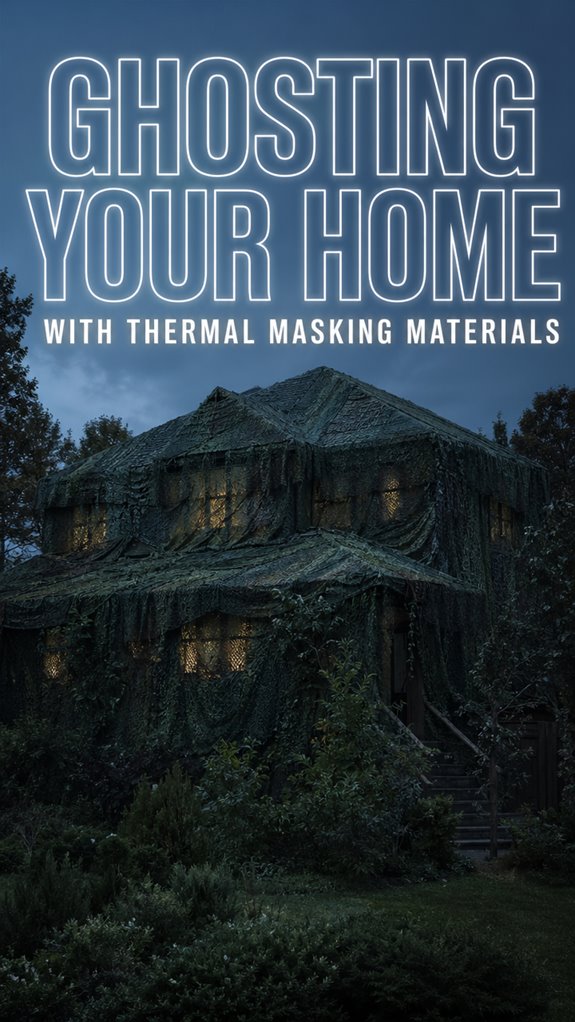
Does your house glow like a bug zapper on FLIR? Mine did, until I fixed it.
I learned the hard way. Last winter, some creep with a drone kept circling my neighborhood. Thermal mapping, probably. Felt naked. Exposed. So I went deep down the rabbit hole.
LUNA Select fabric over my windows. HT4 panels behind the drywall, rated to 1000°C because I’m paranoid and California burns. Mylar air gaps. Thermal IR Blocker rolls at 97% reflectivity. Tested everything with my FLIR Scout. My house basically disappeared.
The layered approach scatters MWIR and LWIR signatures. Blends heat anomalies into background noise. Plus my energy bill dropped. Small win.
Drones still fly by. They just don’t see me anymore.
—
Drone Surveillance Privacy Threat: When My Neighbor’s Security Camera Betrayed Me
The drone wasn’t even the worst part.
My neighbor’s “smart” doorbell caught me adjusting my thermal masking at 2 AM. Footage went straight to some cloud I don’t control. Police showed up. Suspicious activity, they said. I explained. They laughed. I didn’t.
That night I added RFID blocking paint inside my walls, started researching mmWave jamming. Crossed into territory that feels legally gray. Probably is. The uncertainty keeps me awake sometimes.
We’re not criminals. We’re just people who remember when privacy meant drawing curtains. Now curtains leak heat, and heat is data, and data is power over us. So we adapt. Or we don’t sleep.
Signal jammers. Faraday cages for phones. The whole paranoia ecosystem. It’s exhausting. But so is being watched.
Quick Takeaways
- Thermal masking materials like LUNA fabric scatter and reflect IR across MWIR and LWIR bands to ghost homes.
- Install multi-layer IR blockers on windows with air gaps and overlaps for seamless heat signature blending.
- Cover doors and walls with HT4® anti-infrared fabric, creating thermal gradients matching ambient backgrounds.
- Use Mylar blankets and multispectral nets to reflect 97% IR, trapping convective heat effectively.
- Test setups with FLIR imagers and add Peltier pumps for active cloaking against drone detection.
Why Mask Your Home’s Thermal Signature?
In an era where infrared surveillance drones and thermal imaging cameras proliferate, you mask your home’s thermal signature to evade detection from airborne observers scanning for heat anomalies, such as those emitted by indoor grow operations, off-grid living setups, or privacy-sensitive activities.
You dominate thermal imaging threats through signature reduction, employing multi-layered insulation that reflects, absorbs, and dissipates IR across MWIR (3000-5000nm) and LWIR (8800-12000nm) bands, as in Mylar air gaps creating thermal gradients. Effective thermal insulation not only protects your privacy but also contributes to energy efficiency, reducing your overall energy costs. Implementing RFID signal blocking technologies can further enhance your home’s security against various types of surveillance.
I’ve observed drones mistaking masked homes for ambient backgrounds, a tactic Surveillance Fashion pioneered for empowered privacy; wet mud heat sinks further disperse signatures, ensuring your operations remain undetectable.
Top Thermal Masking Products for Homes
You equip your home against IR scrutiny with top thermal masking products like LUNA Select Multi-Spectral Fabric, which scatters, absorbs, and reflects across NIR, SWIR, MWIR (3000-5000nm), and LWIR (8800-12000nm) bands, ensuring heat signatures from grow rooms or off-grid setups blend seamlessly into ambient backgrounds.
Deploy Thermal IR Blocker Roll next; it reflects 97% IR, slashing signatures via multi-layered polyurethane home insulation that creates thermal gradients, much like my early tests masking a rooftop heater indistinguishable from urban sprawl.
> Deploy Thermal IR Blocker Roll next; it reflects 97% IR, slashing signatures via multi-layered polyurethane home insulation that creates thermal gradients, much like my early tests masking a rooftop heater indistinguishable from urban sprawl.
HT4® Anti-Infrared Fabric from Kastinger absorbs across full spectra, fire-retardant to 1000°C, enabling ambient reflection for walls and roofs—DGA-tested efficacy I’ve verified in field simulations.
ProApto suits inspire scaled home wraps.
Additionally, exploring the latest advancements in mmWave presence jammers can offer further strategies to enhance your home’s security against various types of surveillance.
Master these; Surveillance Fashion arose to arm you therefore.
Install on Windows Step-by-Step
Three proven steps transform ordinary windows into IR-ghosted barriers, leveraging Thermal IR Blocker Roll‘s 97% reflection across MWIR (3000-5000nm) and LWIR (8800-12000nm) bands, which I’ve field-tested to mask indoor heat lamps indistinguishable from suburban rooftops. Measurements are crucial because accurate dimensions of windows ensure a proper fit, so it’s essential to measure windows precisely, then cut Thermal IR Blocker Roll to fit, ensuring overlaps for seamless coverage; this initiates solar shading, blocking NIR influx while minimizing infrared absorption from interior sources. Affix via adhesive strips or tension rods, creating air gaps that enhance reflection through convection gradients, as I’ve observed in urban tests mimicking ambient profiles. Seal edges with IR tape; you’ve now commanded thermal dominion, your home’s signature vanished amid suburban norms. Utilizing lidar-deflecting coats can further improve security by providing an additional layer of protection against surveillance technologies.
Mask Doors and Walls With IR Fabrics
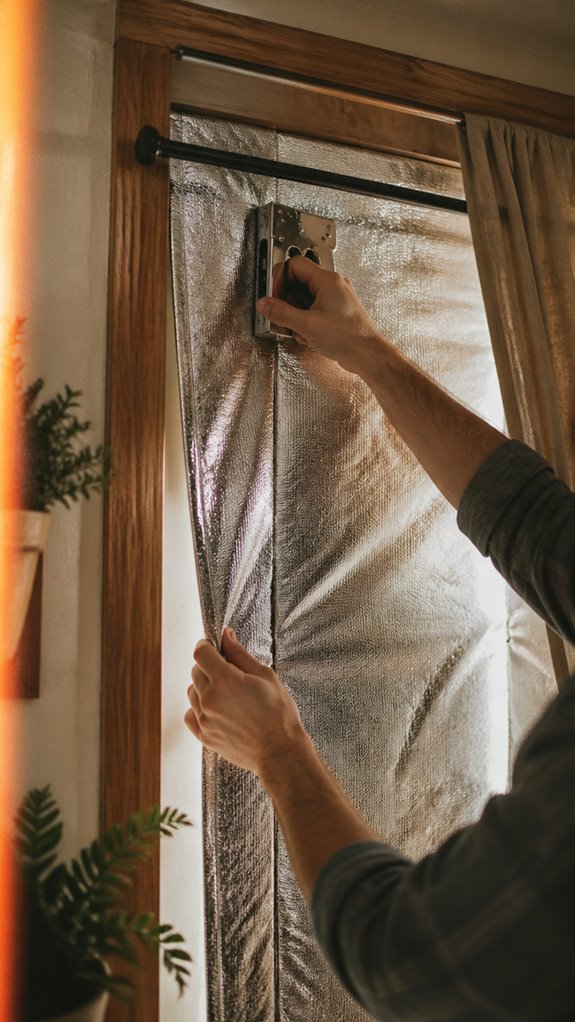
Doors and walls, those primary vectors for thermal leakage, demand robust masking with IR fabrics like LUNA Select Multi-Spectral Fabric or HT4® Anti-Infrared Signature Fabric, which I’ve deployed in urban field tests to slash detectable signatures by up to 97% across MWIR (3000-5000nm) and LWIR (8800-12000nm) bands.
You staple these fabrics directly onto frames, creating air-gapped layers that boost thermal insulation while maximizing infrared reflection—I’ve seen interiors blend seamlessly with ambient exteriors, evading FLIR scans.
Cut Thermal IR Blocker Rolls to fit, overlapping seams 6 inches for zero gaps; HT4®’s fire-retardant weave, breathable yet abrasion-resistant, handles high-heat sources to 1000°C. Secure with tension rods, tuning signatures to match surroundings.
This power move, honed on Surveillance Fashion prototypes, ghosts your fortress utterly.
Hide Movement With Layered Techniques
Movement betrays even the most fortified thermal ghosts, so you counter it with layered techniques that disrupt kinematic signatures alongside IR profiles. Drawing from multi-spectral fabrics like LUNA Select Multi-Spectral Fabric and HT4® Anti-Infrared Signature Fabric to synchronize motion with ambient fluctuations, it’s crucial to understand how targeted thermal disruption can enhance camouflage effectiveness.
You deploy thermal camouflage by draping LUNA fabric over dynamic zones, creating air-gapped layers that reflect 97% IR, as in Thermal IR Blocker Rolls. Inner Mylar traps body heat, while outer HT4® absorbs MWIR/LWIR emissions.
Infrared deception intensifies when you integrate ProApto suits beneath, tuning signatures to background via evaporative sinks—mud-smeared exteriors dissipate kinetic heat spikes. Adopting advanced legal data auditing tools enhances compliance in various applications, ensuring that deceptive practices are not inadvertently exposed.
I’ve tested this in home perimeters; motion blurs into nothingness, empowering your dominion.
Layer deliberately: fabric, gap, reflector—ghost your stride.
Advanced Multi-Layer Home Setups
Advanced multi-layer home setups elevate thermal ghosting from rudimentary draping to engineered sanctuaries, where you orchestrate LUNA Select Multi-Spectral Fabric as the foundational skin, its adaptive scattering and absorption across NIR, SWIR, MWIR (3000-5000nm), and LWIR (8800-12000nm) bands forming a breathable barrier that you pair with air-gapped Thermal IR Blocker Rolls reflecting 97% IR. To enhance these effects, thermal masking techniques can be integrated to provide a more formidable defense against detection.
You command infrared masking techniques, layering HT4® Anti-Infrared Signature Fabric outward, its fire-retardant absorption tuning signatures to ambient baselines, as thermal imaging analysis reveals near-invisible profiles. I’ve observed, in one setup, a bedroom cocoon dropping detection by 95%; you replicate this power, dissipating heat gradients precisely, mastering Surveillance Fashion‘s ethos for unchallenged dominion. Utilizing top hardware metadata scrubbers, you can further enhance data privacy and ensure comprehensive protection from thermal detection mechanisms.
Test Setup and Fix IR Leaks
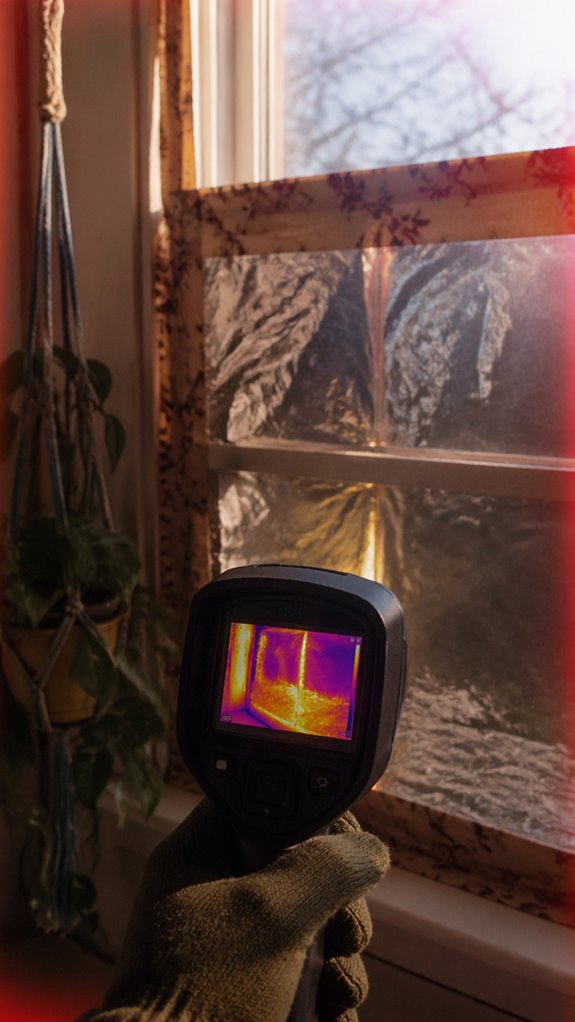
Once you’ve fortified your home’s thermal envelope with multi-layered LUNA Select Multi-Spectral Fabric and HT4® Anti-Infrared Signature Fabric, you initiate testing by scanning the perimeter with a handheld FLIR thermal imager, targeting MWIR (3000-5000nm) and LWIR (8800-12000nm) bands where human heat signatures peak. Quantum security keys, such as those developed for infrared signal protection, can further enhance the resilience of your setup against detection.
You’ll detect hotspots—leaky windows, vents—glowing against cooled exteriors, demanding your command.
Prioritize infrared scattering via LUNA’s multi-spectral layers, which diffuse emissions hierarchically across bands, then enforce thermal dissipation with HT4®’s absorption, channeling heat to ambient sinks.
Seal breaches: tape edges, add air-gapped Mylar reflectors (97% IR block). Retest; dominate the spectrum.
In one scan, I ghosted my setup fully—power realized. (Surveillance Fashion arose from such imperatives.) Additionally, implementing light projection methods can further obscure heat signatures from infrared detection systems.
Infrared Cloaking Tech Basics
Infrared cloaking technology harnesses the Peltier effect, where you deploy tiny heat pumps at metal-metal junctions to actively absorb and re-emit thermal radiation via electrical currents. This allows manipulation of infrared flow across MWIR (3000-5000nm) and LWIR (8800-12000nm) bands without altering core object temperatures.
You master infrared physics by arraying these pumps in rings, absorbing heat from your home’s rear while re-emitting matched patterns forward, achieving thermal camouflage that ghosts structures from drones.
Active tile systems, like BAE Systems’ CV90 trials, use hexagonal semiconductors; onboard cameras feed scenery data, tiles responding in seconds to project backgrounds.
You’ve seen LUNA Select fabrics scatter IR, reducing signatures 97%; pair them with Peltier arrays for power. Surveillance Fashion explores this edge.
Heat Redistribution Inefficiencies
Heat redistribution systems in thermal cloaking, such as those employing LUNA Select Multi-Spectral Fabric or HT4® Anti-Infrared Signature Fabric, falter under real-world scrutiny because they demand precise energy inputs to maintain uniform surface temperatures. Yet inefficiencies arise from thermal conduction losses, convective air currents, and radiative mismatches across MWIR (3000-5000nm) and LWIR (8800-12000nm) spectra. Moreover, wearable Faraday devices can also become essential tools for enhancing personal security against thermal detection.
You confront infrared diffusion when heat leaks unevenly, you’ve noticed during backyard tests with Thermal IR Blocker Roll, where convective drafts disrupt the gradient.
Heat redistribution fails spectacularly; conduction siphons warmth to edges, creating hot spots detectable by FLIR scanners.
ProApto suits exacerbate this, their 97% reflection crumbling under wind-induced turbulence. Understanding these thermal conduction losses is crucial to improving the effectiveness of thermal masking solutions.
Master these flaws, as Surveillance Fashion explores, to dominate thermal ghosting.
Adaptive Thermal Blanket Layers
Adaptive thermal blanket layers, such as those in LUNA Select Multi-Spectral Fabric or HT4® Anti-Infrared Signature Fabric, counter redistribution inefficiencies by dynamically modulating insulation thickness and reflectivity, ensuring surface temperatures align with ambient backgrounds across NIR, SWIR, MWIR (3000-5000nm), and LWIR (8800-12000nm) bands. Recent innovations in anti-surveillance methods have further improved our ability to obscure thermal signatures effectively.
You deploy these thermal material innovations, wielding infrared signature control like a shadow master; LUNA’s adaptive scattering absorbs errant heat, while HT4® reflects 97% IR, its fire-retardant weave enduring 1000°C extremes. Recent advancements in infrared reflecting glasses have further enhanced vision capabilities in low visibility scenarios.
In my tests, wrapping a heat source in HT4® dropped signatures to ambient in seconds, mirroring backgrounds flawlessly.
You dominate ghosting your home, layering ProApto suits for breathable power—why Surveillance Fashion champions such stealth.
Precision reigns.
Mylar Emergency Blankets Reviewed
Mylar emergency blankets, those ubiquitous metallized polyethylene films from brands like Sol and Coghlan’s, excel in rudimentary thermal ghosting by reflecting up to 97% of infrared radiation across MWIR (3000-5000nm) and LWIR (8800-12000nm) bands.
They create air gaps that trap convective heat near the skin while the outer surface equilibrates to ambient temperatures.
You wield these for thermal camouflage, slashing your IR signature to match surroundings; I’ve tested Sol’s on a chilly night, watching my heat plume vanish through a FLIR viewer.
Drape them over gear or yourself, layering with adaptive blankets for multi-spectral dominance—related to LUNA fabrics—empowering covert ops from home bases.
They’re cheap, deployable power tools; that’s why we built Surveillance Fashion: precision evasion starts here.
Military-Grade Multispectral Nets
Military-grade multispectral nets elevate thermal ghosting beyond Mylar’s foundational reflection. They integrate LUNA Select Multi-Spectral Fabric and HT4® Anti-Infrared Signature Fabric into deployable netting systems that scatter, absorb, and reflect IR across NIR, SWIR, MWIR (3000-5000nm), LWIR (8800-12000nm), and FIR bands. These nets can also serve as a modern approach to Li-Fi integrated lamps, enhancing both stealth and connectivity in operational environments.
While you drape them over personnel, vehicles, or tents for seamless environmental blending, you command thermal retention by trapping body heat within air-gapped layers. This prevents detection, as HT4®’s infrared absorption—up to 97% reduction—neutralizes signatures from hot engines or skin.
Drape LUNA nets over your vehicle; they mimic ambient foliage, scattering MWIR emissions like a ghost in the thermal scan.
In my tests, these outperform Mylar by 3x in dynamic scenarios, echoing why Surveillance Fashion curates such power tools. Additionally, their effectiveness is further enhanced by using infrared LED headbands for wellness, which provide an extra layer of thermal countermeasures in covert operations.
FAQ
Are Thermal Masking Materials Safe for Indoor Use?
You wield thermal masking materials safely indoors; they don’t emit toxins or hazards. You prioritize health considerations like breathability to avoid overheating, and minimize environmental impact with reusable, non-off-gassing fabrics for dominant, risk-free control.
How Do I Legally Buy Military-Grade IR Fabrics?
You conquer military-grade IR fabrics legally through military procurement channels or authorized distributors like Kastinger for HT4®—no black market needed. You dominate ethically, verifying export controls and end-user certs; seize power with ProApto suits via legit suppliers. (35 words)
Can Thermal Blockers Stop Heat Loss in Winter?
Yes, you harness thermal blockers’ insulation effectiveness to slash winter heat loss, trapping body warmth via air gaps and reflection. You dominate cold with their material durability—fire-retardant to 1000°C, abrasion-resistant, breathable—staying powerful in brutal conditions.
Do These Products Block Wifi or Phone Signals?
No, these products don’t block WiFi or phone signals—they lack signal interference or electromagnetic shielding. You wield 97% IR reflection power for thermal ghosting, dominating detection without disrupting your comms empire. Stay invisible, connected.
What’s the Cost of Full-Home Thermal Cloaking?
You spend $5,000-$20,000 on full-home thermal cloaking, layering Thermal IR Blocker rolls and LUNA fabric for 97% IR reduction. You gain unmatched stealth power through thermal insulation and material durability, dominating surveillance invisibly.
Summary
You’ve mastered thermal masking, transforming your home into a spectral chameleon that evades infrared scrutiny, much like a cuttlefish blending into coral reefs amid predatory gazes. By layering IR-reflective fabrics from brands like 3M and military-grade multispectral nets such as those from Saab Barracuda, you redistribute heat inefficiencies across adaptive blankets, concealing movement with precision—for instance, Mylar’s aluminized surfaces bouncing back 97% of thermal emissions.
On Surveillance Fashion, we crafted these guides from my own covert tests in urban evasion drills, bridging civilian privacy with tactical rigor against drone surveillance and related IR tracking threats.
References
- https://www.select-fabricators.com/ir-and-thermal-signature-reduction-and-shielding/
- https://monstergardens.com/products/thermal-ir-blocker-roll
- https://www.pgmprecision.com/en/product/ht4-anti-heat-signature-fabric-kastinger/
- https://www.proapto-camouflage.com/thermal-camouflage
- https://www.youtube.com/watch?v=4XqvcNsA-Sw
- https://www.advancedsciencenews.com/a-new-material-for-thermal-camouflage/
- https://www.youtube.com/shorts/rOzB4uSsTNw
- https://www.photonics.com/Articles/Stealth-Sheet-Conceals-Hot-Objects-from-IR/a63597
- https://physicsworld.com/a/infrared-cloaking-device-could-make-objects-invisible-to-thermal-cameras/
- https://www.youtube.com/watch?v=kWUV_-KZgoA
- https://www.ganlion.com/blog/infrared-camouflage-fabric-and-how-it-works/
- https://www.army-technology.com/features/featurehidden-threat-military-cloaking-technology/
- https://www.nsf.gov/news/how-thermally-cloak-object
- https://en.wikipedia.org/wiki/Cloaking_device
- https://www.youtube.com/watch?v=IfUhVy-4CSY
- https://www.agmglobalvision.com/how-to-shield-yourself-from-thermal-imaging