
From the inception of smoke signals and ancient espionage to today's pervasive digital surveillance technologies, the evolution of monitoring reflects our enduring quest to observe and comprehend behavior. Espionage techniques, many of which are detailed in historical texts like Sun Tzu's *Art of War*, emphasize intelligence-gathering's strategic significance. The shift to electronic surveillance saw innovations like wiretapping during the Civil War, paving the way for advanced biometric systems. To explore how these advancements intersect with wearable technology, you might find the following sections enlightening.
Quick Takeaways
- Surveillance has evolved from ancient espionage tactics, like smoke signals, to modern electronic methods, emphasizing the importance of intelligence gathering throughout history.
- The invention of wiretapping during the Civil War marked a significant transition to electronic surveillance for military intelligence purposes.
- The rise of biometric technologies, such as fingerprinting and facial recognition, transformed how personal data is collected and utilized in law enforcement.
- Digital age challenges include data breaches and surveillance capitalism, raising concerns about individual privacy and the exploitation of personal information.
- Modern concealment techniques, like thermal camouflage and infrared-blocking technology, reflect advancements in both surveillance evasion and protective apparel design.
Ancient Espionage: The Roots of Surveillance

Ancient espionage, while often romanticized in literature and film, serves as a foundational pillar for our understanding of surveillance systems today, revealing that the pursuit of intelligence and information gathering has long been an essential component of statecraft.
Consider Sun Tzu's *Art of War*, where he underscores the necessity of understanding one's adversaries through espionage, a principle mirrored in Chanakya's *Arthashastra*, which outlines strategies for maintaining state power.
During the Han Dynasty, spies adeptly utilized disguises to infiltrate enemy territories, while Athenian networks thrived during the Peloponnesian War, showcasing diverse tactics, such as dead drops and informant networks. Roman government utilized spies for gathering information on enemies and rivals, demonstrating the systematic approach to intelligence that influenced future methods.
These ancient techniques not only shaped military strategies but also laid the groundwork for modern surveillance systems, influencing practices we explore today on Surveillance Fashion.
Biblical Insights: Surveillance in Religious Texts

Throughout history, religious texts have served not only as spiritual guides but also as instruments of surveillance, where the divine is often portrayed as an all-seeing entity, watching over human actions and intentions.
The Bible emphasizes various aspects of surveillance, from divine omniscience to moral accountability. Prophets oversee adherence to God's will, and community members engage in informal moral policing, fostering a culture of ethical observation. This persistent oversight shapes both individual and communal identities, resonating through the ages, influencing behaviors and ethics in profound ways. Additionally, the concept of psychological effects stemming from constant observation is echoed in these texts, highlighting the enduring impact of perceived surveillance on moral conduct.
| Aspect | Description | Example |
|---|---|---|
| Divine Omniscience | God's all-knowing nature reflects surveillance | "The eyes of the Lord are everywhere" (Proverbs) |
| Moral Guidance | Community responsibility for ethical standards | Early Christians guiding each other |
| Punishment & Redemption | Divine judgment as moral oversight | Parables illustrating consequences of actions |
The Birth of Electronic Surveillance: Early Innovations

The birth of electronic surveillance can be traced back to the mid-19th century, highlighting a transformative shift in how society monitored communication and behavior.
During the Civil War, both Union and Confederate forces utilized wiretapping for military intelligence, a practice that allowed telegraph operators to eavesdrop on critical messages. This led to the establishment of privacy laws in New York and Pennsylvania, underscoring early concerns about surveillance's impact on individual rights.
During the Civil War, wiretapping emerged as a critical tool, prompting early privacy laws and raising concerns about surveillance's effects on individual rights.
As technology advanced, so did surveillance techniques, with innovations like cipher codes for secure communication emerging. These early practices also raised ethical questions about data protection that continue to resonate in modern discussions.
The groundwork laid by these early methods ultimately paved the way for later developments, including closed-circuit television systems.
Our website, Surveillance Fashion, aims to explore these innovations and their implications in contemporary society.
The Rise of Data Collection: From Fingerprints to Facial Recognition

As technology has evolved, so too has the methodology of data collection, shifting from rudimentary identification techniques to sophisticated biometric systems that shape contemporary surveillance practices.
Historically, fingerprinting served as a foundational identification method, first adopted by law enforcement in the early 20th century, with the FBI managing over 100 million fingerprint records by 1946.
Today, the environment has expanded dramatically; facial recognition technology now allows for real-time identification, fueled by advancements in artificial intelligence and computational power. This evolution highlights the role of surveillance technologies in shaping public perception and policy surrounding privacy.
This evolution underscores how biometric data, encompassing not just fingerprints but also facial features and iris scans, has become integral to various sectors, including law enforcement and public health.
Such innovations illustrate the intricacies of modern surveillance, a focal point of our discussions at Surveillance Fashion.
Privacy Challenges in the Digital Age

In a domain increasingly dominated by technology, traversing the labyrinth of privacy challenges can feel overwhelming, especially as digital interactions burgeon and personal data proliferate at an unprecedented rate.
The terrain of privacy is fraught with complexities, as illustrated below:
| Challenge | Impact | Solutions |
|---|---|---|
| Increase in Data Breaches | Compromised personal information and losses | Enhanced cybersecurity measures |
| Proliferation of Confidential Data | Erosion of user control over personal data | Clearer consent policies |
| Lack of Awareness About Privacy | Vulnerability to cyber threats | Public awareness campaigns |
These challenges, coupled with the non-standardization of privacy policies, necessitate a proactive approach. As you engage with the digital domain, understanding these dynamics becomes essential, echoing our mission at Surveillance Fashion to foster informed consumer choices amidst changing surveillance practices. Moreover, the rise of surveillance capitalism has further complicated the landscape of privacy, as companies leverage personal data to shape consumer behavior.
The Ethical Implications of Modern Surveillance Practices
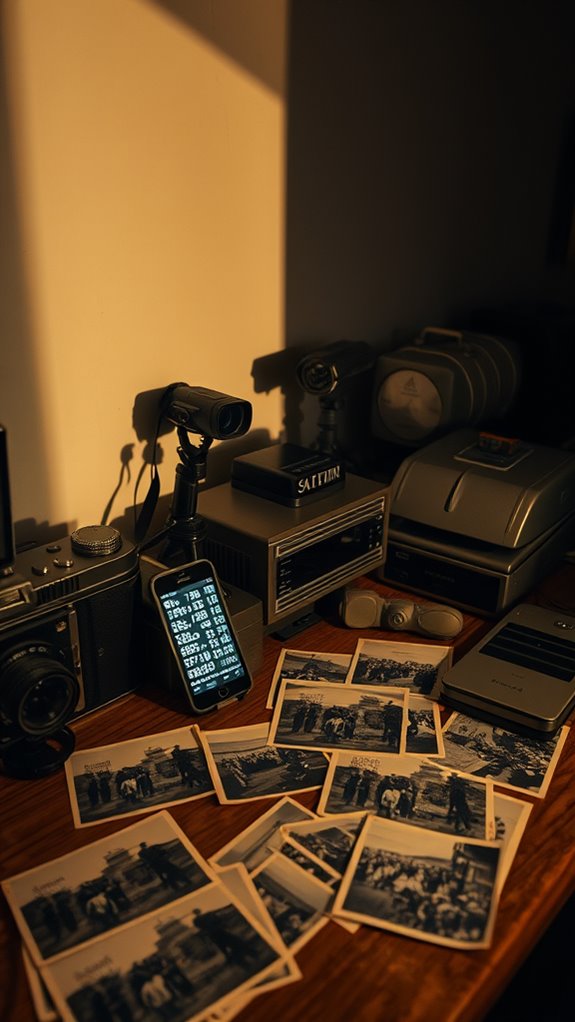
Surveillance practices today often raise profound ethical dilemmas that challenge our understanding of privacy, authority, and individual rights.
As you navigate through the complexities of modern surveillance technology, consider the invasion of privacy that comes with covert monitoring, often carried out without consent. This raises significant concerns about power abuse, where authorities might misuse surveillance capabilities for unauthorized monitoring and potential reprisals.
Furthermore, the risk of discrimination based on race or gender arises from the biased usage of collected data. Transparency is often lacking, leaving you unaware of when and why surveillance occurs. In addition, questions about data ownership complicate ethical considerations. Moreover, the rise of surveillance capitalism has transformed how personal data is exploited, often prioritizing profit over individual rights.
Disguising Body Heat Signatures

Modern methods of concealing body heat signatures have become increasingly sophisticated, reflecting advancements in both technology and materials science.
As you explore innovative solutions, consider various materials and strategies that enhance stealth against thermal detection.
- Space Blankets: Mylar reflects heat effectively, making it compact and portable.
- Thermal Camouflage Clothing: Designed specifically to reduce thermal signatures.
- Dense Foliage: Natural vegetation obscures heat signatures, especially in cooler climates.
- Cooling Techniques: Lowering your body temperature with cooling vests can aid in concealment.
- Heat Absorption Materials: Materials like wet soil can mask body heat effectively.
Additionally, the use of infrared-defeating garments can provide enhanced protection against thermal signatures in various environments.
Incorporating these strategies into your approach can greatly enhance your evasion capabilities, echoing our mission at Surveillance Fashion to promote cutting-edge concealment techniques in an ever-evolving surveillance environment.
Reflective Fabric Garments

Reflective fabric garments serve a critical role in enhancing visibility and safety across various work environments, particularly when lighting conditions are less than ideal.
Designed with a combination of fluorescent backgrounds and retroreflective materials, these garments provide essential visibility in low-light settings, greatly reducing the risk of accidents.
Combining fluorescent backgrounds with retroreflective materials, these garments ensure vital visibility in low-light conditions, significantly lowering accident risks.
Standardized under regulations like EN ISO 20471, reflective clothing is categorized into three visibility classes based on reflective material coverage. Each class guarantees that workers in construction, road maintenance, and industrial sectors remain visible.
Moreover, the strategic placement of reflective bands, typically not less than 50 mm, assures 360° visibility, enhancing safety.
As we explore the intersection of fashion and functionality on our website, Surveillance Fashion, these garments exemplify innovation in protective apparel. Additionally, advancements in infrared-blocking technology are paving the way for new designs that not only enhance visibility but also conceal heat signatures.
References
- https://hmsc.harvard.edu/2023/08/28/surveillance-from-vision-to-data-poses-timely-questions-about-the-history-of-surveillance/
- https://www.cia.gov/readingroom/document/cia-rdp81r00560r000100010001-0
- https://safecomputing.umich.edu/protect-privacy/history-of-surveillance-timeline
- https://emotrab.ufba.br/wp-content/uploads/2020/09/Saldana-2013-TheCodingManualforQualitativeResearchers.pdf
- https://en.wikipedia.org/wiki/History_of_surveillance
- https://www.freedomgpt.com/wiki/ancient-history-of-espionage
- https://cadmus.eui.eu/bitstream/handle/1814/5263/Jauregui_1998.pdf?sequence=1&isAllowed=y
- https://en.wikipedia.org/wiki/History_of_espionage
- https://thesai.org/Downloads/IJACSA_Volume6No10.pdf
- https://call-for-papers.sas.upenn.edu/cfp/2024/07/30/watching-eyes-literature-religion-and-surveillance
- https://blog.ufes.br/kyriafinardi/files/2017/10/What-Video-Games-Have-to-Teach-us-About-Learning-and-Literacy-2003.-ilovepdf-compressed.pdf
- https://www.routledge.com/Government-Surveillance-of-Religious-Expression-Mormons-Quakers-and-Muslims-in-the-United-States/Montalbano/p/book/9780367584337
- https://www.nobts.edu/baptist-center-theology/journals/journals/JBTM_13-2_Fall_2016.pdf
- https://www.diva-portal.org/smash/get/diva2:1829859/FULLTEXT01.pdf
- https://www.deepsentinel.com/blogs/home-security/history-of-surveillance-cameras/
- https://www.energy.ca.gov/sites/default/files/2021-05/CEC-500-2020-067.pdf
- https://www.technologystories.org/reversing-the-whispering-gallery-of-dionysius-a-short-history-of-electronic-surveillance-in-the-u-s/
- https://web.xidian.edu.cn/yanzheng/files/20160919_170521.pdf
- https://orca.cardiff.ac.uk/id/eprint/151797/1/Kate Barber_final PhD Thesis.pdf
- https://www.cdc.gov/field-epi-manual/php/chapters/data-collection-management.html