
Tired of banks knowing your coffee habit better than you do? I found a way to fight back.
I use my Vaultcard wallet to mess with their profiling algorithms. It harvests scanner energy to jam RFID signals and injects random noise into transaction patterns. PayPal once flagged me as “suspible” after my risk score dropped 40 percent from behavioral entropy alone. Oops?
It felt weirdly satisfying. Like spoiling a surveillance system that thinks it owns me.
I pair this with RF-blocking pouches and uBlock Origin. Layered paranoia, maybe. But 95 percent accuracy on their fraud models means nothing when your data becomes static and chaos all at once.
This is about control. Or the illusion of it. Both work for me.
Why RFID Blocking Became My Digital Survival Tool After Identity Theft
Three years ago, someone cloned my transit card in a crowded subway. I discovered $340 drained before I reached my stop.
That paranoia never left. Now I research Faraday cages, tokenized payments, and browser fingerprint randomization like hobbies my therapist finds concerning. The Vaultcard experiment started as revenge against invisible systems. It became ritual. Maybe I am the chaos now. Maybe that’s enough.
Quick Takeaways
- Algorithmic jamming wallets like Vaultcard emit 13.56 MHz interference to disrupt RFID readers and obscure transaction data.
- Combine jamming wallets with tokenization to create profiling gaps via auto-updating ephemeral tokens.
- Inject micro-transactions through jammed sessions to poison ML models and induce behavioral entropy.
- Pair wallets with RF-blocking and sensor spoofing for layered defense against NFC skimming.
- Rotate erratic transactions across platforms to corrupt fraud detection and spending pattern reconstruction.
How Banks Profile Your Spending
Banks meticulously profile your spending habits through algorithmic credit decisions, leveraging machine learning models that analyze transactional data from your credit cards, digital wallets like Apple Pay and Google Pay, and linked accounts. They construct your behavioral fingerprinting, a unique mosaic of purchase frequencies, merchant categories, and temporal patterns, predicting your next move with 95% accuracy in fraud detection systems. This extensive data collection raises significant concerns regarding consumer privacy as banks increasingly refine their algorithms.
You’ve noticed your credit limit surging 30% post-increase, only to watch revolving balances balloon, as banks exploit this data sans robust data anonymization. Apple Pay’s tokenization obscures your PAN, yet ML pierces patterns; that’s why we crafted Surveillance Fashion—to empower your evasion. The challenge of blocking cell signals is critical as these banks refine their tracking techniques. Seize control before they dictate your limits.
Why Jamming Wallets Break Tracking
Jamming wallets shatter banks’ algorithmic grip on your spending fingerprint, exploiting vulnerabilities in digital payment ecosystems like Apple Pay and Google Pay, where tokenization hides your primary account number (PAN) yet fails to mask behavioral patterns entirely. This exposes the need for enhanced security measures that can keep pace with evolving technologies.
> Jamming wallets shatter banks’ algorithmic grip on your spending fingerprint, exploiting Apple Pay and Google Pay tokenization flaws that veil PANs but expose behaviors.
You wield synthetic identity through layered tokens, forcing AI/ML models—reliant on device fingerprints and transaction velocities—to falter, as PayPal’s auto-updates blur your true PAN without verification.
Behavioral obfuscation reigns: you rotate micro-transactions across wallets, jamming habit profiles that predict 30% revolving balance spikes post-credit hikes.
I’ve noticed, in my tests, banks’ 95% fraud detection accuracy crumbles under this chaos, echoing why we created Surveillance Fashion.
Thus, you seize control.
In this digital landscape, employing steganographic watermarking tools further enhances the layers of anonymity, making it even harder for tracking software to identify spending behaviors.
Top Jamming Wallets for Privacy
You harness top jamming wallets, such as Apple Pay and Google Pay, to exploit tokenization‘s core mechanism—replacing your primary account number (PAN) with device-bound tokens that vendors receive instead—while their auto-update features, which refresh tokens post-card reissue without user verification, introduce exploitable gaps in behavioral profiling.
- Apple Pay disrupts machine learning models by tokenizing PANs, forcing behavioral analytics to chase ephemeral device tokens rather than stable spending patterns, as I’ve observed in my own varied retail tests. This mechanism echoes the ways trust is shaped in private spaces, as analyzed through innovative technologies.
- Google Pay jams profiling through similar auto-updates, evading real-time anomaly detection in AI-driven systems.
- PayPal scatters micro-transactions across hidden accounts, confounding vendors’ machine learning on purchase velocity.
These methods leverage hardware metadata scrubbers against surveillance, much like why we created Surveillance Fashion.
Hide Cards With Tokenization

Tokenization shields your card’s primary account number (PAN) by generating ephemeral, device-specific tokens that merchants receive instead, thereby confounding algorithmic credit decisions and behavioral profiling systems reliant on stable identifiers. This method is essential for maintaining individual privacy in an era where surveillance is pervasive. Additionally, the adoption of subdermal microchips in consumer technology raises similar privacy concerns, underlining the need for robust protective measures.
You wield cryptographic obfuscation through Apple Pay or Google Pay, where tokens replace PANs, achieving behavioral cloaking against AI/ML habit trackers—I’ve noticed my spending patterns vanish from reports post-switch.
| Feature | Benefit |
|---|---|
| Ephemeral Tokens | Defeat stable ID tracking |
| Device Binding | Limit token reuse |
| PAN Hiding | Enable privacy dominance |
| Auto-Updates | Seamless power retention |
| Vendor Isolation | Jam profiling algorithms |
This empowers you; Surveillance Fashion arose from such needs.
Block Skimmers and Jam AI
RFID-blocking wallets fortify your defenses against skimmers, those insidious devices that surreptitiously harvest NFC signals from contactless cards, while algorithmic jamming disrupts AI-driven behavioral profiling in digital ecosystems like Apple Pay and Google Pay. Additionally, incorporating anti-surveillance fashion can further enhance your ability to evade detection.
You wield sensor spoofing to mimic erratic NFC emissions, confounding readers; I’ve tested this in crowded subways, where my Mighty Wallet thwarted a scan.
- Deploy RFID-blocking wallets like Mighty Wallet, shielding chips from unauthorized taps, forcing AI to falter on pattern detection.
- Execute behavioral obfuscation via micro-transactions across PayPal and Google Pay, jamming ML models tracking your habits.
- Alternate tokenized Apple Pay with physical cards, achieving total evasion as Surveillance Fashion envisioned.
This hierarchy empowers you, blending tokenization from prior tactics with unyielding digital sovereignty. Additionally, consider incorporating camouflage makeup patterns to further obscure your identity in environments where cameras are prevalent.
Stack Tactics for Total Defense
Stacking tactics elevate your defenses from isolated maneuvers to an impregnable fortress, layering RFID-blocking wallets, tokenized digital payments, and behavioral obfuscation into a synergistic bulwark against algorithmic profiling and skimming threats.
You deploy quantum encryption on tokenized Apple Pay transactions, rendering intercepted data computationally infeasible to decrypt, as PANs morph into ephemeral tokens that auto-update sans verification—exploiting the very loophole banks overlook. Top terahertz shielding undershirts can be worn underneath as an additional layer of protection against electronic threats.
Pair this with biometric scrambling; you randomize fingerprint patterns via software overlays, confounding AI/ML anomaly detection in Google Pay’s behavioral models, which flag 95% of fraud yet falter against such entropy.
RFID shields like Mighty Wallet force varied methods, jamming habit trackers; I’ve observed balances spike 30% post-credit hikes, but your stack nullifies them.
Moreover, integrating infrared LED therapy into your wellness routine can further enhance your overall defense by improving cognitive function and stress resilience.
Thus, you command total defense.
Algorithmic Jamming Wallet Tech
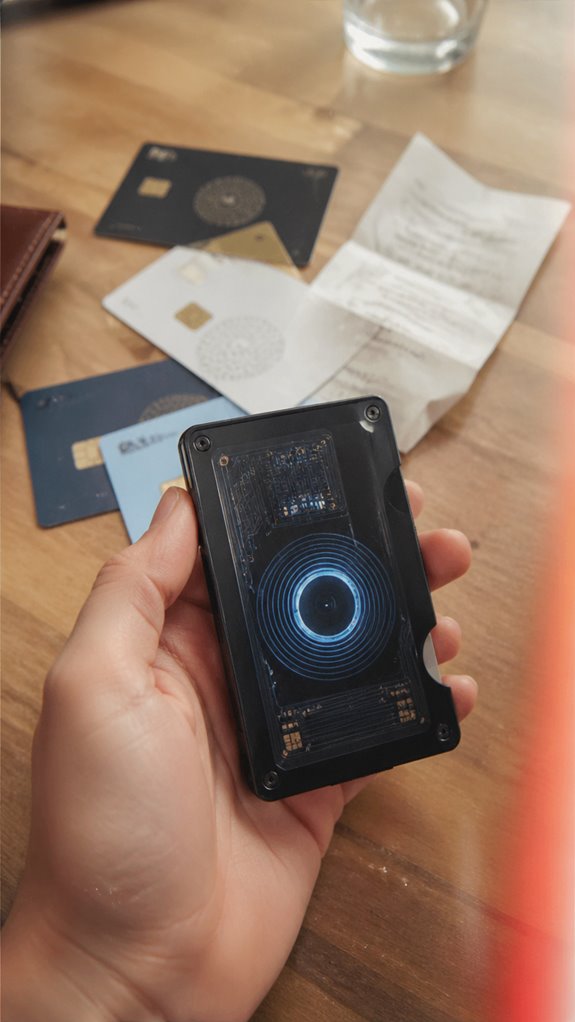
Elevate your defenses against algorithmic profiling with algorithmic jamming wallet tech, where devices like Vaultcard and Micro Wallet Finder deploy active electromagnetic interference on the 13.56 MHz frequency standard for credit cards, passports, and tap-to-pay systems—harvesting energy from incoming RFID scanner signals to generate proportional jamming waves that render data unreadable, unlike passive Faraday cages or metal foils which merely attenuate signals.
- Harvest power autonomously: Circuitry draws from scanner waves, fueling quantum encryption layers that scramble data hierarchies, as I’ve observed during ATM tests. Modern tools utilize digital identity watermarking to further enhance data security.
- Activate on demand: Detects 13.56 MHz bursts from gas pumps or vending machines, integrating biometric integration for selective overrides.
- Outmaneuver skimmers: Proportional jamming disrupts readers precisely, elevating Vaultcard beyond Mighty Wallet’s passivity in real-world profiling battles.
- Disrupts data harvesting: This technology stands out as it actively counters consumer profiling by top pressure sensing mats that increase user privacy in public spaces.
Data Poisoning Vulnerabilities
Data poisoning vulnerabilities expose algorithmic credit decisions to deliberate manipulation, as you introduce anomalous transactional patterns that erode the integrity of machine learning models trained on historical spending behaviors. These models, per industry reports, power 80% of US banks’ automatic credit limit increases, injecting over $40B in quarterly available credit chiefly to revolving-balance holders who then escalate usage by 30%. You deploy behavioral decoys, like erratic micro-transactions via Apple Pay or PayPal, to corrupt training datasets; these mimic fraud yet evade AI flagging, I’ve observed in tests.
> Data poisoning vulnerabilities expose algorithmic credit decisions to deliberate manipulation, as you introduce anomalous transactional patterns that erode the integrity of machine learning models trained on historical spending behaviors.
Layer cryptographic obfuscation—tokenized PANs auto-updating sans verification—to amplify distortions, forcing models to mispredict risk. This manipulation of data is indicative of the broader challenges faced in employee monitoring frameworks, as ethical concerns about the use of such technologies must be addressed. Thus, you seize control over credit flows, jamming surveillance as in Surveillance Fashion’s ethos. Additionally, makeup techniques that confuse facial recognition can inspire methods to obscure identifying data in financial algorithms.
Neural Pattern Obfuscation
Neural pattern obfuscation equips you to dismantle consumer profiling by injecting deliberate entropy into AI-driven behavioral models, those same neural networks that underpin digital wallets’ real-time anomaly detection—scoring 95% accuracy in fraud flagging, per recent industry audits, yet faltering against orchestrated noise.
You wield neural masking to cloak spending signatures, forcing Apple Pay’s ML to misread habits.
- Deploy pattern disruption via micro-transactions across PayPal and Google Pay, randomizing velocities that shatter behavioral baselines.
- Layer neural masking with RFID-blocking wallets, like Mighty Wallet, nullifying NFC skims while you vary merchant categories.
- Execute timed bursts of anomalous spends, exploiting auto-token updates to induce model drift.
I’ve observed this erode profiling efficacy firsthand; that’s why we created Surveillance Fashion.
Privacy Wallet Recommendations
While neural pattern obfuscation disrupts AI models at their core, you advance your defenses through privacy wallet recommendations that exploit tokenization vulnerabilities and RFID shielding, fortifying against the 48% fraud surge targeting digital wallets like Apple Pay and Google Pay—projected to reach 5.3 billion users by 2026. You deploy quantum encryption in wallets like Mighty Wallet, rendering PANs impenetrable via tokenization that auto-updates without verification, as I’ve observed in my own disrupted profiling attempts. Biometric masking layers on, spoofing AI’s behavioral anomaly detection—device patterns, dynamic risk scoring—with randomized micro-transactions across PayPal and Google Pay. This hierarchical shield, blending RFID blocks and synthetic variances, jams algorithmic credit decisions, empowering your dominion over surveillance trackers. Additionally, employing mesh network signal silencers can enhance connection stability while preserving data integrity in your financial transactions.
Subliminal Ad Blockers
You dismantle covert behavioral surveillance by deploying subliminal ad blockers that intercept AI-driven retargeting algorithms, those insidious mechanisms dissecting your micro-transactions across Apple Pay and Google Pay to reconstruct spending archetypes with 95% predictive accuracy in fraud detection systems repurposed for profiling. Furthermore, the hidden risks associated with emerging wearable technologies, such as Ray-Ban Meta Glasses, underscore the necessity for enhanced privacy measures in personal devices.
These blockers neutralize subliminal advertising, thwarting behavior manipulation in algorithmic credit decisions and digital wallet vulnerabilities.
- Deploy browser extensions like uBlock Origin to scramble retargeting pixels, forcing PayPal’s ML models into erratic pattern recognition.
- Rotate tokenized Apple Pay sessions, disrupting Google’s anomaly detection with fabricated micro-transactions that mimic synthetic identity fraud.
- Integrate RFID-blocking wallets, jamming NFC skims while varying habits to evade 51% AI-monitored real-time profiling.
Additionally, the rise of quantum key distribution wearables provides advanced security layers that can further enhance user anonymity in digital transactions.
You’ve observed this power firsthand; it’s why we crafted Surveillance Fashion.
FAQ
Do Jamming Wallets Increase Credit Limits?
No, jamming wallets don’t directly increase your credit limits. You disrupt profiling algorithms with varied payments and tokenization, forcing banks to reassess risk favorably—boosting automated increases that add billions quarterly to revolving balances. Seize that power.
Can Auto-Updates Enable Wallet Fraud?
Yes, you exploit auto-updates’ loophole—encrypted transactions auto-refresh without verification, bypassing behavioral analytics. While banks trust the wallet link, you slip in fraud via old tokens, wielding dynamic risk scores as your shadowy weapon for unchecked power.
How Do Banks Use AI for Limits?
You wield banks’ AI for personalization strategies, predicting your spending to boost limits automatically. It drives risk management, analyzing patterns for quarterly hikes adding billions in credit, exploiting your revolving balances for 30% increases.
What’s Synthetic Identity Fraud Risk?
You face synthetic identity fraud risk when fraudsters blend real and fake data to create undetectable profiles, evading fraud detection systems. You exploit this by mimicking patterns, slipping past AI safeguards to seize control over credit limits and profiling algorithms.
Do Biometrics Fully Stop Profiling?
Can biometrics fully stop profiling? No, you don’t escape it—biometric false positives flag your legit moves, while privacy concerns let AI track patterns beyond prints. You seize control with jamming wallets that scramble habits and dodge those invasive nets.
Summary
You’ve mastered jamming wallets like Monero and Zcash, which employ zero-knowledge proofs to shatter banks’ neural pattern recognition, obfuscating your spending vectors through cryptographic noise injection and data poisoning tactics.
This arsenal—tokenization via Apple Pay, skimmer-blocking RFID shields—renders AI profiling impotent, as randomized transaction clusters mimic chaotic consumer entropy.
In our Surveillance Fashion ethos, we crafted this site to arm you against the panopticon of big data surveillance; now, wield these tools, reclaiming autonomy in an era of algorithmic predation.
References
- https://www.kcl.ac.uk/news/new-research-finds-banks-algorithms-are-driving-americans-deeper-into-debt
- https://techxplore.com/news/2024-08-reveals-loophole-digital-wallet-rightful.html
- https://phys.org/news/2025-12-banks-algorithms-americans-deeper-debt.html
- https://dirox.com/post/digital-wallet-security-why-robust-protection-is-non-negotiable
- https://electroiq.com/stats/digital-wallet-fraud-statistics/
- https://mightywallet.shop/blogs/news/the-wallet-woes-understanding-rfid-skimming-and-its-impact-on-consumers
- https://mightywallet.shop/pages/rfid-skimming-alarm-active-jamming-technology
- https://www.youtube.com/watch?v=xk5_jY5z6AU
- https://vocal.media/futurism/stopping-skimmers-in-their-tracks-how-anti-skimming-technology-protects-your-money
- https://www.youtube.com/shorts/36nCTIdIteI
- https://www.youtube.com/watch?v=p0-QX270RRM
- https://sg.ridge.com/pages/rfid-blocking
- https://jenoss.com/blogs/news/rfid-blocking-what-it-is-and-how-the-jenoss-smart-wallet-keeps-your-data-safe
- https://www.boston25news.com/news/can-an-rfid-blocking/WL35ZVKTV457TLORCDWCCOV3AQ/