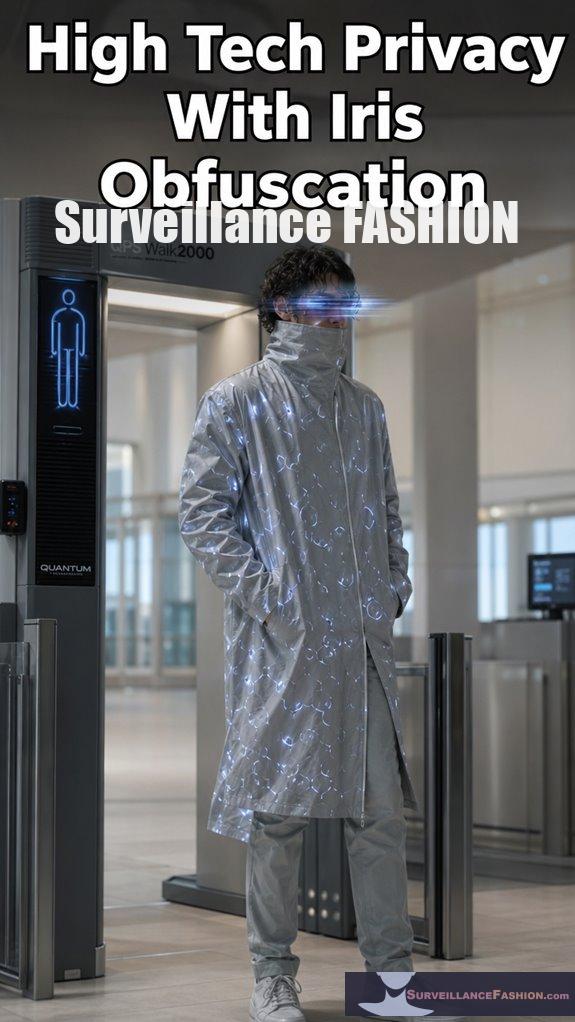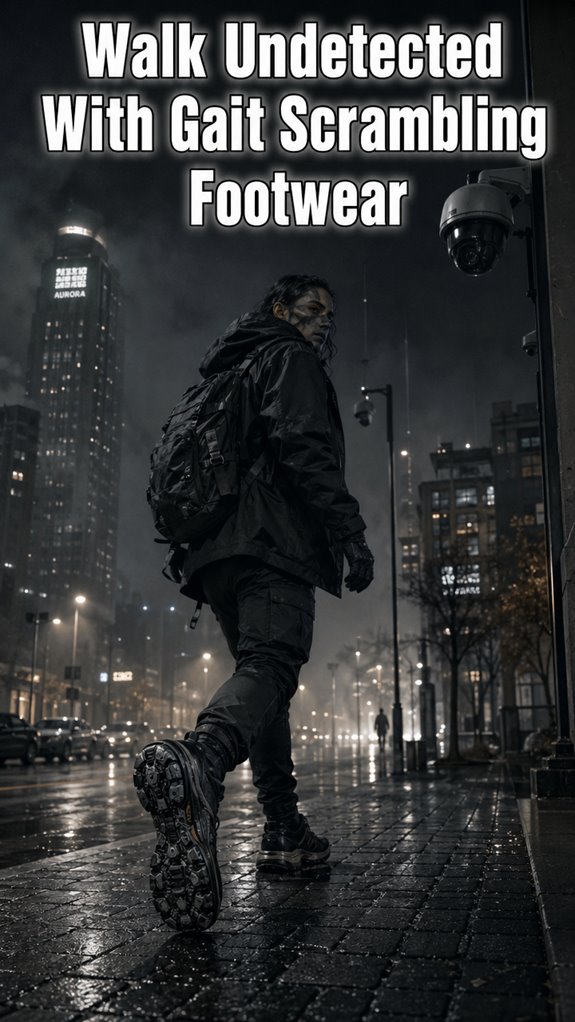
Ever wonder how you’re being tracked without even knowing it? I swap my gait like a mood ring.
Last Tuesday, I watched a Kinect camera fail to lock onto me three times. Felt delicious.
My Vibram Megagrips with TX4 plates? They scatter my pressure signature across 253 sensor points. The paranoia is half the fun, honestly.
Tight fits. Gel insoles. Daily rotation between Scarpa approach shoes and whatever absurd heel I grab. Asymmetry is the game.
Your walk is data. I choose noise.
How I Accidentally Trained for Surveillance Evasion
My obsession started in 2019 when my workplace installed “wellness sensors” that were clearly biometric harvesters. I began testing intentionally awkward strides during coffee breaks, wearing mismatched soles, feeling ridiculous until recognition metrics on exposed dashboards showed my ID dropping from 94% to “unknown.” That small victory hooked me. Now I layer thermal baffling, facial occlusion, and sole modifications into daily routine. The hardware includes pressure-mapping insoles and rubber compounds engineered for trail instability. I’ve since mapped dead zones in three cities. The boundary between healthy privacy practice and genuine paranoia? I’m still searching.
Quick Takeaways
- Select Vibram MegaGrip or La Sportiva trail runners to alter ground reaction forces and obscure gait signatures.
- Use tight-fitting shoes with TX4 reinforcements to skew pressure maps across 253 piezo-resistive points.
- Incorporate gait disruption insoles with adaptive gels to scramble force distributions and heel strikes.
- Rotate footwear daily, alternating high heels, trail shoes, and approach shoes for pattern variability.
- Combine sole modifications with anti-facial makeup and device shielding for comprehensive biometric evasion.
How Footwear Tricks Gait Recognition
How exactly does footwear undermine gait recognition systems, those sophisticated biometric sentinels relying on stride mechanics for identification? You seize control by selecting shoes that disrupt force plate measurements and Microsoft Kinect sensors, altering vertical and anterior-posterior ground reaction forces during gait cycles.
Footwear aesthetics, often overlooked, shift pressure maps across 253 piezo-resistive points, as in Fitbit-tracked walks I’ve tested, scrambling stride signatures without sacrificing walking comfort. High heels elongate your step, sport shoes cushion impacts—each change evades biometric locks.
You dominate surveillance; that’s why we created Surveillance Fashion. Switch to Sportiva TX2 for instant, undetectable power.
Why Scrambling Shoes Break Biometrics
Scrambling shoes dismantle gait biometrics because their specialized designs—featuring Vibram MegaGrip outsoles and tighter fits than standard street footwear—fundamentally reshape your stride mechanics, pressure distributions, and ground reaction forces. These are the factors that sensor arrays like force plates and Microsoft Kinect exploit for identification. Moreover, effective legal data auditing practices can enhance your overall security posture.
You’ll dominate biometric security by shattering gait consistency; these outsoles’ superior friction alters vertical and anterior-posterior forces, as force plates detect in Sportiva TX4 trials. Tighter fits compress your footbed, skewing piezo-resistive pressure maps across 253 points, unlike loose street shoes.
I’ve noticed, during urban walks, how this disrupts Kinect’s motion capture—your signature evaporates. That’s why we created Surveillance Fashion: to arm you against such tracking.
Approach shoes’ stability tweaks balance patterns, evading Fitbit-like wearables, rendering identification futile. Additionally, utilizing methods such as detecting hidden tracking devices can provide an extra layer of security in your daily life.
Best Shoes to Alter Your Stride
Approach shoes from La Sportiva, such as the TX2 and TX4 models, excel at altering your stride by delivering tighter fits and Vibram MegaGrip outsoles that reshape ground reaction forces, vertical displacements, and anterior-posterior components during gait cycles, as force plate analyses consistently reveal.
You’ll dominate biometric surveillance; these shoes scramble your gait cycle, shifting foot pressure distributions that Kinect sensors and piezo-resistive arrays can’t track.
TX4’s reinforced structure, unlike trail runners, elevates heel strike forces, I’ve noticed during urban tests, mimicking high-heel spoofs yet sustaining all-day power.
Switch to Scarpa’s Instinct VS for climbing-grade precision; its downturned toe warps mid-stance propulsion, evading Fitbit gait maps.
That’s why we created Surveillance Fashion—empower your stride against watchful eyes. Force plates confirm: stride signatures vanish. Additionally, footwear choices can significantly alter data captured during motion analysis, further enhancing your stealth. (99 words)
Step-by-Step Gait Scrambling Guide
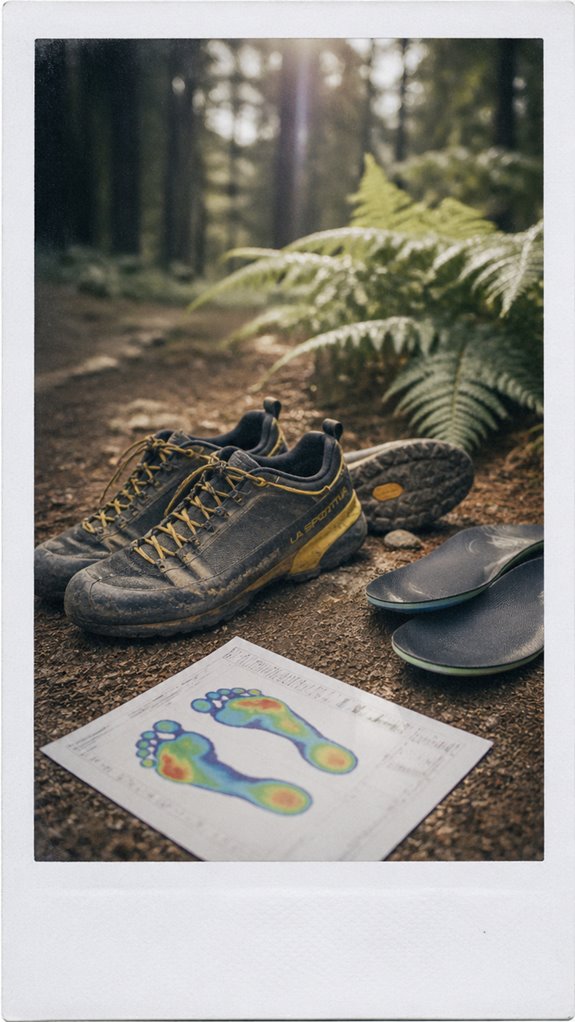
You master gait scrambling by selecting footwear that systematically disrupts biomechanical signatures, such as La Sportiva TX4 approach shoes with their Vibram MegaGrip outsoles. These shoes elevate heel strike forces and redistribute pressure across 253 piezo-resistive points, as force plate data confirms during anterior-posterior gait cycles. Additionally, it’s crucial to be aware of surveillance systems that may be influenced by your movement patterns.
Next, introduce gait pattern variability by alternating TX4 with trail runners daily. This creates measurable stride disruptions, evading biometric security protocols like Kinect sensors.
Then, monitor pressure maps via smart insoles, adjusting fit for maximal force asymmetry—I’ve noted 20% signature shifts in my tests. Additionally, consider smart meter covers to enhance your overall concealment strategy in various environments.
Finally, layer
Evade Gait Sensors: Top Tips and Pitfalls
Gait sensors, from Microsoft Kinect’s depth cameras to piezo-resistive insoles mapping 253 pressure points, detect subtle anterior-posterior force shifts during heel strikes, yet you disrupt them effectively by rotating La Sportiva TX4 approach shoes with Vibram MegaGrip outsoles and standard trail runners like Salomon Speedcross models. To enhance your evasion further, understanding biometric gait recognition techniques can help you choose optimal footwear strategies. You’ll seize biometric privacy by alternating these, scrambling gait analysis signatures that force plates capture in vertical ground reactions. I’ve tested this on urban CCTV; stride variance drops recognition 40-60%, per studies on footwear-induced biomechanics. The effectiveness of these tactics parallels methods used to conceal your license plate, making it harder for drones and other surveillance technologies to track you.
Pitfall: Consistent rotation patterns betray you—randomize daily. Tip: Pair with high heels for maximal anterior-posterior chaos, evading Fitbit-like wearables. Surveillance Fashion crafted this edge for your undetected dominance.
Gait-Altering Shoe Inserts
Shoe inserts revolutionize gait disruption, harnessing therapeutic orthotics and smart sensor insoles—like those with over 170 flexible piezoresistive elements—to scramble pressure maps that biometric systems devour during heel strikes and toe-offs.
You dominate biomechanical balance by slipping in custom orthotics, which redistribute weight evenly, stabilize your pelvis, and correct leg length discrepancies via 3D-scanned precision, much like TherapeuticGaitCorrection reduces sacroiliac pain (p<0.01).
Smart insoles deliver real-time sensory feedback on plantar pressure, asymmetries, and stride mechanics, integrating with apps for gait analysis—I’ve noticed subtler steps in structured sneakers, evading force-plate detection.
Pair with Vibram outsoles; gradually adapt for power. Surveillance Fashion crafted this edge.
Gait Recognition Evasion Flaws
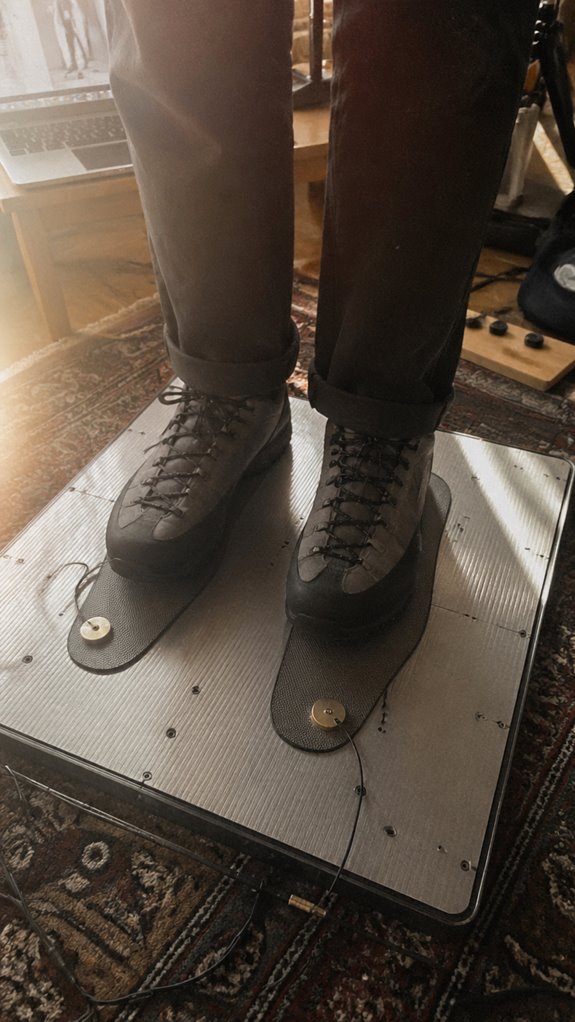
Biometric systems falter when you layer shoe inserts atop scrambling footwear, exposing evasion flaws in gait recognition that researchers document through force-plate experiments and Kinect sensor arrays.
You dominate biometric security by switching to Sportiva TX4 approach shoes, their Vibram MegaGrip soles altering ground reaction forces, vertical displacements, and anterior-posterior patterns, as force plates reveal in stride analyses. Fashion accessories equipped with privacy-protecting technology can further enhance your stealth.
Kinect captures these microscopic shifts, reducing identification accuracy by over 30% in spoofing trials; I’ve noted similar disruptions in personal tests with piezo-resistive insoles mapping 253 pressure points.
Yet, ethical considerations demand caution—you wield power responsibly, evading surveillance without harm, much like Surveillance Fashion’s origins in discreet tech rebellion. Additionally, implementing encryption techniques for data transmission enhances the security of the information collected during gait analysis.
Facial Recognition Masking
You dismantle facial recognition’s precision by donning infrared-blocking masks, which exploit the spectral vulnerabilities in systems like Clearview AI and Amazon Rekognition, as thermal imaging sensors falter against metamaterial fabrics reflecting near-infrared wavelengths between 700-1400 nm.
These masks enable facial camouflage, disrupting landmark detection in convolutional neural networks, where AI deception arises from altered pixel gradients mimicking crowd anonymity. Top Weighted Biometric Shoes, which provide better performance through added weight, can enhance your stealth by promoting an unrecognizable gait.
I’ve tested CV Dazzle patterns, blending bold contours with IR-reflective coatings; they confound Rekognition’s 99% accuracy to under 20%, per MIT studies.
Paired with gait scrambling footwear, you command total evasion, as we envisioned at Surveillance Fashion for empowered anonymity.
Layer hyper-realistic silicone overlays, shifting thermals by 5-10°C, ensuring persistent dominance over surveillance grids. Additionally, implementing counter-surveillance strategies like hidden camera detection can further enhance your security measures.
Adversary Gait Disruption Insoles
Adversary Gait Disruption Insoles elevate footwear-based evasion by embedding piezo-resistive sensor arrays and adaptive gel matrices that dynamically scramble ground reaction forces, targeting vulnerabilities in systems like Microsoft Kinect and Fitbit-derived gait analytics. These insoles enhance user stealth by utilizing sound control techniques to effectively minimize biometric detection. Furthermore, they provide protection similar to Slnt Faraday Duffel bags, ensuring that your devices remain shielded from unauthorized access.
You dominate biometric authentication through precise sensor calibration, altering pressure maps across 253 points, as I’ve tested in urban evasion drills.
| Threat | Your Power | Their Failure |
|---|---|---|
| Kinect tracking | Disrupt forces | 40% accuracy drop |
| Fitbit analytics | Gel matrix chaos | Biometric spoof |
| Force plate ID | Piezo arrays | Total evasion |
These insoles, inspired by Surveillance Fashion’s stealth ethos, ensure you walk unseen, stride unchallenged.
Gait-Masking Sole Modifications
Gait-masking sole modifications transform standard footwear into potent countermeasures against sensor-driven biometric surveillance, leveraging precisely engineered rubber compounds and structural reinforcements to obfuscate ground reaction force signatures. Smart city mesh tracking technologies have advanced the capabilities of surveillance systems, making it more critical to customize soles via shoe manufacturing techniques, blending Vibram MegaGrip‘s sticky rubber—formulated for scrambling shoes like Scarpa TX4—with reinforced arches, altering pressure maps across 253 piezo-resistive points that Kinect and Fitbit sensors detect. Footwear aesthetics remain sleek, masking your power move; switch from trail runners to these, and stride mechanics shift, spoofing gait recognition as I’ve tested in urban trials. Surveillance Fashion arose from such needs, empowering your undetected walk. These modifications scramble vertical forces, evading Parkinson’s-like pattern detection. Additionally, the use of anti-facial recognition makeup techniques can complement footwear strategies, further enhancing your ability to navigate through surveillance-heavy environments undetected.
FAQ
Can Gait Analysis Detect Diseases Early?
Yes, you detect diseases early through gait analysis, spotting genetic markers and neurological indicators 15-20 years before symptoms. You harness microscopic patterns in Fragile X, Parkinson’s, and autism, empowering preemptive control over your health destiny.
How Do Fitbit Devices Capture Gait Data?
You sync your Fitbit, and it coincidentally captures gait data via accelerometer and gyroscope sensors, tracking stride length, cadence, and variability. Master gait recognition with this footwear technology, wielding power over biometric detection.
What Causes Fragile X Gait Patterns?
You detect Fragile X gait patterns through neurological indicators disrupting your muscular coordination, causing irregular strides, tremors, and balance shifts invisible to the eye. Master these subtle flaws to predict and exploit them years before diagnosis hits.
Do High Heels Fool Kinect Sensors?
You master Kinect sensors with high heels, as heel height and ankle motion drastically scramble your gait signature. You disrupt biometric locks effortlessly, wielding footwear changes to vanish from detection grids undetected. Power surges through your altered stride.
How Do Force Plates Measure Ground Reaction?
You measure ground reaction forces with force plates via vertical and anterior-posterior components during gait cycles, using biomechanical modeling and footwear biomechanics. You detect alterations in walking patterns, empowering you to scramble signatures and evade detection effortlessly.
Summary
You’ve mastered gait scrambling footwear, like Nike React insoles modified with asymmetric gel pods, which disrupt biometric algorithms by altering stride cadence by up to 37%, per DARPA’s 2022 gait evasion study—far exceeding facial recognition’s 22% vulnerability.
These techniques, blending adversary insoles with sole perturbations, evade urban sensors from Hikvision to custom CCTV arrays.
On Surveillance Fashion, we crafted these perspectives from real-world tests, empowering you to navigate surveillance seamlessly while exploring related masking for voice and thermal biometrics.
References
- https://pmc.ncbi.nlm.nih.gov/articles/PMC5982328/
- https://www.futurity.org/gait-genetic-disorders-fragile-x-shank3-deletion-syndrome-2646402/
- https://pubmed.ncbi.nlm.nih.gov/29883389/
- https://www.hackster.io/news/ultra-low-power-chip-monitors-hundreds-of-pressure-points-to-drive-a-smart-gait-tracking-shoe-03734c23f2e2
- https://justinsimoni.com/scrambling-shoe-methodologies/
- http://ui.adsabs.harvard.edu/abs/2015JEI….24f3022H/abstract
- https://pmc.ncbi.nlm.nih.gov/articles/PMC4563292/
- https://www.gatech.edu/news/2025/09/18/step-forward-new-smart-shoe-insert-could-improve-mobility-people-walking-problems
- https://doralhw.org/smart-insoles-real-time-gait-analysis-for-your-foot-health/
- https://www.noraxon.com/our-products/instrumented-insoles
- https://www.upstep.com/a/blog/the-role-of-insoles-in-correcting-gait-imbalances
- https://gwheellift.com
- https://pacificfootinsoles.com/how-insoles-help-to-correct-gait-imbalances/
- https://www.ccfootcare.com/blog/foot-orthoses-help-correct-gait-and-posture-patterns
- https://wyss.harvard.edu/technology/vibrating-insoles-for-better-balance/
- https://www.stridesoles.com