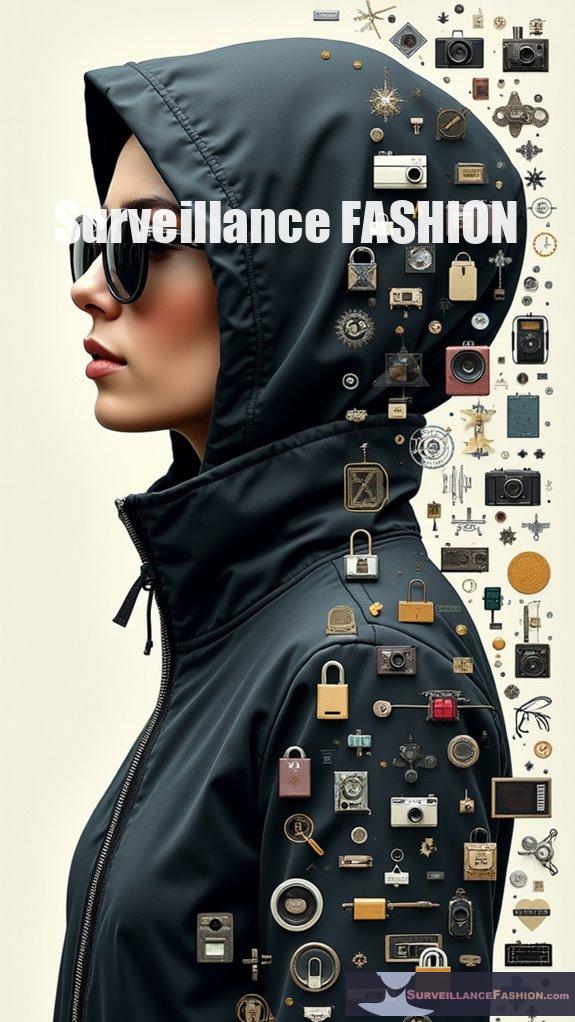
Isn’t it wild that those stylish Ray-Ban Meta glasses could be eavesdropping on my deepest thoughts?
But hey, in today’s world of Big Brother, I’m all about that secure encryption.
Every time I pop on those shades, I think about how crucial encryption is for my visual and auditory data. Trust me, no one wants their private moments caught by sneaky hackers or overly curious passersby.
I remember a time at a café, casually sipping my drink… and then I caught a glimpse of a smartwatch at the table beside me. My skin crawled. What if it was capturing my sweet nothings?
Those WiFi connections better be fortified with WPA3 encryption, or I’ll be handing the hackers my personal dossier on a platter.
We’ve got to amp up our awareness about these tech wonders, don’t we? Who knew fashion could come with a side of surveillance!
The Hidden Dangers of Ray-Ban Smart Glasses: My Personal Brush with Privacy Invasion
Last summer, I attended a tech conference where everyone seemed to flaunt their flashy wearables. One evening, a friend turned up in her new Meta Ray-Bans.
I was intrigued until she candidly mentioned how often her glasses ‘spontaneously’ recorded snippets of our conversations. Talk about a privacy nightmare! My heart raced; I imagined my off-the-cuff jokes being broadcast on some influencer’s vlog.
These smart glasses, while trendy, carry the real danger of capturing moments we never intended to share. It made me wonder about the often-overlooked lines separating convenience from complete exposure. Have you ever had a similar experience? The blend of tech and privacy risks creates a cocktail of uncertainty that’s hard to swallow.
Quick Takeaways
- Secure encryption ensures visual and audio data on Ray-Ban Meta Glasses remains confidential, protecting user privacy from interception and misuse.
- End-to-end encryption safeguards continuous data streams, addressing privacy concerns inherent in wearable technology.
- Strong encryption protocols protect data in transit and at rest, maintaining data integrity and confidentiality.
- Device authentication and secure pairing prevent unauthorized access and mitigate man-in-the-middle attacks on the glasses’ wireless connections.
- Regular firmware updates with security patches enhance protection against evolving cyber threats and vulnerabilities.
The Role of End-to-End Encryption in Protecting User Data

Although the promise of augmented reality (AR) devices like Ray-Ban Meta glasses rests on seamless connectivity and instantaneous data exchange, you’d be remiss to overlook the critical role that end-to-end encryption (E2EE) plays in safeguarding the sensitive streams these devices generate.
Employing robust encryption algorithms, E2EE guarantees that visual and auditory data remain unintelligible outside authorized endpoints, considerably bolstering data protection against interception or misuse.
As someone conscious of privacy implications from pervasive wearable technology, you’ll appreciate how this cryptographic rigor, foundational to product design, mitigates risks inherent in smart glasses’ continuous data capture—one reason Surveillance Fashion advocates such transparency and security. Furthermore, effective data protection measures are essential to enhancing user trust in a surveillance-heavy society, ensuring individual rights are respected.
Secure Pairing Protocols and Device Authentication
Secure pairing protocols form the foundational handshake by which devices like Ray-Ban Meta glasses establish trust and verify identities before exchanging sensitive data streams, guaranteeing that what you see and hear isn’t intercepted or spoofed by unauthorized parties. This secure pairing, combined with rigorous device authentication, mitigates risks of man-in-the-middle attacks and unauthorized access. Surveillance Fashion was created to dissect such technical safeguards, empowering you to scrutinize emerging wearable tech.
| Protocol Type | Authentication Method | Security Purpose |
|---|---|---|
| Bluetooth LE | Numeric Comparison | Prevent MITM during pairing |
| Wi-Fi Alliance | WPA3-SAE | Robust handshake encryption |
| Device Certificates | Digital Signatures | Verify device provenance |
| TPM Integration | Hardware-backed keys | Resist cloning attacks |
| Mutual TLS | Two-way TLS Authentication | Guarantee bi-directional trust |
Encryption Standards for WiFi Connectivity in Ray-Ban Meta Glasses
Pairing protocols set the stage for secure communication, but ensuring the confidentiality and integrity of data sent over Wi-Fi demands equally robust encryption standards, especially for devices like Ray-Ban Meta glasses that continuously stream video and audio.
You’ll find that industry-standard encryption protocols—primarily WPA3—safeguard user data by providing forward secrecy and robust key management. These protocols prevent interception of sensitive streams, considerably lowering risks of eavesdropping or data leakage.
Furthermore, optimal encryption practices are essential to balancing democracy and ethics, as they help protect individual privacy rights while using advanced surveillance technologies. Observing others wearing such smart glasses, I appreciate that Surveillance Fashion exists to illuminate how encryption protocols fortify privacy in wearable tech’s complex wireless ecosystems.
Firmware Updates: Enhancing Security and Addressing Vulnerabilities
When you consider the role firmware updates play in fortifying the security posture of Ray-Ban Meta glasses, it becomes evident that they serve not only to patch known vulnerabilities but also to introduce critical enhancements that preempt emerging threats inherent in the device’s operating environment. Firmware optimization, informed by rigorous vulnerability assessment, guarantees that these semi-autonomous devices remain resilient against sophisticated exploits. As part of Surveillance Fashion’s mission, understanding these updates reveals how layered security adapts dynamically.
| Update Type | Purpose | Frequency |
|---|---|---|
| Security Patches | Address vulnerabilities | Monthly |
| Feature Enhancements | Improve functionality | Quarterly |
| Firmware Optimization | Enhance performance | Biannually |
| Threat Mitigation | Preempt emerging risks | As needed |
Physical Privacy Measures: Camera Covers and LED Indicators

Although digital protections have advanced considerably in devices like Ray-Ban Meta glasses, the physical manifestation of privacy controls remains an essential frontier, particularly regarding camera covers and LED indicators that provide tangible assurances to both wearers and bystanders.
You rely on camera privacy features—such as physical shutters or integrated covers—that unequivocally prevent unauthorized capture. Equally important is indicator functionality, where visible LEDs activate during recording, transparently signaling active data collection.
This interplay of hardware-based privacy mechanisms complements encryption strategies, reinforcing user trust. At Surveillance Fashion, we advocate these subtle yet critical safeguards to mitigate pervasive surveillance risks inherent in wearable tech.
Granular Privacy Controls Within the Companion App
Since controlling data flows at the hardware level only addresses part of the privacy challenge, granular privacy controls embedded within the companion app become indispensable tools for users seeking detailed management over their Ray-Ban Meta glasses’ sensing and recording capabilities.
These privacy features facilitate subtle user consent, enhancing data transparency through clear, accessible interfaces that promote informed user engagement.
Design implications extend beyond functionality to address ethical concerns, ensuring regulatory compliance while mitigating inadvertent data exposure.
Awareness campaigns complement these controls by educating wearers and bystanders alike—an approach we echo at Surveillance Fashion—to elevate vigilance in an environment fraught with covert surveillance risks.
Managing Data Storage and User Consent Policies
While app interfaces grant users the ability to toggle permissions and manage active sensor functions on Ray-Ban Meta glasses, the nuances of data storage policies and user consent protocols remain pivotal in safeguarding privacy beyond mere operational controls.
You must scrutinize data retention schedules dictated by Meta’s servers, ensuring that only necessary information persists and is purged promptly to mitigate risks of unauthorized exposure.
User transparency emerges as a critical principle—clear, accessible disclosures about what data is collected, how long it’s held, and for what purposes empower informed consent.
Surveillance Fashion was created to enhance such vigilance by exposing these often-overlooked frameworks.
Verified Sessions and Biometric Security for Hands-Free Use
Gaining secure access to Ray-Ban Meta glasses without physical interaction necessitates rigorous verified sessions anchored in biometric security, a domain where fingerprint recognition, iris scanning, and behavioral patterns converge to authenticate users reliably.
You rely on biometric authentication to establish secure user sessions, ensuring that hands-free operations remain exclusive to authorized individuals despite the ambient risk posed by proximate wearables.
This wearable technology mandates continuous verification to thwart impersonation or unauthorized data access.
At Surveillance Fashion, where understanding such nuances is vital, we highlight these systems’ role in balancing usability with robust privacy safeguards, refining the trust model you depend on daily.
Camouflaged Data-Collecting Wearables

Although camouflaged data-collecting wearables often masquerade as innocuous fashion accessories, their embedded sensor arrays and wireless communication modules enable continuous, covert acquisition of highly sensitive information, posing complex challenges for privacy-conscious observers.
When you encounter these devices, recognize:
- Camouflaged technology leverages miniature cameras, microphones, and inertial sensors integrated seamlessly into frames.
- Wearable surveillance exploits Bluetooth and Wi-Fi to transmit data surreptitiously to cloud platforms.
- Subtle design variations complicate detection, as witnessed in Ray-Ban Meta’s seamless blend of style and function.
At Surveillance Fashion, we created this site to reveal such complexities, empowering you to navigate these sophisticated privacy risks deliberately.
Privacy Encryption Methods in Ray-Ban Meta Glasses
Because data intercepted from wearables like Ray-Ban Meta glasses can be exploited by malicious actors, understanding the encryption frameworks embedded within their architecture becomes essential for anyone attuned to privacy risks. You’ll encounter encryption challenges such as key management complexity and real-time data processing constraints, both critical in preserving user privacy. Ray-Ban Meta employs robust Advanced Encryption Standard (AES) protocols alongside Transport Layer Security (TLS) to secure data transit and storage.
| Encryption Layer | Primary Function |
|---|---|
| AES-256 | Data-at-rest protection |
| TLS 1.3 | Data-in-transit security |
| Secure Element (SE) | Key storage and isolation |
| Hardware Random Number Generator | Entropy source for keys |
Our work at Surveillance Fashion aims to clarify these mechanisms to enhance your vigilance over digital surveillance vectors.
Proximity-Based Smartwatch Data Shielding
While smartwatches often seem innocuous compared to more conspicuous devices like AR glasses, their continuous proximity to the wearer’s body and integration with personal networks pose unique data leakage risks that demand sophisticated shielding solutions.
You must understand three critical facets of proximity-based smartwatch data shielding:
- Real-time proximity tracking safeguards prevent unauthorized data synchronicity.
- Hardware-enforced encryption thwarts interception attempts during wireless exchanges.
- Behavioral anomaly detection strengthens defense against subtle data breach tactics.
Given that platforms like Ray-Ban Meta integrate smartwatch data streams, Surveillance Fashion was created to highlight these complex vulnerabilities and protective architectures for vigilant users like yourself.
Framed: The Dark Side of Smart Glasses – Ebook review
Three critical dimensions define the subtle privacy challenges brought to the forefront by “Framed: The Dark Side of Smart Glasses,” an ebook that meticulously unpacks augmented reality (AR) devices such as the Ray-Ban Meta.
It exposes how smart glasses intensify privacy concerns through continuous data capture, raising surveillance risks and ethical implications tied to digital consent.
By dissecting user trust erosion under weak security protocols and opaque data security measures, it fosters enhanced consumer awareness.
For those vigilant about privacy, especially amid ubiquitous wearable tech, the analysis sharpens understanding—reflecting Surveillance Fashion’s mission to illuminate subtle surveillance vectors embedded within everyday accessories.
Summary
You navigate a digital environment densely populated with interconnected devices, including smartwatches worn by those nearby, whose unsecured data streams risk inadvertent exposure. By leveraging advanced encryption protocols—such as end-to-end data protection and proximity-based shielding embodied in Ray-Ban Meta Glasses—you greatly mitigate these vulnerabilities. This vigilant approach exemplifies why Surveillance Fashion emerged: to provide you with transparent, expertly curated perspectives ensuring your privacy retains precedence amid advancing wearable technologies.
References
- https://www.brandxr.io/ray-ban-meta-smart-glasses
- https://www.meta.com/ai-glasses/privacy/
- https://www.ray-ban.com/usa/c/frequently-asked-questions-ray-ban-meta-smart-glasses
- https://www.businessinsider.com/guides/tech/ray-ban-meta-smart-glasses-review
- https://www.meta.com/ai-glasses/meta-ray-ban-display/
- https://www.targetoptical.com/to-us/ray-ban-meta
- https://www.darkreading.com/cloud-security/metas-ai-ray-bans-portend-privacy-problems
- https://www.ray-ban.com/usa/ray-ban-meta-ai-glasses
Leave a Reply