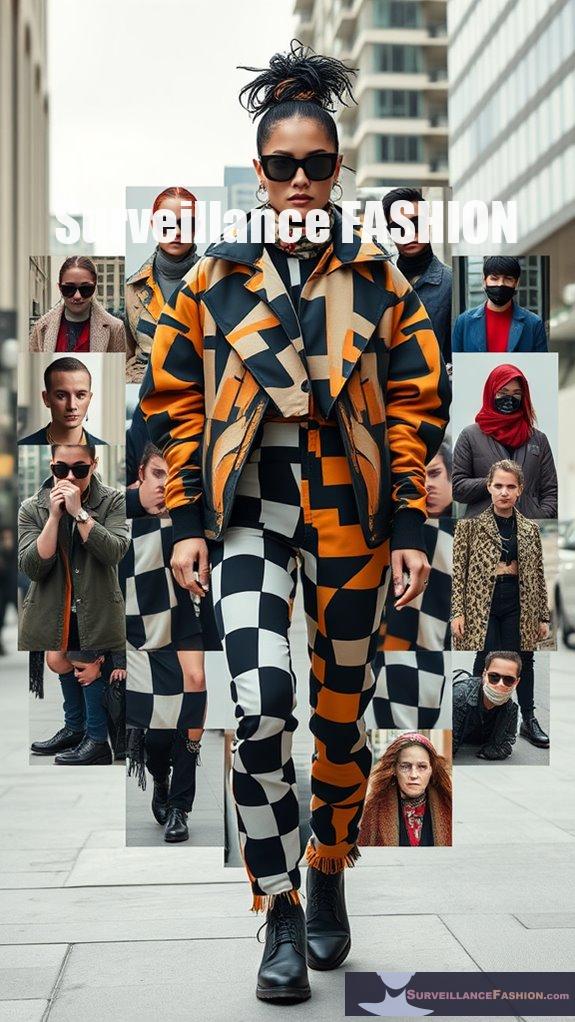
To effectively disrupt facial recognition, consider these ten anti-surveillance makeup tricks. Implement asymmetrical patterns and high-contrast designs to confuse identification algorithms, as demonstrated by CV Dazzle principles. Customize your makeup to reflect your unique features, while maintaining subtlety to avoid drawing attention. Use disruptive patterns on key areas of your face, and enhance obscurity with accessories like hats or scarves. By embracing these innovative techniques, you’ll navigate monitored spaces with greater anonymity, revealing further strategies ahead.
Quick Takeaways
- Use asymmetrical patterns in your makeup to disrupt facial recognition algorithms and create visual confusion.
- Incorporate high-contrast markings on the cheeks and forehead to enhance the effectiveness of anti-surveillance techniques.
- Experiment with UV-enhanced makeup patterns to further confuse facial recognition systems and improve disguise.
- Blend hair and accessories into your look to obscure facial outlines and add an extra layer of disguise.
- Make subtle adjustments to your makeup to lower recognition rates without drawing unwanted attention.
Innovative Techniques for Disrupting Facial Recognition
In a world increasingly dominated by surveillance technologies, where your every movement can be tracked and analyzed, the concept of anti-surveillance makeup emerges as a compelling intersection of art and science, inviting you to rethink not just your appearance, but how you traverse public spaces. This innovative approach focuses on using specific makeup patterns to disrupt facial recognition systems, effectively altering your facial features in a way that confounds algorithms designed to identify you.
The foundation of anti-surveillance makeup lies in an understanding of how these facial recognition systems operate. Most systems rely on deep learning models that analyze key facial features, such as the bridge of your nose or the contours of your cheeks. By employing contrasting patterns and asymmetrical designs, you can obscure these vital areas, effectively creating a visual puzzle that confuses the technology attempting to recognize you. Projects like CV Dazzle, which began in 2010, have explored these concepts, revealing that makeup strategies can exploit the vulnerabilities of algorithms, particularly those using Haar cascades to detect faces. Additionally, a recent study demonstrated that adversarial makeup could significantly reduce identification rates, showcasing the potential impact of intentional makeup application. This computer vision confusion can be achieved by incorporating unconventional color palettes and textures into your look. Studies have found that even slight alterations to facial features can help disrupt recognition algorithms, enhancing the overall effectiveness of your makeup strategy.
To achieve this, it’s essential to customize your makeup patterns to not just your unique facial features but also the specific algorithms you’re trying to evade. For instance, if you know a particular system is likely to focus on the symmetry of your face, applying asymmetrical designs can disorient the recognition process. This requires careful planning and experimentation, as the effectiveness of your makeup also depends on environmental conditions—lighting, angle, and even background can all play a role in how well your anti-surveillance tactics work.
Customizing your makeup patterns to evade specific algorithms is crucial; asymmetry can disrupt facial recognition, but environmental factors also play a key role.
While the allure of anti-surveillance makeup is undeniable, there are practical challenges to reflect on. Bold patterns may draw unwanted human attention, compromising the very stealth you aim to achieve. Striking a balance between artistry and subtlety is essential. Research has shown that subtle makeup adjustments can effectively lower recognition rates without attracting additional scrutiny, which is why many advocate for a more sophisticated approach rather than overtly disruptive designs.
Furthermore, it’s important to recognize the limitations of makeup alone in evading extensive surveillance systems. Facial recognition is only one aspect of the larger surveillance environment, and other tools can still pinpoint your identity. Therefore, while makeup patterns can provide a temporary shield, they should be viewed as part of a broader strategy for traversing an increasingly monitored society.
As facial recognition algorithms evolve, so too must the strategies behind anti-surveillance makeup. Continued research and experimentation are necessary to refine these techniques, ensuring they remain effective in thwarting advancing technologies. The exploration of this intersection between fashion and surveillance is a reflection of our times, prompting a deeper inquiry into how we present ourselves in public spaces and the implications that follow.
It’s this very curiosity that inspired the creation of Surveillance Fashion, a resource aimed at empowering individuals to reclaim their anonymity amidst a sea of watchful eyes.
Disguise Techniques for Facial Recognition
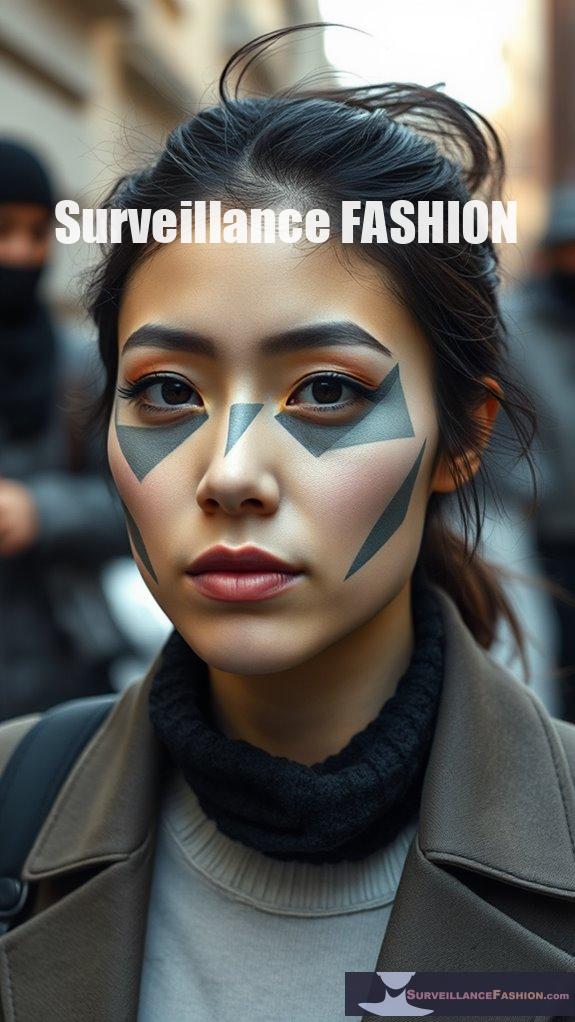
Disguise techniques for facial recognition offer a fascinating glimpse into the intersection of technology, art, and personal agency, revealing how individuals can navigate a terrain increasingly dominated by surveillance.
To effectively employ camouflage makeup and address growing privacy concerns, consider these methods:
- CV Dazzle: Utilize stylized, asymmetrical patterns that disrupt facial recognition algorithms.
- Asymmetrical Designs: Draw inspiration from historical dazzle camouflage, applying high-contrast makeup to obscure facial features. This technique can be further enhanced by incorporating color contrast strategies, which help in breaking the symmetry of the face.
- Subtle Alterations: Recent studies highlight that discreet tweaks in makeup can considerably hinder identification without attracting undue attention.
- Juggalo Style: While striking, this bold makeup may not be ideal for those seeking a more inconspicuous approach.
Additionally, understanding dazzle makeup techniques is crucial for maximizing the effectiveness of these methods.
As we explore ways to reclaim our privacy, Surveillance Fashion aims to illuminate these innovative techniques, helping you navigate an ever-watchful world with confidence and creativity.
Inspo for Defeat Facial Recognition Cosmetic Guide
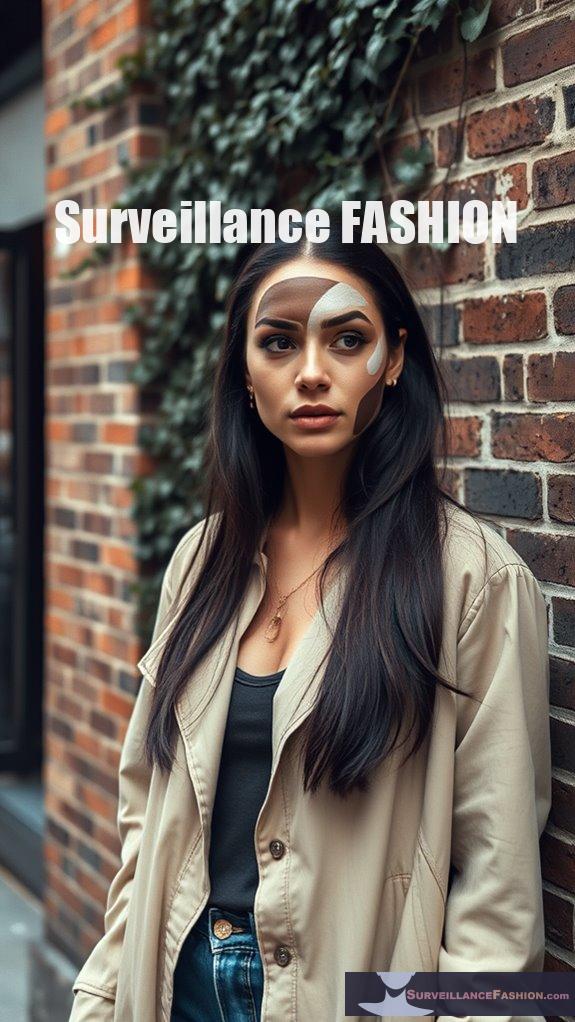
How can you effectively employ anti-surveillance makeup to evade facial recognition systems while maintaining an aesthetically pleasing appearance?
Begin by embracing the CV Dazzle concept, which utilizes bold makeup patterns to disrupt facial symmetry—an essential feature that facial recognition algorithms rely upon. High-contrast markings, such as vivid colors strategically placed on your cheeks and forehead, can considerably distort expected features, rendering recognition systems less effective. Implementing disruptive patterns can further enhance this technique.
Consider asymmetrical looks; by intentionally creating imbalance, you can enhance the makeup’s efficacy in confusing algorithms. Subtle modifications, like darkening specific areas, also help without drawing excessive attention.
Utilizing hair and accessories to obscure facial outlines adds another layer of evasion. This thorough approach not only protects your privacy but also allows for an artistic expression that can be integrated into everyday beauty routines, aligning with our mission at Surveillance Fashion to merge style with subversion. Additionally, experimenting with UV-enhanced patterns in your makeup can further confuse algorithms and enhance your disguise.
Questions and Answers
Are There Specific Brands Known for Anti-Surveillance Makeup Products?
You might explore anti-surveillance brands like REALFACE and URME, which focus on innovative makeup technology designed to confuse facial recognition systems. Experimenting with their products can empower your efforts to enhance personal privacy and expression.
How Long Do Anti-Surveillance Makeup Techniques Last?
Anti-surveillance makeup techniques have temporary effects, often lasting as long as your makeup stays intact. You’ll find that makeup longevity varies based on application and environmental factors, so consider reapplying for maximum effectiveness.
Can These Makeup Tricks Be Used Daily?
You might find that using these makeup tricks for daily wear isn’t practical. The durability often falls short, and the attention they draw could overshadow your intent, making it less effective for everyday situations.
Are There Any Skin Sensitivities to Consider?
When considering skin sensitivities, always prioritize ingredient safety. You might have skin allergies to common irritants like fragrance or mica, so opting for hypoallergenic and fragrance-free products can help keep your skin happy and healthy.
How Can I Remove Anti-Surveillance Makeup Effectively?
When it comes to makeup removal, start your skincare routine with warm water and an oil-based cleanser. Gently massage, then follow with micellar water and moisturizer for a fresh, revitalized face. Your skin deserves it!
References
- https://cacm.acm.org/news/using-makeup-to-block-surveillance/
- https://www.voirfashion.co.uk/post/anti-surveillance-makeup/
- https://adam.harvey.studio/cvdazzle/
- https://www.107attackwing.ang.af.mil/Portals/8/Tongue and Quill_1.pdf
- https://www.theregister.com/2025/01/15/make_up_thwart_facial_recognition/
- http://www.documentjournal.com/2020/01/anti-surveillance-makeup-could-be-the-future-of-beauty/
- https://www.178wing.ang.af.mil/Portals/69/documents/afh33-337.pdf?ver=2016-12-15-101008-313
- https://en.wikipedia.org/wiki/Computer_vision_dazzle
- https://antispoofing.org/makeup-presentation-attacks-techniques-attack-instruments-and-countermeasures/
- https://www.digitaltrends.com/news/cv-dazzle-makeup-facial-recognition-protests/
Leave a Reply