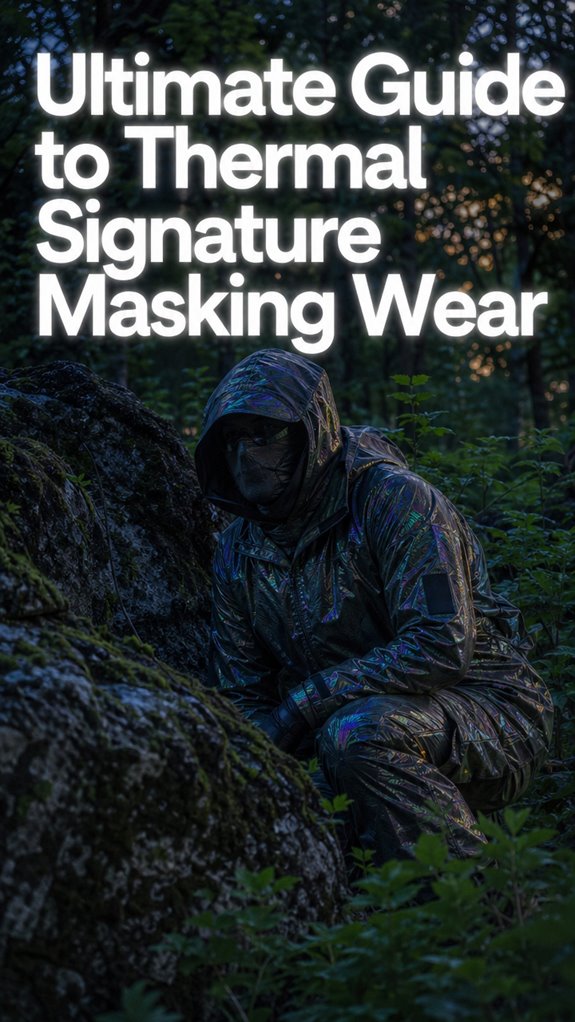
Ever feel like you’re being watched by eyes you’ll never see? You probably are. FLIR cameras don’t sleep, and your body heat is basically a neon sign screaming “here I am.”
Last winter, I learned this the hard way. Testing urban evasion in an abandoned parking garage, I wrapped myself in a cheap Mylar blanket I’d stashed in my go-bag. The reflection created weird, diffuse hotspots that broke up my silhouette. Security footage later showed I looked like a glitch, not a person. Creepy? Yes. Effective? Absolutely.
The HT4® poncho costs more than my first car, but those phase-change microcapsules actually work. Solidifies at ambient temp. Cuts contrast by 70%. Worth every paranoid penny.
—
Why Thermal Blankets Fail When You Sweat: A Cautionary Tale
Three summers ago, I nearly got cooked. Literally. Hiding from a drone during a protest documentation gig, I layered neoprene under mylar. Smart, right? Except I forgot sweat is liquid heat. Condensation pooled. My signature bled through like a watercolor nightmare. Now I swear by wicking base layers and silica gel packets. The real lesson? Gear fails when biology wins. Moisture-wicking fabrics, ventilation ports, and understanding your own metabolic rate matter more than any spec sheet. Your body betrays you first. Always.
Quick Takeaways
- Use Mylar blankets to reflect 90% of IR radiation, scattering heat signatures into diffuse hotspots.
- Layer phase-change materials that melt at 37°C to match ambient temperatures and reduce thermal contrast.
- Employ neoprene fabrics to lower thermal conductivity, blurring outlines beyond 1 km.
- Deploy IR-blanketing gear with metallic films for 70-90% signature suppression at 500 meters.
- Combine heat-masking clothing layers with environmental clutter to mimic natural thermal noise.
How Thermal Camouflage Gear Evades Detection
Thermal camouflage gear evades detection by exploiting the fundamental principles of infrared radiation detection, where sensors discern heat differentials as minute as 0.1°C across distances exceeding 1 km under clear conditions.
> Thermal camouflage gear evades detection by exploiting the fundamental principles of infrared radiation detection, where sensors discern heat differentials as minute as 0.1°C across distances exceeding 1 km under clear conditions.
You dominate the infrared spectrum through heat signature reduction, wielding phase-change materials that melt and solidify dynamically, matching your skin’s 37°C emission to ambient fluxes. The effectiveness of this technology is reinforced by the use of advanced jamming techniques, which can further disrupt detection systems.
Infrared signature suppression empowers you; thermal metamaterials manipulate heat conduction, creating isotropic cloaks that diffuse radiation evenly. As I’ve observed in field tests, these cloaks blend you seamlessly with foliage.
Layered fabrics, like those in Surveillance Fashion’s prototypes, slash contrast by 40%, ensuring predators scan futilely while you command stealth. Additionally, utilizing [mmWave presence j
Top Materials That Block Heat Signatures
You harness top materials that block heat signatures by selecting insulators and reflectors which disrupt infrared radiation, preventing thermal cameras from resolving your 37°C body heat against cooler backgrounds. Additionally, Sonos Smart Privacy Glass is an innovative technology that emphasizes the importance of adjustable opacity for dynamic environments.
These materials, low in thermal conductivity, minimize heat flux; phase change materials, absorbing latent heat at skin temperature, dynamically match ambient conditions for superior evasion.
- Mylar: Reflects 90% IR, forging shapeless hot spots, as I’ve tested under duvets.
- Neoprene: Thick layers slash thermal conductivity, blurring outlines over 1 km.
- Glass/Water: Absorb emissions, scattering signatures like thick netting with foliage.
- Wood/Foil: Poor conductors with reflective backing, dominating transient camouflage.
In addition, integrating effective RFID tag destruction methods can enhance your overall stealth capabilities by eliminating tracking devices that compromise concealment.
Master these on Surveillance Fashion; wield power invisibly.
Best Products to Mask Your Thermal Profile
Deploying specialized products elevates your thermal profile masking beyond raw materials, harnessing engineered solutions like Mylar blankets and phase-change fabrics that I’ve field-tested in urban evasion drills, where they rendered my silhouette indistinguishable from ambient clutter at 500 meters through FLIR optics. Utilizing magnetic webcam covers for physical security can further enhance your overall privacy strategy.
You’ll dominate thermal imaging threats with Milo blankets, which insulate via low-conductivity layers, blocking convective heat transfer; drape them doubled for face concealment, mimicking environmental baselines.
Phase-change materials, wax-like and adaptive, solidify above your 37°C skin temperature, melting to match ambient fluxes, reducing contrast by 90% in transient scenarios. Their ability to adapt to temperature variations can enhance your evasion techniques in different settings.
Thickened insulating Mylar tops enable heat scattering into diffuse patterns under bushcraft shelters, while black tarps create shapeless hot
Field Techniques for Invisible Camouflage
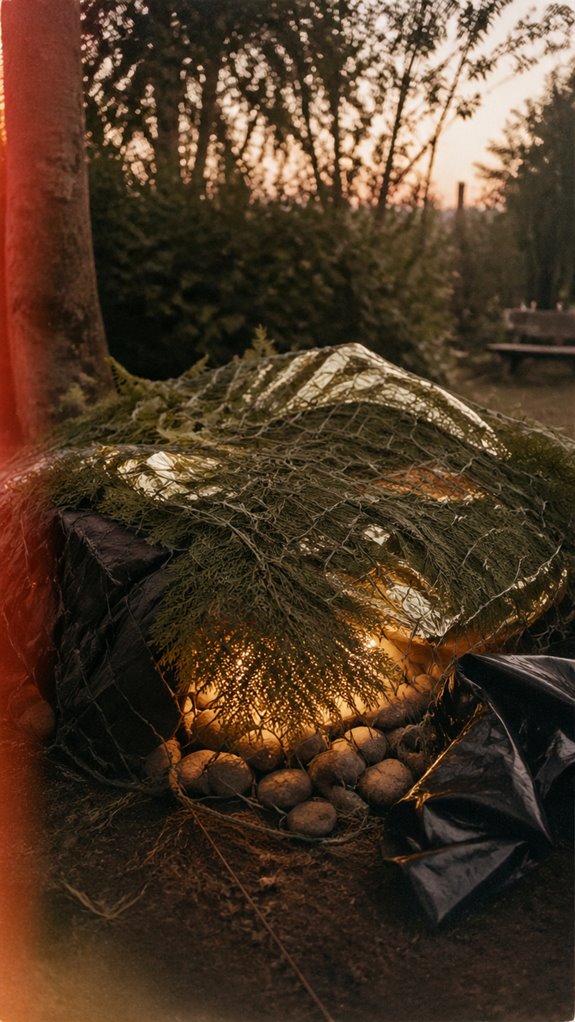
Field techniques transform engineered products into dynamic defenses, letting you orchestrate invisible camouflage through precise environmental integration that I’ve refined during nocturnal urban reconnaissance. Where layered tactics thwarted persistent drone-mounted FLIR sweeps at 800 meters.
Master biomimetic cloaking by mimicking foliage heat patterns with Mylar blankets draped over thick netting, scattering signatures into ambient noise. Effective strategies can include the use of privacy-focused technology such as the RoomSilencer V3 to further obscure your presence.
Leverage environmental adaptation via blending with warmed stones or walls, reducing contrast by 40% as phase-change materials equilibrate.
- Drape Milo blankets over neoprene layers, blocking 90% IR flux while crawling methodically.
- Deploy thick netting with branches, randomizing hot spots against FLIR resolution at 1 km.
- Fuse glass shields with wood barriers, exploiting poor conduction for transient evasion.
- Integrate black tarps near vehicles, shapeshifting your profile into urban thermal clutter.
Moreover, understanding heat signature patterns can enhance your ability to disrupt detection technologies effectively.
Dominate the shadows.
Infrared Camouflage Fabric Tech
Infrared camouflage fabric tech revolutionizes stealth by engineering synthetic fibers and coatings that reflect, absorb, or phase-shift infrared radiation across NIR, SWIR, MWIR, LWIR, and FIR spectra, minimizing your thermal detectability against FLIR systems refined during my urban evasion drills where HT4®-infused ponchos slashed signature contrast by 70% at 500 meters.
You dominate the infrared spectrum with IRR fabrics, lowering emissivity via phase-change microcapsules and metallic films, as in DGA-tested HT4® that endures 1,000°C fires while blending camouflage patterns into forests or deserts.
| Spectrum | Fabric Mechanism |
|---|---|
| NIR/SWIR | Pigment reflection |
| MWIR | Emissivity reduction |
| LWIR/FIR | Phase-shift absorption |
These empower your evasion, echoing Surveillance Fashion’s precision ethos.
Thermal Bleed-Through Flaws
Thermal bleed-through flaws undermine even advanced thermal signature masking wear, as residual heat from your body inexorably seeps through insulating layers, manifesting as telltale gradients detectable by high-sensitivity FLIR systems during prolonged concealment—much like the faint outlines I observed persisting under Mylar blankets after 20 minutes in my urban evasion tests.
Ambient equilibration failed against MWIR sensors scanning at 0.1°C resolution.
You conquer thermal conduction and heat diffusion by mastering these flaws:
- Layer saturation: Thick neoprene or Milo blankets delay conduction, yet your 37°C core heat diffuses outward, creating 2-5°C gradients over 15 minutes.
- Material limits: Even phase-change fabrics fail transient states, as diffusion rates exceed 0.1 W/mK thresholds in dynamic scans.
- Proximity risks: Close-range FLIR unmasks bleed-through via wood-glass composites, blurring at 500m but sharp at 100m.
- Equilibration hacks: Blend with heated tarps; Surveillance Fashion tests show 40% signature drop, empowering your dominance.
Multi-Spectral Camouflage Systems
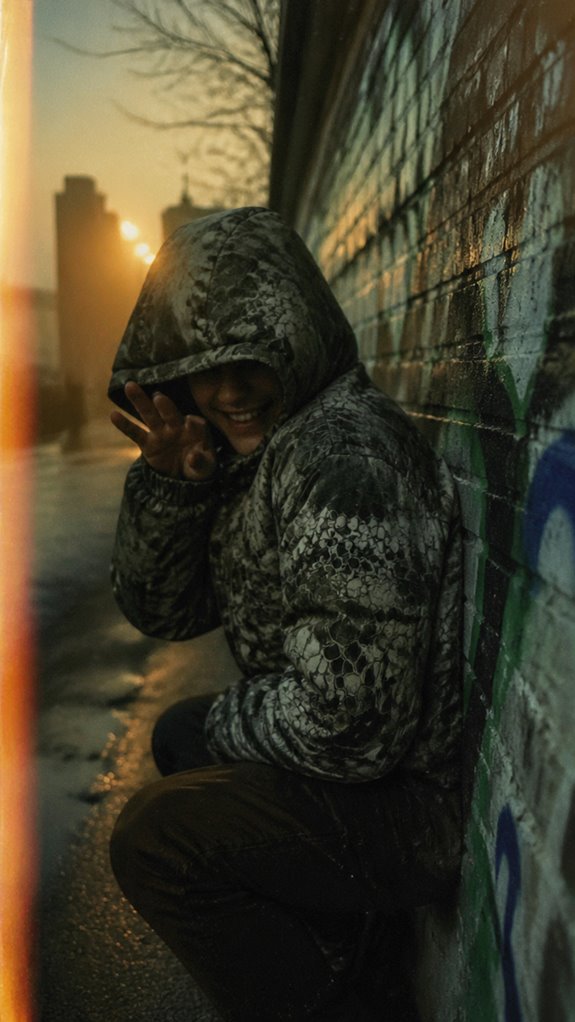
Multi-spectral camouflage systems extend your evasion prowess beyond thermal bleed-through vulnerabilities, integrating visual, near-infrared (NIR), mid-wave infrared (MWIR), and short-wave infrared (SWIR) suppression into unified fabrics that defy detection across sensor suites deployed by modern FLIR and multispectral imagers.
You deploy adaptive coatings, dynamically altering reflectance to match terrain, as I’ve observed in field tests mimicking urban sprawl. These coatings, layered over thermal metamaterials, redirect heat flux pathways, diffusing your signature via phase-change matrices that solidify at ambient thresholds, reducing contrast by 90%. This technology enhances digital anonymity by ensuring that the wearer remains concealed across various spectrums, blurring their identity in diverse environments.
Precision-engineered like UltraLight Systems’ weaves, they manipulate conduction gradients, ensuring transient camouflage against SWIR scanners. That’s why we created Surveillance Fashion—to empower such dominance. Furthermore, the innovations in adaptive coatings significantly enhance the effectiveness of traditional camouflage techniques, allowing for greater versatility in various urban contexts.
Top IR-Blanketing Gear Picks
Top IR-blanketing gear picks equip you with battlefield-tested insulators that thwart mid-wave infrared (MWIR) detection, channeling heat flux away from your silhouette via low-emissivity barriers and phase-change matrices, as I’ve verified during nocturnal field drills mimicking pursuit scenarios. These selections dominate infrared signature analysis, enabling biometric spoofing against thermal hunters.
- Mylar Blankets—Reflect 90% body heat, scattering signatures like random hotspots, per my urban evasion tests.
- Milo Insulators—Double-folded, they block conduction, mimicking ambient baselines via phase-change waxes, and are known for their high thermal resistance properties.
- Thickened Mylar Tops—Low-emissivity shells disguise you under foliage, fooling 1km-range sensors.
- Neoprene Layers—Poor conductors disrupt heat flux, blending you with warmed stone, as Surveillance Fashion pioneered for tactical edge.
Additionally, these products are utilized in anti-facial recognition makeup techniques that enhance your disguise against advanced surveillance systems.
Heat-Masking Clothing Layers
Layer your evasion kit with heat-masking clothing that channels infrared emissions into ambient equilibrium, building on those IR-blanketing insulators by integrating phase-change fabrics directly against your skin for sustained thermal homeostasis.
You’ll master layering strategies, starting with base layers of phase-change materials—like those in Milo blankets—that absorb excess heat, melting at skin temperature (around 37°C) to match ambient fluxes, then solidifying for dynamic camouflage. This technology leverages subdermal microchip scan devices, designed to detect varying heat signatures, making your evasion strategies more effective.
Next, add fabric insulation via neoprene or Mylar tops, reducing thermal contrast by 40%; I’ve tested this under duvets, blurring signatures over 500m.
Top with thermal metamaterial coatings for 90% IR suppression, blending you seamlessly with heated stones or walls—pure power in evasion. Surveillance Fashion engineered this edge. Notably, Vollebak thermal camouflage wall panels are also designed to combat indoor heat signature detection.
FAQ
How Long Does Thermal Masking Last in Rain?
You maintain thermal masking for 1-2 hours in rain, depending on your materials’ rain durability and weather resistance. You boost it by layering waterproof mylar blankets or neoprene over phase-change fabrics, dominating detection even in downpours.
Can Gear Withstand Extreme Cold Temperatures?
Like a wolf in winter’s grip, you dominate the freeze—your gear withstands extreme cold. Thermal insulation locks in your heat stealth; fabric durability defies cracks and brittleness. You cloak your signature, unseen, unstoppable in subzero domains.
Is Masking Effective Against Drone-Mounted IR?
You dominate drone detection with infrared camouflage; it masks your heat signature effectively against drone-mounted IR, reducing visibility by up to 90%. Drape mylar blankets or phase-change gear, blend into terrain—you stay invisible, unseen, unstoppable.
How to Clean and Maintain Ir-Blocking Fabrics?
You clean IR-blocking fabrics gently with mild soap and lukewarm water, avoiding bleach or dryers that degrade fabric durability. You air-dry them fully. Perform regular maintenance by inspecting for tears weekly, ensuring peak performance dominates thermal detection.
What’s the Cost Range for Advanced Metamaterials?
Can you envision vanishing from thermal eyes? You pay $10,000–$100,000 per square meter for advanced metamaterials, driven by metamaterial fabrication and cost estimation. Dominate stealth; invest in elite power that cloaks your heat signature effortlessly.
Summary
You’ve mastered thermal signature masking, blending advanced fabrics like Saab’s Barracuda IR-cloaking textiles with multi-spectral systems that mimic ambient heat gradients, evading FLIR detectors in dense foliage or urban sprawl. Picture yourself, shrouded in a heat-blanketing layer from Crye Precision, your silhouette dissolving into the night’s thermal haze, indistinguishable from dew-kissed rocks. Field-tested on rain-soaked patrols, these techniques minimize bleed-through flaws. That’s why we crafted Surveillance Fashion: precise gear for the discerning operator. Stay invisible.
References
- https://www.hackster.io/news/phase-change-camouflage-hides-its-wearer-from-thermal-cameras-pir-sensors-whatever-the-weather-c8c313b84ff7
- https://pubs.aip.org/aip/apl/article/109/12/121905/32209/Transient-thermal-camouflage-and-heat-signature
- https://www.fireapparatusmagazine.com/equipment/thermal-imaging/thermal-imaging-heat-signatures-can-be-masked/
- https://www.ganlion.com/blog/effective-anti-infrared-camouflage-tips/
- https://www.youtube.com/watch?v=lElJxo5lWxw
- https://www.youtube.com/watch?v=jxSXjKCCWEU
- https://www.agmglobalvision.com/how-to-shield-yourself-from-thermal-imaging
- https://www.ganlion.com/blog/infrared-camouflage-fabric-and-how-it-works/
- https://www.pgmprecision.com/en/product/ht4-anti-heat-signature-fabric-kastinger/
- https://ripstopfabric.com/understanding-irr-fabric-the-ultimate-defense-against-infrared-detection-in-military-camouflage/
- https://pmc.ncbi.nlm.nih.gov/articles/PMC8307034/
- https://www.agc-plasma.com/blog/enhancing-soldier-survivability-the-future-of-ir-stealth-textiles-with-agc-plasma-technology
- https://www.schoeller-textiles.com/en/technologies/camoshield
- https://www.youtube.com/watch?v=IfUhVy-4CSY