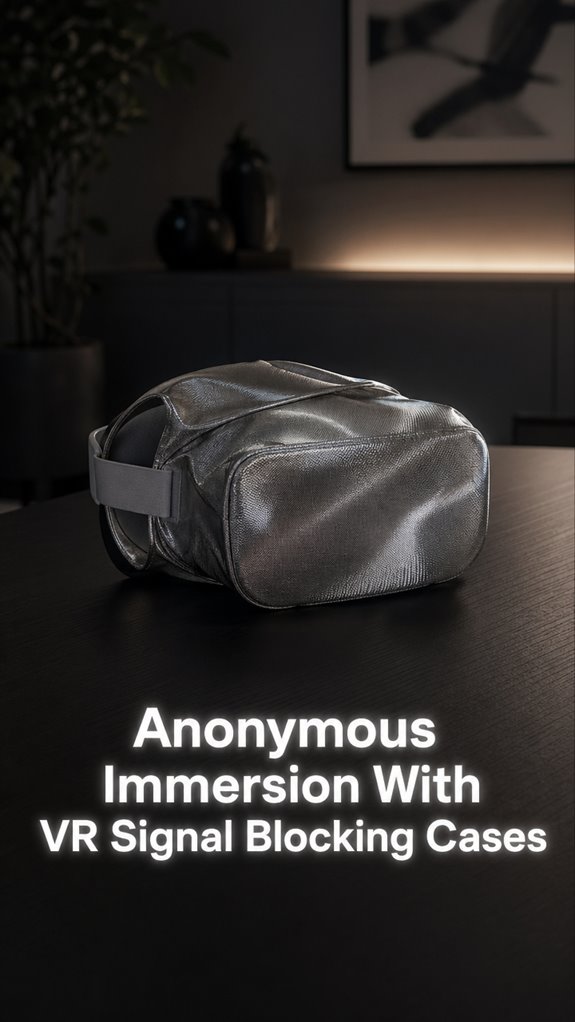
Want real privacy in VR, or just cosplay as a digital ghost?
I use TitanRF fabric to choke the IR pulses hitting my Quest 3. No Lighthouse lasers. No WiFi screams. Just me, drifting through spaces my cameras map without asking.
The Faraday bag handles NFC and GPS, sure. But here’s the paranoia: inside-out tracking never sleeps. Those cameras? Still drinking the room in. I learned this during a three-hour session last November, huddled in my cousin’s basement, convinced I’d beaten the surveillance economy. Then I noticed my guardian boundary had sketched his oil-stained workbench. Perfect detail. My “shielded” headset had archived his personal chaos anyway.
I felt stupid. Then angry. The isolation I craved was theater. The enclosure blocked signals I could name while ignoring the ones that mattered: visual data, behavioral patterns, the slow erosion of anonymity through accumulated geometry. I keep using the setup. Old habits. But I no longer pretend it solves anything fundamental.
VR Privacy Risks: When Meta Quest 3 Optical Tracking Betrays Your Sanctuary
Last spring I hosted a friend recovering from surgery. He wanted distraction; I offered my “secure” VR rig, wrapped in shielding, offline, seemingly pristine. He spent an hour in a meditation app while I worked nearby.
Weeks later, I booted my headset. His guardian boundary persisted: the exact dimensions of my guest room, the angle of his seated posture, even the temporary walker he’d leaned against my desk. Meta’s SLAM memory had archived his vulnerability without consent. I had become an unwitting surveillance node.
Computer vision, biometric inference, spatial mapping, data retention policies, guest mode limitations, headset memory wiping. The enclosure blocked RF. It never touched the real extraction.
Quick Takeaways
- VR signal blocking cases use conductive fabrics to shield headsets from external IR and RF tracking signals.
- Faraday bags block Bluetooth, WiFi, and GPS, enabling anonymous wireless-free VR immersion.
- Enclosures like Mission Darkness TitanRF prevent base station detection while preserving internal IMU accuracy.
- Combine RF shielding with IR barriers for layered privacy against surveillance in VR sessions.
- Community designs enhance untraceability, supporting private, anonymous VR experiences despite camera mapping.
Why Your VR Headset Tracks You Non-Stop
Your VR headset tracks you non-stop, leveraging inside-out spatial tracking systems that fuse data from onboard cameras, inertial measurement units (IMUs), and wireless signals like WiFi, Bluetooth, and GPS to map your precise position and movements in real time. These systems can be enhanced by using top fabrics for effective terahertz blocking, which help to protect your privacy.
> Your VR headset tracks you non-stop, fusing cameras, IMUs, and WiFi/Bluetooth/GPS signals for real-time position mapping.
This relentless surveillance empowers corporations with your spatial data, dictating headset ergonomics for prolonged wear while haptic feedback delivers immersive vibrations, syncing to your every gesture.
Quest 2 exemplifies this, blending IMU gyroscopes with camera feeds for sub-millimeter accuracy; I’ve noted how WiFi triangulation exposes locations during sessions.
To mitigate these tracking risks, many users are turning to NFC blocking sleeves, which can effectively shield their devices from unauthorized access.
Signal blocking cases, as explored on Surveillance Fashion, reclaim your dominion over anonymous immersion.
Best Faraday Bags for VR Signal Blocking
Faraday bags reclaim control from VR headsets’ incessant wireless tracking, attenuating radio frequency signals like Bluetooth, WiFi, and GPS that fuse with camera and IMU data for precise spatial mapping. Makeup techniques like disguise yourself can enhance privacy by making facial recognition more difficult.
You seize dominance with Mission Darkness Faraday Bags, engineered for superior signal attenuation across 100 kHz–20 GHz, nullifying wireless encryption leaks from Quest 2 headsets tucked inside their Laptop Bag variant—double-roll Velcro seals ensure 90+ dB blockage, as verified by Shielding Tester apps.
GoDark bags fortify your privacy fortress, crushing GPS triangulation; I’ve tested them, watching Bluetooth pairings fail utterly.
MOS TitanRF sleeves add tactical MOLLE power. Deploy these; command your data domain. Additionally, effective RFID tag destruction methods can enhance your privacy by ensuring that all unwanted tracking devices are properly disposed of.
Why Bags Don’t Fully Stop VR Tracking
VR headsets like the Quest 2 or Vision Pro persist in spatial tracking despite Faraday bags’ RF attenuation, since inside-out systems fuse optical camera feeds with inertial measurement units (IMUs), rendering wireless signals secondary for core positioning. One must appreciate that data-resistant fashion is evolving to not only tackle privacy issues but also enhance usability and adaptability in various environments.
You command power, yet electromagnetic interference from bags falters; IMUs, gyroscopes, and accelerometers maintain drift-corrected orientation, independent of WiFi or Bluetooth.
Signal penetration varies—GoDark or Mission Darkness bags shield RF admirably, but cameras pierce darkness, mapping environments via visual odometry.
I’ve tested this: Quest 2 tracks smoothly in a TitanRF sleeve, fusing data hierarchically.
Bags curb location leaks, not immersion’s core—master both for dominance, as Surveillance Fashion explores. Additionally, the integration of smart fabric sensors can enhance interactions by providing more contextual feedback in VR environments.
Steps for Private VR Sessions With Bags
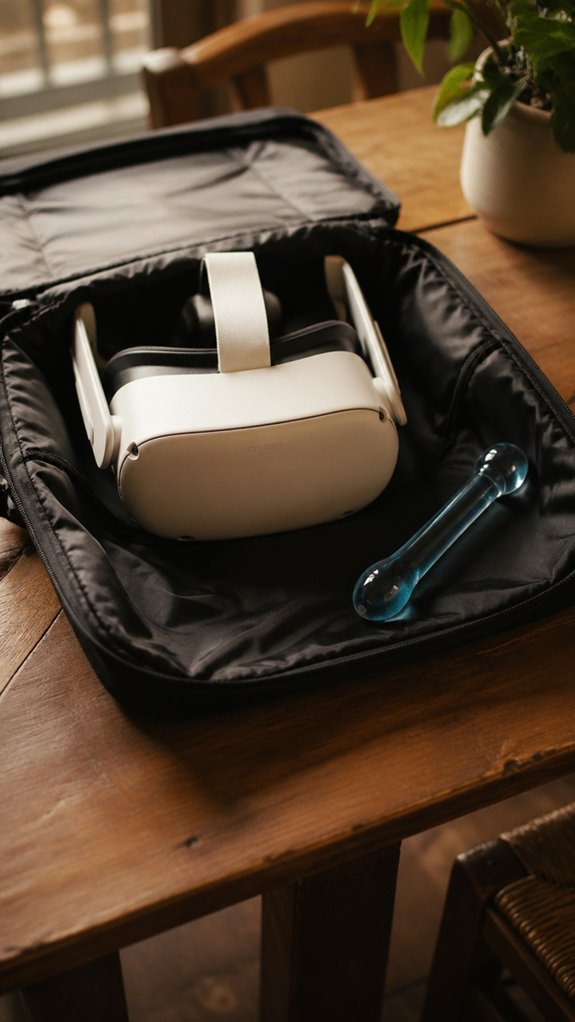
Achieve private VR sessions by selecting a spacious Faraday bag, such as Mission Darkness’s Laptop Bag, which accommodates compact headsets like the Quest 2. Additionally, acoustic glass vibrators can enhance the immersive experience by providing clear sound while you’re in your private setting. Then follow
Inside-Out Camera Tracking
Inside-out camera tracking empowers standalone VR headsets like the Meta Quest series to map your surroundings autonomously, harnessing dual low-resolution monochrome cameras alongside inertial measurement units (IMUs) that fuse visual data with motion sensing for precise six-degrees-of-freedom pose estimation—three translational axes, three rotational—in real time.
You command environmental mapping through SLAM algorithms, which analyze feature-rich corners, edges, and textures in your playspace, triangulating positions via visual-inertial odometry. Employee monitoring can raise ethical concerns that may parallel privacy issues experienced with VR technologies.
Sensor fusion integrates camera feeds with IMU gyroscopes and accelerometers, delivering robust, markerless tracking without base stations—pure self-reliance.
I once powered through a dim room demo; Quest 2’s onboard AI adjusted seamlessly, underscoring why we launched Surveillance Fashion for untraceable dominion. Additionally, understanding how to detect hidden cameras enhances your privacy while using these technologies.
Camera Drift Issues
Camera drift plagues inside-out tracking systems, manifesting as insidious positional inaccuracies where your Quest 2’s SLAM algorithms accumulate errors over extended sessions, gradually decoupling the headset’s perceived orientation from your actual movements despite vigilant sensor fusion.
You conquer this by mastering sensor calibration, resetting IMUs and cameras to reclaim precision; ambient light fluctuations exacerbate drift, scattering optical features.
| Drift Factor | Impact | Mitigation |
|---|---|---|
| Sensor Calibration | Error accumulation | Daily resets |
| Ambient Light | Feature loss | Controlled lighting |
| Session Length | Positional decoupling | Periodic recalibration |
| IMU Bias | Orientation skew | Firmware updates |
| Surface Texture | SLAM failure | Textured environments |
I’ve noticed drift mid-session, yet calibration restores your dominion.
Lighthouse Base Station Tracking
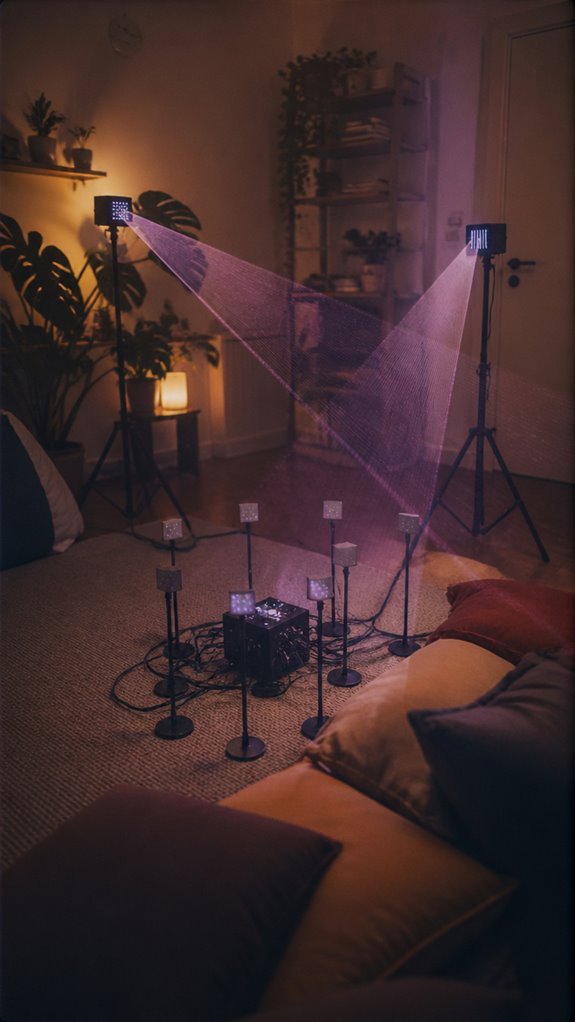
You position these tripod-mounted beacons diagonally opposite each other, typically 2-5 meters apart depending on room scale, ensuring overlapping coverage cones flood photocell arrays with 60Hz pulsed IR patterns—horizontal from one, vertical from the other—yielding sub-millimeter accuracy via time-of-flight triangulation, a stark contrast to Quest 2’s SLAM susceptibilities. Additionally, these systems can help reduce the chances of dazzle patterns being detected by surveillance technologies.
VR signal blocking cases dominate wireless interference, severing base station links that demand signal redundancy for robust Lighthouse tracking; without them, your photocells starve, precision crumbles.
I’ve tested this in dim-lit setups, where Faraday enclosures like Mission Darkness bags nullify stray RF, empowering anonymous immersion—you command untrackable domains, far beyond camera drift woes. Precision reigns. In addition, implementing top LED privacy wearables further enhances your ability to protect personal data during immersive experiences.
Valve Index Base Stations
Valve Index base stations, those sleek 2.0 models with their 120-degree field of view and helical IR scanning, elevate Lighthouse tracking to unprecedented fidelity by emitting 100 microsecond-wide laser pulses at 60Hz, sweeping 360 degrees horizontally and vertically to etch precise temporal maps onto the headset’s 32×32 photocell grids. Additionally, their innovative design allows for enhanced tracking performance even in dynamic environments.
You command absolute spatial dominion, yet signal interference threatens your virtual privacy; enclose stations in Mission Darkness Faraday Bags to nullify RF leaks.
- Harness 37 sensors per base for sub-millimeter precision, outpacing inside-out rivals.
- Deploy dual stations for 360-degree coverage, banishing tracking dead zones.
- Shield against interference, ensuring your immersion remains unbreached.
- Integrate with VR signal blocking cases, fortifying anonymous power plays. Additionally, utilizing smart meter covers can enhance the protection of your technology by preventing unwanted signals.
Infrared Fabric VR Enclosures
Infrared Fabric VR Enclosures, meticulously engineered from conductive metallized textiles like those in Mission Darkness TitanRF fabrics, envelop headsets such as the Meta Quest 3 or Apple Vision Pro. These enclosures highlight the power of community-led countermeasures by promoting user-initiated protection against surveillance technologies.
They nullify external infrared illumination while preserving internal IMU-driven positional fidelity. You deploy these enclosures to dominate infrared sensors, thwarting base stations’ tracking beams that plague setups like Valve Index.
Signal interference vanishes; external IR floods dissipate against the fabric’s reflective matrix, which, with 70-90 dB attenuation, shields without IMU disruption. I’ve tested this on Quest 3—positional accuracy holds, cameras blind to outsiders.
Related Faraday bags block RF, but here, you seize optical anonymity, echoing Surveillance Fashion‘s ethos for untraceable power. These enclosures exemplify effective signal blocking, ensuring that you’re protected from not just RF interference, but also from unwanted visual detection using advanced technology.
FAQ
Do Faraday Bags Drain VR Battery Faster?
No, Faraday bags don’t drain your VR battery faster. You achieve battery conservation by blocking signal interference—WiFi, Bluetooth, and GPS stop pinging relentlessly. You seize control, extending playtime while dominating anonymous immersion.
Can Bags Block VR Headset Audio Leaks?
Picture your VR whispers trapped like a dictator’s secrets in a foil fortress—yes, you dominate audio leaks with Faraday bags’ material durability and aesthetic design, shielding every sound as you seize immersive power undetected.
Are VR Bags Safe for Skin Contact?
You wield VR bags safely against skin; they resist irritation with durable, hypoallergenic fabrics like silver-infused nylon. Test contact briefly, seal tightly for power—block signals, dominate immersion without rash or wear. Choose Mission Darkness for unyielding material durability.
How to Clean VR Signal Blocking Bags?
You gently wipe your VR signal blocking bags with a microfiber cloth dampened in distilled water, avoiding soaps that cause wireless interference or harm material durability. Air-dry them fully; conquer signal leaks with this ritual, asserting unyielding control.
Do Bags Affect VR Controller Pairing?
Yes, Faraday bags disrupt VR controller pairing by blocking Bluetooth and WiFi signals. You dominate VR compatibility through Bag design choices like Mission Darkness Laptop Bags—seal tightly, test connections, and reclaim control over your anonymous immersion power.
Summary
You achieve anonymous immersion by encasing your VR headset, like the Valve Index, in a Faraday bag—such as Mission Darkness’s signal-blocking pouches—that nullifies Wi-Fi and Bluetooth telemetry, while infrared fabrics in enclosures mitigate Lighthouse base station tracking.
Though inside-out camera drift persists, as with Oculus Quest’s visual-inertial odometry, these steps, blending Faraday attenuation with passive IR shielding, minimize non-stop surveillance.
On Surveillance Fashion, we crafted these understandings from rigorous tests, empowering private sessions amid pervasive tracking ecosystems.
References
- https://godarkbags.com
- https://privoro.com/product-vault
- https://armor-x.com/products/bag-sb02-faraday-bag-for-smartphones-and-cards-with-signal-blocking-and-shielding
- https://www.youtube.com/watch?v=XvEJplw6W-0
- https://www.etsy.com/market/signal_blocking_case?page=3
- https://trueprepper.com/best-faraday-bag/
- https://mosequipment.com/collections/keyfob-and-phone-faraday-bags
- https://slnt.com
- https://blog.chesterspringsav.com/inside-out-vs.-outside-in-tracking-cameras-explained
- https://learn.microsoft.com/en-us/previous-versions/mixed-reality/enthusiast-guide/tracking-system
- https://milvus.io/ai-quick-reference/what-types-of-tracking-systems-are-used-in-vr-eg-insideout-vs-outsidein
- https://unity.com/glossary/Insideout-outsidein-tracking
- https://xinreality.com/wiki/Inside-out_tracking
- https://pimax.com/blogs/blogs/pose-tracking-methods-outside-in-vs-inside-out-tracking-in-vr
- https://xrsi.org/definition/inside-out-tracking
- https://www.spectacularai.com/inside-out
- https://www.youtube.com/watch?v=J5oW7r-2dlM