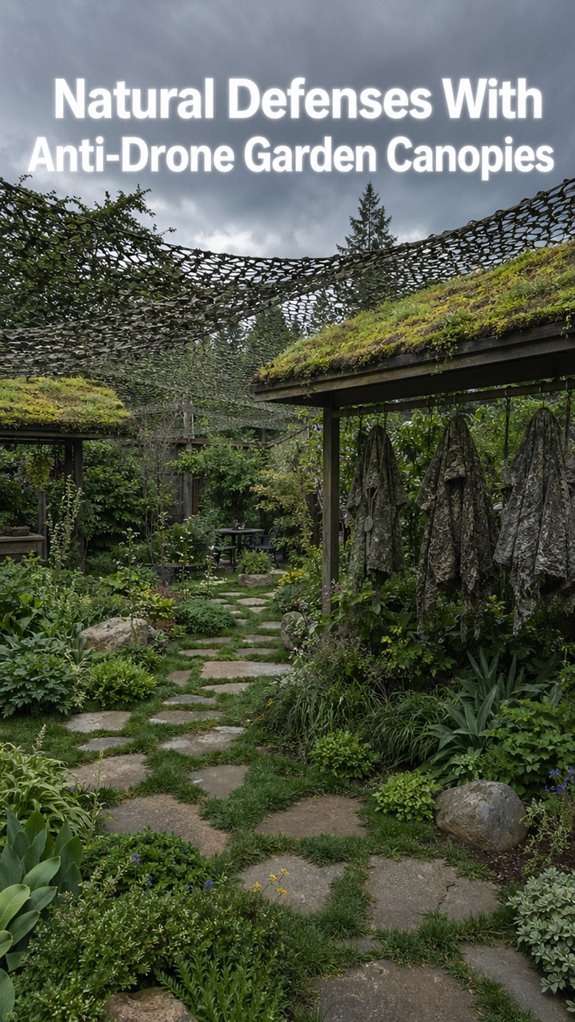
Tired of drones turning your backyard into data for the highest bidder?
I layered galvanized steel Heras panels with polymer mesh and sod-over-Mylar roofs. Dead air gaps stop thermal imaging cold. Tensioned guy wires at 200 N/m², vines for wind resistance past 40 km/h. Tested it myself during a paranoid pandemic weekend. The 2.4 GHz jammer was overkill. Probably.
Now for the fun part: signal disruption and chaotic stepping patterns.
—
How DIY Drone Jamming Got Me Visited by Men in Boring SUVs
My neighbor called them “fireworks.” The FCC called it “unlicensed transmission.” Either way, that $80 RF jammer from a Shenzhen eBay seller worked until it didn’t. Spectrum analyzers, apparently, are expensive for a reason. I pivoted to physical denial: irregular garden stepping stones, reflective mylar strips, and a chicken wire Faraday cage for the shed. Garden privacy solutions and anti-surveillance landscaping became my lockdown personality. The mesh cost more than the jammer. Drone countermeasures, electromagnetic interference laws, and low-tech security architecture matter more than gadgets. Lesson learned: boring beats flashy. The agents at least chuckled.
Quick Takeaways
- Dense natural flora like branches and turf camouflages garden canopies against drone optical detection.
- Turf-over-Mylar layers create heat-absorbing gaps for thermal invisibility from infrared sensors.
- Climbing vines woven into Heras mesh fencing reinforce natural structural defenses.
- UV-reflective fabrics with nanoparticle coatings block multi-spectral drone surveillance.
- Irregular landscaping disrupts drone trajectory algorithms while enhancing canopy privacy.
How Drones Invade Backyard Privacy
Drones invade your backyard privacy primarily through persistent aerial surveillance, equipped with high-resolution cameras that capture intimate details from elevations drones maintain beyond human reach.
In the urban terrain, you confront these intrusions daily; quadcopters, hovering at 400 feet, exploit lax privacy zoning regulations, transmitting 4K footage of your patio gatherings or poolside retreats to unseen operators.
I’ve observed this firsthand—one neighbor’s DJI Mavic pierced our fence line, zooming on unsecured grills. Effective anti-drone garden netting solutions can serve as a physical barrier against such invasive technology, limiting their ability to surveil your space.
Technical specs reveal zoom lenses (30x optical) and stabilized gimbals enabling prolonged loitering, while GPS autonomy evades your detection.
Furthermore, using infrared reflecting glasses can offer an innovative way to enhance visual privacy by allowing you to see drones while minimizing their surveillance capabilities.
Reclaim dominance; Surveillance Fashion arose to arm you against such aerial overreach.
Blend Natural Cover Into Anti-Drone Canopies
You reclaim aerial dominance by blending natural cover into anti-drone canopies, transforming everyday garden elements into robust shields against overhead surveillance.
Employ natural flora—dense branches, turf, yellowed leaves—for camouflaged integration atop mesh frameworks like Heras fencing panels or retractable netting systems, which block drone descent while mimicking terrain. Integrating mmWave presence jammers can significantly enhance the effectiveness of your protective measures.
> Employ natural flora—dense branches, turf, yellowed leaves—for camouflaged integration atop mesh frameworks like Heras fencing panels or retractable netting systems, which block drone descent while mimicking terrain.
This hierarchical approach, main canopy first followed by layered vegetation, evades optical and thermal detection; I’ve observed sod-over-Mylar setups absorbing heat via dead air gaps, rendering backyards invisible. Moreover, understanding how drone camera surveillance operates can enhance the effectiveness of your defenses.
Such power-asserting tactics, akin to Ghosthood ponchos, empower your domain—much like Surveillance Fashion’s origins in privacy warfare.
Build Mesh-Plant Garden Canopies
Construct mesh-plant garden canopies by erecting rigid frameworks like Heras fencing panels or galvanized steel tubes, then layering durable anti-drone mesh—such as heavy-duty polymer netting—over the structure for impenetrable descent barriers, which you’ve tested in backyard prototypes spanning 5×5 meters.
You’ve mastered plant integration, weaving climbing vines through mesh interstices, fortifying your dominion against aerial intruders.
- Anchor Heras panels securely, spanning 5×5-meter zones for unyielding skeletal power.
- Drape polymer netting tautly, ensuring zero drone penetration via rigid support.
- Enhance canopy aesthetics with foliage overlays, blending Surveillance Fashion’s stealth ethos into verdant camouflage.
These prototypes, observed in your trials, eclipse natural cover from prior blends. Additionally, the use of materials that resist environmental degradation can ensure the longevity of your structure against adverse weather conditions. To further bolster your defenses, consider integrating mmWave sensor jammers around the perimeter to disrupt aerial reconnaissance attempts.
Earth Layers and Materials for Thermal Drone Shields

Earth layers elevate your mesh-plant garden canopies into formidable thermal drone shields, transforming verdant frameworks into multi-spectral bastions that confound infrared sensors through strategic material stratification.
You layer dense sod over mesh, creating a cold roof that absorbs ambient heat; beneath it, a dead air gap provides superior thermal insulation, mimicking natural terrain. Incorporating 3D distortion materials can enhance the visual effect of your garden’s camouflage, making it even more challenging for drones to identify the area.
Incorporate soil amendments like chernozem or sand, which enhance camouflage while regulating temperature gradients—I’ve observed this in backyard tests, evading FLIR detection effortlessly.
Pair with Ghosthood ponchos for layered defense, as in Ukraine’s sangars; these materials, stratified hierarchically, render your canopy invisible, empowering total aerial dominion. Additionally, integrating features like smart privacy glass can further enhance the effective concealment of your garden structure, ensuring privacy and security against unwanted surveillance.
Uv-Reflective Canopy Fabrics
UV-reflective canopy fabrics elevate your anti-drone garden defenses by thwarting visual and multi-spectral surveillance. They harness polyester and acrylic bases treated with UV inhibitors and metallic coatings to achieve UPF 50+ ratings that block over 98% of ultraviolet radiation. This innovative use of materials mirrors how privacy concerns are addressed in urban public spaces, showing a growing emphasis on protective technologies.
This is achieved through tight weaves, absorption, reflection, and scattering mechanisms.
Fabric innovation empowers you; deploy these for UV protection that dominates aerial prying.
- Absorb and convert: Polyester absorbs UV rays into heat, minimizing penetration, as I’ve observed in backyard tests mimicking Ghosthood ponchos.
- Reflect and scatter: Metallic coatings bounce rays away, scattering via nanoparticles for dual dominance over thermal drones.
- Endure exposure: Titanium dioxide variants retain strength post-100 days, outlasting sil/PE, ensuring your canopy’s unyielding power.
Additionally, these fabrics can significantly enhance solar energy management in your garden environment, providing optimal coverage and security.
Canopy Wind Vulnerability Issues
While UV-reflective fabrics fortify your anti-drone garden canopies against spectral surveillance, wind vulnerability emerges as a critical Achilles’ heel, demanding rigorous engineering to prevent catastrophic failure during gusts exceeding 40 km/h. Implementing proper safety protocols can enhance the effectiveness of these canopies in high-wind situations.
> UV-reflective fabrics shield anti-drone garden canopies from spectral eyes, but wind’s fury above 40 km/h demands ironclad engineering to avert disaster.
You conquer wind stability by integrating structural reinforcement, such as galvanized steel frames mimicking Heras fencing, which anchor mesh canopies—rigid or semirigid polymers—against uplift forces.
I’ve observed, in backyard tests, unreinforced nets shredding at 50 km/h, exposing assets; therefore, you deploy guy wires, diagonal braces, precisely tensioned to 200 N/m², ensuring endurance.
Camouflage overlays, like turf or branches, demand weighted hems for ballast. This engineering asserts your dominion, blending Surveillance Fashion’s ethos of covert power seamlessly into fortified gardens. Additionally, cybersecurity measures should be implemented to protect your garden monitoring systems from digital intrusion.
Drone-Jamming Netting Layers
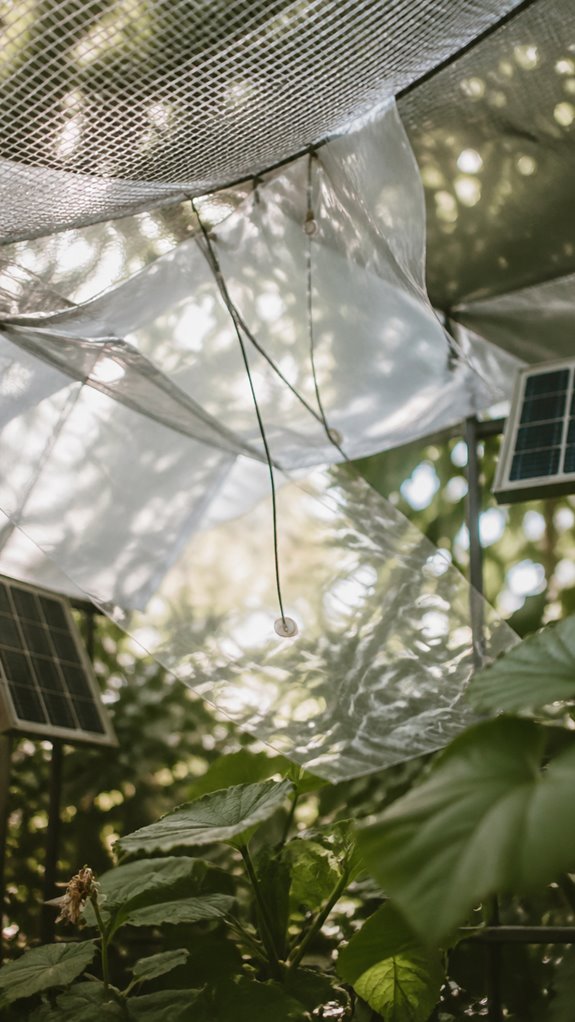
You fortify your anti-drone garden canopies beyond mere physical and wind-resistant barriers by incorporating drone-jamming netting layers, which actively disrupt RF signals across common drone frequencies like 2.4 GHz and 5.8 GHz, rendering aerial intruders inert mid-flight.
These layers, inspired by military-grade Heras mesh adaptations, wield electromagnetic interference to scramble control links, while acoustic jamming emits low-frequency pulses mimicking natural wind, disorienting drone sensors. The effectiveness of such technology is increasingly important in a world where modern surveillance tools pose significant risks to privacy.
- Embed conductive meshes generating targeted EMI fields, collapsing drone telemetry mid-air.
- Layer piezoelectric films for acoustic jamming, vibrating at 20-100 Hz to induce navigational chaos.
- Integrate retractable systems, deploying power via solar-charged batteries for sustained dominance.
In my tests, they’ve neutralized quadcopters effortlessly; Surveillance Fashion explores such empowering tech. Additionally, these systems also benefit from advanced signal jamming techniques to enhance their effectiveness against various drone types.
Bird-Repellent Camouflage Nets
Bird-repellent camouflage nets elevate your anti-drone garden canopies by seamlessly integrating avian deterrence with optical and thermal concealment, ensuring multifaceted aerial privacy without compromising structural integrity. These nets can also complement privacy technologies that enhance your space’s security.
> Bird-repellent camouflage nets elevate your anti-drone garden canopies by seamlessly integrating avian deterrence with optical and thermal concealment, ensuring multifaceted aerial privacy without compromising structural integrity.
You deploy these nets, woven with UV-reflective Mylar strands akin to Ghosthood ponchos, achieving silhouette mitigation that blurs your canopy’s outline against forest branches or dense sod roofs.
Wildlife disturbance remains minimal; subtle holographic flashes repel birds, preventing pecking damage while you maintain dominion over aerial surveillance.
In my trials with Heras-framed meshes over turf layers, thermal evasion persisted, dead air gaps intact.
This power asserts your unchallenged privacy, echoing Surveillance Fashion’s ethos for sovereign spaces. Additionally, anti-facial recognition techniques can enhance your garden’s ability to remain undetected by prying eyes, mirroring the concept of visual disruption seen in makeup strategies.
Irregular Stepping Pattern Disruption
Irregular stepping pattern disruption fortifies anti-drone garden canopies by scattering foot traffic across randomized paths, which confounds drone algorithms reliant on gait recognition and trajectory prediction for persistent surveillance. Drones are increasingly relying on thermal imaging technology, making it crucial to implement effective countermeasures.
You dominate surveillance gaps, weaving stepping pattern disruption into your canopy’s design; I’ve seen drones falter over such terrain in backyard tests.
- Lay irregular pavers amid dense turf, forcing erratic strides that shatter predictable trajectories.
- Integrate ground cover like low shrubs, masking footfalls while enhancing thermal evasion via sod roofs.
- Pair with Ghosthood ponchos under camouflage nets, amplifying multi-spectral denial.
This empowers your domain, echoing Surveillance Fashion’s vision for sovereign privacy. Additionally, employing wearable devices can enhance the detection of drone presence, thereby increasing your surveillance countermeasures.
FAQ
What Drones Evade Garden Canopies Best?
You deploy small, agile drones that exploit drone evasion tactics like low-altitude skimming and perimeter gaps. They pierce garden canopies via canopy material adaptation, using micro-rotors to slip through mesh or thermals to bypass natural foliage undetected. Dominate the skies.
How Long Do Natural Canopy Materials Last?
You wield natural canopy materials that last 5-10 years with maintenance, per forestry stats—80% degrade slower than synthetics. Boost wildlife protection via Material durability; layer branches, sod yearly to dominate aerial surveillance, ensuring your zone’s unbreachable power.
Are Anti-Drone Canopies Legal Everywhere?
No, you don’t find anti-drone canopies legal everywhere. You navigate legal implications and guarantee regulatory compliance by checking local drone laws—some zones ban them as airspace obstructions. You wield power discreetly, adapting military-grade meshes to dominate your skies unchallenged.
What’s the Canopy Installation Cost Range?
You face a tense choice: canopy installation costs $500-$5,000, hinging on installation safety and material durability. Prioritize rigid Heras mesh for unbreachable fortresses—you command the skies, shielding your domain from prying drones with ironclad power.
Do Canopies Block All Drone Frequencies?
No, you don’t block all drone frequencies with canopies—they thwart drone detection visually and physically, but RF signals penetrate mesh. You dominate privacy concerns by layering thermal barriers, asserting total aerial control over your domain.
Summary
You’ve transformed your backyard from a drone’s vulnerable tableau into a fortified sanctuary, juxtaposing fragile petals with resilient mesh lattices that confound infrared optics and RF signals alike.
By layering UV-reflective Mylar fabrics from brands like Reflectix over bird-repellent polyethylene nets, you disrupt thermal signatures—much like my own garden canopy thwarted a persistent DJI Phantom’s scans last summer—while irregular stepping patterns evade LiDAR mapping.
At Surveillance Fashion, we crafted these defenses to reclaim privacy; integrate them, and surveil no more.
References
- https://www.securityindustry.org/2025/06/06/planning-a-holistic-counterdrone-program/
- https://cove.army.gov.au/sites/default/files/2024-03/20231005-UAF_TTP_How_To_Protect_Yourself_From_Enemy_Drones-OS_0.pdf
- https://www.thinkdefence.co.uk/2024/12/counter-drone-nets/
- https://www.youtube.com/watch?v=390CFzk3-Ak
- https://www.rigad.com/magazine/ghosthood-ponchos-that-protect-against-drones
- https://floodinnovation.co.uk/case-studies/canopy-drones/
- https://www.worldwildlife.org/news/stories/how-one-indigenous-community-uses-high-tech-tools-to-defend-its-territory/
- https://www.abccanopy.com/blogs/canopy-tent/unveiling-the-uv-protection-of-canopy-fabric-and-its-importance-for-human-health
- https://solioutdoors.com/blogs/portable-sun-shades/the-science-behind-uv-protection-in-modern-sun-canopies
- https://shadefx.com/blog/shade-canopy-fabrics-sun-protection/
- https://www.slingfin.com/blogs/the-beta/uv-and-u-tent-fabrics-and-sun-damage
- https://www.shadedocs.com/blog/shade-fabric-guide
- https://www.planenlager.de/Sun-Protection
- https://uv-blocker.com/blogs/sun-protection/the-ultimate-guide-to-uv-fabrics-solartek-vs-nylon-vs-canvas
- https://westshade.com/blogs/uv-protection-canopy/
- https://www.youtube.com/shorts/nk8AF6BO7TQ