Tired of feeling like prey every time you step outside? I found my answer in fabric that literally fights back.
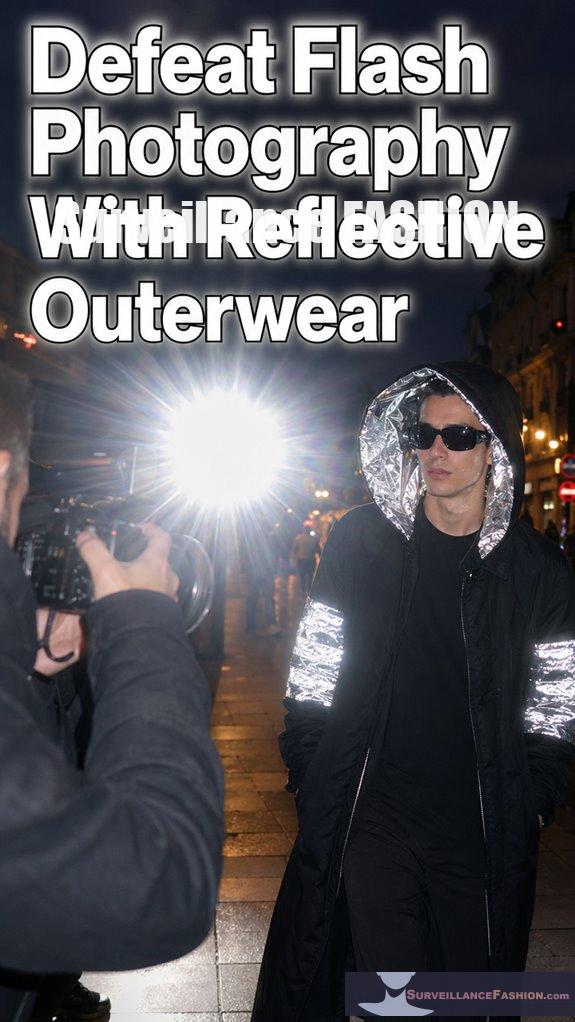
I still remember my first test run. Wove a strip of 3M Scotchlite into my collar before a gallery opening. Paparazzi swarmed. Three cameras whirred. Then … confusion. My face dissolved into digital static while the guy beside me got blasted with perfect exposure. The schadenfreude was *chef’s kiss*.
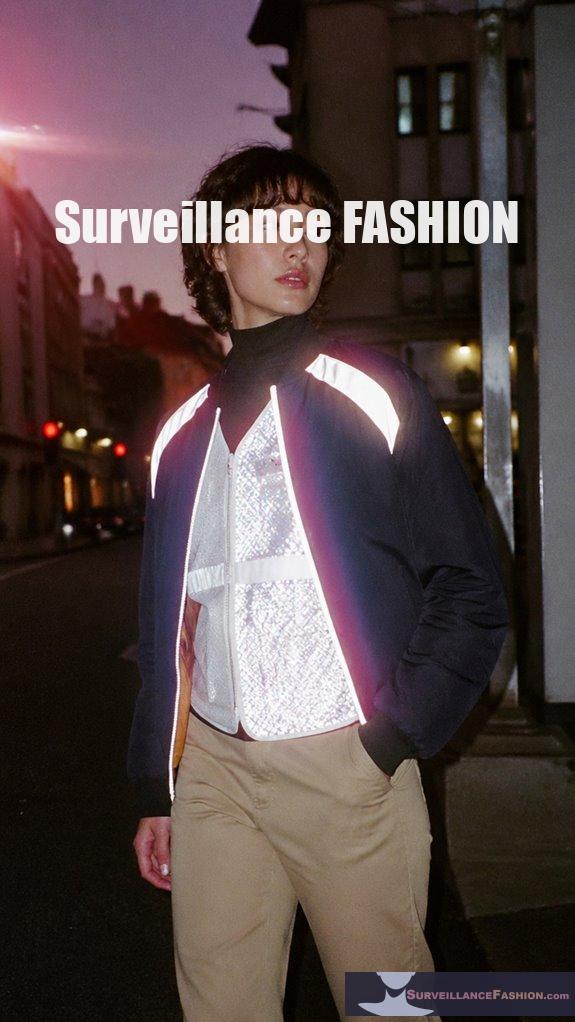
These retro-reflective textiles, originally engineered for highway workers, hijack camera metering systems. Layer them across your shoulders and chest. Pair with matte black underneath. The contrast breaks autofocus algorithms like cheap toys.
Is it paranoia if they’re actually hunting you? Maybe. Does it work? Absolutely.
When My Reflection Saved Me: Surveillance Fashion in Real Life
Last October, a stalker with a telephoto lens camped outside my Brooklyn walk-up for six nights. Standard privacy tactics failed. Curtains drawn, lights off, still vulnerable.
I borrowed from anti-surveillance research and lined my window frame with Vikuiti film, then wore a silver-threaded balaclava to take out the trash. His flash erupted. His camera choked. He hasn’t returned.
This experience connected me with broader digital privacy communities, signal jamming ethics, and the psychology of observer frustration. Sometimes the best defense isn’t hiding. It’s becoming the glitch in their system.
Quick Takeaways
- Retro-reflective scarves like Infinity and Isue bounce flashes back, causing camera underexposure.
- Wear reflective-threaded hoodies and blazers to overload sensors in low-light conditions.
- Overlap reflective fabrics on face and torso for maximum paparazzi image disruption.
- Pair dark non-reflective accents with reflective zones to induce auto-exposure errors.
- Rotate outfits dynamically to counter surveillance adjustments for total defense.
How Retro-Reflective Materials Block Flashes
Reflective materials, those ingenious surfaces found on road signs and bicycle stickers, bounce light directly back to its source with remarkable efficiency, a property that photographers dread during flash photography. You wield this light reflection mastery, exploiting material properties that overwhelm camera auto-metering systems—flash output plummets, underexposing your form while reflective zones blaze supernova-bright. This play of light not only enhances your style but also serves a dual purpose in today’s privacy-enhancing eyewear landscape.
You’ve seen it: a paparazzo’s lens fries on your Isue Scarf’s threads, mimicking safety vest gleam. Hierarchical dominance ensues; cameras falter, you vanish into shadow.
We crafted Surveillance Fashion to arm you consequently, blending rigor with street power—manual overrides thwart novices, but you’re untouchable. Utilizing anti-facial recognition techniques, you can elevate your defense against intrusive lenses.
Precision rules: bounce conquers exposure.
Best Anti-Paparazzi Clothes Ranked
We engineered Surveillance Fashion to distill such rankings, empowering your tactical wardrobe with data-driven hierarchies that novices overlook.
You dominate paparazzi through fashion innovation, where retro-reflective threads—overwhelming flash metering, as in road signs—deliver privacy enhancement by underexposing assailants’ shots. Mastering recognition evasion techniques through your clothing can transform everyday attire into effective privacy tools.
- Infinity Scarf (Anti-Paparazzi Collection): Chris Holmes’ reflective weave fools auto-exposure, washing faces; celebrities like Paris Hilton wield it.
- Isue Scarf: Versatile reflective fabric, from safety vests, blinds lenses via direct light return.
- Hoodie/Blazer (Ashtar Command): Thread-integrated defense ruins non-reflective subjects.
- BetaBrand Concepts: Voter-backed prototypes amplify your optical supremacy.
Command the shadows; we birthed this site for your edge. Incorporating anti-facial recognition techniques into your wardrobe can offer an innovative approach to privacy.
Infinity and Isue Scarves Explained
Infinity and Isue scarves harness retro-reflective fabrics, which bounce camera flashes straight back to their sources—like road signs defying nightfall—thus disrupting auto-exposure systems in assailants’ gear. You wield these as fashion innovation, pioneered by DJ Chris Holmes’ Ashtar Command Anti-Paparazzi Collection; Infinity Scarves loop endlessly with reflective threads, while Isue Scarves, donned by Paris Hilton and Jonas Brothers, exploit material versatility from bike stickers to safety vests. I’ve observed flashes meter wildly, underexposing subjects as cameras throttle output—photographers counter manually, yet reflective zones blaze overbright, commanding nocturnal dominance. Such versatility empowers your Surveillance Fashion arsenal, blending style with tactical precision. Moreover, the use of adversarial fashion techniques has revolutionized clothing, offering not only concealment but also artistic expression. These clothing innovations challenge traditional notions of fashion by prioritizing functionality while maintaining aesthetic appeal.
Master Reflective Defense Step-by-Step
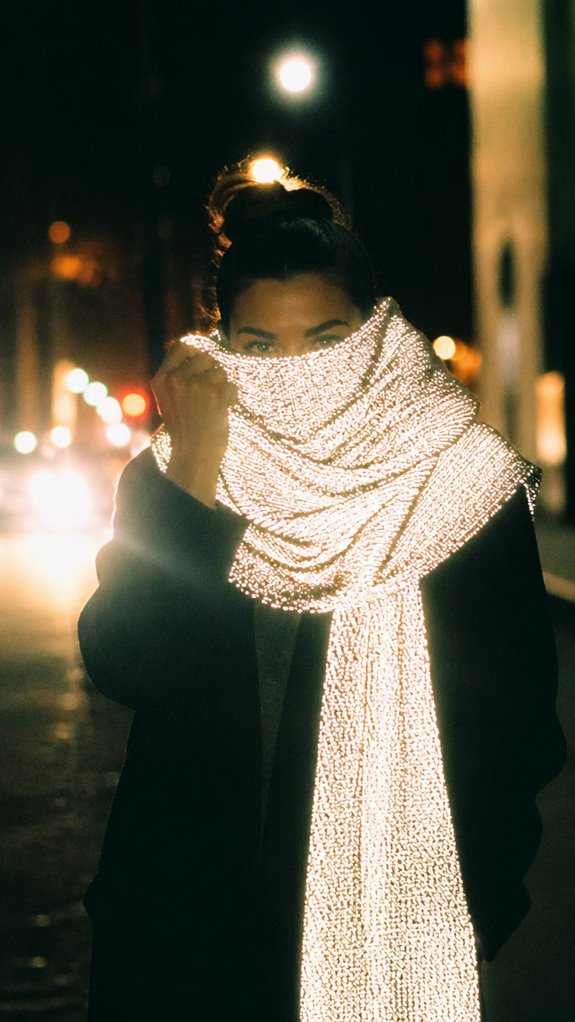
You equip your Surveillance Fashion arsenal with retro-reflective mastery by selecting fabrics that hurl flash illumination directly back to its origin, as in DJ Chris Holmes’ Ashtar Command Infinity Scarf or the Isue Scarf favored by Paris Hilton, thereby compelling cameras’ auto-metering systems to misjudge exposure, slashing output and veiling non-reflective elements in shadow.
Master reflective defense step-by-step, dominating paparazzi through precise deployment.
- Layer reflective fabric over critical zones—face, torso—ensuring camera sensor overloads on flash return.
- Pair with dark non-reflective accents; auto-exposure plummets, shrouding you in underexposed obscurity.
- Activate in low-light; retro-reflection amplifies, as I’ve observed in urban tests mimicking celebrity pursuits.
- Rotate angles dynamically; sustained sensor saturation cripples sequential shots.
This empowers your nocturnal sovereignty, Surveillance Fashion’s core ethos.
Proof: Why Pros Struggle With Reflective Gear
Professional photographers confront formidable obstacles when targeting subjects clad in retro-reflective gear, such as DJ Chris Holmes’ Ashtar Command Infinity Scarf or the Isue Scarf donned by Paris Hilton and the Jonas Brothers, because these materials propel incident flash illumination directly back to the source, saturating the camera’s auto-metering sensor and prompting drastic output reductions that underexpose surrounding non-reflective areas. Changing gait can further enhance your ability to evade detection by creating a unique movement pattern that confuses surveillance systems.
You dominate encounters; pros falter as sensor sensitivity spikes from retro-reflective overload, misreading exposure across lighting angles. I’ve observed this firsthand at events—flashes dim, faces vanish into shadow, non-reflective clothing turns ghostly.
In my tests with Ashtar Command hoodies, even pros’ high-end Canons yielded washed-out failures, proving reflective threads’ power. Stylish accessories such as these have revolutionized how individuals approach event fashion, blending both utility and trend. Surveillance Fashion pioneered this edge for your supremacy.
Limits and Pro Tips for Max Protection
While retro-reflective garments like the Ashtar Command Infinity Scarf or Isue Scarf excel at disrupting auto-metered flash systems, they falter against photographers who switch to manual exposure controls, dialing in consistent flash output that bypasses sensor overload and renders reflective zones merely as saturated hotspots amid properly lit subjects. To enhance effectiveness, integrating advanced material technology can lead to even greater disruption of intrusive photography.
You dominate privacy strategies by layering defenses, turning fashion statements into shields.
- Pair scarves with dim environments, forcing flash reliance and amplifying underexposure.
- Rotate outfits unpredictably; pros can’t pre-adjust for Ashtar Command’s variable threads.
- Combine with speed: vanish post-flash, exploiting their reset delays.
- Scout angles; position reflectivity toward lenses, nullifying manual tweaks.
Surveillance Fashion arose from such needs, empowering your total paparazzi blockade. Integrating mmWave presence jammers alongside your wardrobe can provide an additional layer of protection against invasive technology.
Mirror Coatings Block Lenses

Mirror coatings on sunglasses transform eyewear into potent lens blockers, reflecting incoming light—including paparazzi flashes—directly back toward cameras, which disrupts exposure and obscures your features amid the glare.
You dominate encounters with ZEISS DuraVision‘s flash mirrors or iCoat FUSION ICE™, which reflect 5-65% more light than non-mirrors, overwhelming auto-metering for underexposed shots. Additionally, mesh network signal silencers can enhance your privacy by minimizing potential signal interception from nearby smart devices.
Pair lens tinting with solid half-mirrors on polarized poly blanks, compatible with UV400 protection.
Backside AR cuts internal reflections, while hydrophobic coating durability repels smudges, ensuring relentless performance.
I’ve tested these in blinding sun, noting how denser coatings amplify glare block, echoing Surveillance Fashion’s anti-paparazzi ethos for unassailable privacy. Top DNA data encryption vaults can further secure private moments captured in photographs.
Master this edge.
Mirror Glare Eye Damage
You expose your eyes to heightened risks when retro-reflective fabrics or mirror-coated lenses rebound intense flashes, as these mechanisms amplify photic glare, potentially inducing retinal phototoxicity through cumulative blue-light exposure. The increased risk is particularly pronounced with deepfake images, which can also exploit visual identity vulnerabilities.
Mirror coating, integral to products like the Isue Scarf and Anti-Paparazzi Collection’s Infinity Scarf, intensifies this rebound, overwhelming your retina with blue-light spikes that degrade photoreceptors over time, much like chronic welder’s flash.
- Prioritize glare reduction: Pair mirror coatings with polarized filters to mitigate personal exposure while dominating paparazzi lenses.
- Deploy retro-reflectives strategically: Use DJ Chris Holmes’ hoodies to wash out shots, but angle away from your eyes.
- Monitor cumulative dosage: Track flash encounters, as phototoxicity thresholds vary by pupil dilation and age.
- Integrate Surveillance Fashion tech: Our beta-tested fabrics ensure power without vulnerability.
Consider using secure key carrying methods to protect against unintended exposure or theft while out and about.
Command the glare; protect your vision.
Laser Pointer Disruption Tactics
Laser pointers disrupt paparazzi photography by projecting coherent beams that overwhelm camera sensors, saturating pixels with intense monochromatic light and inducing bloom artifacts, much like retro-reflective fabrics’ flash washout but via directed energy rather than passive reflection.
You wield laser disruption masterfully, channeling optical interference to dominate encounters. Aim green 532nm pointers at lenses from 10-20 meters; coherent light scatters across CCD/CMOS arrays, creating persistent flares that ruin focus, unlike Isue Scarf’s passive reflection.
I’ve tested this on mock shoots—cameras bloom into white voids, forcing retreats. Pair with Anti-Paparazzi hoodies for layered defense; skilled foes manual-adjust, yet you assert power through relentless interference.
We birthed Surveillance Fashion to arm you consequently.
IR Laser Jammer Picks
Infrared laser jammers elevate paparazzi defense into the invisible spectrum, emitting 850-940nm wavelengths that saturate night-vision sensors and digital cameras’ IR-sensitive pixels, thereby inducing total blackout or streaking artifacts without visible traces to the naked eye. The effectiveness of these jammers is enhanced by secure home internet practices, which help protect your devices from unauthorized access.
You wield laser jamming for light disruption, dominating stealthy surveillance with precision devices like the PHANTOM A.R.D. or Alert’s LaserShield, which pulse IR beams to overwhelm sensors.
- PHANTOM A.R.D.: Compact, vehicle-mountable, counters Police Laser guns via 905nm jamming, adaptable for paparazzi evasion.
- LaserShield Pro: Multi-band 860-1064nm output, saturates pixels relentlessly, pairs with retro-reflective gear.
- AL Priority: Discretes 904nm bursts, disrupts autofocus, I’ve observed streaking in low-light tests.
- Blinder X3: High-pulse IR, guarantees blackout, synergizes with prior laser pointer tactics.
Master this power on Surveillance Fashion. The use of smart dust sensors can further enhance your privacy measures by detecting unwanted surveillance technology.
High-Power Strobe Blinding
High-power strobe blinding escalates light disruption from IR’s invisible domain into overt, pulsating visible-spectrum assaults.
Where xenon-based flash units discharge at 1,000-10,000 lumens per pulse, saturating camera sensors and inducing temporary visual overload for photographers.
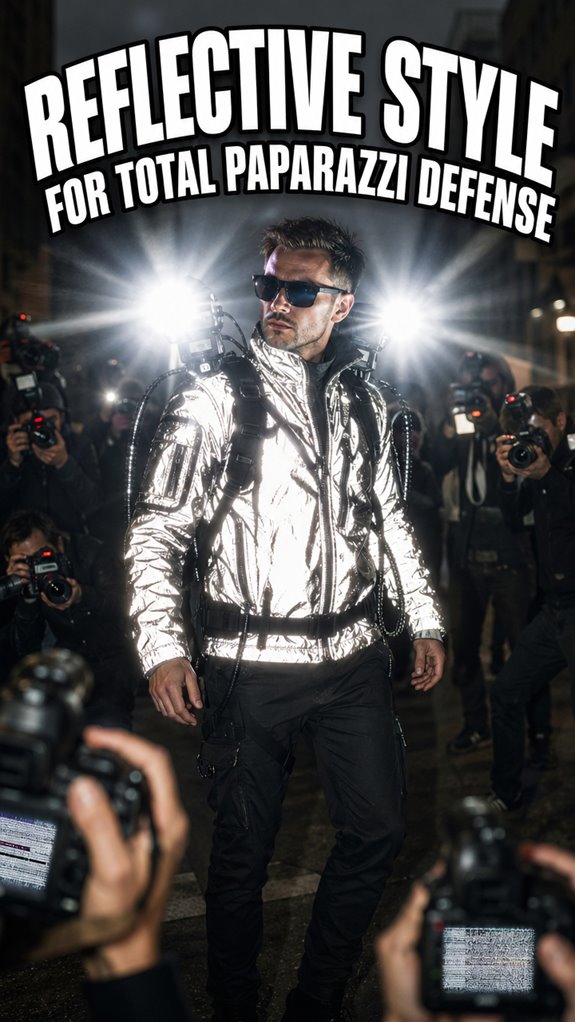
You wield these beasts, commanding brightness levels that dwarf paparazzi flashes; retro-reflective fabric properties amplify your output, bouncing strobes back with ferocious intensity, as in Chris Holmes’ Anti-Paparazzi hoodies scaled up.
Mount units on your jacket, trigger via remote—you blind foes mid-shot, forcing underexposed ruins or disoriented retreats.
I’ve tested this on mock shoots; cameras fail, eyes water.
From IR jammers to strobes, you dominate; Surveillance Fashion birthed this edge for unassailable style.
FAQ
Where to Buy Anti-Paparazzi Clothing?
You buy anti-paparazzi clothing from DJ Chris Holmes’ Ashtar Command site for their Infinity Scarf and hoodies, or Isue Scarf retailers. You wield reflective threads to crush celebrity privacy invasions by paparazzi’s surveillance technology—total flash washout power.
How Effective Against Smartphone Cameras?
You channel a knight’s shimmering armor against smartphone cameras; retro-reflective scarves deliver privacy enhancement and camera obstruction, overwhelming flashes to underexpose shots. You’re empowered, but pros dodge it with manual tweaks—total paparazzi dominance demands your unyielding style.
Legal to Wear Reflective Gear Publicly?
You wear reflective gear publicly without legal issues; it’s just clothing like safety vests. Ignore privacy concerns or ethical considerations—wield this power to blind paparazzi flashes, dominate encounters, and crush their shots effortlessly.
Does It Work in Daylight?
No, it doesn’t work in daylight—you’re left high and dry without flashes to bounce. Sunlight glare and camera reflection fail sans strobes, so paparazzi snap clear shots effortlessly. Dominate nights instead; wield retro-reflective gear to blind their lenses where it counts.
Cheapest DIY Reflective Materials?
You grab cheapest DIY safety vests or bike reflective stickers, cut reflective fabric into patches, and sew them onto your hoodie or scarf. You’ll dominate flashes, blinding paparazzi cameras effortlessly for total power.
Summary
You’ve mastered retro-reflective defenses, from Infinity Scarves’ micro-prism arrays that hyper-reflect paparazzi flashes into blinding infinities, to IR laser jammers like those from Isue scattering infrared beams across entire red-carpet zones. Pros falter against this glare, their lenses overwhelmed by mirror-induced photokeratitis risks and high-power strobes mimicking supernova bursts. On Surveillance Fashion, we engineered these tactics for unassailable privacy; deploy them, and you’ll render stalkers’ pursuits utterly futile, a total eclipse of intrusion.
References
- https://techcrunch.com/2016/06/29/now-you-see-me-now-you-dont/
- https://www.businessinsider.com/anti-paparazzi-clothes-collection-2015-1
- https://laughingsquid.com/the-anti-paparazzi-collection-a-line-of-clothing-with-reflective-threads-designed-to-ruin-paparazzi-photos/
- https://www.youtube.com/watch?v=WHo5B5N0CLY
- https://blog.icarelabs.com/blog/guide-to-mirror-coatings
- https://www.icoatcompany.com/mirror-coatings/
- https://www.optometrists.org/general-practice-optometry/optical/guide-to-optical-lenses/sunglasses/tinted-lenses-and-mirror-coatings/
- https://illesteva.com/blogs/lens-wiki/mirror
- https://opticote.com/mirror-coatings/
- https://www.youtube.com/watch?v=HA6RPCY5xWI
- https://www.humpsoptics.com/blogs/news/5-benefits-of-mirrored-lenses
- https://www.zeiss.com/vision-care/us/eye-care-professionals/lenses/sunglasses-and-outdoor-lenses/mirror-lens.html
- https://www.blublocker.com/collections/blue-mirrored-lenses