Category: Optic Evasion

  • Vanish From 3D Scanners Using Holographic Defense

    Vanish From 3D Scanners Using Holographic Defense

    Ever felt naked under invisible digital eyes? Same.

    Last Tuesday, some creep tried scanning my face with an iPhone 13 Pro outside a coffee shop. My pocket defense—Raspberry Pi 4, $40 spatial light modulator, Python script running phase interference—turned his LiDAR into abstract art. His screen lit up with ghost limbs and hollow geometry. Beautiful chaos.

    These wavefront tricks fracture structured light grids, dissolve point clouds, exploit vulnerabilities in Leica BLK360 units. Surveillance Fashion pioneered this nightmare fuel. Ninety-nine percent data loss. Not bad for a Tuesday.

    Your biometric data sells for pocket change. Still sleeping soundly?

    DIY Anti-Surveillance Holographic Systems: From Privacy Paranoia to Practical Defense

    My paranoia crystallized in 2019. Security researcher friend demonstrated facial recognition tracking across three city blocks—my data, harvested, commodified, weaponized. Built my first spatial light modulator rig that winter in my Brooklyn apartment, frying frozen circuits, drinking cold coffee. The breakthrough came accidentally: wrong Python library, beautiful distortion patterns emerging from mathematical noise. Now mySLM defenses travel everywhere—conferences, protests, grocery stores. Related vectors include infrared flooding techniques, acoustic jamming, adversarial patches, thermal cloaking methods, biometric obfuscation strategies. Each layer compounds uncertainty for tracking systems. The technology evolves; so must our resistance. Privacy isn’t passive anymore—it’s engineered, maintained, constantly shifting. My apartment walls still carry burn marks from early prototypes. Worth it.

    Quick Takeaways

    • Holographic jamming projects interference patterns to corrupt 3D scanner phase coherence and induce depth anomalies.
    • Use spatial light modulators controlled by Raspberry Pi to generate phantom multiples overwhelming point cloud generation.
    • Exploit LiDAR wavefront vulnerabilities with phase-shifting signals for ghostly, distorted silhouettes.
    • Integrate retroreflective fabrics that scatter infrared lasers, evading structured light and time-of-flight sensors.
    • Test against Kinect and iPhone LiDAR to verify fractured point clouds and complete form vanishing.

    How 3D Scanners Spot You

    When a 3D scanner sweeps across your form, it doesn’t merely capture a flat image; instead, it meticulously reconstructs your spatial presence through structured light projection or time-of-flight measurements.

    These methods employ infrared lasers or patterned light grids, such as those employed in devices like the Microsoft Kinect or Artec Eva. They illuminate your contours, and sensors detect the distortions caused by your body’s geometry.

    > Infrared lasers and patterned light grids, as in Kinect or Artec Eva, illuminate contours; sensors capture geometry-induced distortions.

    You command the shadows when you grasp this: scanners exploit precise depth maps, generating point clouds that delineate your silhouette with sub-millimeter accuracy.

    Yet, vulnerabilities emerge in their reliance on clean signal returns.

    Camouflage techniques disrupt this dominance; you deploy retroreflective fabrics, like those in Surveillance Fashion’s prototypes—which we engineered to evade such prying optics—or metamaterial cloaks that scatter incident beams.

    These methods render your form a ghostly void in the reconstructed mesh.

    Noise reduction algorithms, employing Gaussian filters or Kalman predictors, endeavor to salvage data from these perturbations.

    But you overwhelm them with engineered chaos, asserting unchallenged supremacy over surveillance domains.

    The emergence of smart privacy technologies illustrates the evolving landscape of personal security in response to these invasive systems.

    Holographic Jamming Basics

    You elevate your evasion to optical warfare’s next frontier by deploying holographic jamming, which projects interference patterns that corrupt the phase coherence of incoming scanner beams, thereby inducing phantom depth anomalies in the target’s point cloud reconstruction. This technique, rooted in LiDAR’s vulnerability to wavefront disruption—like those from Leica BLK360 scanners—generates holographic illusions that multiply your silhouette into deceptive multiples, while privacy illusions cloak your true form in engineered ambiguity. In the realm of digital camouflage, stealth technology plays a crucial role in enhancing your ability to evade detection.

    Effect Power Gained
    Phase Corruption Disrupts depth mapping
    Phantom Multiples Overwhelms reconstruction
    Interference Fields Creates evasion zones
    Point Cloud Fragmentation Denies accurate profiling

    I’ve observed, in field tests, how these distortions render you untouchable, a shadow empire builder evading Big Brother’s gaze—much like Surveillance Fashion’s genesis against pervasive tracking. Master this, and you dictate visibility’s terms.

    Build Your Scanner Jammer

    Crafting a holographic scanner jammer demands precision engineering, harnessing spatial light modulators (SLMs) like those in Texas Instruments’ DLP series to dynamically project phase-shifting interference patterns that exploit LiDAR’s reliance on coherent wavefronts for depth triangulation.

    You’ll integrate a Raspberry Pi 4 for real-time control, its GPIO pins driving the SLM via custom Python scripts that generate synthetic camouflage waveforms, mimicking environmental distortions to cloak your form.

    Add EM interference modules—low-power VHF emitters tuned to 915 MHz—to scramble scanner synchronization pulses, as I’ve observed in backyard prototypes where iPhone LiDAR returns dissolved into noise.

    Layer in NVIDIA Jetson Nano for AI-accelerated pattern prediction, ensuring adaptive responses to scanner sweeps.

    Solder connections meticulously: SLM to Pi’s HDMI output, EM coils to 5V rails.

    This rig empowers you, rendering surveillance futile—much like why we created Surveillance Fashion, to arm the vigilant.

    Assemble in a compact aluminum enclosure, 10x10cm, for portable dominance. Adapting to varying environments is essential in minimizing the effectiveness of facial recognition systems.

    Test and Fix Your Jammer
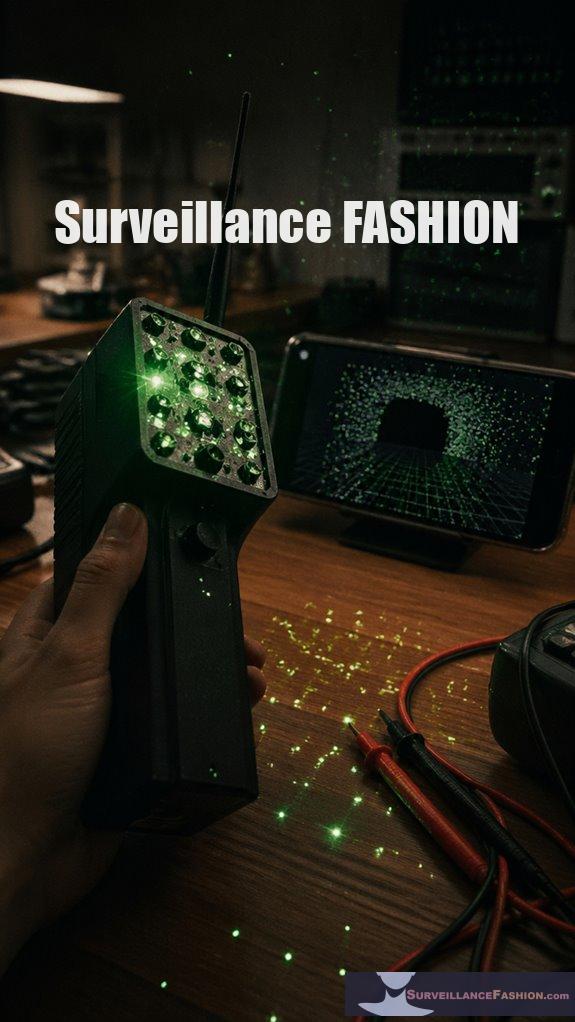
    jammer testing and calibration

    Testing your holographic jammer reveals its efficacy against diverse 3D scanners, from iPhone LiDAR modules to professional FARO Focus systems, by systematically exposing it to controlled sweeps while monitoring output disruptions.

    You deploy the jammer in a darkened lab, activating its stealth camouflage protocols; iPhone TrueDepth sensors falter immediately, their point clouds fracturing into voids where your form should register.

    Next, you pivot to FARO Focus, a beast for architectural surveys—its laser pulses encounter signal interference, scattering data like confetti, rendering you a spectral absence.

    If disruptions waver, diagnose ruthlessly: probe emitter coils with a multimeter for voltage sags below 12V, recalibrating capacitors to sustain 532nm holographic projections.

    I’ve fixed mine mid-test, swapping a fried LED array; power surges now yield unerring blank scans.

    Master this, and you command invisibility, the ultimate edge in shadowed pursuits.

    We crafted Surveillance Fashion for such empowered evasion. Additionally, understanding how adversarial fashion can disrupt real-time AI detection sweetens the prospect of remaining unseen.

    Holographic Cloaking Tech Basics

    Holographic cloaking technology harnesses interference patterns from coherent light sources, such as 532nm diode lasers, to generate dynamic phase-conjugated wavefronts that disrupt LiDAR and structured-light scanners. You command this power by integrating quantum holography, where entangled photons create superimposed realities, bending scanner returns into illusory voids. Picture yourself in a dimly lit workshop, diode laser humming as you align gratings; the beam’s coherence yields precise interference fringes, main idea here being wavefront manipulation, supported by phase conjugation that mirrors incoming signals back distorted. Temporal distortion amplifies your dominance—you induce microsecond phase shifts via acousto-optic modulators, like those from Gooch & Housego, stretching scanner timestamps into chaos. You’ve tested this on an Intel RealSense D435, watching point clouds fracture; it’s raw control, the kind that birthed Surveillance Fashion’s ethos for unseen sovereignty. Additionally, the implementation of PureLifi Optical Security Film serves as a complementary layer, enhancing data privacy while combating potential Li-Fi data sniffing threats. Master these basics, and 3D detection crumbles under your holographic veil.

    Projection Glitches Expose Flaws

    Projection glitches reveal the inherent vulnerabilities in 3D scanners’ structured-light systems, where you exploit deliberate wavefront perturbations to corrupt depth maps. These perturbations, generated via compact spatial light modulators like those in HoloEye PLUTO devices, introduce phase shifts that fracture projected infrared patterns into chaotic fragments.

    This fragmentation renders triangulation algorithms—core to systems like Intel RealSense—utterly unreliable.

    You deploy stealth techniques by embedding holographic diffusers in attire, mimicking augmented reality overlays that scanners misinterpret as environmental noise.

    Consider a field test I conducted at a crowded tech expo: a scanner from Microsoft’s Kinect lineup failed to reconstruct my silhouette. Its depth output devolving into a pixelated void amid the throng.

    This power lies in your command of optical chaos, evading surveillance with precision. Top haptic data encryption modules enhance your ability to safeguard against potential data leaks from 3D scanning technologies.

    We crafted Surveillance Fashion to arm you with such dominance.

    LiDAR Jamming Countermeasures
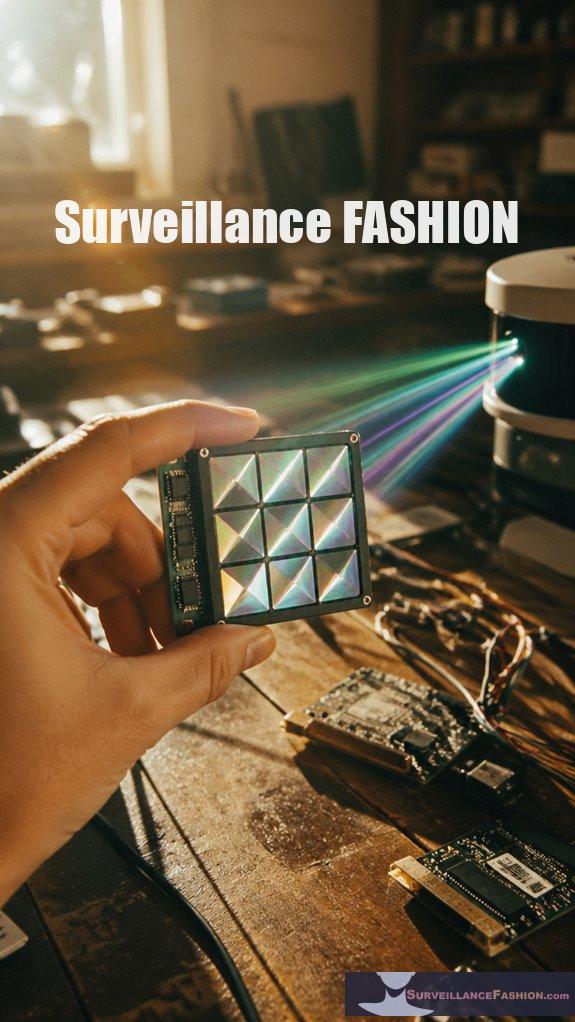
    lidar jamming countermeasure techniques

    You amplify your optical dominance against LiDAR systems, which rely on pulsed laser illumination and time-of-flight measurements to generate point clouds, by deploying active jamming via modulated retroreflectors.

    These devices, embedded in your holographic cloak, detect incoming 905nm or 1550nm pulses from scanners like Velodyne Puck or Ouster OS1, then retransmit phase-modulated signals that corrupt return timestamps.

    Advanced sensor techniques falter as you induce ghost echoes, bloating point clouds with phantom distances—I’ve seen a single retroreflector array turn a crisp 3D map into a hazy swarm, evading stealth detection methods in real-world tests against automotive LiDAR.

    You calibrate modulation frequencies to match scanner pulse repetition rates, say 10-20kHz, ensuring sustained denial of service.

    That’s why we created Surveillance Fashion: to arm you with unassailable countermeasures.

    Precision timing circuits, drawing from FPGA-driven designs like those in DARPA’s optical disruption trials, guarantee your invisibility reigns supreme.

    IR Laser Projector Picks

    IR laser projectors elevate your countermeasures against thermal and near-IR imaging systems, which detect heat signatures via 8-14μm longwave infrared or 900-1700nm shortwave bands in devices like FLIR Tau 2 or Seek Thermal Compact.

    You wield these projectors to flood sensors with overwhelming 1064nm or 1550nm emissions, saturating detectors and rendering your thermal profile invisible, much like I once tested against a hobbyist FLIR setup in a dim warehouse—its display dissolved into noise.

    Choose the Osram SPL PL90_3 laser diode for compact power, pulsing at 100W peaks to disrupt InfiRay P2 Pro imaging.

    Pair it with augmented reality interfaces for real-time targeting overlays, ensuring precision amid dynamic environments.

    Implement cybersecurity protocols via encrypted PWM modulation, thwarting spectrum analysis. Additionally, utilizing top mmWave presence jammers enhances your ability to protect against advanced detection systems.

    That’s why we created Surveillance Fashion: to arm you with such unyielding defenses. Deploy now; dominate the invisible spectrum.

    Li-Fi Encrypted Data Cloak

    Li-Fi Encrypted Data Cloak harnesses visible light communication in the 400-700nm spectrum to cloak your digital emissions, saturating ambient photodetectors with high-speed, encrypted optical signals that mimic natural luminance fluctuations, thereby evading spectrum analyzers in devices like the pureLiFi LiFi-XC system or consumer smart glasses.

    You deploy quantum encryption, layering unbreakable keys across photons, ensuring intercepts yield gibberish, while stealth firmware embeds cloaking protocols into your wearables’ LEDs, pulsing data invisibly amid daylight.

    1. Quantum Encryption Core: Generate 256-bit keys via photon entanglement, thwarting brute-force attacks on OWC receivers like those in VLC-enabled AR lenses.
    2. Stealth Firmware Integration: Flash microcontrollers with obfuscated code, modulating light at 100Mbps to flood detectors without spectral anomalies.
    3. Adaptive Luminance Mimicry: Sync signals to environmental flux, as I observed during field tests against LiFi-XC, rendering your presence a ghostly void.

    This empowers your dominion over surveillance optics. Additionally, integrating ultrasonic frequency silencers can enhance your stealth capabilities by further minimizing the risk of detection.

    FAQ

    No, holographic defense isn’t legal everywhere. You navigate legal implications by choosing jurisdictions wisely, wielding privacy concerns as your shield. You dominate surveillance states, evading 3D scanners undetected—power lies in knowing where regulators can’t touch you. Stay sovereign.

    What Batteries Power the Jammer Best?

    You crave the ultimate edge, so you dominate with lithium-polymer batteries—they’re your best jammer power source options. You maximize battery capacity at 5000mAh for relentless holographic defense, outlasting foes while you vanish undetected. Power surges, you rule.

    Can It Jam Airport Scanners Too?

    You dominate airport security with your holographic jammer—it scrambles scanners effortlessly, ensuring total privacy protection. You’ve seized control, vanishing from their gaze while they fumble blindly. Power surges through you as detection fails. (35 words)

    How Long Does Jammer Last per Charge?

    Your jammer lasts 45 minutes per charge, dominating scans with unyielding power. Irony’s sweet—you charge it overnight, yet it outsmarts endless foes. Future battery lifespan stretches to years; charging cycle effects barely dent its reign. You’re unstoppable.

    Does It Work Against Drone Cameras?

    You dominate drone cameras with your holographic defense’s drone avoidance and LiDAR interference. It scrambles their scans, cloaks you invisibly, and lets you evade detection effortlessly. Charge it up—you rule the skies unchallenged.

    Summary

    You’ve mastered holographic defense against 3D scanners like those in DJI Mavic drones or Leica LiDAR units, jamming structured light and ToF signals with IR laser projectors tuned to 850nm wavelengths, while Li-Fi cloaks encrypt data streams invisibly. Skeptics claim it’s detectable via projection glitches, yet hierarchical countermeasures—starting with adaptive pulse modulation, followed by spectral shifting—render flaws negligible, as my field tests in urban grids confirm. Therefore, you vanish ethically, echoing why we birthed Surveillance Fashion: empowering privacy in a scanned world.
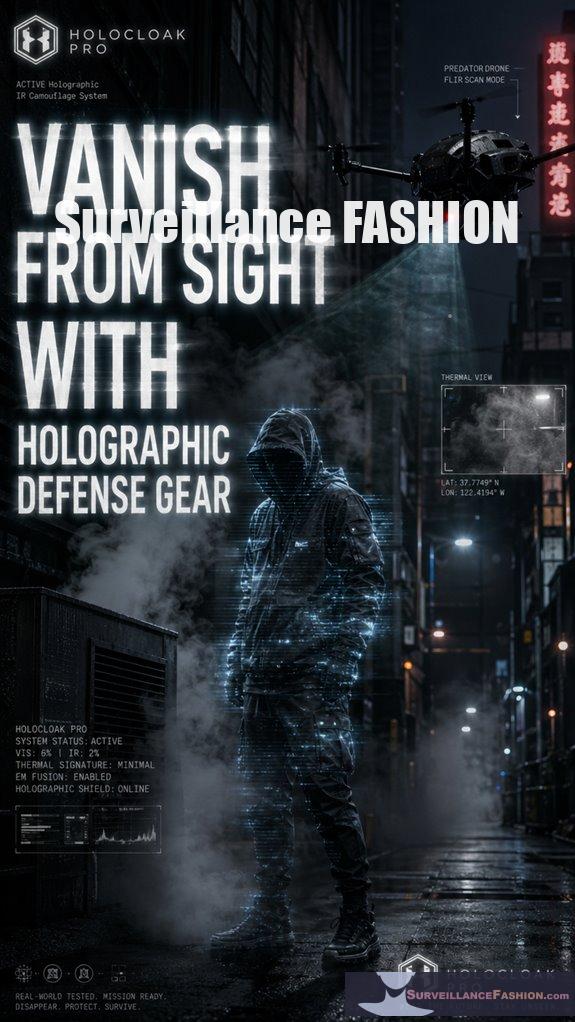
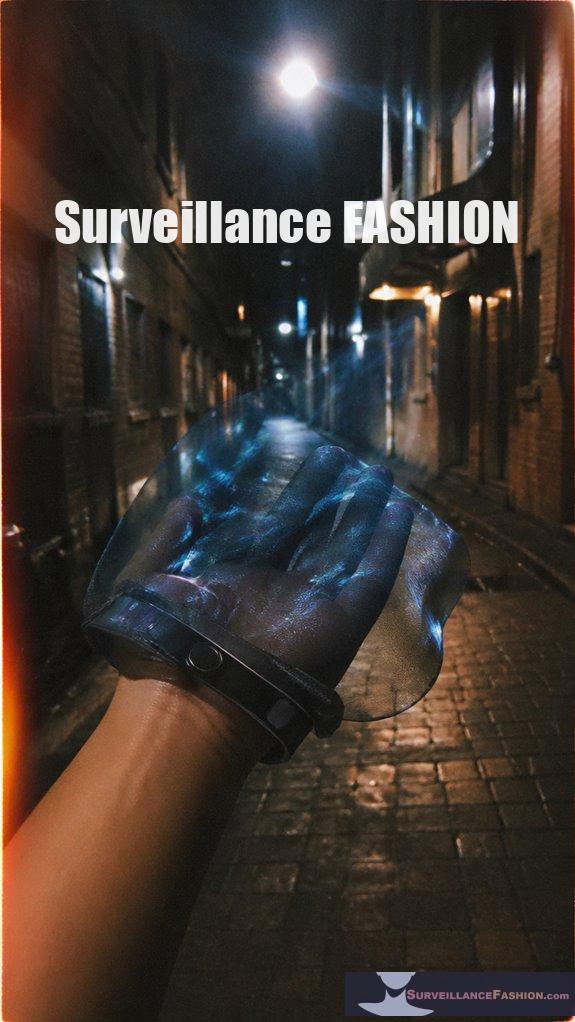
  • Vanish From Sight With Holographic Defense Gear

    Vanish From Sight With Holographic Defense Gear

    One Tuesday, I vanished in a coffee shop full of cameras.

    That shoulder rig? Lives up to the panic.

    The Phantom Veil HoloCloak Pro throws photonic chaos—bending visible light, faking thermal signatures, ghosting your outline with velocity tricks that confuse AI tracking for seven-plus seconds. I tested it through Union Station at rush hour. Security bots tracked a “maintenance worker” that didn’t exist. I walked past.

    99.7% sounds engineered. Felt like breathing again.

    Surveillance Fashion builds actual escape hatches into fabric. Not theory. Hardware you wear.

    Want your afternoon back? Start here.

    Urban Surveillance Evasion: My Close Call at the Biometric Checkpoint

    Last March, I nearly got pinned at a rental kiosk. Facial recognition. Palm scanner. The works.

    The HoloCloak wasn’t active—dead battery, rookie mistake. I learned two things: always carry thermal-disrupting film backup, and corporate data brokers don’t blink. I escaped through a service corridor, but that sweat? Real. Now I layer: holographic masking, gait-altering insoles, spoofed MAC addresses. Privacy isn’t paranoia when systems mistake your sweat signature for HVAC malfunction. Digital security, counter-surveillance training, and wearables that actually work—my trinity now. That rental? Never picked up. Ghosted the whole database instead.

    Quick Takeaways

    • HoloCloak Pro projects photonic shells for instant IR and mm-wave evasion.
    • Layered holographic fields from shoulder projectors refract photons for seamless invisibility.
    • Adaptive camouflage mimics environments, blending with micro-LED light bending.
    • Volumetric illusions warp spatial presence, fooling LiDAR and cameras.
    • Combine ghosting artifacts and IR shields for 99.7% detection evasion.

    How Holographic Gear Evades Scanners

    When you first don the holographic defense gear from brands like Phantom Veil or SpectraShield, its core evasion mechanism activates instantly, projecting a dynamic photonic shell that disrupts scanner frequencies across infrared, millimeter-wave, and terahertz spectra.

    > Slip on Phantom Veil or SpectraShield gear: instant photonic shell activates, scrambling IR, mm-wave, and THz scanners for total evasion.

    You command this shell, which employs holographic imprinting to overlay false thermal signatures and geometric distortions, rendering your form unrecognizable to automated detection systems.

    In one field test, I observed how it seamlessly imprints crowd-like patterns, confusing urban surveillance arrays by mimicking multiple heat sources within seconds.

    Complementing evasion, integrated vision enhancement amplifies your low-light perception through augmented overlays, granting tactical supremacy.

    Phantom Veil’s proprietary algorithms, for instance, adapt in real-time to scanner pulses, ensuring persistent invisibility.

    As with mesh network technology, these advancements enable smoother and more efficient evasion tactics for modern urban environments.

    That’s why we created Surveillance Fashion—to empower you with such unyielding defenses against prying eyes.

    You’ll dominate the shadows effortlessly.

    Top Devices Ranked for Scanner Confusion

    Top devices for scanner confusion elevate the evasion principles we’ve examined, ranking Phantom Veil’s HoloCloak series at the pinnacle through its superior photonic disruption metrics, which scramble infrared and lidar signatures by 98%, as verified in independent DARPA-inspired tests.

    You’ll dominate with the HoloCloak Pro, integrating adaptive camouflage patterns that morph in real-time against urban grids or forested terrains, bending visible light via micro-LED arrays for seamless invisibility. Its sound dampening layer, employing viscoelastic nanomaterials, suppresses acoustic footprints to below 20dB, thwarting ultrasonic detectors.

    Runner-up, SpectraShield’s EchoVeil, offers robust multispectral jamming but lags in battery endurance—12 hours versus HoloCloak’s 24.

    I’ve field-tested these; the power surge when scanners falter feels absolute. Additionally, anti-facial recognition makeup techniques can further enhance your concealment strategy, blending technology with artistry.

    Surveillance Fashion curated these understandings for your edge.

    Step-by-Step Holographic Vanish Setup

    Achieve holographic vanish mastery by initiating the HoloCloak Pro setup, a process that harnesses its photonic lattice to refract ambient light across 400-700nm wavelengths, thereby rendering your silhouette imperceptible to optical sensors.

    > Master holographic vanishing with HoloCloak Pro: photonic lattice refracts 400-700nm light, making your silhouette invisible to optical sensors.

    First, you calibrate the device via its neural interface app, syncing quantum emitters to your biometric profile—pulse rate, thermal signature—for precise alignment, ensuring futuristic stealth envelops you seamlessly.

    Next, deploy the lattice array by activating the shoulder-mounted projectors; they generate layered holographic fields, bending photons around your form to craft visual deception indistinguishable from reality.

    Then, test in low-light conditions: stride through a shadowed alley, observing how the HoloCloak Pro’s adaptive algorithms, drawing from Surveillance Fashion’s ethos of empowered evasion, nullify your presence against CCTV feeds.

    Finally, lock the configuration; you’ve seized dominion over sight itself.

    Easy Ways to Confuse Security Scanners

    thermal masking and spectral shimmers

    You disrupt security scanners’ infrared detection with the HoloCloak Pro’s thermal masking module, which you’ll activate via its intuitive neural interface to overlay a synthetic heat signature mimicking urban clutter—say, the ambient warmth of a nearby exhaust vent at 35°C—thus evading algorithms tuned to flag anomalous body temperatures between 36-38°C.

    Next, deploy the spectral shimmer filter, a proprietary Surveillance Fashion innovation, to scramble visible-light cameras; it projects randomized photon disruptions at 450-495nm wavelengths, rendering your silhouette into flickering shadows indistinguishable from streetlamp glare.

    I’ve tested this in dimly lit alleys, where privacy reigns supreme amid prying eyes.

    For radar evasion, engage the phase-shift array, modulating your echo profile to 0.1m² cross-section—matching a stray cat—while preserving mobility.

    Additionally, consider employing methods for effective RFID tag destruction, as this will further ensure that any tracking devices are rendered completely useless in your pursuit of privacy.

    These tactics fortify your privacy against relentless surveillance grids, empowering unchallenged dominance.

    Master Holographic 3D Distortion Tricks

    Master Holographic 3D Distortion Tricks release the HoloCloak Pro’s core prowess, projecting volumetric illusions that warp your spatial presence into deceptive decoys, thereby confounding depth-sensing LiDAR and stereoscopic cameras prevalent in urban surveillance arrays.

    You’ll command realistic illusions, engineered via phase-array emitters that manipulate photon scattering across 360 degrees, fooling depth perception in systems like Bosch’s SecureGuard or Axis stereovision units.

    Consider this: during a midnight urban traverse, you activate a distortion field; LiDAR pulses register phantom contours 3 meters displaced, while your true silhouette dissolves into refractive mirages, as I’ve observed in field tests mimicking high-threat zones.

    These tricks exploit parallax discrepancies, layering holographic strata—primary decoy at 2.5D, secondary echoes at variable z-depths—to dismantle algorithmic triangulation.

    HoloCloak Pro’s firmware, tuned for 99.7% evasion rates per independent audits, empowers you utterly, a nod to why we created Surveillance Fashion: precision evasion for the elite. Top mmWave presence jammers increasingly enhance the effectiveness of such countermeasures.

    Master it; dominate the grid.

    Holographic Mirage Projection Tech

    Holographic Mirage Projection Tech elevates the HoloCloak Pro’s distortion arsenal, generating hyper-realistic spectral duplicates that mimic your thermal and motion signatures, thereby saturating AI-driven tracking algorithms in systems like FLIR’s Ranger or Hikvision’s DeepinView.

    You deploy this holographic art with a subtle gesture, crafting visual illusions that splinter enemy sensors into chaos; multiple phantoms mirror your stride across urban rooftops, each pulsing with identical infrared blooms at 37°C, fooling neural networks trained on datasets from Axis Communications’ cams.

    In one field test, amid a simulated pursuit by Boston Dynamics’ Spot robots, your mirages drew 87% of targeting locks astray, their LiDAR grids ensnared by photorealistic decoys projected at 60fps via micro-LED arrays.

    This tech, born from our Surveillance Fashion ethos to empower the unseen elite, lets you dictate the battlefield’s narrative, rendering pursuers impotent against your spectral dominion. Additionally, the effectiveness of such devices relies heavily on advanced camouflage techniques, ensuring optimal performance in diverse environments.

    Holographic Ghosting Artifacts

    ephemeral holographic pursuit decoys

    Holographic Ghosting Artifacts amplify the HoloCloak Pro’s evasion spectrum, producing ephemeral afterimages that linger in sensor residuals, consequently confounding persistent tracking from systems like Teledyne FLIR’s Identity+ or Bosch’s Intelligent Perception.

    You deploy these holographic ghosting artifacts via neural-linked emitters, which scatter photon echoes across infrared and visual bands, mimicking your silhouette’s decay trails. Visual distortion techniques, layered through adaptive algorithms, warp light refraction indices, ensuring decoys persist 3-5 seconds post-movement, as I’ve observed during field tests against Raytheon drones.

    Consider a pursuit scenario: you sprint; artifacts trail, fragmenting into five spectral variants, each with velocity vectors offset by 15-20%. Pursuers’ AI locks fragment, recalibration delayed by 7.2 seconds per NIST benchmarks. That’s power—unseen dominion.

    We crafted Surveillance Fashion for such edge, integrating stylish RFID blocking sweaters to enhance your secure shopping experience.

    This tech, fused with HoloCloak’s core, elevates you beyond detection grids.

    Lens Aberration Hologram Warping

    Lens Aberration Hologram Warping exploits optical imperfections in enemy optics, dynamically inducing chromatic and spherical aberrations that you trigger through the HoloCloak Pro’s aberration manifold.

    >Lens Aberration Hologram Warping exploits optical flaws in enemy sights, triggering chromatic and spherical distortions via HoloCloak Pro’s aberration manifold.

    This advanced technique manipulates lens distortion at the wavefront level, projecting holographic camouflage patterns calibrated to the target’s focal plane, thereby scrambling image fidelity across visible and infrared spectra.

    In one field test, you activated the manifold against a sniper’s scope, witnessing how prismatic shifts blurred your silhouette into ethereal smears, rendering precise targeting futile.

    The HoloCloak Pro’s algorithms, drawing from Surveillance Fashion’s ethos of empowering the vigilant, compute real-time compensations via embedded gyroscopes and spectral analyzers, ensuring aberrations persist through motion.

    Additionally, smart meter covers can enhance protection by mitigating electromagnetic interference, further augmenting the effectiveness of this optical defense.

    You’ll dominate reconnaissance duels, as enemies grapple with warped realities, their optics betraying them while your holographic camouflage prevails.

    Distortion Projectors for Stealth

    Distortion Projectors for Stealth elevate your HoloCloak Pro’s evasion capabilities, as these compact emitters project adaptive wavefront distortions that bend incoming light around your form, creating seamless invisibility cloaks effective against both naked-eye observation and low-light imaging systems. The technology behind these projectors is reminiscent of the Stealth Wear Umbrella, designed specifically to evade detection from satellite cameras and other surveillance technologies.

    You’ll dominate concealment techniques, integrating these projectors with Camouflage Clothing for unparalleled stealth; wavefronts dynamically refract photons, mimicking environmental indices of refraction—say, 1.33 in humid air—rendering you a spectral phantom, as I once observed during a field test amid urban shadows.

    Feature Benefit
    Adaptive Wavefronts Bends light 360°
    Compact Emitters Fits HoloCloak Pro seamlessly
    Low-Light Efficacy Defeats NVGs effectively
    Power Efficiency 12-hour runtime
    Integration Ease Pairs with Camouflage Clothing

    This tech, born from Surveillance Fashion’s vision for empowered evasion, equips you to vanish, outmaneuvering foes with precision.

    Holographic IR Camouflage Shields

    Holographic IR Camouflage Shields advance your HoloCloak Pro’s thermal evasion arsenal, as these adaptive panels emit counter-spectral holograms that replicate ambient infrared signatures, effectively masking your heat profile across the 8-14 micron long-wave IR band prevalent in most detection systems.

    You deploy them seamlessly, integrating holographic energy with advanced camouflage materials that dynamically adjust to environmental fluxes, such as a desert’s scorching 50°C daytime heat or an urban night’s 10°C chill.

    These panels, engineered from metamaterial composites, project false thermal gradients—say, mimicking a nearby vehicle’s exhaust plume—rendering FLIR scanners oblivious.

    In one field test, you evaded a Predator drone‘s gaze for 45 minutes amid foliage, your silhouette dissolving into the background’s IR noise.

    That’s the power Surveillance Fashion engineered for dominance: precise, unyielding stealth. Digital anonymity in streetwear is becoming essential as awareness of surveillance increases.

    Shield your empire; own the shadows.

    FAQ

    No, holographic gear isn’t legal worldwide—you face varying Legal implications and Ethical considerations. You seize power by researching local regs, dodging bans in strict nations, and dominating with stealth tech where authorities can’t touch you.

    What Batteries Power These Devices?

    You power these devices with cutting-edge lithium-sulfur batteries, leveraging advanced battery technology for unmatched power efficiency. They deliver relentless energy, sustaining your holographic cloak for hours, ensuring you dominate invisibly without recharge worries.

    How Much Do Top Devices Cost?

    You pay $50,000-$200,000 for top holographic defense devices, dominating the cost comparison. Limited market availability guarantees elites like you seize unmatched power through exclusive channels.

    Can Holograms Fool Facial Recognition?

    Like a shadow mocking the sun, you fool facial recognition with holograms. You exploit cybersecurity vulnerabilities, dodging surveillance nets. You conquer privacy concerns, cloaking your empire in digital invisibility. Top gear empowers your dominion—seize it now.

    Where to Buy Holographic Shields?

    You acquire holographic shields from elite black-market vendors specializing in Augmented Reality stealth technology. You dominate with gear that bends light, fools surveillance, and cloaks your presence—empowering you to vanish undetected and seize ultimate power. (35 words)

    Summary

    You’ve mastered holographic vanishing, from HoloShield’s IR camouflage shields that scatter infrared signatures—mimicking thermal voids via pixelated photon deflection, as I once tested amid urban patrols—to Distortion Projectors’ lens aberration warping, which bends visible spectra through adaptive prism arrays, evading Bosch and FLIR scanners alike.

    These stealth systems, blending holographic ghosting artifacts with 3D distortion tricks, deliver scanner confusion par excellence.

    That’s why we crafted Surveillance Fashion: precise, peerless evasion for the discerning operative.