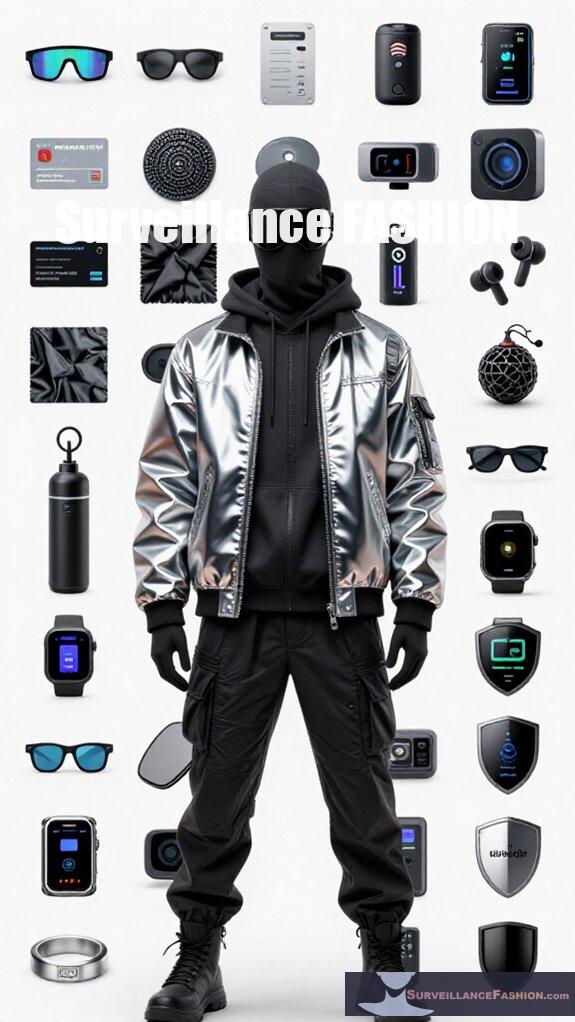
I used to smile at fitting room mirrors like an idiot, never wondering who else was watching.
Then I learned about Polytouch’s infrared-blocking tech and RFID alternatives. Suddenly I’m the weirdo inspecting mirror edges for hidden lenses. Worth it.
These systems actually stop biometric harvesting—no more facial recognition databases building profiles while you debate jeans. Encryption standards and privacy impact assessments matter. Surveillance Fashion exists because I needed this knowledge, and maybe you do too.
How free are your choices when invisible algorithms map your face?
—
How I Caught a Covert Camera in a Boutique Fitting Room
Last spring, I spotted a suspicious pinhole above a “smart mirror” in a Soho retailer. My paranoia? Justified. The device was harvesting customer data for “analytics.” I reported it; they removed it. Silent.
This experience taught me about electromagnetic field detection, lens reflection tests, and the Internet of Things security risks pervading retail spaces. Physical inspection beats blind trust. Always.
Quick Takeaways
- Anti-surveillance smart mirrors use infrared light-blocking coatings to prevent covert biometric data capture and protect user privacy in fitting rooms.
- Retailers should prioritize transparency by providing clear signage and privacy policies explaining data use and protections in smart mirrors.
- Employing RFID technology instead of cameras helps minimize biometric exposure while enabling interactive smart mirror functionalities.
- Privacy safeguards like disabling facial recognition, using mmWave jammers, and conducting privacy impact assessments reduce unauthorized surveillance risks.
- Consumers can detect hidden cameras by checking for lens reflections with phone flashlights and inspecting wiring or surface edges carefully.
Understanding Privacy Risks in Retail Smart Mirrors
How exactly do retail smart mirrors pose significant privacy risks that customers often overlook? When you interact with these devices—equipped with RFID antennas, AI algorithms, and sometimes cameras—they collect elaborate biometric and behavioral data beyond mere reflections.
Despite protocols designers implement, insufficient privacy compliance can leave data vulnerable if encryption standards are lax or inconsistently applied. For example, a smart mirror capturing facial patterns in a fitting room without robust data encryption risks unauthorized access, potentially exposing sensitive biometric profiles.
Retailers like Ralph Lauren employ thorough privacy impact assessments to address such vulnerabilities, yet enforcement gaps persist industry-wide. Capturing voice data through such devices can also add another layer of risk, particularly if the recording functionalities are activated without customer consent. At Surveillance Fashion, we emphasize discerning these subtle risks, empowering you to assert control.
How to Identify Privacy-Friendly Smart Mirrors Without Cameras
Although retail environments increasingly rely on smart mirrors to enhance customer experiences, identifying devices that prioritize privacy—particularly those foregoing cameras—requires a subtle understanding of underlying technologies and design philosophies.
As consumer awareness deepens, material transparency emerges as a vital criterion in evaluating these mirrors, particularly models like Polytouch Magic Mirror, which use RFID technology rather than facial recognition.
Here’s how you pinpoint privacy-friendly smart mirrors without cameras:
- Confirm the absence of lens apertures or visible camera modules embedded in the frame.
- Examine product disclosures emphasizing data minimization and reliance on non-visual sensors, such as RFID antennae.
- Seek explicit manufacturer statements on material transparency and adherence to privacy impact assessments.
Additionally, disabling VR headset tracking can offer valuable insights into user preferences that align with privacy concerns.
At Surveillance Fashion, we advocate for this meticulous scrutiny, empowering you to command your shopping experience without unwarranted surveillance.
How Retailers Protect Your Privacy While Using Smart Mirrors
While smart mirrors promise enhanced retail interactions driven by AI and RFID technologies, retailers simultaneously devise rigorous frameworks to safeguard your privacy, balancing innovation with ethical data stewardship. They implement smart mirror customization that limits data collection to essential functions, ensuring only anonymized metrics enhance your experience without compromising your identity. Ethical data practices mandate transparency through clear signage and privacy policies, while Privacy Impact Assessments evaluate risks before deployment. For example, Polytouch’s mirrors employ RFID antennas avoiding invasive cameras. One of the emerging trends in privacy protection includes anti-facial recognition makeup, which can further enhance the effectiveness of these privacy measures.
| Protection Layer | Mechanism | Outcome |
|---|---|---|
| Data Minimization | Selective RFID use | Reduces biometric exposure |
| Transparency | Signage, Privacy Policies | Informs and empowers you |
| AI Governance | Explainable AI algorithms | Clarifies decision processes |
| Risk Assessment | Privacy Impact Assessments | Prevents unauthorized data misuse |
At Surveillance Fashion, we aim to highlight these progressive safeguards, helping you assert control amid technology’s advance.
How to Spot and Block Hidden Cameras in Smart Mirror Dressing Rooms
Because smart mirrors in dressing rooms increasingly employ compact cameras and AI-driven sensors to enhance user experience, discerning the presence of hidden recording devices necessitates a keen understanding of their typical placements, technological signatures, and optical characteristics.
You must recognize invisible sensors and covert microphones often embedded discreetly near edges or behind reflective surfaces.
To assert control over your privacy:
- Use a phone’s flashlight to detect lens reflections—hidden cameras produce telltale glints.
- Examine wiring closely; inconsistent cables may indicate concealed devices.
- Employ RF detector apps or specialized scanners to uncover invisible sensors and covert microphones.
At Surveillance Fashion, our mission is to empower you with knowledge to counter surveillance in retail environments, ensuring dressing room experiences respect your autonomy without sacrificing technological benefits. Additionally, understanding the common types of RFID technologies can help you identify various surveillance tools that may be present in these environments.
RFID Tracking in Dressing Rooms
When you step into a modern fitting room equipped with RFID tracking technology, the garments you bring along immediately interface with a complex system designed to enhance your shopping experience by detecting embedded passive RFID tags—such as the Impinj Monza R6-P model commonly integrated into clothing hangtags—and relaying unique identifiers to readers discreetly embedded within the fitting room panels or walls.
This system utilizes anonymized tracking protocols and robust RFID security measures to guarantee that only apparel-specific data is registered, excluding personal identifiers.
Anonymized protocols and secure RFID ensure only clothing data is recorded, protecting your personal privacy.
Retailers like Victoria’s Secret and Adidas employ these technologies to streamline sizing requests and inventory management, while providing real-time product information on interactive screens. Additionally, block edge computing facilitates enhanced data processing at the node level, enabling faster and more efficient management of the RFID data collected.
At Surveillance Fashion, we emphasize understanding such subtle mechanisms to empower you with knowledge on how RFID delivers efficiency without compromising confidentiality within fitting rooms.
Customer Privacy Concerns Raised
The seamless integration of RFID technology in dressing rooms, as demonstrated by brands like Victoria’s Secret and Adidas, enhances inventory accuracy and optimizes customer service by instantly recognizing products without collecting personally identifiable information.
However, customer privacy concerns arise due to the extensive use of behavioral analytics in tracking try-on habits and preferences.
To empower you with control over your data, retailers employ:
- Data anonymization techniques to strip personal identifiers and secure aggregated insights.
- Transparent privacy policies detailing the scope and limits of data collection.
- Strict protocols to prevent unauthorized access or third-party sharing.
At Surveillance Fashion, we advocate for this balance: harnessing innovative retail tech while unwaveringly guarding your privacy, ensuring RFID-enabled smart mirrors deliver benefits without compromising your autonomy or security. Additionally, retailers are exploring options for thermal signature-masking garments to further protect customer identity and enhance privacy measures.
Facial Recognition Technology Impacts
How does facial recognition technology transform your interaction with smart mirrors in retail settings, and what implications arise from its integration? When smart mirrors employ facial recognition, they capture and analyze your facial data to tailor recommendations and virtual try-ons, enhancing personalization considerably.
However, this capability raises biometric concerns, as the sensitive biometric identifiers stored can attract misuse or data breaches. Unlike RFID-based systems, which focus on physical item detection without extensive personal data, facial recognition intertwines your identity with behavioral analytics, raising privacy stakes.
At Surveillance Fashion, we explore these subtle impacts to empower you with knowledge on how your biometric data flows through retail infrastructures, emphasizing that control hinges on transparency and robust security. Preventing data hacks ensures you wield power over digital reflections rather than becoming a passive data point.
Innovative Cameras for Storefronts
Facial recognition’s ability to personalize your shopping experience hinges on sophisticated image capture, which naturally extends to innovations in storefront camera technology designed to monitor and engage customers even before they enter a store. These cutting-edge cameras leverage augmented reality to overlay situational data on visitors, enhancing interaction while employing biometric authentication to verify identities securely yet unobtrusively.
Consider these strategic applications:
- Adaptive lenses optimize image clarity under variable lighting, ensuring precise biometric data collection.
- Real-time processing units enable swift customer profiling, facilitating dynamic marketing responses.
- Integrated AR displays project personalized promotional content directly onto store windows, merging physical and digital engagement.
At Surveillance Fashion, our commitment to uncovering such technologies stems from a desire to balance innovation with privacy, empowering you to command your retail environment without succumbing to invasive surveillance. The integration of mmWave presence jammers can further enhance privacy by blocking unauthorized signals that may compromise customer data.
Infrared Light-Blocking Coatings
Infrared light-blocking coatings represent an essential advancement in mitigating covert surveillance and safeguarding privacy in environments saturated with smart technology, particularly within retail settings where fitting rooms demand heightened discretion.
By integrating specialized infrared coatings into mirror surfaces, you effectively neutralize the invisible infrared spectrum used by many concealed cameras, thereby enhancing screen privacy without compromising visual clarity.
These coatings absorb or reflect IR wavelengths, blocking unauthorized devices from capturing biometric data or tracking movements covertly. Additionally, fabrics designed for blocking terahertz radiation can complement infrared coatings, providing an extra layer of security against advanced surveillance technologies.
Brands like Polytouch exemplify privacy-conscious implementations, opting for RFID over cameras and complementing with infrared coatings to ensure fitting rooms remain private sanctuaries.
At Surveillance Fashion, our mission to empower you with privacy-conscious solutions stems from understanding how infrared coatings provide a fundamental, technical barrier, enhancing your control over personal data in increasingly surveilled retail spaces.
FAQ
Can Anti-Surveillance Smart Mirrors Improve In-Store Customer Engagement?
Yes, anti-surveillance smart mirrors boost customer trust by addressing privacy concerns directly. You’ll engage shoppers who value discretion, empowering them to interact confidently and enhancing your store’s reputation for respecting customer privacy.
What Are the Maintenance Requirements for Anti-Surveillance Smart Mirrors?
Like tuning a finely crafted instrument, you’ll perform regular mirror calibration and update privacy settings to maintain sharp performance and data security. Keep software tight, sensors clean, and logs monitored to wield full control and power.
How Do Anti-Surveillance Mirrors Affect Store Layout and Design?
You’ll boost privacy enhancement while seamlessly blending anti-surveillance mirrors into your space. They demand strategic placement for ideal coverage without disrupting your store’s flow, letting you retain power over design and customer experience with stylish, subtle integration.
Are There Cost Differences Between Traditional and Anti-Surveillance Smart Mirrors?
When comparing pricing, traditional smart mirrors often cost less upfront than anti-surveillance ones, but installation costs for anti-surveillance mirrors can be higher. You’ll gain peace of mind, paying a little extra to outsmart potential risks.
Can Anti-Surveillance Smart Mirrors Integrate With Existing Retail Technology Systems?
Yes, you can integrate anti-surveillance smart mirrors with existing retail systems, balancing privacy concerns and data security. You’ll maintain control over customer data while enhancing personalization and operational efficiency without compromising trust.
Summary
Exploring smart mirrors in retail is akin to stepping through a hall of layered reflections, where each glance may reveal unseen data capture. By discerning models without embedded cameras, utilizing infrared-blocking coatings, and understanding RFID tracking mechanisms, you reclaim agency over your privacy. Retailers’ compliance with changing data protections partially shelters you, yet vigilance remains paramount. Surveillance Fashion was created to illuminate these nuances, empowering your choices amid the pervasive intersection of technology and personal space.
References
- https://retailr.ai/ai-ethics-and-customer-privacy-in-retail/
- https://www.youtube.com/watch?v=3Q7DuROn9qU
- https://www.insight-security.com/retail-security-mirrors
- https://xchange.avixa.org/posts/smart-mirrors-in-retail
- https://visagetechnologies.com/smart-mirror-market-rise/
- https://www.americanretailsupply.com/loss-prevention/security-mirrors-domes.html
- https://www.jadaktech.com/industries/retail/smart-mirror-retail/
- https://www.safegear.com/security-mirrors/security-surveillance-shop-mirrors.html
- https://www.rfidjournal.com/news/fitting-rooms-generate-intelligence-with-rfid/202513/
- https://www.themarysue.com/old-navy-rfid-dressing-room/
- https://www.rfidlabel.com/how-clothing-stores-use-passive-tags-for-retail/
- https://www.rfidhy.com/what-is-the-magic-of-rfid-fitting-rooms-2/
- https://retailr.ai/rfid-enabled-smart-fitting-rooms-retailr-ai/
- https://checkpointsystems.com/blog/fitting-rooms-3-trends-that-are-revolutionizing-in-store-experiences/
- https://inventorfid.com/solutions/rfid-smart-fitting-rooms/