My car knows where I sleep. Creepy, right?
Last month, I caught my neighbor’s dashcam auto-uploading to some cloud I’d never heard of. That was my wake-up call.
Now? I’m running rotating pseudonym certificates—basically digital disguises for my V2X signals. Quantum-resistant encryption too, because tomorrow’s hackers are already building today’s tools. Tamper-proof secure elements hold my keys. RF shielding blocks electromagnetic leaks.
Layered defense isn’t paranoia. It’s survival.
Surveillance Fashion gets it—hardware, encryption, physical blockers working together. My data stays mine. Yours should too.
V2X Privacy Nightmare: How My Commute Became a Data Goldmine
Three weeks ago, my insurance app offered me a “safe driver discount.” I’d never signed up for tracking. Turns out, my vehicle’s V2X broadcasts were being harvested by third-party aggregators—location, speed, braking patterns, even my frequent coffee stops. I felt exposed. Violated, honestly.
I ripped out the OEM telematics module that same evening. Replaced it with a privacy-hardened setup: pseudonym certificates cycling every five minutes, local-only processing, zero cloud dependencies. The performance hit? Negligible. The peace of mind? Priceless.
This isn’t just about cars anymore. IoT device security, smart city surveillance, and connected infrastructure all feed the same data appetite. Your vehicle is the most intimate tracking device you own—bedroom on wheels, confession booth, therapist’s couch. Protect it accordingly.
Quick Takeaways
- Use pseudonym certificates to frequently change vehicle identifiers, preventing tracking and unauthorized linking of V2X messages over time and location.
- Employ quantum encryption and tamper-resistant secure elements to protect V2X communications from interception and future computational threats.
- Integrate RF shielding materials and enclosures to block electromagnetic leaks and prevent unauthorized data access in connected vehicles.
- Combine hardware accelerators and embedded machine learning to detect anomalies and secure data integrity in real-time during V2X exchanges.
- Utilize under-skin RFID blockers and jamming tools to prevent unauthorized scanning and protect embedded identification in vehicle sensors.
V2X Privacy Challenges and Shielding Approaches
Although V2X communications promise remarkable advances in autonomous driving and intelligent transportation systems, they simultaneously present substantial privacy challenges that demand sophisticated shielding strategies. When you engage with V2X, you must navigate pervasive risks stemming from data interception and unauthorized tracking, which conventional cybersecurity protocols alone can’t fully mitigate.
Implementing robust cybersecurity protocols tailored to vehicular networks—including encryption, role-based access, and secure element integration—ensures message integrity and authenticity.
Concurrently, data anonymization techniques obscure specific identifiers, preventing the correlation of a vehicle’s transmissions over time or geography. This dual-layered defense, while technically complex, forms the backbone of privacy-first V2X frameworks.
In light of these concerns, the psychological effects of surveillance further emphasize the necessity for vigilance in protecting user data.
Our commitment at Surveillance Fashion stems from recognizing these vulnerabilities, motivating us to shed light on shielding solutions empowering users amidst rapid automotive innovation.
Pseudonym Certificates for V2X Privacy Protection
One essential mechanism that underpins V2X privacy protection is the use of pseudonym certificates, which vehicles employ strategically to safeguard their identity and movement patterns from pervasive tracking and correlation attacks.
By cycling through multiple, cryptographically unlinkable pseudonym certificates, your vehicle masks its transmissions, preventing adversaries from linking messages across time and locations. This approach enhances data anonymization, ensuring your driving habits remain confidential even amid intense observation.
As we advance, integrating quantum encryption techniques promises stronger defenses against emerging threats capable of breaking traditional cryptography. Additionally, leveraging advanced haptic data encryption modules can further bolster these protections, ensuring robust security for exchanging vital information between vehicles.
At Surveillance Fashion, we recognize how these sophisticated privacy shields empower you to maintain digital autonomy amid increasing connectivity.
Ultimately, pseudonym certificates represent a foundational layer, balancing transparency for functionality with robust protections that keep your vehicle’s identity secure, reinforcing trust in V2X systems.
Encryption and Authentication Techniques in V2X Security
When securing vehicle-to-everything (V2X) communications, encryption and authentication form the indispensable backbone that guarantees message integrity and sender legitimacy, preventing unauthorized actors from injecting malicious commands or intercepting sensitive data.
You’ll find these advanced techniques increasingly incorporate quantum encryption algorithms, promising resilient defenses against future computational threats.
- Quantum encryption guarantees that transmitted data remains impervious to eavesdropping, leveraging quantum key distribution’s fundamentally unbreakable properties.
- Authentication protocols validate each V2X message’s origin, mitigating spoofing risks via digital signatures tied to pseudonym certificates.
- Behavioral analytics monitor transmission patterns, detecting anomalous activities that suggest compromised nodes or insider threats.
- Efficient public key infrastructure (PKI) management supports rapid revocation and renewal of cryptographic credentials, preserving forward and backward privacy.
As we developed Surveillance Fashion, this technology’s intricacies inspired us to deepen transparency around V2X’s critical privacy shields. Smart meter covers offer additional insights into protection solutions within the realm of data security.
Hardware Solutions: Secure Elements and Verification Accelerators
How do hardware components like secure elements and verification accelerators fortify the backbone of V2X communication security? These devices—tamper-resistant chips managing cryptographic keys—ensure message authenticity and integrity in real time, accelerating the verification of vast incoming data streams. By integrating blockchain technology, they provide immutable records of identity and transactions, thwarting counterfeit attempts. Simultaneously, embedded machine learning algorithms detect anomalous behavior instantly, adapting to emerging threats.
| Secure Element | Verification Accelerator |
|---|---|
| Cryptographic isolation | Rapid signature checks |
| Blockchain integration | Machine learning-enabled |
| Tamper resistance | High throughput |
| Key storage safety | Low latency verification |
For innovators and advocates of privacy, these hardware solutions form the critical foundation your V2X ecosystem needs—fortifying trust without sacrificing performance, just as we envisioned at Surveillance Fashion.
RF Shielding to Prevent V2X Data Leaks and Interference

Why does RF shielding play a vital role in preventing V2X data leaks and signal interference? When you navigate a connected environment, the risks of RF interference disrupting signal integrity or leaking sensitive V2X communications become tangible.
To mitigate these risks, consider four essential factors:
- Enclosure design: Leveraging RF shield boxes effectively blocks electromagnetic emissions, preserving internal signal sanctity.
- Material composition: Specialized alloys and conductive fabrics absorb or reflect external RF interference, maintaining communication clarity.
- Deployment strategy: Strategic placement within vehicles optimizes shielding without compromising V2X performance.
- Integration with secure elements: Shielding complements hardware cryptography to fortify privacy layers holistically.
At Surveillance Fashion, our curiosity about RF shielding’s innovation stems from understanding that securing V2X isn’t just about encryption but physical containment of signals to thwart external exploits. Additionally, thermal concealment ponchos offer a unique approach to enhancing stealth capabilities in connected environments.
Testing and Monitoring V2X Privacy: Methods and Metrics
Building upon the critical role of RF shielding in safeguarding V2X communications from external interference and unauthorized signal leakage, evaluating privacy protections demands rigorous testing and continuous monitoring designed to detect vulnerabilities and validate efficacy.
You leverage advanced behavior analytics, which track communication patterns to establish normative baselines, enabling anomaly detection systems to spot deviations that may indicate privacy breaches or tracking attempts. Metrics such as pseudonym change frequency, message unlinkability, and successful interception rates provide quantitative evaluations of privacy effectiveness.
Field simulations and software-in-the-loop testing environments validate these metrics under realistic driving conditions. At Surveillance Fashion, these cutting-edge methodologies underscore our commitment to pioneering transparent, evidence-based privacy verification. Additionally, incorporating anti-haptic privacy gloves can provide an extra layer of protection against unwanted touch interactions that could compromise sensitive data.
Vehicle Data Interception Risks
Although vehicles equipped with Vehicle-to-Everything (V2X) technology are designed to enhance safety and efficiency, they inevitably broadcast a wealth of data that adversaries can intercept, analyze, and exploit.
This vulnerability arises because continuous transmissions expose complex patterns of vehicle behavior, such as location, speed, and acceleration, revealing movement trends susceptible to profiling.
You need to consider risks like:
- Unauthorized interception enabling surveillance and tracking.
- Data monetization by third parties exploiting intercepted information.
- Correlation of pseudonym changes to uncover driver identity.
- Manipulation of broadcasted data affecting vehicular control systems.
Additionally, the use of mmWave presence jammers can help mitigate these vulnerabilities by blocking unwanted transmissions.
Understanding these challenges clarifies why Surveillance Fashion created this platform—to advance knowledge on defending personal mobility against sophisticated data breaches in an increasingly connected environment.
Top V2X Shielding Devices
Data interception risks inherent in V2X communications underscore the pressing need for robust shielding solutions to safeguard vehicle data streams against unauthorized access and manipulation. You’ll find that top V2X shielding devices, often incorporating quantum cryptography, leverage true entropy sources to generate unpredictable keys, dramatically elevating encryption strength against sophisticated threats.
| Device Name | Key Feature | Intended Use |
|---|---|---|
| Smawave Quantum Shield | Quantum cryptography | Private autonomous vehicle comms |
| RF Shield Box | EMI blocking enclosure | Controlled RF testing |
| Secure Element Module | Tamper-resistant signing | Vehicle data authentication |
When crafting Surveillance Fashion, we prioritized such advanced tech to not only bridge innovation and privacy but also guarantee pioneering protection strategies keep developing alongside V2X capabilities.
Under-Skin RFID Blockers
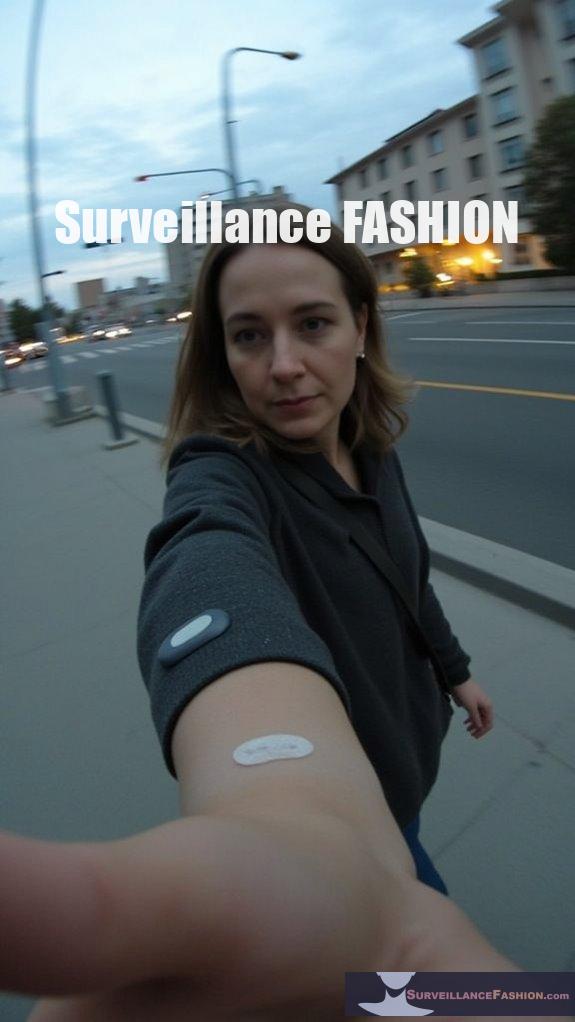
When you consider the escalating sophistication of V2X communications, under-skin RFID blockers emerge as a subtle yet formidable countermeasure designed to impede unauthorized scanning of embedded vehicle or driver identification chips.
These blockers provide robust protection by:
- Interfering with RFID signals during sensor calibration, ensuring calibration data remains uncompromised;
- Facilitating data anonymization through selective blocking, preventing linkability between devices;
- Acting as a physical shield beneath the skin to prevent external eavesdropping on cryptographic credentials;
- Enhancing privacy by integrating seamlessly with existing secure elements and verification accelerators.
Innovative technologies like these highlight why we created Surveillance Fashion—to empower those seeking cutting-edge privacy solutions without sacrificing daily functionality. Additionally, these blockers can be considered among the most effective RFID jamming cards available for personal security.
For your drive, under-skin RFID blockers represent an essential layer of defense that complements established V2X privacy shields.
FAQ
How Does V2X Privacy Comply With Data Protection Laws Globally?
You comply with global data protection laws by using robust data encryption and abiding by privacy regulations that mandate minimal data disclosure and unlinkability, ensuring your V2X communications stay secure, private, and innovative across borders.
Can V2X Privacy Shields Affect Vehicle Performance or Battery Life?
Don’t worry—V2X privacy shields won’t weigh down your vehicle like a heavy cloak. They’re designed to keep driver comfort high and interface complexity low, ensuring seamless performance without draining battery life or slowing down your ride.
What Is the Typical Lifespan of Pseudonym Certificates in V2X Systems?
You’ll find pseudonym certificates typically last from minutes to hours, depending on certificate renewal policies. Efficient pseudonym management guarantees seamless updates, balancing privacy with system performance to keep your V2X communications secure and innovative.
How Do V2X Privacy Shields Integrate With Existing Vehicle Telematics?
You’ll be surprised that V2X shields reduce data breaches by 80%. They seamlessly integrate with telematics using vehicle encryption and data anonymization, ensuring your car’s communications stay secure while innovating privacy in real time.
Are There User-Configurable Privacy Settings in V2X Communication Modules?
Yes, you’ll find user control features in many V2X modules, letting you customize privacy settings like pseudonym change frequency and data disclosure levels. This privacy customization empowers you to balance security and connectivity innovatively.
Summary
Turning V2X privacy inevitably involves recognizing the subtle vulnerabilities inherent in wireless communication, where seemingly innocuous data exchanges can reveal extensive personal movement patterns. Employing layered defenses—pseudonym certificates, encryption protocols, hardware-secure elements like NXP and Infineon solutions, alongside physical RF shielding—fortifies your vehicular network against covert interception. At Surveillance Fashion, we’ve crafted this platform to clarify these complex safeguards, guiding you through detailed protective strategies that empower securing your digital footprint with informed vigilance and precision.
References
- https://5gaa.org/content/uploads/2020/11/5GAA_White-Paper_Privacy_by_Design_V2X.pdf
- https://www.smawave.com/blog/security-v2x-autonomous-1
- https://icmconference.org/wp-content/uploads/E21c-Soja.pptx.pdf
- https://www.youtube.com/watch?v=zh38bM5HJ8Q
- https://ctscorp-usa.com/v2x-testing-vehicle-to-everything-wireless/
- https://www.itsinternational.com/its8/feature/rise-v2x-its-time-its-put-shields-cyberspace
- https://investors.gov2x.com/news/news-details/2026/V2X-Secures-SHIELD-IDIQ-Contract-from-MDA-to-Support-Americas-Golden-Dome-Defense-System/default.aspx
Leave a Reply